search expand

Marianne Gullestad er død

gullestad bilde

En av Norges viktigste antropologer er død. Marianne Gullestad døde igår etter langvarig sykdom. Få antropologer har forsket så mye på Norge og det norske som Gullestad. For et halvt år siden kom hun ut med en ny bok Misjonsbilder – Bidrag til norsk selvforståelse og for få måneder siden fikk hun språkprisen til Det Norske Akademiet.

1984 vakte hun oppsikt med Kitchen-Table Society: A Case Study of the Family Life and Friendships of Young Working-Class Mothers in Urban Norway

MaterialWorld-blogger Daniel Miller har republisert forordet han skrev i anledning dødsfallet. Han skriver blant annet:

Indeed, what made this such an important work when it first came out was, rather, that it was in many respects a conventional ethnography – though of the type of population that, on the whole, had not been the subject of conventional ethnographies. The topic was working class women in the town of Bergen on the West coast of Norway.

What made this special was that there was nothing special about these people. They were not being studied because they were a problem that academics were supposed to shed light on, such as drug-takers or the unemployed. They represented the neglected topic of the merely ordinary.

>> les hele teksten “Marianne Gullestad 1946-2008

20 år senere var hun aktiv i debatten om klassereisen og ble nedringt av journalister.

Gullestad var også aktiv i innvandringsdebatten. Hun gikk inn for mindre vekt på den etniske nasjonen og var ikke redd for påpeke mindre positive trekk i det norske samfunnet som for eksempel den utbredte hverdagsrasismen.

For å få tak i rasisme som problem har hun formulert “The five major challenges in anthropology”

Hun så på forskning som livsform.

—-

OPPDATERINGER: Nekrolog: Thomas Hylland Eriksen om Marianne Gullestad

>> Institutt for samfunnsforskning om Gullestads død

Long Litt Woon har lagt ut et innlegg hun holdt ved lanseringen av hennes bok “Plausible Prejudice” i 2006

—-

Her et utvalg av tidligere saker om Marianne Gullestad på antropologi.info

– Godt språk forgyller forskningsresultatene

For mindre vekt på den etniske nasjonen: Marianne Gullestad med ny bok

Norske verdier, islam og hverdagsrasismen

Misjonsbildenes makt over sinnene – ny bok av Marianne Gullestad

The Five Major Challenges for Anthropology

Vis billetten – du er på klassereise

Orientalisme på norsk – fem foredrag om norsk kultur som mp3-fil

For en fullstendig oversikt over hennes forskning se Marianne Gullestads hjemmeside ved Institutt for samfunnsforskning

gullestad bilde

En av Norges viktigste antropologer er død. Marianne Gullestad døde igår etter langvarig sykdom. Få antropologer har forsket så mye på Norge og det norske som Gullestad. For et halvt år siden kom hun ut med en ny bok Misjonsbilder…

Read more

Marianne Gullestad has passed away

Yesterday, one of Norway’s most important anthropologists has passed away: Marianne Gullestad. I got to know it just a few hours ago, and MaterialWorld-blogger Daniel Miller has already made a post about her and has re-published the introduction he wrote to Gullestads book Kitchen Table Society:

Indeed, what made this such an important work when it first came out was, rather, that it was in many respects a conventional ethnography – though of the type of population that, on the whole, had not been the subject of conventional ethnographies. The topic was working class women in the town of Bergen on the West coast of Norway.

What made this special was that there was nothing special about these people. They were not being studied because they were a problem that academics were supposed to shed light on, such as drug-takers or the unemployed. They represented the neglected topic of the merely ordinary.

>> read the whole post “Marianne Gullestad (1946-2008)”

I have written severa posts on her work, one in English about her “best of” book Plausible Prejudice: Everyday Experiences and Social Images of Nation, Culture and Race. To understand the problems of the world today, we need to “decolonize anthropological knowledge”, she writes and lits five major challenges for the discipline of anthropology >> read the whole post “The Five Major Challenges for Anthropology”

Several papers by her are available online:

Marianne Gullestad: Blind Slaves of our Prejudices: Debating ‘Culture’ and ‘Race’ in Norway

Marianne Gullestad: Normalising racial boundaries. The Norwegian dispute about the term ‘neger’

Marianne Gullestad: Mohammed Atta and I. Identification, discrimination and the formation of sleepers

Marianne Gullestad: Invisible Fences: Egalitarianism, nationalism and racism

Yesterday, one of Norway's most important anthropologists has passed away: Marianne Gullestad. I got to know it just a few hours ago, and MaterialWorld-blogger Daniel Miller has already made a post about her and has re-published the introduction he wrote…

Read more

To formulate a thesis question

I’ve got one year and six months pay left of my research grant and with the help of organised writing I hope it won’t be a problem to finish in time. But I realise that the writing must be organised this time, so no more writing 140 pages too much like I did with my previous thesis. For the sake of organising myself, I read Authoring a PhD last Christmas (on a black volcanic beach on La Gomera in the Atlantic ocean, so the book is full of dark grains of sand). (Thanks to Mary Stewart for recommending the book on her research blog here).
[teaserbreak]
Manage your readers expectations is the first advice Patrick Dunleavy (2003: 15-16). When I wrote my Master thesis I was so sure I had something interesting to tell, that I couldn’t give a damn about readers expectations… How naïve one can be. This time I’ll follow Tim Ingold’s advise and write more like the swishy swashy pictorial language of We’re going on a bear hunt, and lead my readers on every step through East Paris and her suburbs. In addition to “orienting devices” like headlines etc and “signposts” (indicating the sequence of topics to be handled) (p. 272, 274), Dunleavy suggests an aphorism from Nietzsche so not to forget about the audience during the writing process:

Never ignore, never refuse to see what might be thought against your thought
(Nietzsche quoted in Dunleavy 2003: 134)

When I presented an unfinished article to various readers a while ago, I reminded myself of this quote – in order to handle the at times contradictory feedback I got.

The second good advice I found in Dunleavy’s book was the five components making up an interesting intellectual problem (une problématique, en problematikk), thus how to phrase a thesis question:

1) a goal or objective which can tell how to judge the outcomes, how to see that an improvement has been achieved

2) an initial state, the starting situation, and the resources available to be used

3) a set of operations that can be used to change the initial state and resources (a toolkit of research methods and new date)

4) constraints: designating certain kinds of operations as inadmissible

5) an outcome

Or put differently: “Problematizing your thesis question” means “setting the answer you hope to give within a framework which will show its intellectual significance” ((from Robert Nozick, Dunleavy 2003: 23)

My (preliminary) aim – component number 1 – is to describe and makes sense of a former colonial metropolis as fundamentally marked by its past and present global connections. Thinking about readers’ expectations, I realise that already in this sentence, my choosing of words points in the direction of a specific perspective. Instead of writing just “Paris”, I say “a former colonial metropolis”, for instance…

Component 2: the starting situation and the resources available in an anthropological study I guess must be a specific empirical ground/arena and certain perspectives by which I look at it, in order to generate data and knowledge. I’ve divided the overall aim into a threefold perspective:

i) a microstudy of the creation of a cosmopolitan space: the slam poetry scene

ii) an analysis of the process of inhabitation (from Ingold) in cosmopolitan East Paris

iii) an analysis of France as inherently postcolonial, seen from the perspective delineated by Eric Wolf in Europe and the people without history

The initial states are thus i) the existing slam poetry scene (very mixed in terms of gender, age and social and ethnic background), ii) East Paris (visibly marked by former and present immigration) and iii) the ongoing debates on what constitute France and the history of France, + Eric Wolf’s and similar perspectives on global connections

Component 3: my research methods and new data:

i) observation, participation and filming on about 100 slam soirées → data on the places, audiences, performances, participants… In addition to some “off stage” participation with some of the participants, poetry texts, myspace sites, interviews… + literature on space/place and phenomenology…

ii) observations, hanging around and living in East Paris which give me some idea of how the process of inhabitation can be an appropriation of space. Examples are how the waves of immigration have made their marks on the environment, all the streetart, posers and writings on the wall, and finally the various places, cafés and bars, where the slam is taking place. + literature on performance, oral poetry and…?

iii) to answer the third question, I will draw on my findings from the two previous fields of investigation, in addition to literature and media coverage on the public debates on history and France.

Component 4: the constraints affecting my work, I’ll discuss soon in another dull post on methodology and scientific criteria.

Component 5: the outcome: hopefully a satisfactory description and sense-making of a Society in the Making: The slam poetry scene and Postcolonial Paris…

The final useful point I’ll mention from Authoring a PhD this time, is to try to work out as soon as possible what one will be able to say something about, in order to make a close fit between the question asked and the answer delivered. The author also recommends to formulate the thesis question so as to showcase your own findings, instead of going on and on about other people’s research (Dunleavy 2003: 24-5). That fits well with my aim to write descriptive and swishy swashy, very far away from the language and content of this blog post…


I’ve got one year and six months pay left of my research grant and with the help of organised writing I hope it won’t be a problem to finish in time. But I realise that the writing must be organised…

Read more

Tidsskrifter: Universitetsforlaget femdobler prisene

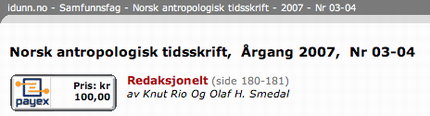
nat-screenshot

Mens flere og flere tidsskrifter åpner arkivene sine for folk flest, har Universitetsforlaget / Idunn valgt motsatt strategi: De har femdoblet prisen per artikkel. For å kunne lese en eneste artikkel må en nå plutselig ut med 100 kroner. Vitenskapelige artikler er dermed blitt enda mindre tilgjengelige for folk utenfor akademia og institusjoner uten abonnement.

Flere og flere forskere og bibliotekarer verden over protesterer mot forlagenes anti-demokratiske prispolitikk og har delvis oppfordret til boikottaksjoner. Flere og flere forskere publiserer heller artiklene sine i tidsskrifter som er gratis tilgjengelig på nett (open access). Renommerte universiteter som Harvard har til og med gjort open-access-publisering obligatorisk. Bevegelsen er ikke så sterk i Norge. “Norge – en sinke på Open Access”, skrev nylig Stein Høydalsvik i Vox Publica.

Hvem skriver forskere for? Skal kunnskapen føres tilbake til samfunnet eller holdes inne i elfenbenstårnet?

SE OGSÅ:

Forskere boikotter forlagene, vil ha gratis tilgang til forskning på nett

Mer gratis publisering på nettet! Bibliotekene ønsker forskeropprør

Danah Boyd on Open Access: “Boycott locked-down journals”

Børs og bibliotek: Det er bonanza i kunnskapsmarkedet

Museum Anthropology Review goes open access

First issue of open access journal “After Culture” is online

– Antropologer må bli flinkere til å bruke nettet

Why should anthropologists care about open access?

nat-screenshot

Mens flere og flere tidsskrifter åpner arkivene sine for folk flest, har Universitetsforlaget / Idunn valgt motsatt strategi: De har femdoblet prisen per artikkel. For å kunne lese en eneste artikkel må en nå plutselig ut med 100 kroner. Vitenskapelige…

Read more

– Fortell at kvinnelig omskjæring er på vei ut!

Trenden er entydig: Færre og færre jenter i Norden blir omskåret. Få ut denne nyheten! Kunnskap om at kvinnelig omskjæring er på vei ut, er den beste beste beskyttelsen for jentene som fortsatt risikerer omskjæring, skriver antropolog Sara Johnsdotter i Dagbladet:

Om vi tenker oss en familie der en av foreldrene lurer på om datteren bør omskjæres eller ikke – hvilket budskap gjør jenta tryggest: Overskrifter om at massevis av norske jenter fortsatt omskjæres eller kunnskap om at omskjæring i og med migrasjonen overgis av de fleste?

Det går an å være på vakt og ha retningslinjer for hvordan samfunnet skal håndtere mistenkte tilfeller, uten at vi samtidig påstår at massevis av jenter omskjæres. Den beste beskyttelsen for jentene som fortsatt virkelig risikerer omskjæring er at foreldrene deres får vite hvor mange av deres landsmenn som har overgitt tradisjonen.

>> les hele saken i Dagbladet

SE OGSÅ:

Ny studie viser at kvinnelig omskjæring i Sverige er på vei ut

Omskjæring: Hvorfor er ingen interessert i de positive nyhetene? Få, om noen, om­skjæ­rer sine døt­re et­ter at de er kom­met til Nor­ge

Aud Talle om omskjæring: “NRKs tall er tvilsomme”

Circumcision: “Harmful practice claim has been exaggerated”

Trenden er entydig: Færre og færre jenter i Norden blir omskåret. Få ut denne nyheten! Kunnskap om at kvinnelig omskjæring er på vei ut, er den beste beste beskyttelsen for jentene som fortsatt risikerer omskjæring, skriver antropolog Sara Johnsdotter i…

Read more