search expand

Warum helfen sie illegalisierten Flüchtlingen?

cover

Warum gibt es Menschen, für die es selbstverständlich ist, zu helfen, obwohl sie dabei Gesetze brechen? Diese Frage untersucht Ina Boesch in ihrem neuen Buch “Grenzfälle. Von Flucht und Hilfe. Fünf Geschichten aus Europa”.

Boesch studierte Ethnologie, Geschichte und Publizistik an der Uni Zürich. Viele Jahre hat sie als Kulturredaktorin bei Schweizer Radio DRS2 gearbeitet.

>> Besprechung im Tagesspiegel

>> Rezension in der WoZ

Boesch hat auch eine interessante Webseite: http://www.inaboesch.ch

SIEHE AUCH:

Festung Europa: “Wir wollen die Schicksale hinter den Zahlen aufzeigen”

Erforschte das Leben illegalisierter Migranten

cover

Warum gibt es Menschen, für die es selbstverständlich ist, zu helfen, obwohl sie dabei Gesetze brechen? Diese Frage untersucht Ina Boesch in ihrem neuen Buch "Grenzfälle. Von Flucht und Hilfe. Fünf Geschichten aus Europa".

Boesch studierte Ethnologie, Geschichte und Publizistik…

Read more

Ethnologie-Vorlesungen gratis auf iTunes

screenshot

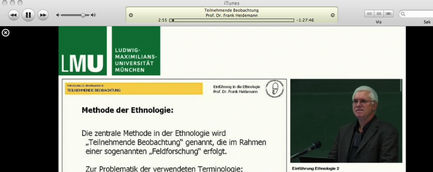
Die Ludwig-Maximilians-Universität (LMU) München hat ab sofort eine eigene Plattform auf iTunes. Im Angebot an Audio- und Video-Podcasts finden wir auch die Vorlesungsreihe “Einführung in die Ethnologie” von Frank Heidemann. Man kann sich 14 Vorlesungen anschauen zu Themen wie Kulturrelativismus, Teilnehmende Beobachtung, visuelle Ethnologie usw.

LMU-Präsident Professor Bernd Huber sagt in einer Pressemitteilung:

“Die LMU erprobt seit längerem mithilfe der neuen Medien innovative Formen der Wissensvermittlung in Ergänzung zum grundlegenden Lehrangebot. Auf unserem neuen Portal bündeln wir sukzessive diese audiovisuellen Inhalte aus der Lehre, aber auch zur Forschung an der LMU und zu unserem Profil. Damit wollen wir gezielt die ‘Generation iPod’ erreichen.”

>> zum ITunes-Angebot der Uni München

screenshot

Die Ludwig-Maximilians-Universität (LMU) München hat ab sofort eine eigene Plattform auf iTunes. Im Angebot an Audio- und Video-Podcasts finden wir auch die Vorlesungsreihe "Einführung in die Ethnologie" von Frank Heidemann. Man kann sich 14 Vorlesungen anschauen zu Themen wie Kulturrelativismus,…

Read more

Cities: It was twenty years ago. Part 2

The roar is not really loud, it’s rather tiny, but with a high pitch. He learns and develops new sounds at the moment, the books say and we’ve certainly noticed that. On the brighter side; he’s also learning to laugh. I find that wonderful and such a good symbol of the human condition (as a product both of nature and society): the urge to laugh (and smile of course) is innate but babies has to learn to make the right sounds! So, now my son opens his mouth and tries to make the “h” sound…
[teaserbreak]
Well, yes, his roars and laughter is my concern at the moment. But there is of course plenty of time to think of updates for this blog, I could tell my friend who made jokes about it in the previous post. When I nurse or stroll the little lion in his pram there often isn’t much else do than letting the mind wander. And it often wanders familiar streets in Paris and goes through my experiences from the time I lived there. Certain of these streets, the “feel” of them and what they meant to me is one such possible update. I imagine myself walking certain routes – along the canal, to the bakery, down the boulevard… – Another is my relationship to Paris throughout the years. What has this city meant to me?

I started thinking of that as a possible blog post long time ago, when I heard a letter from the correspondent from the Norwegian Broadcasting Corporation stationed in Berlin. He had gone there on inter rail in his early twenties, in 1989 when the wall fell and he’s letter talked about how the city appeared to him at that time and how it had changed (the notes I made are in my office, where I haven’t set foot since early November). In 1989 we went to Berlin by train, too. When the wall was torn down some months afterwards, I felt a personal victory after what I saw of the East German border police with their eager examination of the train compartments and the passengers. But Berlin hardly made an impression on me compared to the three weeks we spent in Paris. At the time I found it curious that my Dad let me go and stay there in an hotel with four friends while there was no way he would let me go to the Roskilde festival before I was 18. When my son is 17, I would say the same thing. Drinking and smoking is part and parcel of the Roskilde festival, there’s hardly a way to escape it, while we hardly tasted a drop of alcohol t in Paris. Why should we? Just being there was an adventure in itself. In fact, just hanging around at the lawn at Les Halles and at Place Beaubourg outside Centre Pompidou all the time was enough for us. I think perhaps we went to Père Lachaise to see Jim Morrison and Oscar Wilde’s graves once and we made a couple of more excursions, but most of the time we spent less than 10 minutes away from the hotel. And there we watched people and even made some friends.

The funny thing is, that we, just by chance, stumbled upon the cool place to be in Paris at the time, I learnt from one of my slammer-friends. He told me he used to go to Place Beaubourg at the same time to try to chat up young models and actresses, as far as I remember. The friends we made in Paris, was the kind one meets when one travels and which one remembers the rest of one’s life even though one only spends a week or even just a day together. “That trip to Paris is 20 years ago in 2009” my friend told me on new years eve when I told her about the blog updates I was thinking about. The following parts of this post will be about what that and other trips to Paris has meant to me and how they have shaped my understanding of the city and France. This part, however, I would like to finish with a personal thought on time and life. I think I resigned and thought that I could as well settle down with a family when I – to my big surprise – realised things like it’s 20 years ago since I considered myself at the height of my youth. Then it’s time to do something completely different, like marvel at the wonders of nature that make humans with an innate urge to smile and laugh long before they are three months old!

The roar is not really loud, it’s rather tiny, but with a high pitch. He learns and develops new sounds at the moment, the books say and we’ve certainly noticed that. On the brighter side; he’s also learning to laugh.…

Read more

…It was twenty years ago: Cities. Part 1

A friend who checks my blog on a regular basis and know me well in “real time” commented jokingly that “style, voice and perspective” wasn’t really what concerned me at the moment, so, where’s the update? Numerous updates spin around in my head daily when I, hours on end, feel like I do nothing, but, when I in fact do nothing less than providing the total nourishment for keeping another human being alive. I try to see it that way, that I actually do something very important with long lasting effects and which in the big scheme of things doesn’t take that much time… But it’s hard to change outlook entirely and over-night from one aloof and intellectual to one almost entirely concerned with biological and material necessities. Naïvely, before the little creature arrived, I imagined I would have at least a couple of hours a day for doing other things. But unfortunately we happened to call him Leo and indeed he eats like a lion. …well, duty calls with a loud roar. That’s it for today. I didn’t even get to the point of telling what happened twenty years ago and what that has to do with cities and why this is of concern for this blog.

I’m curious to see how many parts it will take me to get me to finish this post or even get to the point. Well, that’s life at the moment.

A friend who checks my blog on a regular basis and know me well in “real time” commented jokingly that “style, voice and perspective” wasn’t really what concerned me at the moment, so, where’s the update? Numerous updates spin around…

Read more

Humain Terrain anthropologist attacked in Afghanistan has died

(via ‘Ilm al-insaan) An anthropologist embedded with the U.S. Army in Afghanistan to help soldiers understand local customs has died more than two months after she was doused with fuel and set on fire, according to ap.

Anthropologist Paula Loyd, 36, had been chatting with an Afghan man about fuel prices when he suddenly attacked her. She worked for contractor BAE Systems in a Human Terrain Team, in which social scientists and anthropologists are embedded with combat brigades, according to court records.

She earned a cultural anthropology degree from Wellesley College and spent much of her career abroad.
According to BAE Systems Loyd served in Bosnia as a U.S. Army reservist, working on civil military affairs projects. She had spent significant time in Afghanistan, working as a civilian military officer for a United Nations Assistance Mission in Afghanistan, and also as a field program officer for the U.S. Agency for International Development in one of Afghanistan’s poorest provinces.

>> read the whole ap-story (link updated)

Oh I see there is also a story about her death in Wire Third ‘Human Terrain’ Researcher Dead and on Open Anthropology The Unreported Death of Staff Sgt. Paula Loyd of the Human Terrain System: Third Researcher to Die with lots of additonal resources (Open Anthropology seems to be the first to have reported on her death)

SEE ALSO:

More and more anthropologists are recruited to service military operations

“Anthropology = Smarter Counterinsurgency”

Cooperation between the Pentagon and anthropologists a fiasco?

The dangerous militarisation of anthropology

(via 'Ilm al-insaan) An anthropologist embedded with the U.S. Army in Afghanistan to help soldiers understand local customs has died more than two months after she was doused with fuel and set on fire, according to ap.

Anthropologist Paula Loyd,…

Read more