search expand

Protest gegen “rassistischen” Professor in Münster

(via ethmundo) Vor einem Jahr protestierten Mainzer Ethnologen gegen seine “rassistischen Aussagen”. Nun ist Heiner Rindermann in der engeren Auswahl für eine Professur am Institut für Erziehungswissenschaften der Uni Münster.

Er hatte in einem Interview im Deutschlandradio über Intelligenzunterschiede zwischen “Völkern” und “Rassen” geredet. Ich meinte damals, die Kritiker seien vielleicht etwas zu weit gegangen.

In ihrem offenen Brief an die Berufungskommissionen gibt die Fachschaft Soziologie an der Uni Münster weitere Beispiele rassistischer Argumentation des Professors. “Wir stellen uns die Frage, wie zwei Berufungskommissionen der Erziehungswissenschaft derart unkritisch mit rassischen Naturalisierungen von Intelligenzunterschieden umgehen können”, schreiben die Soziologen.

Die Studierendenvertretung in Münster hat sich auch in diesem Fall engagiert. “Herr Rindermann sollte solange keine Lehrveranstaltungen anbieten dürfen, bis er sich deutlich von einer wissenschaftlich überholten Rassevorstellung distanziert hat”, schreibt sie in einer Stellungnahme.

SIEHE AUCH:

Mainzer Ethnologen protestieren gegen Gen-Rassismus

(via ethmundo) Vor einem Jahr protestierten Mainzer Ethnologen gegen seine "rassistischen Aussagen". Nun ist Heiner Rindermann in der engeren Auswahl für eine Professur am Institut für Erziehungswissenschaften der Uni Münster.

Er hatte in einem Interview im Deutschlandradio über Intelligenzunterschiede zwischen…

Read more

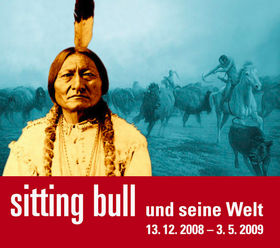
Umstrittener “Sitting Bull” im Bremer Überseemuseum

screenshot

„Eine solche Ausstellung wäre in den USA schwer vorstellbar“, sagt Ethnologe Christian Feest. Nicht jedoch in Bremen. Im Übersee-Museum ist bis zum 3.5.09 eine Ausstellung über das Leben eines der bekanntesten Indianer zu sehen – Sitting Bull. Zivilisationskritiker erkoren ihn zur Ikone. Doch unter den Lakota-Sioux war er isoliert; seine kompromisslose Haltung gegenueber den Weissen ist bis heute in den USA umstritten.

Christian F. Feest, Direktor des Museums für Völkerkunde Wien, konzipierte die Ausstellung im Auftrag des Kunsthistorischen Museums Wien. „Sitting Bull und seine Welt“ feiert Premiere in Bremen, bevor die Ausstellung nach Finnland und Österreich weiterreist.

>> weiter in der WAZ

>> Webseite der Ausstellung

“Eine große und ziemlich grandiose Ausstellung”, schreibt die Welt, die auch mehrere weiterfuehrende Links gesammelt hat.

screenshot

„Eine solche Ausstellung wäre in den USA schwer vorstellbar“, sagt Ethnologe Christian Feest. Nicht jedoch in Bremen. Im Übersee-Museum ist bis zum 3.5.09 eine Ausstellung über das Leben eines der bekanntesten Indianer zu sehen - Sitting Bull. Zivilisationskritiker erkoren ihn…

Read more

Headhunting as expression of indigenousness

logo

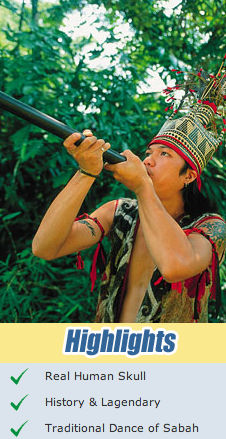
Anthropologists often criticize mainstream media for exoticizing people. But in Borneo you’ll find indigenous people who promote themselves as headhunters and are proud of it.

headhunter-ad

The journal Cultural Analysis has recently received a prize in the Savage Minds awards. It was voted as the second best Open Access anthropology journal. In the recent issue, folklorist Flory Ann Mansor Gingging writes about headhunting as an expression of indigenousness.

Headhunting is no longer practiced but the tradition has been commercialised by the tourist industry many places in South East Asia. But the headhunting past has not only taken on a commercial value, but also a cultural and political one, Flory Ann Mansor Gingging argues:

I propose that the tongue-in-cheek invocation of headhunting by the tourism industry represents one way in which Sabah‘s indigenous people counter the outside world’s designation of them as the Other; that is, by parodying their headhunting past, they demonstrate their understanding of the joke and thus guard their indigenousness and their status as human beings.
(…)
Marginalized groups in Sabah, many of whom share a headhunting past, have re- written the headhunting narrative in their favor, becoming co-authors of a cause that seeks, in Hoskins’ words, “to seize an emblem of power, to terrify one’s opponents, and to transfer life from one group to another” (Hoskins 1996a, 38). Thus re-imagined, the headhunting narrative emerges as a tool useful in working towards change and equality.
(…)
Observed in cadence with past and present political milieus, the “refashioning” of the headhunting narrative within tourism in Sabah hence seems to reflect a general consensus among certain of Sabah’s native groups: that Otherness, strategically invoked and appropriated, provides them with an instrument for addressing external threats to their identities.

The anthropologist folklorist and doctoral student in the Department of Folklore and Ethnomusicology at Indiana University grew up in the village she writes about. One of her friends, herself an indigenous Sabahan, said the headhunting imagery and narrative in tourism promotion is “embarrassing but cool”:

“It’s beyond comprehension that I have ancestors that might have been headhunters. At the same time freakish ancestors totally distinguish you from the rest of the global population, so it’s secretly thrilling as well. I love seeing the slightly raised eyebrows reaction I get when I tell someone new I’m from Borneo.”

The researcher heard lots of stories about headhunters during her childhood. As she grew older, her relations to these stories changed:

As I got older, I began to be aware of the economic and political struggles that indigenous people in my state face. Since becoming part of Malaysia in 1963, Sabah, a former British colony, had never had a chief minister who was both indigenous and non-Muslim. Consequently, when in 1984, Joseph Pairin Kitingan, a Dusun lawyer, became the first non-Muslim native to assume this position, being indigenous suddenly meant something to me.

It was also around the same time that I remember feeling a new attraction to the macabre and exotic elements of my culture—one of them being headhunting. Without quite knowing it, I was invoking those aspects of my culture that were potentially embarrassing as a way of responding to the threat I felt towards my own Dusun-ness. For me, headhunting ceased being just a part of history and became, in the most personal way, a part of my heritage—an expression of my indigenousness.

In my opinion, making headhunting such a visible icon of tourism in Sabah is an example of what Michael Herzfeld calls “cultural intimacy,” which he describes as “the recognition of those aspects of a cultural identity that are considered as a source of external embarrassment but that nevertheless provide insiders with the assurance of common sociality” (Herzfeld 1997, 3).

A good example for this trend is the Monsopiad Cultural Village. Here, she writes, Herzfeld’s “cultural intimacy is performed”. Although it is by no means the first to use the state’s headhunting histories within the context of tourism, she believes the Village is the only tourist site that has developed an entire park around the headhunting theme.

On the village’s website they write:

Monsopiad Cultural Village, the traditional village is a historical site in the heartland of the Kadazandusun people and it is the only cultural village in Sabah built to commemorates the life and time of the legendary Kadazan and head-hunter warrior: Monsopiad. The direct descendants of Monsopiad, his 6th and 7th generations have built the village on the very land where Monsopiad lived and roamed some three centuries ago to remember their forefather, and to give you an extraordinary insight into their ancient and rich culture.

Read the whole article:

>> Flory Ann Mansor Gingging: “I Lost My Head in Borneo”: Tourism and the Refashioning of the Headhunting Narrative in Sabah, Malaysia

SEE ALSO:

Ainu in Japan: Cool to be indigenous

In Norwegian TV: Indian tribe paid to go naked to appear more primitive

“They still eat their fellow tribesmen”

Anthropology and tourism: Conference papers are online

logo

Anthropologists often criticize mainstream media for exoticizing people. But in Borneo you'll find indigenous people who promote themselves as headhunters and are proud of it.

The journal Cultural Analysis has recently received a prize in the Savage Minds awards. It…

Read more

The anthropology of children, war and violence

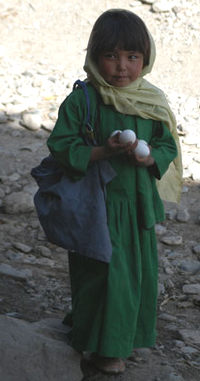
Baktay trying to sell eggs so that she can buy a notebook

What impact has war on children? What has anthropology to say on this? This autumn I watched the movie “Buddha collapsed out of shame” by the Iranian film maker Hana Makhmalbaf. It tells the story of children who reproduce the violence of the adults. For me, it was the most impressive movie of the film festival Films from the South (Film fra Sør) in Oslo. Makhmalbaf won the Silver Mirror, Films from the South’s main award.

– This is no funny movie. I hope you’ll feel the pain and the suffering, said the 19 year old director before the screening in Oslo.

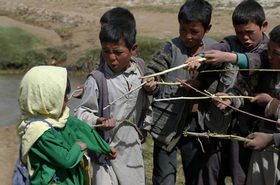
Five year old Baktay dreams of going to school. But her family is poor. When Baktay finally managed to sell the eggs of the family’s chicken and was able to buy a notebook, she gets attacked by boys who play war where they are the Taliban. The boys rip pages from her book, put a paper bag on her head, thread to stone her and to bury her alive. For girls aren’t allowed to go to school, and they must not show their hair.

In an interview on her own homepage, Hana Makhmalbaf says:

By showing today’s picture of Afghanistan, I tried to depict the effects of the recent years’ violence on the country. So that the adults could see how their behavior affects the younger generation.
(…)
First, it was the Russian communists, then the Taliban showed up, and now the Americans. One was communist, the other Muslim and the last one either atheist or Christian. But they all had one thing common, and that was “Violence”. And this violence has been injected over and over from three different groups into the culture of the people in this country so strongly that you can see it in their children’s play.

"Taliban" boys attack Baktay

“Buddha collapsed out of shame” was reviewed (among others) by The Hollywood Reporter, The Guardian, The Epoch Times and Avuncular American. There are some video clips online as well

The movie reminded me of the thesis by anthropologist Elisabet Eikås about young people trying to rebuilt Afghanistan. Their activism is a continuous struggle with the structures of the society that they tend to reproduce.

In Children, War and Nation: Croatia 1991-4, anthropologist Maja Povrzanovic also writes about how children reproduce the adults’ behavior (in this case the Balkan war) in their daily life:

In winter 1991-2, my son Martin, who was two-and-a-half then, constantly built, ruined, rebuilt and ruined again his Duplo-buildings in a very aggressive way, claiming he was ‘playing Vukovar’. (…) In autumn 1993, in my son’s very first minute at kindergarten, a boy approached him with a toy airplane, making noise and boasting: ‘I am shooting the Serbs!’ On christmas Eve 1993, Martin wanted to decorate our Christmas tree with his toy guns (p84/85).

But it seems that children, violence and war is an underresearched topic.

“Descriptive work on children experience violence, in general, is better developed than theoretical frameworks are to explain the causes or consequences of such violence”, Jill E. Korbin writes in her article “Children, Childhoods, and Violence” in the Annual Review of Anthropology 2003.

She notes that for a long time, children’s own voices and perspectives have been largely absent from the anthropological literature on childhood and violence.

Also in a more recent paper, anthropologist Jason Hart and Bex Tyrer remark that there is a lack of anthropological studies on children and war:

To date, the majority of research on children and war has come from the fields of medicine, psychiatry and psychology. This has included a heavy emphasis on “trauma” and pathology, with a more general body of literature exploring the individual’s physical, emotional and psychological nature of suffering.

Although these issues are obviously very significant, the wider societal dimensions of conflict – namely how war pervades institutions, political structures, culture, economy and communication systems – have been overlooked.

They quote Jo Boyden and Jo de Berry who write:

[War] does not just cause psychosocial and emotional harm, but also attacks the most fundamental conditions of sociality, endangering social allegiances and confidence, and drastically reducing social interaction and trust.

The researchers call for childrens’ participation in the research process:

The involvement of children directly in research activities represents an important move away from traditional approaches, according to which children are solely the objects of enquiry. A growing number of advocates now argue that children’s active participation in research is both a means to improve the quality and relevance of the data and make children themselves more visible within a particular community or within the broader society.

Such participation can also improve a child’s ability to communicate her/his views and acquire new knowledge. In this way participatory research can contribute to children’s empowerment.

Both Hart, Tyrer and Korbin stress that children do not only reproduce what they see and experience. They are not necessarily victims but they are active agents as well. Children’s involvement in political-military action (children as soldiers etc) are not solely the result of compulsion, coercion, and brainwashing. Hart and Tyrer write:

Few authors have shown willingness to consider the possibility that, in some situations, young people may engage with military groups as a reasoned strategy – as the most desirable option within the range of choices available. They may also enrol out of social and political concern.

They conclude:

Without denying the existence of trauma and without refuting the idea that the young may be victimised, we should learn more about the strategies children employ to deal with their adverse circumstances and maintain material, psychological, emotional and physical wellbeing.

While most literature that I’ve found is not accessibe for the public, their paper Research with Children Living in Situations of Armed Conflict: Concepts, Ethics & Methods is freely available. It is one of the Refugee Studies Centre Working Papers

SEE ALSO:

Thesis: The limits of youth activism in Afghanistan

“We want children to be their own ethnographers”

Transforming the Anthropology of Childhood – Anthropology News April

Play as research method – new Anthropology Matters

Conflict Resolution and Anthropology: Why more scholarship on violence than on peace?

Baktay trying to sell eggs so that she can buy a notebook

What impact has war on children? What has anthropology to say on this? This autumn I watched the movie "Buddha collapsed out of shame" by the Iranian film maker Hana Makhmalbaf. It tells the story of children who reproduce the…

Read more

Institut for Antropologi i København åpner nytt klimasenter

Hvordan reagerer mennesker på klimaendringer? “Et nyt, dansk klimacenter åbner for alvor til februar, når eksperter fra hele verden diskuterer, hvordan mennesket reagerer på klimaet”, melder videnskab.dk.

Antropolog Kirsten Hastrup holder på med å forberede åpningen av senteret som skal stå for “de hidtil mest ambitiøse analyser af, hvordan mennesker reagerer på klimaforandringerne”.

Hun forteller:

Konferencen skal dels markere, at vi er på banen, og dels skal vi møde nogle af de kolleger, vi allerhelst vil være i kontakt med i forbindelse med projektet.

Vi skal stille nye spørgsmål til begrebet ‘resilience’ – modstandsdygtighed. Det handler om mennesker og hvordan vi dæmmer op for trusler og forandringer i forbindelse med klimaet. Ved at tage fat i det begreb med det samme, åbner vi for de centrale temaer og lægger forhåbentlig et godt grundlag for de næste fem års arbejde.

Hastrup har allerede fått flere forespørsler fra både forskere og internasjonale phd-studenter som har lyst til å være med. Hun vil gjerne få med folk fra noen av områdene som blir spesielt hardt rammet av klimaendringene og er glad over at en phd-student fra Bangladesh allerede har tatt kontakt.

>> les hele saken på videnskab.dk: Hvordan klarer vi klimaforandringerne?

Videnskab.dk har vært flink i å følge opp klimaprosjektet, se bl.a tidligere sak Flygtninge skal med i kæmpe klimaprojekt. På hjemmesiden til Institut for Antropologi i København derimot finner jeg ikke noe informasjon.

I Norge er forskningsprogrammet PLAN opptatt av lignende spørsmål, se intervju med forskningsleder Karen O’Brien.

SE OGSÅ:

Kirsten Hastrup 60 år

Skal bringe sammen klima og antropologi

Håper at samfunnsforskere begynner å interessere seg for globle miljøendringer

How Anthropologists Can Respond to Disasters

Hvordan reagerer mennesker på klimaendringer? "Et nyt, dansk klimacenter åbner for alvor til februar, når eksperter fra hele verden diskuterer, hvordan mennesket reagerer på klimaet", melder videnskab.dk.

Antropolog Kirsten Hastrup holder på med å forberede åpningen av senteret som skal…

Read more