search expand

Fieldwork – a moveable feast?

Maybe away from Paris I could write about Paris as in Paris I could write about Michigan. I did not know it was too early for that because I did not know Paris well enough. But that was how it worked out eventually (A moveable feast, 2007, p. 4).

It took Hemingway several decades to write about Paris. [teaserbreak]I wonder if it was Paris as such or the kind of life he’s had there, which made it so hard to write about. I’ve only read about 1/3 of Hemingway’s memoirs of his young years in the city, but I’m eager to know his view on the subject. After my year in London, it took me about a year of philosophical chinoiseries before I managed to approach the real stuff. With Paris, I suddenly had a breakthrough some months ago and I haven’t stopped writing since. Even if I subtract all the things that I’ve been through the last years, it still can’t explain why it had to take me so long. I think, for me, the difficulties of getting to the core of the matter after field work is related to the existential journey that the field experience has brought about on both occasions.

In an unfinished post from some years back, I criticise the anthropologists Akhil Gupta and James Ferguson for their attack on what they call “the standard anthropological tropes of entry into and exit from ‘the field’” (Gupta and Ferguson 1997: 12). If I remember correctly, their point is that these stories exotize the field experience and enhance the strange- and otherness of the field site. That is probably the case in much anthropological writing (the first entry story that came to my mind is Evans Pritchard among the Azande, and there the Azande are far more alive and at least as recognisable in the intro than elsewhere in the book, so that was a bad example.) But that is surely not whole role of these stories. For me, the entry to as well as the exit from the field were surely full of existential experiences that readily can be likened to odysseyic voyages.

Anyway, I’m looking forward to seeing if Hemingway can contribute anything to my disagreement with Gupta and Ferguson, but it will take me a while to find out, because I’m so busy writing that there’s hardly any time to read… :-)

Maybe away from Paris I could write about Paris as in Paris I could write about Michigan. I did not know it was too early for that because I did not know Paris well enough. But that was how it…
Read more

The multilingual playground

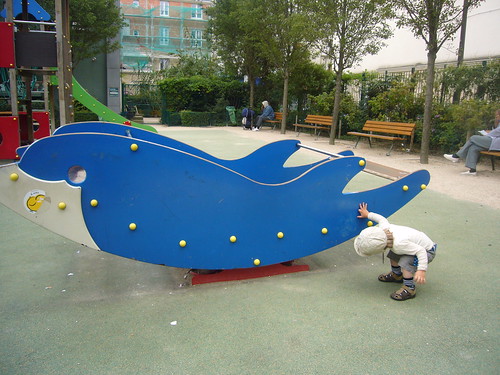
P1130473
(Early Sunday morning. Where are my playmates?)

It’s not the first time I write about how I enjoy hanging out in Parisian playgrounds (see posts from 2005 and 2007). They’re small to middle sized and every neighbourhood seem to have one. So, if you’re looking for a green and shady place to relax for a while and observe the local way of life, a playground can be recommended. Earlier, I haven’t paid much attention to the standard of the equipment, but this time I quickly noticed that all the parks in this part of the town have got new, exciting and very varied games for the different age sets. Perhaps this is part of an renovation of the public spaces in the Northeastern and poorer districts of Paris?
[teaserbreak]

Parc de Belleville in full blossom

Parc de Belleville for instance, has always had very well kept and diverse flower beds compared to comparable spots in Oslo’s poorer neighbourhoods, but now they’ve planted flowers and plans all over it – presumably in relation to the biodiversity plan of the city of Paris. (I see on the municipal net site that Père Lachaise is participating from the 20th Arrondissement, but they haven’t written anything about Parc de Belleville yet.) But I presume also as part of an over-all refurbishment of this part of the city. Anyway, back to the playgrounds.


Leo adds to the diversity and learns to drink running water from watching the older children at the playground

It happens that our local playground is the same one I wrote about in 2007, and I can only repeat what I wrote about diversity at that time. The first friend my son made in France, was a little French Japanese girl with a nice Japanese bug on wheels which she swapped for a while for Leo’s excavator. Another day, Leo talked to himself as he played with cars side by side some older children. One of the north African looking ones asked what language he spoke, and he was so amazed to hear that it was something called Norwegian that he had to boast of his knowledge in Chinese. Whereupon he said something and the Chinese looking boy present (who were even a little older, and not too nice towards the smaller ones) laughed acknowledgingly. Today, he played around two girls where one of them was bilingual in German. And so on. The playground bears witness both to the increasing gentrification and the high Chinese presence in the area, in addition to the North African Muslim as well as Jewish immigration. An many others.

P1130473

(Early Sunday morning. Where are my playmates?)

It’s not the first time I write about how I enjoy hanging out in Parisian playgrounds (see posts from 2005 and 2007). They’re small to middle sized and every neighbourhood seem to have…

Read more

La concierge, Parisian overture part 2

This terrible and expensive mess I created during a tenth of a second’s inattentiveness and a draught from the balcony doors would never have happened if it weren’t for the French holidays. But now the holidays are over and the house has got back its gardienne (a warden, an occupation formerly known as a concierge before it became a derogatory), and then everything falls into place. She probably knows most of what goes on in the apartment block and so she knows when someone needs a plumber, electrician, carpenter or locksmith, and he can recommend them one. So she’s got a whole estate backing up her negotiating power with the local providers of practical jobs, and negotiate she can! I’ve never lived in a building with a concierge before so I’ve never had the chance to see how they excel in their work. And by golly, that was something! Here, I get to my point. Or, I’m not really sure yet what this has got to do with my fieldwork and research, but I have a feeling that to see a concierge work means to see an essential element in how this society works.

The way she negotiated over the phone for a better price and super fast accomplishment with a locksmith she knew, at the same time as she answered all the inhabitants who greeted her en passant for work after her holidays, and intermittently sort of put in place the Jeunet drunkard (who only had tried to help us, but who shrunk a little anyway as he knows he stinks of alcohol probably), called up carpenters in her own flat and gently told them off, commanded Leo and the bird dog not to get to close and so on, all in a firm but sort of generous way. Her charisma was that of a school teacher whom you just know you must behave your very best with, and if you do, things will go your way. I wouldn’t be surprised if Bourdieu have written extensively on la concierge in the French version of The Distinction, because her position in the French class hierarchy must be quite peculiar. I’ve heard a very nice documentary series on these kind of wardens on France Culture a while ago, but now I’ve seen one in action and I definitely want one for my block back in Oslo. (But of course we’ll never get a concierge, we’ve only got this shitty neoliberal caretaker service business providers who call themselves things like economical solutions and who might change a bulb after a week but never ever greet you and make sure that everything is all right).

This terrible and expensive mess I created during a tenth of a second’s inattentiveness and a draught from the balcony doors would never have happened if it weren’t for the French holidays. But now the holidays are over and the…

Read more

Parisian overture, or getting a locksmith in the holiday season


Back in Belleville, – if only for a short visit

Finding a place to stay in Paris is one of the worst things I know (except from at a hotel, which is easy.) I’ve lived at six different places in the city, and almost every time some kind of trouble has been involved. (The only exception had a quite boring neighbourhood which was almost eventless in terms of fieldwork relevance.) This time, everything went unbelievably smooth. Even arriving with a small child was just enjoyable. Until I made a horrible mistake after ten minutes when I closed the high security fucking reinforced door when we were just popping across the street to get something for Leo’s supper. With a draught of wind, the door was closed with a spare key in the key hole on the inside. The next few hours involved a dozen of kind and welcoming neighbours, the wonderfully helpful cleaning lady and her wonderfully caricatural companion taken right out of a film by Jean-Pierre Jeunet (or maybe comics by Tardi), three conmen and three policemen.
[teaserbreak]
It all happened late in the afternoon a Saturday in the end of the French public holiday month. At such times, locksmiths can charge an exorbitant amount of money for opening a door. But not more than 1800€ which these conmen tried to get out of the newly arrived foreigners. Then the caricatural companion phoned the police, and they ran off. Luckily after having let us in, with our tired and impatient little baby, – by demolishing the high security lock completely, but leaving a hole in our door which could not be repaired until the weekend high rate period was over and the honest locksmiths were back from holidays. Then one of the conmen came back (for the “bill” with phone number and everything they had left in the hurry) and shouted outside our damaged but bolted door, and I found it best to call the cleaning lady (for the tenth time), and she sent the police.

Tomorrow, Monday, we’ll hopefully get a new lock and be able to leave the fall all three together.

This time it was my own fault and bad luck, but It seems like I continue to get into trouble and lose money over Parisian flats. I dare not think of what might happen if I ever get the chance of setting in motion my dream of getting my own place to stay in this labyrinth of industrious scoundrels and laborious jurisdiction.

Back in Belleville, - if only for a short visit

Finding a place to stay in Paris is one of the worst things I know (except from at a hotel, which is easy.) I’ve lived at six different places in the…

Read more

Research and ethics: France on Facebook

All of a sudden, people I knew from different circles in France started appearing on Facebook, about two years after the craze hit Norway. It reminded me of a question brought up in a seminar preparing graduate students for fieldwork I lead a while ago: Should one include one’s informants on one’s regular Facebook account? A girl wondered whether to keep two accounts; one for the fieldworker and one for her private self. If not, all attempts at anonymising would of course be futile.
[teaserbreak]
There are several reasons why two accounts wouldn’t work. It would just be easier for the locals to puzzle out who is who on the more limited “research account”. An equally important objection is that immersed in the field, the researcher needs friends and for me and many others, it’s nothing more natural than to find them among one’s “informants”.

In Paris this is not a problem for me, as I have no intention of anonymising the slam poets. In my fieldwork in London, however, the situation is different, as the thesis was full of sensitive issues and all but a few people had to be unrecognisable. So even though I’ve found many of my former “informants” on Facebook and I would love to use that tool to get in touch with them again, I hesitate to include them in my network for everybody to see.

All of a sudden, people I knew from different circles in France started appearing on Facebook, about two years after the craze hit Norway. It reminded me of a question brought up in a seminar preparing graduate students for fieldwork…

Read more