search expand

What is it that I’m studying “the making of…”?

For a long time, the preliminary title of my research project was communities in the making… I was thinking of Britain and France as the two communities that were in a constant state of creation and recreation. Then I realised how flawed this title was. First of all, many misunderstood what I meant by “community”, thinking that I had such an old-fashioned perspective on society as consisting of different (“ethnic” or whatever) “communities” that were reproducing themselves. (Perhaps I lost a PhD scholarship that way). Second, I finally realised that it wasn’t strange that people misunderstood, as “community” is the very word particularly favoured in multicultural thinking of ethnic minorities. The word then seemed to be useless for my usage in general, and particularly useless, as I wanted to employ it on the situation in France. There, the word seemed most commonly used in relation to communautarisme; the community-making of religious or “ethnic” minorities which threatens the societal cohesion of society as a whole. “Society” seemed thus a better choice.

But what is “society”? [teaserbreak]Ouch… when I start think about it, I really hate such words. The advice given in Pelto and Pelto’s Anthropological research: The structure of inquiry concerning the nature of concepts is excellent when it comes to such words. They emphasise that concepts are “arbitrary selections from the universe of experience”, and that they are “abstractions from concrete observations” (P&P 1978: 9). Therefore: “All terms in the stated problem must relate to observable natural phenomena of the universe, however indirect the path of abstraction involved” (P&P 1978: 27). Whatever they might mean by “observable natural phenomena”, P&P acknowledge that all terms used by anthropologists do not have “accessible empirical referents” (ibid.). However, they emphasise that if abstract, relational terms are used in research, “the research design must (…) make clear to the reader just what observational procedures will be taken as evidence supporting a proposition involving the abstract concept” (ibid.).

What observational procedures will be taken as evidence of “a society in the making”, then? “Society” must to be taken apart [… this reminds me of Foucault’s title society must be defended. Should check that one out; what might he have meant by that?], just like “culture”, which Eric Wolf and Adam Kuper tore to pieces once and for all for me with this – oh, so simple – quote:

if the elements of a culture are disaggregated, it is usually not difficult to show that the parts are separately tied to specific administrative arrangements, economic pressures, biological constraints, and so forth. “A culture,” Eric Wolf concluded, “is thus better seen as a series of processes that construct, reconstruct, and dismantle cultural materials, in response to identifiable determinants” (Kuper 1999: 246 (Wolf 1997: 387)).

Then, what are the series of processes making up the thing we call society? What are the identifiable determinants and what kind of material is being constructed, reconstructed or dismantled in the processes creating the unstable and unbound unit called society. The “material”, I suppose, must be relations. Relations are built, rebuilt and broken between people, between people and places, and probably between larger units of people and between people working within and on behalf of institutions… The identifiable determinants can be values, rules, laws, power relations, (lack of) knowledge, prohibitions, traditions… The series of processes constantly reproducing social units are thus all these exchanges going on in the various relationships within different shaping frameworks.

When I chose the term society for the title of my thesis, I of course also thought about the slam poetry scene in Paris as a society in the making, maybe even as France in miniature.

The Parisian slam society, or community – which has a better ring to it, I think – is certainly created and recreated through ongoing series of processes: People meet at various places, usually at slam sessions, but also often in the streets of the neighbourhoods of Belleville, Ménilmontant, metro line 2 (the northern and eastern section)… There they exchange poems, greetings and kisses, opinions… They might eat, smoke and drink together, arrange things together… and drop out of the community for a while and then come back… The territory (=important ingredient in old definition of society) of the slam community is perhaps defined by the density of slammers present: Some places, as the areas (and metro stretch) I mentioned, the density is high, while sometimes – but probably very rarely – two or more slammers (≈distinct people = another important ingredient in old def.) meet in Champs Elysees or the Latin Quarter, and for a brief moment re-enact social bonds in the slam community. And what about the “determinants” these social processes are responses to? I’m running out of time here, but the “ethos” (≈specific “culture” = important ingredient in old def.) of French slam poetry is important here, but this ethos is of course shaped by values and forces in the larger society. I should say something about “institutions” as well, which is the fourth ingredient in the old def. but that must be for later…

I have a feeling that I’ve jumbled things together a little in this piece, but hopefully it will help me to sort out my answer to Pelto and Pelto’s commandment for anthropological research when time has come to write my methods chapter.

For a long time, the preliminary title of my research project was communities in the making… I was thinking of Britain and France as the two communities that were in a constant state of creation and recreation. Then I realised…
Read more

Home Migration and the City: New Narratives, New Methodologies – here I come!

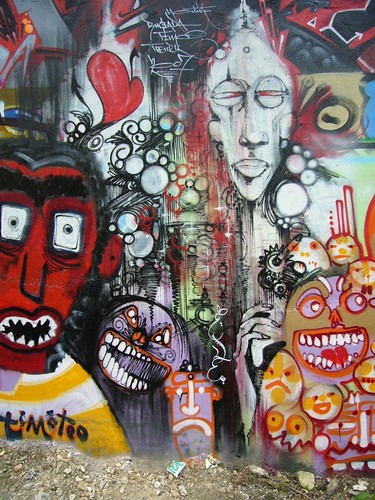
La Forge, Belleville
[teaserbreak]
I wasn’t selected for the quantitative methods workshop in Paris. Not so strange perhaps, since there is hardly any counting in my work… However, the competition was far fiercer for the other European Science Foundation happening I applied for, and there they wanted me (out of more than 260 abstracts :-) ) Paris is slightly more enticing that Linköping, that is so, and it would probably have been a very good learning experience one way or the other to hear more about how to study “discrimination” and particularly “integration” quantitatively (which is quite hard for us qualitatively focused people to see). And, not least, one of the organisers, Patrick Simon, has done a lot of work on Belleville. It would have been an excellent opportunity to network a little.

I’ve realised that networking, whether I like it or not – which happens to be the case – is an important part of this game. One comes nowhere without networks, a fact I learnt after I got a ridiculously meagre response to a workshop I tried to organise recently. And one day I’ll be finished at my old university, and that day is approaching faster than I like to think of. Home Migration and the City: New Narratives, New Methodologies in Linköping will also be an excellent place to start. From the program, I see that people come from all over the world, and it looks extremely interesting. I’m very much looking forward to going and I’ve already booked the trip. (It will be quite an adventurous journey it seems, as it’s almost as difficult to travel by train from Oslo to neighbouring capital Stockholm as it is between Thessalonica and Istanbul…).

The title of my paper is “Cosmopolitan space, place and notions of nation: Narratives of migration in Parisian performance poetry”, and I will look at how certain stories performed at the slam soirées play a key role in creating the cosmopolitan character of the sessions. Now, it’s just to get time to write it…

La Forge, Belleville

[teaserbreak]
I wasn’t selected for the quantitative methods workshop in Paris. Not so strange perhaps, since there is hardly any counting in my work… However, the competition was far fiercer for the other European Science Foundation happening I applied for, and…

Read more

Qualitative and quantitative ways of seeing (social) integration

Suddenly, at least to me, the ESF, European Science Foundation, pops up everywhere with interesting conferences and seminars. I’ve already applied for Home, Migration and the City: New Narratives, New Methodologies, a combination of themes which matches perfectly with my research. Now, I aim for an extremely interesting seminar in Paris, which appears equally made for my research perspective, but at the same time is very challenging. The perfect match is that they want to look at two differing approaches to incorporation of immigrants in Europe (one focused on social/cultural integration the other on (anti-)discrimination measures), a comparison which is very similar to my aim of comparing the two different philosophies of social integration in (“multicultural”) Britain and (republican) France. The challenge is that their research is quantitative! Quantitative methods in the Social Sciences: Immigration and Population dynamics: Measuring Integration and Discrimination. Do they want my qualitative approach? I doubt it, but I’m going to try anyway. Besides, the precision they demand from the use of concepts is a very gratifying challenge:
[teaserbreak]

It is certainly not the aim of this seminar to find a definition that satisfies many, but rather to start from the empirical end, and see how integration is being operationalised in research (ESF).

– Not so difficult. I have my three levels of analysis which, when I come to think of it, actually is an operationalisation of my conception of social integration:

1) A microstudy of the creation of an open, cosmopolitan and democratic space: the slam/performance poetry scene, where people of all ages and of very varied social and ethnic backgrounds come together and perform their own short texts. I attempt to analyse the sessions as a prism of French society, in many ways more true to the republican ideals than the republic itself.

2) An analysis of the process of inhabitation (Ingold 2000; 2007) – how people shape the environment they live in as well as being shaped by it – in Belleville, in Northeast Paris, the cradle of Parisian slam poetry.

3) An analysis of France as inherently postcolonial (i.e. shaped by her colonial past), seen form the perspective delineated by Eric Wolf’s Europe and the People without History (1982). (from my abstract)

The fundamental aim of the research is in fact to come a little closer to what social integration can mean in Europe today:

The overarching aim of the research project is to describe and make sense of the making of society – the social integration – in a former colonial metropolis, postcolonial Paris (and London). I understand the incorporation of newcomers – as well as of older residents – as a continuous process, where society – itself a process – is reproduced daily through everyday activities and encounters. Integration, understood as social cohesion or vivre ensemble, is thus a core concept in the project.(from my abstract)

What indicators are used and how are these believed to reflect integration as a process, but also as a state of affairs? (ESF).

Here the qualitative approach runs into serious trouble. Integration as a process, we’re good at of course, particularly since anthropology easily turns everything, including society itself into a an ongoing process. But indicators… Let’s try. What people say might be an indicator, no? I look at notions of belonging and perceptions of society among its members. I also look at who gets to voice their opinion and be heard. If, as my main hypothesis(!) says:

France is inherently postcolonial, i.e. fundamentally marked by her past and present global connection, but this fact has to a very limited degree been officially recognised. I claim that various forms of reappropriation – of space, time/history and notion of society – take place, on a conscious as well as unconscious level. Reappropriation becomes thus an important factor in postcolonial social integration.(from my abstract)

Why have these indicators been chosen, and to what extent do differences in theoretical viewpoints play a role in such choices? (ESF)

And, very good food for thought:

What are the major indicators of immigrant incorporation and how should these be operationalised in research that may be carried out at the interface of the two approaches [integration and (anti-) discrimination]? (ESF)

The last are not questions I could answer within the limit of 500 words, but definitely something to think about for my methodology chapter. The call for papers asked explicitly for main hypotheses, data, methodology and expected conclusions. Even though I love these kinds of puzzles where I have to match the answers to the questions perfectly, it’s not a way I as an anthropologist work very often. What exactly do I look for in the comparison between London and Paris?

In order to more clearly see the dynamic between the making of society and notions of belonging, I intend, in the final chapter of my PhD, to compare two different constructions of society with divergent categorisations of its inhabitants (e.g. hyphenated identity categories are common in the UK). Parallel postcolonial reappropriations take place in France and Britain, but since the two countries have distinctly different traditions of social philosophy accompanied by different histories as nation states, colonial powers and societies of immigration, the resulting perceptions of society and notions of belonging will be different. (from my abstract)

What questions do I want to answer when I look at this and that? Or, the other way around; what questions am I able to answer if my is gathered mainly through participant observation and informal conversations. In my opinion, there is no better way to investigate into the condition of society and its members that to actually look at what people do and listen to what they have to say about it. However, when I compare my approach to the specific language of quantitative approach can I understand why it’s more difficult to translate my own wordy descriptions into simple answers to direct questions… I’m not sure if this make sense yet, but it interests me and it seems relevant in order to investigate into the contributions of artful elements in anthropology that I’ve been writing about lately. And it will of course be relevant when I write my methods chapter in the autumn.

Suddenly, at least to me, the ESF, European Science Foundation, pops up everywhere with interesting conferences and seminars. I’ve already applied for Home, Migration and the City: New Narratives, New Methodologies, a combination of themes which matches perfectly with my…

Read more

Anthropologists and novelists, part two

Anthropology is just one way among many fields that try to make sense of and represent social life. A post ago I stated that it probably isn’t even the most superior at it. Funnily, in the days after I wrote that post, I read in the papers several similar comments made by other social scientists.

“The best novelists and playwrights are – almost by definition – those who understand human nature better than others” (the social and political theorist Jon Elster quoted by the ditto theorist Rune Slagstad in Morgenbladet 19-25, 2010. Jon Elster is interested in the role emotions play in relations to knowledge and behaviour. And no social scientist gets as deep into these intricacies as authors.

The gender researcher and novelist Wencke Müleisen has provided some fine social science inspired analyses of Knausgård’s writing earlier, and some days ago in a feminist column in Klassekampen she, too, ended her comment by singing the praise of novels:

A friend told me that while reading volume three [about childhood], she realised for the first time that her mother had behaved similarly [passive] in relation to her father’s aggressive behaviour. … It is hard to understand how this passive feminine violence seeps so invisibly into a kind of cultural gender pattern that one simply just doesn’t see it. In that respect, it is telling that in Knaugsård’s novel, [the mother’s deceit] is staged [“iscenesatt”] as absence and silence. Much seem to indicate that more readers get activated unpleasant memories of fathers’ aggression and mothers’ betrayals. The visibility of masculine violence makes us blind of the feminine passive acceptance. Language at work [“språkarbeid”] is needed. Novels can do that. (KK 22.02.2010, my translation)

Why is that? How do novelists do that? Does it have anything to say that the versimilitude (truthlikeness) of their depiction of the world within and around us resonate with the reader’s experience, rather than hinge on the logics of scientific methodology? Or is it a function of the literary language compared to concise concepts?

Anthropology is just one way among many fields that try to make sense of and represent social life. A post ago I stated that it probably isn’t even the most superior at it. Funnily, in the days after I wrote…

Read more

An Ariadne’s thread?


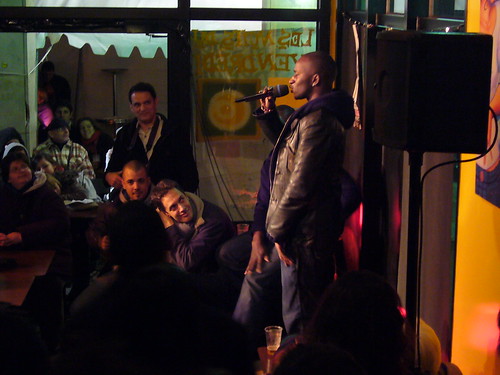
Souleymane Diamanka at Café Culturel in Saint Denis in the suburbs outside Paris

Haven’t I claim that French slam poetry can be seen as a commentary on and/or a representation of French society? Yes, certainly I have. From my very first slam session, I’ve felt that there was a strong connection between scene and society. And then, when I was exploring further the relations between anthropology and literature I wrote about in the previous post (and which I’ll come back to soon), I made a giant step forward in getting to grips with the relationship. Suddenly, I saw a clear connection between the slam scene in the years 2006-2007 and the riots in the autumn 2005 and the deepest oppositions in French society. All thanks to the ritual and performance theorist who for a long time has been looming in the background, or rather in the middle of the heaps of books I’m building my project upon. This is not to reduce the artistic element of the slam phenomenon. On the contrary, good ol’ Victor Turner conjoins the two – theatre and social drama – on a deeper level and shows how the two actually feed off each other.

Souleymane Diamanka at Café Culturel in Saint Denis in the suburbs outside Paris

Haven’t I claim that French slam poetry can be seen as a commentary on and/or a representation of French society? Yes, certainly I have. From my very first…

Read more