search expand

To formulate a thesis question

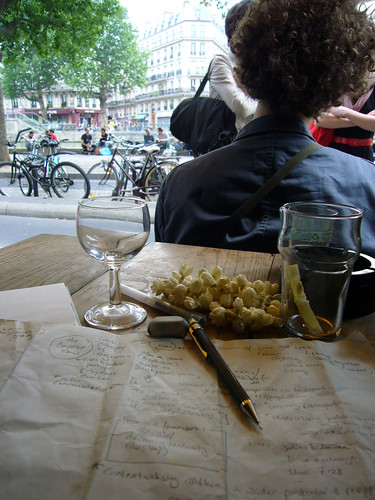
I’ve got one year and six months pay left of my research grant and with the help of organised writing I hope it won’t be a problem to finish in time. But I realise that the writing must be organised this time, so no more writing 140 pages too much like I did with my previous thesis. For the sake of organising myself, I read Authoring a PhD last Christmas (on a black volcanic beach on La Gomera in the Atlantic ocean, so the book is full of dark grains of sand). (Thanks to Mary Stewart for recommending the book on her research blog here).
[teaserbreak]
Manage your readers expectations is the first advice Patrick Dunleavy (2003: 15-16). When I wrote my Master thesis I was so sure I had something interesting to tell, that I couldn’t give a damn about readers expectations… How naïve one can be. This time I’ll follow Tim Ingold’s advise and write more like the swishy swashy pictorial language of We’re going on a bear hunt, and lead my readers on every step through East Paris and her suburbs. In addition to “orienting devices” like headlines etc and “signposts” (indicating the sequence of topics to be handled) (p. 272, 274), Dunleavy suggests an aphorism from Nietzsche so not to forget about the audience during the writing process:

Never ignore, never refuse to see what might be thought against your thought
(Nietzsche quoted in Dunleavy 2003: 134)

When I presented an unfinished article to various readers a while ago, I reminded myself of this quote – in order to handle the at times contradictory feedback I got.

The second good advice I found in Dunleavy’s book was the five components making up an interesting intellectual problem (une problématique, en problematikk), thus how to phrase a thesis question:

1) a goal or objective which can tell how to judge the outcomes, how to see that an improvement has been achieved

2) an initial state, the starting situation, and the resources available to be used

3) a set of operations that can be used to change the initial state and resources (a toolkit of research methods and new date)

4) constraints: designating certain kinds of operations as inadmissible

5) an outcome

Or put differently: “Problematizing your thesis question” means “setting the answer you hope to give within a framework which will show its intellectual significance” ((from Robert Nozick, Dunleavy 2003: 23)

My (preliminary) aim – component number 1 – is to describe and makes sense of a former colonial metropolis as fundamentally marked by its past and present global connections. Thinking about readers’ expectations, I realise that already in this sentence, my choosing of words points in the direction of a specific perspective. Instead of writing just “Paris”, I say “a former colonial metropolis”, for instance…

Component 2: the starting situation and the resources available in an anthropological study I guess must be a specific empirical ground/arena and certain perspectives by which I look at it, in order to generate data and knowledge. I’ve divided the overall aim into a threefold perspective:

i) a microstudy of the creation of a cosmopolitan space: the slam poetry scene

ii) an analysis of the process of inhabitation (from Ingold) in cosmopolitan East Paris

iii) an analysis of France as inherently postcolonial, seen from the perspective delineated by Eric Wolf in Europe and the people without history

The initial states are thus i) the existing slam poetry scene (very mixed in terms of gender, age and social and ethnic background), ii) East Paris (visibly marked by former and present immigration) and iii) the ongoing debates on what constitute France and the history of France, + Eric Wolf’s and similar perspectives on global connections

Component 3: my research methods and new data:

i) observation, participation and filming on about 100 slam soirées → data on the places, audiences, performances, participants… In addition to some “off stage” participation with some of the participants, poetry texts, myspace sites, interviews… + literature on space/place and phenomenology…

ii) observations, hanging around and living in East Paris which give me some idea of how the process of inhabitation can be an appropriation of space. Examples are how the waves of immigration have made their marks on the environment, all the streetart, posers and writings on the wall, and finally the various places, cafés and bars, where the slam is taking place. + literature on performance, oral poetry and…?

iii) to answer the third question, I will draw on my findings from the two previous fields of investigation, in addition to literature and media coverage on the public debates on history and France.

Component 4: the constraints affecting my work, I’ll discuss soon in another dull post on methodology and scientific criteria.

Component 5: the outcome: hopefully a satisfactory description and sense-making of a Society in the Making: The slam poetry scene and Postcolonial Paris…

The final useful point I’ll mention from Authoring a PhD this time, is to try to work out as soon as possible what one will be able to say something about, in order to make a close fit between the question asked and the answer delivered. The author also recommends to formulate the thesis question so as to showcase your own findings, instead of going on and on about other people’s research (Dunleavy 2003: 24-5). That fits well with my aim to write descriptive and swishy swashy, very far away from the language and content of this blog post…

I’ve got one year and six months pay left of my research grant and with the help of organised writing I hope it won’t be a problem to finish in time. But I realise that the writing must be organised…
Read more

Ethnography under colonialism: what did Evans-Pritchard think of it all?

“When the Government of the Anglo-Egyptian Sudan asked me to make a study of the Nuer I accepted after hesitation and with misgivings” (Evans-Pritchard 1940: 7).

“A Government force surrounded our camp one morning at sunrise, searched for two prophets who had been leaders in a recent revolt, took hostages, and threatened to take many more if the prophets were not handed over. … It would at any time have been difficult to do research among the Nuer, and at the period of my visit they were unusually hostile, for their recent defeat by Government forces and the measures taken to ensure their final submission had occasioned deep resentment. Nuer had often remarked to me, ‘You raid us, yet you say we cannot raid the Dinka’; ‘you overcame us with firearms and we had only spears. If we had had firearms we could have routed you’; and so forth. When I entered a cattle camp it was not only as a stranger but as an enemy, and they seldom tried to conceal their disgust at my presence, refusing to answer my greetings and even turning away when I addressed them” (ibid. p. 11).

There is no other anthropologist I’ve read so extensively and thoroughly as Evans-Pritchard. I love how he makes reference to his arguments over witchcraft with members of the Azande community. His ethnographic descriptions of situations and even individuals in Witchcraft, Oracles, and Magic among the Azande are so “thick”, that you are allowed judge by yourself whether you agree with his theoretical analysis or not. When I reread The Nuer a couple of weeks ago, my hero disappointed me.

The book is nothing but generalisations – there isn’t one event, one situation, one individual mentioned after the short introductory chapter. Not even his one “constant companion in Nuerland” Nhial (p.10), who must have been indispensable in acquiring knowledge of the fierce and hostile Nuers appears in the text proper. He leaves us with an image of Nuer society as a seamless, timeless whole* devoid of real human beings. But as we know from his own introduction, Nuerland is in full anti-colonial revolt at the moment of writing. And in Evans-Pritchard’s own tent, young and proud Nuer men “endlessly visit”, talking about nothing but cattle and girls (which “led inevitably to that of cattle” :D ) and asking for tobacco without bothering to answer his questions.

Like anyone who’s been through a graduate course in social anthropology, I was of course familiar with the critique. However, my recent interest in colonial encounters gives an extra edge to reading 70 years old ethnographic descriptions by a white Brit in East Africa (Bourdieu among the Kabyle has certainly moved up on my reading list).

“I … never succeeded in training informants capable of dictating texts and giving detailed descriptions and commentaries. This failure was compensated for by the intimacy I was compelled to establish with the Nuer. As I could not use the easier and shorter method of working through regular informants I had to fall back on direct observation of, and participation in, the everyday life of the people. … Information was thus gathered in particles, each Nuer I met being used as a source of knowledge, and not, as it where, in chunks supplied by selected and trained informants. … Azande would not allow me to live as one of themselves ; Nuer would not allow me to live otherwise. … Azande treated me as a superior ; Nuer as an equal” (Ibid. p. 15).

Between the lines of this cold and “objective” ethnography, I read a lot of respect for the Nuers. But how on earth could this brilliantly alert and bright anthropologist not reflect on his own position as employed by the colonial – and so obviously repressive and violent – government. And equally puzzling: how can he treat the fact that he moves around with black servants (not Nuers, of course!) as such a matter of course? From the previous quote it even sounds like he usually treated his informants as servants… (This classical photo from Monica’s blog apparently gives a good indication of his relationship with the Azande).

A student alerted me to the fact that Evans-Pritchard lead African troops against the Italians in Eastern Africa during the WWII (Wikipedia). After seeing the French film Indigènes (see earlier blog post) on how the French colonial troops were treated during the war, I cannot but wonder how my predecessor treated his own soldiers.

*) This seamless whole is in fact what he wanted, as he writes that he wanted to write a new kind of monograph where the development of theory isn’t drowned in ethnographic detail.

“When the Government of the Anglo-Egyptian Sudan asked me to make a study of the Nuer I accepted after hesitation and with misgivings” (Evans-Pritchard 1940: 7).

“A Government force surrounded our camp one morning at sunrise, searched for two prophets who…

Read more

Fieldwork fatigue …and outline from the end to the beginning

“[O]ur work cannot transcend being a human endeavor, with attendant costs as well as benefits” (Wolcott 2005: 141)

Earlier this week, I got ditched on one of my first interview rendezvous. [I later learnt that yes, he had been there, in exactly that huge, rather kitschy Indochinese colonial style bar … My incapacity to find him just proves that I’m suffering from fieldwork fatigue…]. Since it’d been a hard day after another sleepless night, I decided to neither wait longer than 25 minutes, nor phone the person, but instead walk off into the busy street at Place de Pigalle. For once, I was in a place without my bike and with nothing planned. I decided to walk back east, following a boulevard one probably cannot find anything like anywhere else in the world, through Pigalle and Anvèrs (tourists, sexshops, local Americans and ordinary inhabitants), Barbès (French Arab quarter for several generations) and La Chapelle and Stalingrad (crowded, noisy and polluted with traffic, known for its social deprivation and heroin). By quieter and gentrified Canal Saint Martin (where students and artists, tourists and homeless picnic side by side), I know a nice little bar, with three tables outside and a few more on the inside, wooden, brown and sympathetically worn down. They play mostly French music, a little bit punkish, a little bit of Mano Negra, some French Tom Waits, a little bit of Balkan-gipsy style that is so popular here… While I wouldn’t dream of drinking a glass of wine alone in public at Zorba or Les Folies 10 minutes away up in Belleville, I don’t hesitate at Café Jemmapes. After my 40 minutes stroll, I sat down quietly and listen to the chattering around me and watched the people sitting by the canal. I started on this blog post but soon realised that perhaps following an advice from The Art of Fieldwork could help me in my state of fieldwork fatigue:
[teaserbreak]

…think through your entire study in the reverse order of the way you intend to carry it out. Begin with a careful consideration of where you want to end up… Try to anticipate as specifically as you can the outcomes you want to achieve. Then back up a step to identify the kinds of data and range of experience you will need to support or illustrate those outcomes. Then back up one more step to ascertain how to get that information (Wolcott 2005: 194-5).

That morning, the first thing I did was to reschedule my return flight back home, thus shortening my stay with 16 days. I had woken up really early, after only a few hours sleep. Faubourg du Temple might be a nice street for strolling, and a perfect street for sitting down for a coffee, but it’s far from perfect to sleep five floors above. Too vibrant, too cobbled-stoned, too picturesque… In addition, I’ll have to move house again soon, since the propriétaire will move back in, after a thorough refurbishment of the worn down place. Hearsay tells that his parents bought the flat for 90 000€ in 1999, and now – even before it’s refurbished – it’s worth 270 000€. That says about it about the housing market in Paris. I’ve not had success in re-entering it for the last month of my stay, so I end up shortening my stay and spending the last ten nights in an hotel around the corner. I’m a bit tired of it all…

I’ve lived so many strange places in this city, with mice, mould, and mites, only to mention the problems starting on m. The fieldworker is his or her own worst enemy (as well as her best asset, on good days of course), as Wolcott states somewhere in his book on method. And I think he also says something about the field, with all its nuisances, getting in the way of doing fieldwork. I feel a certain fieldwork fatigue at the moment. I have realised – possibly because the end is so close – that it is “only” fieldwork. With that insight it suddenly became work more than anything else for me. Gone is the attempt to try to live it. There are many other reasons for this fatigue as well. Living conditions, the extra effort to wrap it all up and pursuing all the people and events that I haven’t come across naturally or by chance until now, my life situation, the fieldworker role (being there for everybody without anyone really being there for me… – I remember how depended I was on my flatmates back in Freemantle street in London as an outlet for this self-effacing role. Here I don’t have any such outlet, in addition my role is even more self-effacing as I’m a far better listener than a speaker when it comes to French).

At the moment, reflecting on my growing feeling of detachment, I get a sad taste of failure. Professionally, I think I’m doing fine, the failure is rather on the human side of it. I feel I’ve failed in really living here which is probably connected to my failure in improving my French as much as I hoped to. Too much of my days have disappeared at home, in front of the computer, working on the videos. I’m thinking about another quote from The Art of Fieldwork:

Every choice is also a sacrifice… Every articulation precludes not only its own alternatives but all sorts of developments they would have made viable (Susanne Langer quoted in Wolcott 2005: 257).

Whatever the reasons might be, the northern immigrant to East Paris has retreated (with a bowed head), and it’s the anthropologist that is sitting down drinking a glass of white wine at Café Jemmapes, thinking about Wolcott’s questions; where do I want to end up and what are the outcomes I want to achieve?

I started focusing on the slam poetry scene because I wanted to study a cosmopolitan milieu. (In my view, cosmopolitanism is – in contrast to the national identity craze hitting politicians in France and Britain at the moment – the future of Europe. We have no other choice.)

My preliminary main claim is that the slam soirées can be seen as an appropriation of time and space; – time through story telling (thus the creation of narratives, which is a creation of meaning) and space through being together, sharing with and listening to others, many with a very different background from your own. It is an appropriation because it is free and democratic/accessible for all. Elements of this appropriation can be termed a postcolonial re-appropriation: Spatially because the scene is uniquely cosmopolitan, and because many of the texts re-describe public space on French soil in cosmopolitan as opposed to national/monoethnic/”white”… terms. The re-appropriation is also temporal as personal history and French history are being told from various “immigrant” (or e.g. descendants of slaves’) perspectives.

The slam often seems to be a personal as well as collective response to social and personal problems. In this sense, it provides a solution to the individualising/atomising forces in our time hindering collective movements.

I will contextualise the slam phenomenon within a wider postcolonial re-appropriation or time and space that has been going on in France for a while. (What will happen now, when one of the first points in Sarkozy’s victory speech was that we will now finish with all this repentance, and a few days afterwards his Ministry of national identity and immigration was set up.) I’ll support the description of the struggles surrounding French history by the historical and theoretical framework in Eric Wolf’s Europe and the People without history: European modernity and the history of Europe itself must be viewed within the context of European expansion from the 16th century onwards. For instance, the industrial development in Britain is intrinsically tied with sugar plantation in the Caribbean. Just as French post-war economic growth must be seen in relation to labour immigration from the former colonies.

What “kinds of data and range of experience” do I need “to support or illustrate those outcomes” and how will I get that information? I must describe the soirées – the people present and the interaction and their texts. I’ve been to open microphone sessions at almost 30 different bars and cafés at least once, in addition to sessions at a museum, a mental hospital, a metro station, theatres… in addition to concerts, workshops and plays, and I’ve filmed around 35 of the sessions (so I can take it easy about the 6 hours of so with film I erased by accident the evening before the fieldwork fatigue hit with force). In addition, the slammers are kind enough to provide the foreigner with written versions of their texts, which I’ll study more in depth when I get back up north, in the wintertime I can imagine when the teaching in the autumn semester is finished, sitting at my office at the sixth floor in the social sciences building at the University of Oslo, thinking about the Parisians I for a while was living among… When I’ve written a first draft and gone through all the texts, I’ll ask for a new round of interviews and conversations to verify what I’ve come up with so far. What is left for me to do, are the interviews with as many people I can. I’ll leave that part for another blog post.

I’ve met a few parents and other family members, and I’ve been in a couple of homes, but that kind of background information has been hard to get here, and it will also be practically impossible to write about, since I’ll not anonymise any of the participants….

“[O]ur work cannot transcend being a human endeavor, with attendant costs as well as benefits” (Wolcott 2005: 141)

Earlier this week, I got ditched on one of my first interview rendezvous. [I later learnt that yes, he had been…

Read more

The art of fieldwork

For 3-4 months I’ve been so immersed in fieldwork that I’ve taken it to be my one and only life. Vaguely, I’ve remembered that there exist a parallel universe up north (which seem to be my one and only life when I’m not elsewhere), but it wasn’t before I actually dipped back into that life for 9 days that it all crashed back into my conscience: There is an office there waiting to host me at inhumane working hours in just a few months time. There are students to be taught and colleagues to exchange with, and loads and loads of books to read… (Unfortunately, there isn’t any home with a view over Oslo to hibernate me, my plethora of succulents and dusty books anymore…).

When I entered the field again after a short trip outside of it, I couldn’t get one sentence from a book on anthropological method and the darker arts of fieldwork out of my head:
[teaserbreak]

“Is seduction one of our darker arts? As craftspeople, are we so crafty that others don’t know when they are being seduced?” (Wolcott 2005: 141).

I realised that I’m so crafty when doing fieldwork that the participant role of my persona seduces even me. I appear so sincere because I belive it myself. I want to stay here (or in London when I was there), it’s my genuine one and only wish. For the moment. I also tell people that I’m here to write a thesis and yes, it is actually my paid work to hang around in bars listening to slam poetry. But I forget at the same time that what I’ve been doing the last months, is not part of my life-to-come but part of my academic career. I suspect people around me are more aware of the fact that I’m simply dropping in and then out of their lives again, than I am myself. But I wouldn’t be surprised that the genuine enthousiasm I express by saying that I want to settle here helps strengthening my relationships with people. Wolcott calls this superficiality and seduction the darker arts of fieldwork. I was surprised to realise that my self-deception actually is treated in a book on fieldwork methods.

Both my fieldworks have been in environments close to my own interests. I could have been – and I surely would have loved to be –hanging around with policial activists in Brixton and mucisians in Tower Hamlets as well as slammeurs and slammeuses in Belleville, even without the excuse of doing fieldwork. Partly, I see this as a more honest anthropology as it is entirely based on the idea of an anthropology without radical difference, and more so, I don’t have to fake or hide anything – not what kind of information I’m looking for, neither my political views, my artistic interests and my way of life in any sense. On the other hand, as I’ve found myself asking the last week; what if I’m faking it all (so well that I believe it myself!), getting access through this perhaps naïve enthusiasm.

“Fieldworkers willing to make research commitments on such a grand scale [as to spend at least 12 months away from home] are also likely to be overcommitted in other aspect os their lives,” Wolcoff writes (2005: 117), and he continues further down: “Fieldworkers have an understandable but perhaps unfortunate tendency to represent themselves not only as different from those who do quick-and-dirty studies but somehow as more sensitive and caring humans as well.”

So, maybe this self-deception, the going native, is part of the darker arts of fieldworkers’ repertoir?

Ever since my early teens, perhaps my whole life, there has been a tension between the safe framework of academia and the attraction of adventurous escapes. In Oslo, the adventurer apparently does the head in on my entourage, and here she has been pushing the academic in the background for a while now. But almost as the conflict is about to be won, the adventurer evaporates into a cunning and crafty anthropologist…? Is that how it is?

Participant observation:
The anthropologist as Slammeuse,
at Lou Pascalou 11.04.07

For 3-4 months I’ve been so immersed in fieldwork that I’ve taken it to be my one and only life. Vaguely, I’ve remembered that there exist a parallel universe up north (which seem to be my one and only life…

Read more

Fieldwork and (little) blogging

I’m happy to hear that some Master students read my blog in order to prepare for their own first fieldwork. The idea of this blog has never been to inform about what’s going on in France, neither on findings in my own research, but rather to show snapshots from an anthropological fieldwork-in-progress – so I would love that other fieldworkers (to be) find inspiration here. As the research has moved into a new stage after I returned to Paris in mid January, the time is therefore overdue to provide some news from the progress.
[teaserbreak]
My low blogging frequency recently is partly due to lack of time. Since I held my breath (out of fieldwork anxiety) and dived back into the Parisian slam poetry scene the 24th of January, I haven’t had many idle moments. As I mentioned in the previous post, French slam poetry has really taken off recently. I’ve started to film the soirées, in order to better capture what “slamming” is about. Just as blogging brings about (unforeseen) consequences for the fieldwork, so does of course also filming. It takes up incredible much time, but lets me study in detail the texts, but the performance, gestures, ways of dressing and interaction with the audience. Perhaps it was a bit shortsighted of me to not realise that the time I knew I would have to spend on filming would have be taken from some other fieldwork related task (as I’ve never had any free, non-fieldwork related time here, unless I’ve had visitors).

I still spend a lot of time in front of my computer, but instead of reading news on Indymedia or in the dailies and weeklies (on the election for instance…) or write for this blog, I write notes or convert and organise my videos. And of course, the more time I spend outside, the more material have I to work on when I come home.

However, I’m not sure if lack of time is the main reason for my reluctance to post here. I rather think it’s the stage of fieldwork I’ve reached at the moment. I’ve all the time been cautious to blog too close to my fieldwork proper, thus I practically never mention people I know well and go into detail on events I participate in. I think there are many reasons for this prudence and reluctance, some of which I’m probably not even conscious, just uncomfortable… One is that I want to avoid imposing premature interpretations which undoubtedly will happen if I write text to publish here. Further, the unpredictability of anthropological fieldwork does that I never know who will get an important role in my research later, and again I would feel uncomfortable publishing a premature description. So now, when I spend all my time with/studying people I know, I get fewer ideas for suitable subjects to write about.

I’m happy to hear that some Master students read my blog in order to prepare for their own first fieldwork. The idea of this blog has never been to inform about what’s going on in France, neither on findings in…

Read more