search expand

Sunny Sunday – cycling and les techniques du corps


Cycling in the banlieues, neuf-trois (93)

Many months ago, I mentioned that I wanted to write about cycling in Paris versus Oslo, from the perspective of Marcel Mauss’ techniques du corps (available for download in French here). I’m reminded of this old classic each time I go from my Norwegian bike to my French one. Most bikes in Norway have an extra angle on the handle, putting it more in front, thus making the cyclist lean more forward. In Paris, the cyclists sit with their back straight. The majority of bikes in Oslo are some kind of – rather fancy – sport bikes. In Parisian streets, the sport bikes are rare, and you see men and women cycle on anything on two wheels – men on what usually is considered a woman’s bike are for instance not unusual. (And sure, after having my foldable, and expensive indeed, bike stolen after just a couple of months, the last thing I want is a new fancy looking one. What I’ve got now is a cheap retro looking inconspicuous one, – which a friend immediately condemned as bourgeoisie-looking. My only justification was that it was the cheapest I could find.)
[teaserbreak]
In addition to leaning forward on their seat, many Norwegian cyclists use a helmet. Surveys show that cyclists with helmets are more likely to suffer serious injuries, – obviously because they cycle faster. And of course the cyclists in Oslo – forward leaning and with sport bikes – cycle far faster than their Parisian counterparts. Here’s of course the connection to les techniques du corps, where Mauss in 1934 described how what we think are “natural” ways of moving the body, are highly social (physiological + social + individual (or psychological), I think he writes.

I often think of cycling in Paris as a flâneur-like activity, -as the bike itself and the way ones sits, in addition to some general mood, perhaps, don’t encourage one to cycle very fast. The pedestrians also are generally strolling around rather than hurrying. And if someone hurries past you, you very often hear a pardon – yesterday the person in hurry even bothered to turn around to excuse himself to me face to face.

If cycling in Paris has a character of flânerie, in London it’s closer to extreme sport. In Oslo I’ve until now thought of it as simple transportation, but after having read Dag Østerberg’s socio-material analysis of Oslo I realise that our way of everyday city cycling can be read as a an example of our “naturalness”. On my bicycle trip along the canal far into the suburbs today, I noticed that many Parisian cyclists put on helmets and sports gear and get their sport bikes out the cellar in order to go out of the city, as a Sunday activity. In Norway, fast cycling with helmets takes place inside the city. Østerberg writes about the Norwegian bourgeoisie (my translation):

The distinguished naturalness is a characteristic of the women and men of the Norwegian bourgeoisie: They engaged in sport and open-air activities to a far more than the rest of the European bourgeoisie. No other bourgeoisie lives in a forest (Østerberg 1993: 48-9). (For those who are interested, an additional explanation follows in an extended quote at the bottom of this post).

This “naturalness”, in perhaps less “distinguished” versions, permeates the Norwegian society. I wonder if it’s that which makes street life in Norway less communicative, less filled with meaning/significance, thus not social situations, while here in contrast, such small situations are “cultivated” into a little grain of social interaction. One example is the man saying sorry for just walking quickly past me in the street. “How many doors have you got in the face today,” is a standing joke at the Centre Culturel Français in Oslo, as many Norwegians ignore if someone is coming behind them through the door. It’s a lack of politeness, of course, but it’s also a lack of acknowledging that you are interacting with others in a social environment. The notion of living together “vivre ensemble” is everywhere here in Paris; from a core value at school to municipal politics.

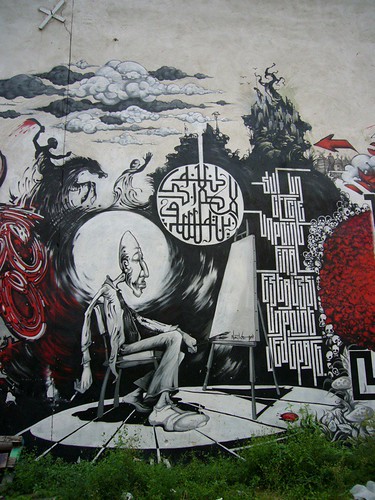
I notice that I’m deviating a little from my sunny Sunday bike trip now, and I’ll end this post with one more comment on socio-materiality. It’s so flat to cycle here that I didn’t realise where I was until I was far out in the in the banlieues in Seine-Saint-Denis. However, what I had noticed was that the highly varied east Parisian street art suddenly had turned to pure graffiti “pieces”, and at times even tags and simple scribbling were predominant.
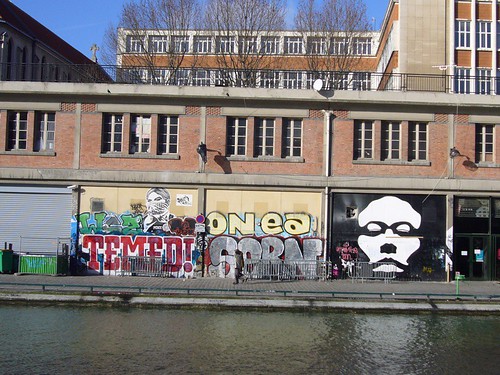

Street art and graffiti at Canal Saint Martin (75010)
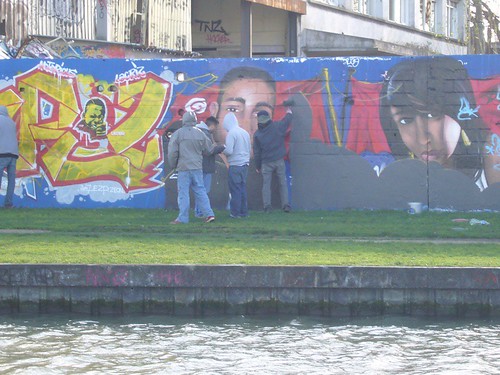

Graffit artists at work in Seine-Saint-Denis

More photos from “neuf-trois” here

When I got back to Paris, I passed Place de la République, and guess what? There were police as well as demonstrators present. (This time it was an anti-abortion demonstration).

The nature impression of Oslo is strengthened by the fact that parts of the economic, political and cultural ruling strata live in the hills, among trees and forest. These strata legitimise themselves party through “nature” and naturalness, in contrast to what is the case in many other countries. The bourgeoisie legitimised themselves from the 18th Century by appealing to “nature”, that we are born equal etc. The powder perukes and the rest of the baroque and the rococo were seen as unnatural, and were consequently left behind. However, around 1850 this changed. The bourgeoisie discovered that nature was and “vulgar”, because one found it among the farmers and the threatening labour movement. From now on, the bourgeoisie legitimated themselves with cultivatedness, with manners in contrast to raw nature. The bourgeoisie of Oslo and the leading stratum, on the other hand, still legitimises itself partly with nature, houses with a forest, Tyrol-looking houses, cabins in the mountain, long cross-country skiing trips. More precisely: It legitimises itself with distinguished naturalness, with carefully prepared natural look (my – quick, sorry – translation, Østerberg 1993: 114).

Cycling in the banlieues, neuf-trois (93)

Many months ago, I mentioned that I wanted to write about cycling in Paris versus Oslo, from the perspective of Marcel Mauss’ techniques du corps (available for download in French here). I’m reminded of this…
Read more

Intermezzo


Parisian street art – an example of appropriation of space

This blog has been rather quiet for a long time now. Despite a steady increase of half finished, and half started, posts, they’ve not yet found their way to the web. My lack of inspiration for blog writing has perhaps been due to the intermezzo-like character of the autumn. I’ve for the most part stayed in Oslo, trying to reintegrate into the office environment at the university after having been autonomous fieldworker for almost two semesters. In terms of writing and reading, and even thinking, the reintegration has not been very fruitful. One of the few things I’ve got around to do, was to present my research so far at a handful of occasions. Writing and getting feedback on these presentations (they don’t deserve the term “paper”), I’ve come up with a few themes to focus my attention around. As this intermezzo is coming to an end and I’ll get on with phase two of my fieldwork, this is a suitable occasion for a little summary.
[teaserbreak]
I’m suggesting that the French slam poetry scene is creating a site, or space, for popular resistance and cosmopolitan co-existence. When I once briefly mentioned to a colleague that I focused on resistance, she asked “resistance to what?” “The state,” I replied, looking a bit surprised, thinking by myself: what else to resist. However, it’s of course more complicated than that, and I’ll have to be far more specific and concrete in my description. It’s not simply “the state”, and the slam poetry is about far more than just resistance. Moreover, of course, as good anthropology, I’ll now have to show, i.e. evocatively describe, how such a space – for popular resistance and cosmopolitan co-existence – is created. Here I’ll have to look into the performances themselves, within the context of the slam soirée. I’ve started thinking about what makes some recitals good and others not. It’s something about the force of the performance, it’s “trueness” or “authenticity”… Don’t ask me yet what I mean by this.

That the slam scene is cosmopolitan was one of the determining factors when I chose to focus my research on it, as cosmopolitanism was what I came to Paris to study in the first place. Initially, I found Paris (and France) to be undeniably postcolonial, but surprisingly segregated and surprisingly little cosmopolitan. The broader socio-political context, within which I’ll situate the slam scene, I’m thinking of analysing in terms of a postcolonial reappropriation of time as well as space:


Indication of the postcolonial reappropriation of French history…

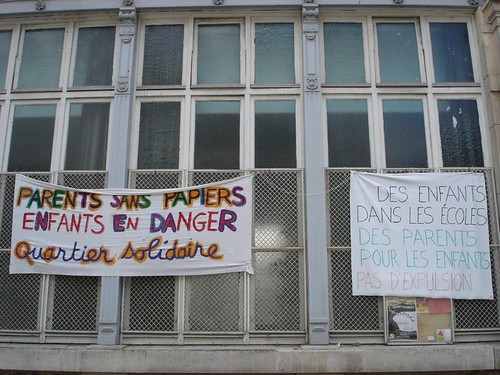
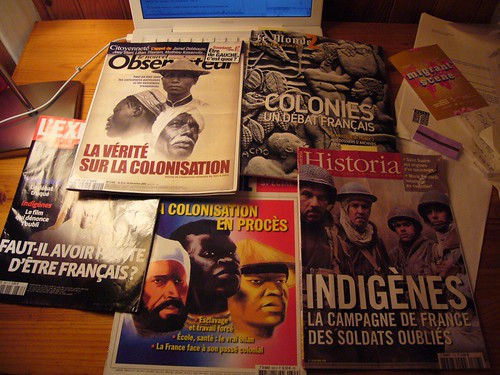
It seems to me to be a postcolonial reappropriation of French history taking place at the moment. I also wonder if one can say that there is a postcolonial reappropriation of space taking place in areas like Eastern Paris. – Shops, ways of dressing and ways of using the public space, are just a few examples. The constant mobilisation for the sans-papiers, with demonstrations, posters, banners outside schools for instance…, is another. Street art and graffiti appear to me to be a visual equivalent to the slam poetry – both are concentrated in the popular east side of the city and both are taking art to the people where the people are. I’ve shot several hundred photos of street art just wandering around, but now I’m considering doing a more systematic research.


Postcolonial reappropriation of space in East Paris

So, the plan for the next months is to focus on slam poetry, urban landscape, popular resistance and perhaps a little bit of street art. (As an envious professor said to me when he heard that I was going to Paris for eight months to study slam poetry: “If [the leader of the far right party] knew what you’re doing with the tax payers money…”. (To be honest, it’s not the Norwegian taxpayers who’re paying this time as I’ve taken leave without pay from my Ph.D. post, but a scholarship from a charitable and art loving Frenchman by the name Georges Sautreau.)

Parisian street art - an example of appropriation of space

This blog has been rather quiet for a long time now. Despite a steady increase of half finished, and half started, posts, they’ve not yet found their way to the web.…

Read more

– my research project so far (part 2): Parisian slam poetry vs British Asian ethnogenesis

In the second part of my presentation, I moved on to the particular field where I hung around and conducted anthropological fieldwork proper; thus participated as I observed or vice versa. As some will already know, that field is a slam poetry scene in Paris. I’ve written about it here already, and I’ll surely return to it, so I’ve not found it worth translating that part of my presentation here. Instead, I’ll reflect a little around the comparison I’m intending to make between the slam poetry phenomenon in Paris and the cultural expressions which constituted a core element in my study in London. In the third and final part of this post, I’ll try to recall the questions I got after my presentation.
[teaserbreak]
In my MA/MPhil thesis I looked at the creation (i.e. the ethnogenesis) of a home-grown British Asian identity – thus a new way of being British –, where cultural expressions, particularly music, with influences from south Asia played an important part. Without cutting corners in my future analysis, these two artistic phenomena – the wave of British Asian music, London 1999, and the slam poetry scene, Paris 2006 – show interesting similarities and differences.

In both phenomena, people create a space where they can express themselves. I’d say that it can be described as a, more or less, free space, and it reminds me of my favourite (anarcho-)philosophical quote:

Maybe the target nowadays is not to discover who we are, but to refuse what we are. We have to imagine and to build up what we could be to get rid of this kind of political “double bind,” which is the simultaneous individualization and totalization of modern power structures. The conclusion would be that the political, ethical, social, philosophical problem of our days is not to try to liberate the individual form the state, and from the state’s institutions, but to liberate us both from the state and from the type of individualization which is linked to the state. We have to promote new forms of subjectivity through the refusal of this kind of individuality which has been imposed on us for several centuries (Foucault 1982, “The subject and power”).

I’ve already sketched the outline of an analysis of to what degree some British Asian cosmopolitans in my study, represented attempts at such new forms of subjectivities. I think Foucault’s perspective can be a constructive approach to my Parisian field as well.

Another similarity between the two phenomena is that they were in vogue (when I did my research), seemingly just about to reach the top before they get commercialised, get too big and turn stale, with too many jump the bandwagon… The knowledge of how trends, commercial forces and bourgeoisation work probably worry participants in all such artistic waves.

On the other hand, the differences are also interesting: The slam poetry scene in Paris seems to have little to do with identity politics, and its cosmopolitan and heterogeneous (thus non ethnic/communitarian) nature is striking. All this, I find characteristic of the French society, and in contrast to the British.

I know this overview of the two fields is extremely sketchy, but this theme is not at all what I will be working on at the moment. The point has just been to justify my choice of the slam scene as suitable for a comparison with my London ethnography.

In the second part of my presentation, I moved on to the particular field where I hung around and conducted anthropological fieldwork proper; thus participated as I observed or vice versa. As some will already know, that field is a…

Read more

Back home part 2 – presenting my project so far (part 1)

Each time I tell about my fieldwork, I end up saying different things to different people, and usually I feel that it turns out quite messy, whatever I say. That was certainly the case when I tried to sum up the main points to my supervisor. So before my first seminar presentation (in front of a small multidisciplinary audience), the time had come to structure all I had experienced neatly into a comprehensible – and hopefully quite comprehensive – format.

My presentation was almost purely empirical, as I’ve not been reading much else than newspapers the last 9 months. The structuring principle I chose was to first give a socio-political overview of the bigger social events that took place during my fieldwork (October 05 to July 06), before I shifted to a more concrete micro focus on what and whom I’ll focus my research on (due to a need to anonymize at the web, I’ll be a little less concrete in this English version). I see the major socio-political events as forming a backdrop to my ethnographic micro focus, which – I hope – in turn can contribute to the understanding of these larger events. The first part of this post gives an English version of the first, events focuses, part of my presentation. The next part moves on to the micro focus, with a few words on my intended comparison with London as well as an attempt to sum up some of the comments I got after my presentation.

This is roughly what I said:
[teaserbreak]
I have not changed the fundamental focus of my project, thus I still focus on societal integration in two postcolonial European metropolises, particularly aspects of identity (formation) and belonging. However, my narrow focus on the so-called second generation (of one ethnic category; British Asians) in London, seemed – as predicted – of little relevance in Paris. [And coming to think of it, neither “identity” nor “belonging” is of that much importance to me anymore… We’ll see now, after summing up, if not “Communities in the making: Space, time and revolt” isn’t after all a more fitting title.]

During my 9-10 months of fieldwork, several large political events with huge relevance for my project took place. In the end of October, three weeks of rioting – car burning (which French youth are particularly keen on doing on a regular basis) and burning of schools and the like took place in deprived suburbs characterised by high unemployment and a large proportion of habitants of non-European decent.

In the spring, we had several weeks of massive protests against the new labour law, which had the intention of liberalising and increasing the flexibility of the labour market, but were seen as creating more insecurity (insécurité).

In addition, I would like to mention the abrogation, by President Chirac, of the less than a year old law paragraph saying that schools should teach the positive effects of colonisation. Until it’s abrogation, the paragraph and the protests it caused, never ceased to make it to the headlines. For instance, scheduled protests by the Martiniquais, including the poet Aimé Césaire, made Interior Minister Sarkozy to cancel his trip to the (French!) island.

The first day in commemoration of slavery (as a crime against humanity) took place the 10th of May. I had been looking forward to the day, anticipating it as a key event in my fieldwork. It was perhaps due to my great expectations that the day – for me – turned out to be almost a non-event.

The latter two events – the controversial paragraph about the teaching of history and the commemoration of slavery – give evidence to how important the struggle around the definition of (the correct and official version of) history is in France. I read into these events, as well as the last one I’ll mention – the active mobilisation against the new immigration law –, an increased demand for recognition of the transnational foundation of the French nation. [If this appears opaque at the moment, I’ll probably return to it in later posts, as I’m planning to work on what I’ll claim is a transnational appropriation of time and space this autumn…].

(Contrary to what was the case in the UK – and Norway! – the caricature affaire was no big event in France.)

I was struck by the constant focus on crisis and the feeling of anger and frustration present in the French society. The feeling of economic insecurity was present to a completely different degree there than what I was used to from Norway. In the beginning, the protests against the liberalisation of working conditions, seemed of little importance to my research (despite the fact that the law was part of Prime Minister de Villepin’s project on “égalité de chances”). However, as the protests gained ground, they pointed me in directions of important aspects of French social and political life:

*) Mobilising and protest: the belief that it’s possible, worthwhile and even correct and a good thing for proper citoyens to protest (i.e. it had already worked against the paragraph on colonialism).

*) Revolutions and riots as central aspects of the French national narrative, which is echoed on various levels in society, from the enthusiasm with which the pedestrians cross the street on red light – often dragging their children along, to the widespread (acceptance of) civil disobedience when “godfathering” and hiding sans-papiers children who are threatened by expulsion. For instance, many parents, teachers and other middle-aged people described the (sometimes quite violent) protests in the spring as a learning experience of democracy for the young. Apropos the riots in the banlieues: many commentators saw – utterly seriously, which surprised me – the riots as a positive sign: they riot against injustice, donc they are very French indeed!

*) Explicit and active scepticism against “(economic) liberalism”, partly as a so-called “Anglo-Saxon” phenomenon. (I.e. also “the republican model of integration” is also seen in contrast to the “Anglo-Saxon” multiculturalisms.

The two waves of protest and riot were easily interpreted within ideological discourses – not only by social scientists, but also not least in the public discourse. Both the two large events were frequently lifted up to a higher politico-philosophical level: For instance, one could readily hear that the riots in the banlieues were a proof that the French model of integration was destitute and France needed to turn in more in direction of multiculturalism. Equally, instead of the typically (so it went) French line of confrontation in politics – resulting with 1-3 millions in the streets against the CPE/first employment contract – needed to learn more from the “Scandinavian line of consensus”.

I find it interesting – particularly to my British/French comparison – that an excellent newspaper like the Guardian in my opinion not wholly grasps some particularities of French society in this respect. They wondered about the fact that 70% of French youth wished for something as boring and safe as a position as a public servant, and interpreted the protests as conserving and backward looking. My point is not whether their interpretation is right or not, but I find it quite ethnocentric and in lack of a native French point of view. (But that’s what we have anthropologists for ☺ )

My analysis is still at an embryonic or even less developed state, but it seems to me that these differing interpretations indicate a different relationship to the state, thus different state traditions, amongst British and French youth. I also have suspicion that one might read into the attitudes differences in visions of what constitutes a good life: perhaps in terms of more focus on career versus leisure, on consumption versus other forms of expressivity…. Well, probably I’m idealising the French context…

I hope to get a better grasp of these larger socio-political issues by looking at them though an ethnographic micro focus. However, it took me many months of fieldwork before I found such an ethnographic focus where I would be able to grasp what I saw as significant in the present situation. I went to loads of meetings and various gatherings and hung around in various places, but I found neither a suitable environment nor a suitable focus – until two months before I left the field.

I know this post can do with some links, but I’ll have to leave that for later… sorry

Each time I tell about my fieldwork, I end up saying different things to different people, and usually I feel that it turns out quite messy, whatever I say. That was certainly the case when I tried to sum up…

Read more