search expand

Art in the suburbs


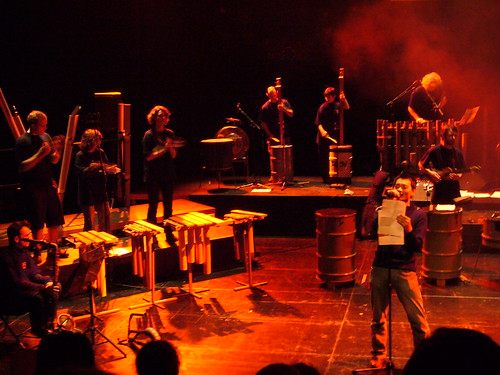
Slameur and musicians in a forum culturel in the suburb

Following the Parisian slam scene immediately led me to the suburbs. During my 9 months long first stay here, I crossed la pheripherique (ring road) only five times (except to go to the airport). Three times in the summer I attended open microphone slam events; two in Saint Denis (by Stade de France which one can se on the way to the airport) and one in Fontenay-sous-Bois (to the south east). Saint Denis is well connected to the metro system, Fontenay-sous-Bois is not, and it was a true galère to get there, according to one I travelled with. (One of our adventures dans la galère, I recounted here in Nouvelle France).
[teaserbreak]
Before I discovered the slam phenomenon, I went extra muros only twice, both with a friend visiting from Norway. Partly we wanted to have a look at the places where the youth were so angry, partly we went traditional sightseeing. In Saint Denis we dropped by at the famous basilica there where all the French kings have been crowned, and in Val-de-Marne we went to Mac/Val, a contemporary arts museum.

It seems quintessential of for this state, built on the ideal of Enlightenment to the people, to put such avant-garde institutions far into suburbia. It costs (practically) nothing to enter, which is probably a way of encouraging the locals to come to this place. I think they succeeded to some degree. While the exhibition was rather playful, the restaurant was minimalist, in terms both of its interior and the food. Someone told me that the highbrow restaurant was an attempt at encouraging Parisians to take the trip. However, the atmosphere (and prises?) didn’t encourage the locals I observed to feel at home there. (I remember this incident, but I can no loner remember what made me think certain visitors were locals belonging to certain social strata –at the time, I obviously didn’t follow my own note-taking advise and described instead of categorised….)

To get to this museum, one takes a metro line to its final destination (Choisy – Chinatown, in fact, which we discovered also made it a poor target for our angry youth expedition – perhaps the sino-français haven’t yet become second or third generation on the dole?), and then walk or take a bus even further into the (sub)urban sprawl.

The same travelling procedure, I’ve followed several times the last three weeks. First, I take the metro all the way to its terminus, then I go on by feet, bus or tramway – through names of places one remembers from the November ‘05 riots –, until I am at a Place de la Liberation or Place de la Résistance…(I’ll leave these interesting place names, full of national remembrance, for another post), where I find some more or less grandiose cultural centre where all kinds of experimental artistic activities take place. The slam poetry is not at all seen as an experimental activity, but rather to “invite the street in and listen to it”.

In one of these places, Le Blanc-Mesnil, the whole affair appeared slightly absurd to me: Outside the very grandiose Forum culturel there were groups of predominantly black youth dressed hip-hop style inside, well, the percentage of black hip-hop style was not very high.

The Norwegian arts scene is probably one of the least elitist in the world, while the French is probably quite high on the other end of the spectrum. So, while I find a bit bewildering the time and place to perform some rather experimental jazz jam or modern ballet or whatever, the French seem to react if it is completely normal.

Slameur and musicians in a forum culturel in the suburb

Following the Parisian slam scene immediately led me to the suburbs. During my 9 months long first stay here, I crossed la pheripherique (ring road) only five times (except to go…
Read more

Back home part 1 – blogging continues

Since October 2005, I’ve been blogging from my fieldwork experiences right amongst the Parisians, but from now on this is – hélas – no longer the case. I’ve returned to Oslo with all my fieldnotes, photos, impressions and sentiments, and after living and working autonomously for 10 months, I’m now trying to reintegrate into the office environment (as well as my Oslo life). Since my intention with this blog has been to document not only how my fieldwork developed, but also the rest of the research process, I’ll try to keep on blogging from the office.
[teaserbreak]
From my (new) office at the University of Oslo, I’m looking down at one of Oslo’s more well-off neighbourhoods, with multicoloured wooden villas, all with neat gardens dotted with apple- and various other trees. (While (the lack of) mixité social seemed to be an ever-present matter of concern in Paris, I don’t find it to be that much of an issue here).

From one corner of my office window, I see the light blue Oslo tramway passes every fifth minute or so, and from the other I see a red brick church at a small tree-covered hill. When I lean a bit over my desk, I get a glimpse of the clear blue Oslo fjord with some blue hills on the other side. Far away, climbing up another hill, I see what must be a banlieue, with its high-rise buildings from the 1960s. The university campus itself is situated up-hill from the centre as well. All these hills I’m describing remind me of a funny incident when someone who knew my street in Paris described it as “the one that goes up”. I was struck by surprise for a second, when he said that. Yes, elle monte un peu, but what surprised me was that I had never even noticed the slight rise. Looking at the geography of Oslo – and even more so at the hilly city of Trondheim, where I lived the first twenty or so years of my life – one easily understands why.

So, from this office with this view, I hope to get on with stage two of my research project. From documenting research-in-progress during fieldwork, where theoretical and analytical discussions have been scarce or absent, I think the blog posts the next months will take two distinct but intertwined directions. On the one hand, I’ll write explicitly research-focused posts on how the project develops as I read, write and discuss my work. On the other hand, my mind keeps creating small (phenomenological) blog posts on my experiences in Oslo and how that contrasts with Paris. I think writing about such ethnographic contrasts can have several functions. As I experience them, they will probably take part in shaping my attention in the following stage of the research process. They can also perhaps be stepping-stones for a possible future fieldwork in Oslo. We’ll see we’ll see. I don’t know if I even can manage to experience, and write about, Oslo as I experienced and wrote about Paris.

The two following posts will be one in each direction: First a research centred post about the ethnographic status quo of my project, as I presented it at a multidisciplinary seminar last week, then a Norway/Paris contrast-focused post on techniques du corps (where cycling plays a part, of course).

Since October 2005, I’ve been blogging from my fieldwork experiences right amongst the Parisians, but from now on this is - hélas – no longer the case. I’ve returned to Oslo with all my fieldnotes, photos, impressions and sentiments, and…

Read more

“Liberté, Égalité, tes papiers!”

Blonde and blue-eyed as I am, I’m not treated as an immigrant here. I often think of my privileged position and how much better I’m treated than many of the locals. While the kids in Clichy-sous-Bois, and elsewhere, are asked for identity papers up to four times daily, I’ve never ever been asked for mine. That’s really lucky, because it’s actually obligatory to carry an id card here, and I always forget mine…
[teaserbreak]
Last night I got reminded of the sheer sickening injustice of this once more. I found myself in the awkward situation of being on a bus… with a bike instead of a valid ticket, and as usual, without identity papers. But, as I’m not a black woman – which was the unfortunate case for another passenger – I didn’t have to first cry as the nazi looking brute of a ticket controller loudly threatened to bring her to the commissariat since she didn’t have her papers on her, and then, put up forced giggles as the brute found it suitable to use his powerful position to try to chat her up instead of bringing her in. No, that was not what happened to me. I gave the brute a ticket from earlier in the evening and hoped for the best. Apparently everything was all right. Then he asked whose bike it was, and after a little back and forth (lasting maybe 30 sec) he said; “I’m just telling you it’s not allowed with bikes here”.

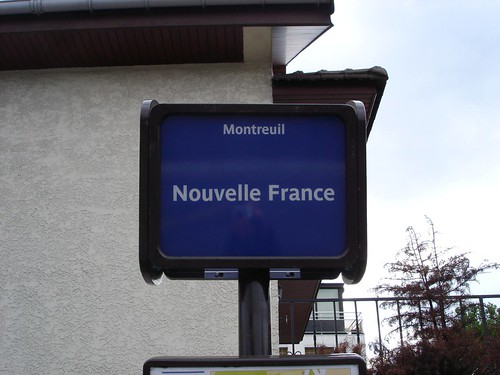
My company all had their season tickets, which however was not valid for the zone we were. But as they were neither female, nor black, there wasn’t any need to fine and harass them… For all the other passengers in the bus it must have seemed like the four of us had valid tickets, which wasn’t the case with none of us. The incident with the black lady dragged on for the better part of the quite long bus ride, and on our way we passed a stop named “Nouvelle France”. We found that very, very symbolic indeed, and one of them suggested that I write a blog post on what had happened with the title “New France”. I replied that I for months had planned to write about this subject, as this was not the first time I experienced such things.

Blonde and blue-eyed as I am, I’m not treated as an immigrant here. I often think of my privileged position and how much better I’m treated than many of the locals. While the kids in Clichy-sous-Bois, and elsewhere, are asked…

Read more

“Elle va se faire draguer”

Every blog post I’ve tried to write on gender strands for some reason or another before they reach the web. The following text was meant to be a simple and silly account of a quick bike trip around Belleville. However, when I let it rest for a moment in order to start sorting out the huge heap of paper – flyers, magazines, newspapers, brochures… -that was threatening to cover more and more of the surface space in my little office-cum-livingroom-cum-kitchen, I came a cross an old article about a café that I had just passed on my trip. This café reached the national media right after the Mohammad caricature affaire because they put up an exhibition with blasphemous caricatures right in the heart of Belleville. Well, the article in itself wasn’t enough to put me off track. It was rather it’s point of view, or framing, that threatened to put my experiences on my little trip in a new light. I started worrying that my silly little text had to become a bit more complicated.
[teaserbreak]
In one of my French classes in the autumn, my teacher made my research into a little subject of discussion. According to her, a fieldwork in Belleville would be difficult for me, as the local boys would “try to chat me up” (elle va se faire draguer). I’ve been reminded of her words recently, as the season of la drague obviously is well on its way.

The way men and women communicate or not communicate in public spaces in this city is a part of French society I can’t really get my grips on. People exchange glances, or look casually at each other or around themselves, far less in the street here than I’m used to. I think men as well as women feel that that they should keep their eyes to themselves – unless they have certain intentions, that is – but it seems obvious to me that men’s gaze is far freer than women’s.

When I cycled through Belleville the other day, I wasn’t more than giving a young boy a little resigned smile after he – who probably was almost half my age – had leaned out in the street in front of me and called me ma chérie, before he found it opportune to announced to the whole street that one est chaude!. In my hometown Oslo, this – which in my opinion can be categorised as light verbal sexual harassment – has happened to me only a couple of times. At one occasion, when I told the kids to have some respect, they quickly excused themselves. Here, I avoid all further exchanges. I don’t know if that is the best way, but as I said, I don’t understand this interaction. And at occasions when I have answered back, it usually comes to some kind of scene where the man for some reason feels obliged to display a lot of hurt feelings and start an argument.

In another French class we discussed these strange Latin gender relations in public spaces, and una bella Italiana said she appreciated attention in the street. I don’t know if the attention the two of us get is exactly the same, but I didn’t get much support in my class – which for the day consisted of various Latins – for the view that this is limiting women’s freedom.

The kid who called me chaude (“hot”) was probably of North-African origin (either Muslim or Jew, I don’t know – it was right in the Jewish Tunisian part of Belleville). A Danish woman (mid twenties) I discussed this with, said she mostly got attention from men of North-African origin. However, I must say that I’ve experienced approaches by French men of all colours and ages – from old men coming close and almost whispering bonjour (as if I was looking like a prostitute?! – a less “prostitute-like” desscode than mine is hard to find), to such kids – and it happens all over the city. My worst experience took place when I was 17, when two men literally tried to abduct me at Les Halles (they were white French, a point I remember because the police asked specifically about their skin colour).

And it was around here my post stranded some weeks ago. From this point I can wrap up with some more comments on French gender relations in public spaces, – or I can change the framing towards the question of class relations in Belleville, and ask, as they did on posters in a similar quarter in Marseille; à qui appartient la rue? (“to whom belongs the street?”)

I can’t tell how the guy’s sexualising insult should be interpreted. Certainly, it was not a good point of departure for really trying to me draguer. I guess he was probably acting cool in front of his mates. (But why is that a way to act cool, one can ask?) However, the article I found in Le Nouvel Observateur looked at the controversy around public spaces in Belleville in a class perspective.

There is a process of gentrification going on in Belleville and Ménilmontant, where the bourgeois-bohemians are moving into this working-class and cosmopolitan area. And just by Parc de Belleville, a new chic café had decided to make their own little caricature affaire, where they put up religious caricatures on their bright red walls, clearly visible for the passers-byes. (Part of) the local Muslim youth didn’t think that was such a good idea. And then there were discussions (à la français – i.e. loud arguments) and a little destruction, and some national media coverage.

This was certainly a negotiation of space going on, which I, when I read the article, felt was reverberating down to my own recent bike trip. Coincidentally, perhaps, I never experienced any similar incidents on my many trips around Belleville last autumn. Initially, I took all this male expressiveness to be signs of spring, (which seems to affect the locals stronger than elsewhere :D ), but as one of the opening lines in the article went: “the intellos come there with their bikes, while the roughs charge with their Vespas…” I suddenly felt part of a bigger scheme.

As I’ve decided to get this first text on gender relations out on the web now, I’ll not linger any further…

Every blog post I’ve tried to write on gender strands for some reason or another before they reach the web. The following text was meant to be a simple and silly account of a quick bike trip around Belleville. However,…

Read more

Les cassurs – the “demonstration breaker” phenomenon

“The demonstrators shall be protected, and the casseurs shall be taken in for questioning,” Interior Minister Sarkozy said some days ago. It’s not the first time Sarkozy has expresses his binary vision of the youth in this country (“real and fake youth”). For a minister in charge of interior security, the world might be this simple, (though I remember how he during the November riots used the to two single cases of attacks on humans to discredit the whole three week and enormously widespread revolt). To me it seems like this broad casseur category hides at least three distinct, but perhaps related phenomena: There are the anarchists and left wing radicals who attack the police (and far right “fachos”, if present). Attacks on publicity boards (JCDecaux) and perhaps also on banks and multinationals (as is common in i.e. the UK) can probably also be connected to this category of casseurs – although in my opinion a distinction should always be kept in mind between attacks on property and on humans (including police officers).
[teaserbreak]
The next category of casseurs seems also to have some kind of political motivation, though less articulated. It was a funny situation on TV the other day: Two youths were asked why they were demonstrating. “We’re against the CPE, of course, ” the one replied quickly. “No,” the other goes plainly, “I’m here to fight the CRS [riot police].” It seems to me that this category of casseurs might be related to the November riots, against “Sarko” and probably also the CRS. It shouldn’t be forgotten that the incident sparking off the revolt was an identity control and a police chase ending in the (accidental) death of two young boys and the serious wounding of a third, – facts that were curiously misrepresented by the infamous “Sarko” himself. Such identity controls are a daily ordeal for certain French citizens.

The third category of casseurs is a phenomenon so unheard of that I can’t understand it in any other way than as alienation… There are groups of kids robbing demonstrators of their mobiles and other valuables…! In fact there was one trying to snap my camera as well on Tuesday. (I so much wished that I had the lens open so I had been ready to capture his surprise as he noticed that I had the camera attached in a string around my neck, and it wasn’t just to pick it. My reaction time will never make me a good photojournalist…).

This third category of casseurs is a very sad phenomenon indeed, particularly if the French demonstrations are seen – as I do – as a symbol of the strong participatory sense of citizenship in this country.

“The demonstrators shall be protected, and the casseurs shall be taken in for questioning,” Interior Minister Sarkozy said some days ago. It’s not the first time Sarkozy has expresses his binary vision of the youth in this country (“real and…

Read more