search expand

One year ago today…


Leaving Paris by train

Today, it is one year since I packed my bags and left the field. I left a little earlier than planned because the field exhausted me and I wanted some calm. The last ten days I had lived in an hotel, because the letting contract had run out and I was not in the mood, nor had the energy, nor the extravertness to ask any of my acquaintances for a place to stay. After sleeping 6 months on the world’s hardest futon four floors above the madness of Rue du Faubourg du Temple, the crammed hotel room with thin walls and slamming doors almost felt like a relief. Instead, I think it was the nature of the fieldwork itself that exhausted me.

In London, I lived in a great flat share (in such a lovely British terraced house with blackbirds, squirrels and cats in the greenery outside my window), where I could withdraw from the maelstrom of the field for some hours or a day or two, with people to share my frustrations and find inspiration. In Paris, I had nothing but aloneness – and probably quite a lot of loneliness – when I refuged from the field. In addition, the field itself was several levels more advanced than what I had sharpened my anthropological tools on in London.

My command of French limited, but had I not chosen to study a group of people whose force was their command of language, game of words and poetry? In London, practically all my “informants” were my peers, in terms of level of education and to some extent social background, and they were no more than ten years older or younger than me. In Paris, the majority hadn’t even finished 12 years of schooling and only a handful had been to university. Instead, many had been through a whole different school of life than I could imagine. In terms of age, they ranged from 20 years younger to 35 years older. Moreover, while my focus of study had been of great interest to the people concerned in London, I never really felt that that was the case in Paris. Perhaps it was the language that made me qua researcher far more interesting to spend time with in England than in France, perhaps it was the subjects of concern, or perhaps it was just the French tradition of liaisons that rarely let me qua femme (et blonde et exotique en plus) retreat in favour of the researcher and even friend. I wouldn’t say that this fieldwork demanded black belt in professional and language skills and social sagacity, but it demanded enough to make me so exhausted in the end that I voluntarily left Paris more than two weeks before schedule. But it was really an awful summer anyway. And besides, I had important business to sort out at home.

After an autumn of absence, the field started coming back to me. When I hurried through my old neighbourhood in East Paris for a quick coffee by Canal Saint Martin on my way back from Corsica to Oslo in the spring, I realised how much I missed the atmosphere. What atmosphere? I can’t say for the moment, but that particular feel the streets of North East Paris instigate is something I grapple with in my writing at the moment. The sheer diversity of human beings and activities everywhere at all times, the history, beauty and grandeur emanating from the buildings and boulevards, the touch of anarchy and creativity in the street art and street life… I don’t know, but there is a difference. It was very hard to live it, but I really miss it. Now, for the time being, I’ll have to make do with trying to describe it.

Leaving Paris by train

Today, it is one year since I packed my bags and left the field. I left a little earlier than planned because the field exhausted me and I wanted some calm. The last ten days I had…

Read more

Rainy day and interviews

It’s pouring down in Paris, and there is no sign of the heat wave that struck us a year ago. I’m stranded at the local bistro, wishing I had brought my woollen jacket. If the best thing to do when it rains like this is to cuddle up at home with a cup of tea, living alone in a hotel is perhaps one of the least pleasant things. (However, seeing all the people sleeping rough in this city, sometimes right on the pavement outside this bistro, it could have been very much worse. And I’m planning a sizzling hot fish tagine for lunch – if I just could get down to the restaurant – so I’m not complaining).
[teaserbreak]
Since my last post, I’ve done four interviews: two quite good and long ones with people I know at least a little bit and who – at least as importantly, I think – has seen me around on various venues for 6 months, and two with people who have rarely if ever seen me working. The latter were of course far shorter and less good, not due to the interviewees, but not surprisingly to the interaction and dynamic between us. My mediocre French also hinders me in creating a very constructive dialogue there and then, which could have counterbalanced the lack of confidence between two strangers. In London, I conducted interviews with three people I’d only been emailing with beforehand which resulted in excellent material. They knew I would anonymize them, and also that we probably would never meet again, so they used me a little bit like a psychologist, when telling about their experiences of growing up. The slammers can in most cases of course not be anonymized, so the interviews develop completely differently, not deviating much from their public persona. And in the cases where I know people well, both sides know there are strict limits to what I can reveal about them, and obviously also to what seems relevant to my study. One of the explicit issues in London was identity formation. Here identity is relevant as well, but only implicitly. In addition, many will say that they tell about this and that – more or less poetically expressed – in their texts.

I concentrate so hard when interviewing that I feel dizzy afterwards. In order to grasp (almost) all they are saying – often in a café that appeared calm and quiet until I find myself face-to-face with a surprisingly softly spoken slammer – I’ve realised that I scrutinise people’s face, following their mouth as if reading on their lips. Sunday, I listened to people talking for almost 6 hours – at a balcony overlooking Canal d’Ourcq in the northeast, and in a café off Rue Moufftard, in the southeast – with only a 40 minutes bikeride in-between. The morning after, I woke up feeling like I’d been drinking until the early hours. Strange.

Today, I’ll go at an end-of-the season soirée at a small bar at Barbès, where I’ll meet up early to finally do the interview I ditched (unwillingly!) at Pigalle some weeks ago. – Under the counter in this bar, a slammeuse told me, there lays a Paris Match from mid October 1961 saying nothing about the hundreds of French Algerians thrown into the Seine by the police after the peaceful demonstration the 17th (see this post). The barman had shown it to the eldery slammeuse after she had performed a text on the police chief of the time, Maurice Papon (who has such a dark record that the fact that he died peacefully in a hospital bed without having been severely punished makes certain aspects of French politics utterly incomprehensible to me). The barman showing her the magazine had moved her, she said. He in return was surely moved by her performance, although it’s nothing new that White Frenchmen also were concerned about the plight of the Algerians. (For instance, all the 9 killed by the police at metro Charonne in February 1962 had traditional French names. See this post). He can’t have been old, if he was born at all, in 1961. The magazine must thus have been laying in the bar or having been kept in his family from that time, probably in order to remember that although it mentions the demonstration, it said nothing, nothing about what really happened. Knowledge I’m sure was widespread amongst the French Algerians at Barbès at the time. This knowledge, together with the more than 40 years silencing of it, continues to live on, under counters at bars in Barbès, as well as elsewhere… “Finish with the repentance…” (as Sarkozy says – see a post or two ago), well, I don’t know if the time is due yet.

Instead of moving on to the third café with wifi (after a late breakfast in the neighbourhood, I hurried through the rain for a late lunch at picturesque and rain wet Place Sainte Marthe), I think I’ll post this now and take benefit of the surely temporary stop in the downpour to move on.

It’s pouring down in Paris, and there is no sign of the heat wave that struck us a year ago. I’m stranded at the local bistro, wishing I had brought my woollen jacket. If the best thing to do when…

Read more

Choices… List of (some of) what I lost out on the last one and a half week

I scribbled down this text à l’arrache a day all my plans disappeared and I was still under influence of the fieldwork fatigue. Since then, I’ve not become less fatiguée, but at least I enjoy my fieldwork again. I think actually that the change came right when I took a step back and wrote this post…
[teaserbreak]
Saturday, I skipped everything else and went to Parc Floral for the first jazz concert of the year. Last year I was there almost every weekend, either with friends or with my notebook to write up my last fieldwork adventures. I had planned to get some writing done this time as well, but when I got there I just sat down on the grass and listened to jazz for a couple of hours, being puzzled over the strange sensation of feeling my muscles slowly relaxing. What an unfamiliar feeling these days…

Saturday night was the first evening of three where I tried to go and see D’ de Kabal’s play Ecorce les peines – on the (personal) history of slavery and life in the suburbs – but moved along too slowly to get there in time. [I’ve finally seen it now after two weeks of inertia in that respect. It was well worth it and I’m already quite sure that two of his texts will end up in my thesis: one commenting on the finir avec la repentance (“finish with the repentance” concerning France’s colonial past) speech of Sarkozy the night he was elected president and the text nous, on vit là (“we, we live here”) on living in the infamous suburbs. At the theatre, I got into a conversation with a Haitian poet. Such things – going to interesting events any time I want, meeting interesting people just by chance – happen all the time in this city, and I know I’m going to miss it badly in a few weeks time… ]

Sunday, I went to Aubervilliers for the monthly Slam Caravane open mic event for writing workshops in the (same infamous) 93 suburbian department, started by the same D’ – who, by the way also initiated the slam in Louvre happening with Toni Morrison I wrote about 9 months ago. Slam Caravane was great as usual, with an enormous variety in themes and performers. To get to Le Theatre de la commune in the obviously quite deprived suburb Aubervilliers, I took the 65 bus all the way from République. On the bus I caught myself thinking, again, that there aren’t many kinds of people I don’t see in this city. I’ve only come across one Inuit, and that was on a party a few years ago (were someone gave me the unforgettable chat-up line: “Can you (vous, of course) live by your poetry?” The world is a stage and every Parisian worthy of the title knows it…). The 65 bus travels through the South Asian part of Paris, up north, and from the window I saw piles of mango crates stacked up outside the shops announcing the yellow mango season, just like at Tøyengata back in Oslo.

Monday, I ditched my interview object, as I’ve already lamented, and down the drain also went an opportunity to go with him to a radio show at an independent radio station in an art collective in the 13th Arrondissement.

Tuesday, I went to the classic slam soirée by 129H at Lou Pascalou. Earlier in the day, I had spent three hours chez une slammeuse, looking at her paintings, getting a generous pile of fanzines she had edited in the early days of Parisian slam and interviewing her. She lives in the (rather chic) suburb Les Lilas, which lies in the other end of Rue de Belleville, on the other side of the hill. So, I cycled up, up, up and crossing the ring road La Perhiphèrique in an enormous roundabout, and there I was in the little village Les Lilas. I love this kind of straight streets – or bus lines – which takes you from one side of the city to another.

Wednesday I thought I had a lot lined up. Most workshops for youth and children take place on this weekday, as school only lasts half day to leave time for cultural, sportive or religious activities in the afternoon. This Wednesday I had forsaken 2-3 other workshops in favour of one particular with pensioners and youth, and then interview some of the participants afterwards. Once in a while – at completely irregular and unforeseen intervals, it seems to me, but I have a bad suspicion that it’s only me not staying up to date…. – the workshop takes place at a local home for elderly people. So also that Wednesday. Last time I was there, one of the pensioners had been very kind and shown me the way. This time I got instructions from one working at the youth house where I thought the workshop was to take place, but he knew his knowledge of the subject was limited and wished me good luck. Of course I didn’t find the place. Instead, I got the chance of doing some participant observation on a suburban bus in the rush hour. The bus to Aubervilliers had air-conditioning, this one hadn’t. As this is the daily life of very many people, it was an interesting experience, but I don’t know if it was the best way of spending this Wednesday afternoon.

– Particularly since I had erased by accident videos of two slam sessions with people from the workshop I didn’t show up for an appointment with… Methodologically, I constantly feel trapped between being too superficial in everything I do because I try to cover it all and on the other hand having serious gaps in my data material because I don’t manage to capture everything… Put differently; should I concentrate on a few or should I try to get a comprehensive overview? Whom, in that case? As this study starts to become rather comprehensive, I’m worrying about the gaps, while the depth have worried me for a long time: I starting to know everybody but do I really know anyone well enough? –

Thursday afternoon I didn’t mess up anythingk I just lost out on several other things (when I chose to go to a recording session with a 16-yearold and his teacher from the workshop. Afterwards I did an interview with the former.) in the night, I messed up getting to D’s theatre play in time again. This time it was my bourgeois looking but utterly crappy bike that did me in.

Friday finally, had no failure. I went to the most chaotic open mic event I’ve ever been to, in a narrow one-way street behind the huge market and roundabout and shopping centre at Porte de Montreuil. Thinking about it no, I certainly didn’t fell completely up to I that day either I lefte quite rapidly after la soirée bordelique and on the way home I couldn’t understand why I had been in such a hurry.

All these choices, all these challenges for doing the right hing all the time is perhaps one of the most tiring experiences of fieldwork. I know for certain that I n the long run I’ll forget about all my little regrets like this, but when I’m standing there, having to make choices like that at least once a day (should I stay or should I go, and which of the places should I go) one could get the fatigue from less.

Saturday, I had wine for lunch (at the University of Chicago Paris branche), and in addition to the unexpected downpour, all my other plans dissolved (my other plan was a workshop followed by an open mic event with Slam o Feminin up north in Porte de Montmartre. In the evening, once more, strangely, I missed out on D’s theatre play, but got a nice bicycle ride instead and could fall asleep before midninght over Steven Feld’s Sound and sentiments (on poetics in Papua New Guinea).

Sunday was a peak in this week’s feeling of insufficiency. Instead of going to Bobibny and Canal 93 for the restitution of tall the workshops there (not only slam poetry, but also music, dance…) I chose the jazz concert in Parc Floral, and ended up stuck under a tree in a neverending torrent. I cucled home in the warm but heavy summer rain and refused to considered going out again. Afterwards, several people (amongst them the 16.years old and his prof) told me it had been interesting, even great in Bobigny…

Monday, I forgot about the slam event in the campaign for legalising cannabis (which certainly not will have any success under the present presidency), and there was another alternative event I knew about but couldn’t find the address for, and lastly I ignored a concert and open mic – I later heard from several sources that it had been excellent – with a person I shortly afterwards discovered would provide me with lots of interesting material that goes straight in to my thesis. But my evening had been of the better ones, spent with people I like listening to music (and poetry) I also like.

Today, I had a really tight schedule with got fucked up partly by me, partly by external forces: I woke up before 7 from a mouse eating noisily at my bedside table. I wanted to scream for my coloc to immediately put up the mousetrap again, but he’s always asleep at this time of the day and he’s also just got a new boyfriend so I realised it wasn’t the time. Luckily, I managed to fall asleep again, but felt far from awake when the alarmclock disturbed me later to hurry me off to an appointment at a radio station in a suburb. At Chatelet, waiting for the RER local train, I realised I had miscalculated the time and I went all the way home again. Consequently, I missed out on the planned interview with the radio presenter (and slammeur, bien sûr) as well.

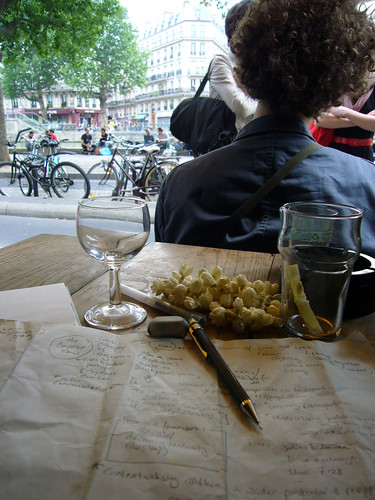
My busy scheduled day trickled away, I’m not-so-ashamed to admit. The workshop I was going to attend on Batofar, the concert venue on a boat at the Seine, was cancelled due to lack of interest and organisational problems. Now, I’m content to be slacking in the shade, writing blog posts by hand, looking at other summer time slackers by the canal. It’s a warm day, the hottest since the heat wave in April. It finally feels like summer. I suddenly feel a spark of absence in my constant bad conscience for not doing enough, not making the right choices, never staying long enough, talking enough to people. I fell utterly content – almost – just sitting here with my paper and pencil… And in the evening, I’ll try once more to go and see D’s play.

I scribbled down this text à l’arrache a day all my plans disappeared and I was still under influence of the fieldwork fatigue. Since then, I’ve not become less fatiguée, but at least I enjoy my fieldwork again. I think…

Read more

Fieldwork fatigue …and outline from the end to the beginning

“[O]ur work cannot transcend being a human endeavor, with attendant costs as well as benefits” (Wolcott 2005: 141)

Earlier this week, I got ditched on one of my first interview rendezvous. [I later learnt that yes, he had been there, in exactly that huge, rather kitschy Indochinese colonial style bar … My incapacity to find him just proves that I’m suffering from fieldwork fatigue…]. Since it’d been a hard day after another sleepless night, I decided to neither wait longer than 25 minutes, nor phone the person, but instead walk off into the busy street at Place de Pigalle. For once, I was in a place without my bike and with nothing planned. I decided to walk back east, following a boulevard one probably cannot find anything like anywhere else in the world, through Pigalle and Anvèrs (tourists, sexshops, local Americans and ordinary inhabitants), Barbès (French Arab quarter for several generations) and La Chapelle and Stalingrad (crowded, noisy and polluted with traffic, known for its social deprivation and heroin). By quieter and gentrified Canal Saint Martin (where students and artists, tourists and homeless picnic side by side), I know a nice little bar, with three tables outside and a few more on the inside, wooden, brown and sympathetically worn down. They play mostly French music, a little bit punkish, a little bit of Mano Negra, some French Tom Waits, a little bit of Balkan-gipsy style that is so popular here… While I wouldn’t dream of drinking a glass of wine alone in public at Zorba or Les Folies 10 minutes away up in Belleville, I don’t hesitate at Café Jemmapes. After my 40 minutes stroll, I sat down quietly and listen to the chattering around me and watched the people sitting by the canal. I started on this blog post but soon realised that perhaps following an advice from The Art of Fieldwork could help me in my state of fieldwork fatigue:
[teaserbreak]

…think through your entire study in the reverse order of the way you intend to carry it out. Begin with a careful consideration of where you want to end up… Try to anticipate as specifically as you can the outcomes you want to achieve. Then back up a step to identify the kinds of data and range of experience you will need to support or illustrate those outcomes. Then back up one more step to ascertain how to get that information (Wolcott 2005: 194-5).

That morning, the first thing I did was to reschedule my return flight back home, thus shortening my stay with 16 days. I had woken up really early, after only a few hours sleep. Faubourg du Temple might be a nice street for strolling, and a perfect street for sitting down for a coffee, but it’s far from perfect to sleep five floors above. Too vibrant, too cobbled-stoned, too picturesque… In addition, I’ll have to move house again soon, since the propriétaire will move back in, after a thorough refurbishment of the worn down place. Hearsay tells that his parents bought the flat for 90 000€ in 1999, and now – even before it’s refurbished – it’s worth 270 000€. That says about it about the housing market in Paris. I’ve not had success in re-entering it for the last month of my stay, so I end up shortening my stay and spending the last ten nights in an hotel around the corner. I’m a bit tired of it all…

I’ve lived so many strange places in this city, with mice, mould, and mites, only to mention the problems starting on m. The fieldworker is his or her own worst enemy (as well as her best asset, on good days of course), as Wolcott states somewhere in his book on method. And I think he also says something about the field, with all its nuisances, getting in the way of doing fieldwork. I feel a certain fieldwork fatigue at the moment. I have realised – possibly because the end is so close – that it is “only” fieldwork. With that insight it suddenly became work more than anything else for me. Gone is the attempt to try to live it. There are many other reasons for this fatigue as well. Living conditions, the extra effort to wrap it all up and pursuing all the people and events that I haven’t come across naturally or by chance until now, my life situation, the fieldworker role (being there for everybody without anyone really being there for me… – I remember how depended I was on my flatmates back in Freemantle street in London as an outlet for this self-effacing role. Here I don’t have any such outlet, in addition my role is even more self-effacing as I’m a far better listener than a speaker when it comes to French).

At the moment, reflecting on my growing feeling of detachment, I get a sad taste of failure. Professionally, I think I’m doing fine, the failure is rather on the human side of it. I feel I’ve failed in really living here which is probably connected to my failure in improving my French as much as I hoped to. Too much of my days have disappeared at home, in front of the computer, working on the videos. I’m thinking about another quote from The Art of Fieldwork:

Every choice is also a sacrifice… Every articulation precludes not only its own alternatives but all sorts of developments they would have made viable (Susanne Langer quoted in Wolcott 2005: 257).

Whatever the reasons might be, the northern immigrant to East Paris has retreated (with a bowed head), and it’s the anthropologist that is sitting down drinking a glass of white wine at Café Jemmapes, thinking about Wolcott’s questions; where do I want to end up and what are the outcomes I want to achieve?

I started focusing on the slam poetry scene because I wanted to study a cosmopolitan milieu. (In my view, cosmopolitanism is – in contrast to the national identity craze hitting politicians in France and Britain at the moment – the future of Europe. We have no other choice.)

My preliminary main claim is that the slam soirées can be seen as an appropriation of time and space; – time through story telling (thus the creation of narratives, which is a creation of meaning) and space through being together, sharing with and listening to others, many with a very different background from your own. It is an appropriation because it is free and democratic/accessible for all. Elements of this appropriation can be termed a postcolonial re-appropriation: Spatially because the scene is uniquely cosmopolitan, and because many of the texts re-describe public space on French soil in cosmopolitan as opposed to national/monoethnic/”white”… terms. The re-appropriation is also temporal as personal history and French history are being told from various “immigrant” (or e.g. descendants of slaves’) perspectives.

The slam often seems to be a personal as well as collective response to social and personal problems. In this sense, it provides a solution to the individualising/atomising forces in our time hindering collective movements.

I will contextualise the slam phenomenon within a wider postcolonial re-appropriation or time and space that has been going on in France for a while. (What will happen now, when one of the first points in Sarkozy’s victory speech was that we will now finish with all this repentance, and a few days afterwards his Ministry of national identity and immigration was set up.) I’ll support the description of the struggles surrounding French history by the historical and theoretical framework in Eric Wolf’s Europe and the People without history: European modernity and the history of Europe itself must be viewed within the context of European expansion from the 16th century onwards. For instance, the industrial development in Britain is intrinsically tied with sugar plantation in the Caribbean. Just as French post-war economic growth must be seen in relation to labour immigration from the former colonies.

What “kinds of data and range of experience” do I need “to support or illustrate those outcomes” and how will I get that information? I must describe the soirées – the people present and the interaction and their texts. I’ve been to open microphone sessions at almost 30 different bars and cafés at least once, in addition to sessions at a museum, a mental hospital, a metro station, theatres… in addition to concerts, workshops and plays, and I’ve filmed around 35 of the sessions (so I can take it easy about the 6 hours of so with film I erased by accident the evening before the fieldwork fatigue hit with force). In addition, the slammers are kind enough to provide the foreigner with written versions of their texts, which I’ll study more in depth when I get back up north, in the wintertime I can imagine when the teaching in the autumn semester is finished, sitting at my office at the sixth floor in the social sciences building at the University of Oslo, thinking about the Parisians I for a while was living among… When I’ve written a first draft and gone through all the texts, I’ll ask for a new round of interviews and conversations to verify what I’ve come up with so far. What is left for me to do, are the interviews with as many people I can. I’ll leave that part for another blog post.

I’ve met a few parents and other family members, and I’ve been in a couple of homes, but that kind of background information has been hard to get here, and it will also be practically impossible to write about, since I’ll not anonymise any of the participants….

“[O]ur work cannot transcend being a human endeavor, with attendant costs as well as benefits” (Wolcott 2005: 141)

Earlier this week, I got ditched on one of my first interview rendezvous. [I later learnt that yes, he had been…

Read more

The art of fieldwork

For 3-4 months I’ve been so immersed in fieldwork that I’ve taken it to be my one and only life. Vaguely, I’ve remembered that there exist a parallel universe up north (which seem to be my one and only life when I’m not elsewhere), but it wasn’t before I actually dipped back into that life for 9 days that it all crashed back into my conscience: There is an office there waiting to host me at inhumane working hours in just a few months time. There are students to be taught and colleagues to exchange with, and loads and loads of books to read… (Unfortunately, there isn’t any home with a view over Oslo to hibernate me, my plethora of succulents and dusty books anymore…).

When I entered the field again after a short trip outside of it, I couldn’t get one sentence from a book on anthropological method and the darker arts of fieldwork out of my head:
[teaserbreak]

“Is seduction one of our darker arts? As craftspeople, are we so crafty that others don’t know when they are being seduced?” (Wolcott 2005: 141).

I realised that I’m so crafty when doing fieldwork that the participant role of my persona seduces even me. I appear so sincere because I belive it myself. I want to stay here (or in London when I was there), it’s my genuine one and only wish. For the moment. I also tell people that I’m here to write a thesis and yes, it is actually my paid work to hang around in bars listening to slam poetry. But I forget at the same time that what I’ve been doing the last months, is not part of my life-to-come but part of my academic career. I suspect people around me are more aware of the fact that I’m simply dropping in and then out of their lives again, than I am myself. But I wouldn’t be surprised that the genuine enthousiasm I express by saying that I want to settle here helps strengthening my relationships with people. Wolcott calls this superficiality and seduction the darker arts of fieldwork. I was surprised to realise that my self-deception actually is treated in a book on fieldwork methods.

Both my fieldworks have been in environments close to my own interests. I could have been – and I surely would have loved to be –hanging around with policial activists in Brixton and mucisians in Tower Hamlets as well as slammeurs and slammeuses in Belleville, even without the excuse of doing fieldwork. Partly, I see this as a more honest anthropology as it is entirely based on the idea of an anthropology without radical difference, and more so, I don’t have to fake or hide anything – not what kind of information I’m looking for, neither my political views, my artistic interests and my way of life in any sense. On the other hand, as I’ve found myself asking the last week; what if I’m faking it all (so well that I believe it myself!), getting access through this perhaps naïve enthusiasm.

“Fieldworkers willing to make research commitments on such a grand scale [as to spend at least 12 months away from home] are also likely to be overcommitted in other aspect os their lives,” Wolcoff writes (2005: 117), and he continues further down: “Fieldworkers have an understandable but perhaps unfortunate tendency to represent themselves not only as different from those who do quick-and-dirty studies but somehow as more sensitive and caring humans as well.”

So, maybe this self-deception, the going native, is part of the darker arts of fieldworkers’ repertoir?

Ever since my early teens, perhaps my whole life, there has been a tension between the safe framework of academia and the attraction of adventurous escapes. In Oslo, the adventurer apparently does the head in on my entourage, and here she has been pushing the academic in the background for a while now. But almost as the conflict is about to be won, the adventurer evaporates into a cunning and crafty anthropologist…? Is that how it is?

Participant observation:
The anthropologist as Slammeuse,
at Lou Pascalou 11.04.07

For 3-4 months I’ve been so immersed in fieldwork that I’ve taken it to be my one and only life. Vaguely, I’ve remembered that there exist a parallel universe up north (which seem to be my one and only life…

Read more