search expand

Hierarchy… work ethics and myths… and fieldwork

I realise – as I read an interesting comment in Le Monde on, of all things, why the Toyota model can’t be French – that I haven’t written any posts on hierarchy yet. My cahiers and mind are full of speculations of quite another sort than on French business and work place interaction – for instance I’m thinking about what I can make out of the coincidence that the two last books I’ve read are called the art of something (loving and fieldwork to be precise). Thus, I’m relieved to find another reason for choosing this subject for a post after such a long silence in the blogsphere; it’s unforgivable to have written 69 blog-posts from France without mentioning hierarchy and arrogance!
[teaserbreak]
I’m up in the air again, with Air France, my for all reasons favourite air company for the time being. It’s awfully sunny up here, we haven’t seen any of the thunderstorm and turbulence they announced at Gardermoen, and the French (slightly) arrogant steward has served me chilled Chardonnay from Pay d’Oc – an excellent remedy against turbulence – and I’m not sure what I feel about going back to Faubourg du Temple after 9 days up north which seemed like an eternity at the other side of the galaxy (in terms of mind set of the anthropologist. Perhaps more on that later. I’ve realised that what anthropologists call going native, lay people like my Mom and ex call the Stockholm syndrome – surely this makes important data for a blog on fieldwork and anthropological research, but right now we’ll return to hierarchy). It’s not only the chilled Chardonnay that explains my fancy for Air France. I just love to serve myself unashamedly with a pile of French newspapers and go through all of them as I’m forced to do little else for 2 hours and 25 minutes. The great thing with newspaper in paper versions – compared to the e-version I usually consult through my rss feed thingy – is that I read articles I never would have clicked on deliberately. Pourquoi Toyota n’est pas français is a typical example.

At a dinner party light-years ago, an economist I know told me about a survey he’d read about in the Norwegian economist newspaper Dagens Næringsliv, explaining France’s economic and business retard as a lack of confidence between the echelons in the workplace hierarchy. The analysis in Le Monde seems to refer to the same or a very similar survey (perhaps this view is common knowledge in the financial world outside France): The gap between the managers/employers and the employees are wider in France than most other countries in the western world. There are archaic social relations in this country, the analysis claims, which keeps the French from working well together. The cadres don’t give any freedom to their subordinates, as they do not trust their capacities, and the lower employees are mistrustful of those above them. “Of course I wouldn’t use his first name and tu (second person singular as opposed to vous, the polite second person plural),” a friend of mine said about his – quite clearly idiot – boss, “he’s not my pal!”

The radical labour unions are another division holding back French business, according to the analysis. The labour unions in France have little interest in improving the work conditions for the labourers, as that would just help capitalism and le patronat… The unions here – les syndicates – are very different from the ones we’ve got back in Scandinavia. Here, less than 10% of the workforce is organised, while back home I think there are only 10% who are not in a union. I don’t know too much of what they do here, but they seem far more radical than my own “Union for researchers” which mostly care about salaries (in addition to some grumbling over the worsening conditionings for doing research after the university reform). In France, les syndicates are feared for their strike force. A relatively large portion of the French are fierce strikers, and many people count on – or worry for – what will happen to his reforms when the striking season sets off in the autumn.

Thus, it’s this archaism and divisions that are to blame, and not decline of work ethics, as the new president complains. He proclaims a rupture with the past and wants – like leaders before him in history – to restore the values of travail, famille, patrie (work, family and fatherland…). To the contrary, claims the analysis: In the developed world, the French are among those who gives most importance to work and many think it important to instil in their children the value of working hard. (Perhaps in contrast to the oil bubble Norway, if you ask my aging teacher parents…).

Interestingly, it’s not only the president who thinks that the French don’t value work sufficiently. The Guardian loves to portray the French as non-protestant hedonists who know that one should work in order to live and not live in order to work. (For instance Goodbye to la Belle France? on the possible effects of Sarkozy’s reforms). I would agree that the pace of life appears slower – and frequently comes completely to a halt on pavement cafés, just for idle conversation for hours – here than in Oslo or London. (It would be interesting to count people walking around with paper cups with coffee in the three capitals. Oops, here I can feel the urge for a digression on espresso at the counter in Latin countries, but I’ll retain myself). However, diverging from what appears to the eye of The Guardian and me – but in line with the argument that strong work ethic still exists – productivity per work hour is higher in France than in the US and Britain (but the same as in Norway).

I’ve landed in freezing cold France days ago, and when I opened the document in order to round up this post and put it online, I could no longer remember where I initially had planned to end it. I probably had tons to say about how hierarchy and “archaic social relations” shape social life here. I’m sure it also shapes the slam poetry scene, and my relations there. A few indications: French slam poetry is an east end, popular phenomenon in a country with high youth unemployment. In stark contrast to my previous fieldwork, I have markedly more education than the majority of the people who surround me, in some cases more than ten years of formal schooling and education. And where to place poetry in the French field of archaic hierarchies?

I realise – as I read an interesting comment in Le Monde on, of all things, why the Toyota model can’t be French – that I haven’t written any posts on hierarchy yet. My cahiers and mind are full of…

Read more

Discussing slam poetry on TV and the schism in French slam

When I was contemplating a title for this post, the first thing that came to mind was the revolution will not be televised (Gil Scott-Heron’s eternal phrase). This association might seem a bit far off, but watching TV as rarely as I do, makes me surprised how crappy that medium is to pass on intelligible and sensible information. (Apropos French elitism versus Norwegian anti-elitism which I wrote about some posts ago; stating that one doesn’t watch TV is commonplace and almost expected in my circles in France, in Norway on the other side it’s seen as verging on elitism :D )

The show in question is a 30 minutes “debate” on French slam between four slameurs and an interrupting and not very knowledgeable journalist, called “Slam: from the bistro to the telly” (Slam: du bistrot à la télé). It was broadcasted 13.11.06 on France 3, and to my knowledge it’s not widely discussed in slam circles, and when it’s brought up it’s mostly in order to diss the fourth participant, which will also be my subject in this post (in addition to dissing TV in general)… I found it on the Internet here. In addition to a lot of interruptions and all-speaking-at-the-same-time (typical French TV entertainment), it also contains some throwing of water and some short slam performances. I’ll give a short résumé…
[teaserbreak]
The show is recorded just after Toni Morrison invited the slam poets with her to Louvre, and it starts with a reportage from the event, first showing Yo (who hangs around in bars in Belleville and whom I just saw animating the monthly open microphone soirée Slam Caravane taking place in the banliues in Seine-Saint-Denis (9-3)), then Astien [myspace] (whom I just met at a huge slam tournament in Le Mans) and ending with D’ de Kabal (who is one of the initiators of Slam Caravane as well as the event at Louvre, my photo here).
The latter was also present in studio, together with Grand Corps Malade (a photo from the soirée in Saint Denis here), Dgiz [myspace, his old site with some old songs] and Pilote Le Hot. The four seems to me a fairy representative choice, except from – as Dgiz remarked during the séance – où sont les slameuses? (“Where are the female slammers?”) GCM is the blockbuster guy, D’ the one initiating a million events, Dgiz for his personal and artistic trajectory and Pilote le Hot for being (one of) the first to introduce slam poetry to France and for being the central figure in a huge slam network. (Links to Slameur and Fédération Française du Slam Poésie).

It’s not a coincidence that I haven’t mentioned Pilote Le Hot before. The network he belongs to is – with very few people overlapping – almost entirely separated from the milieus I’m frequenting. I don’t know yet how I’ll incorporate this other milieu in my thesis. Initially, I was thinking of making it a small comparative case, but I’m not sure if I’ve got time to treat it properly (Any suggestions?)

The TV programme serves as a good introduction to this schism in French slam, as it turned out to be just a big fight over the definition of slam: For D’, it as a space for free speech (espace de parole libre), GCM emphasised the word partage (“sharing”) – of a text, words and emotions and of a stage – as well as free access to speech (accès libre à la parole) and Dgiz defined slam as taking place through l’écoute ((attentive) listening) and as an ephemeral, poetic moment. He continued by pointing to how representative he found the four slammers present there; un black (D’), un blanc (“white”, GCM), un beur (“Arab”, Dgiz) et un animal (Pilote – who quickly became on edge with everyone) [it was here Dgiz asked where the female slammers were]. D’ de Kabal followed by saying that the slammers is not a community like les jeunes (“the young”) and les rebeus (“the Arabs”) [he’s of course ironic here…], they have different opinions. Neither do they have a leader who tells them how to do things… Pilote on the other hand insisted – by interrupting, monologuing and not listening to the others – to such a degree on the original US-American definition of slam poetry as a competition with a jury in the audience, that GCM ended up calling him a fundamentalist (integriste).

Sharing, listening, free speech and the cosmopolitan environment are characteristics I often hear about the French slam scene. However, for Pilote le Hot, apparently only the rules set down in by Mark Smith Chicago in 1984 counts [wikipedia on history of American slam]. For an anthropologist this conflict between purism and cultural translation is of course interesting, but as I said, I don’t yet know how I best can integrate that other scene into my study – and if I’m not already to integrated myself into one part after the schism to cross the boundary to the other.

Towards the end of the program, the four slammers perform a text (Pilote, with a paper on what he claims slam is, D’ knows his – in rememberance of slavery – by heart, Dgiz improvises on the situation and GCM performs the start of Attentat Verbal – also on slam – from his record). As Pilote is not listening to D’, he throws him a glass of water, Pilote retaliates and later says to GCM that in your text you say that whoever can come and do whatever on stage and say that is slam, but that is not the case… and the slam will soon be a competition in elitisme d’underground… GCM calls him an integriste, Dgiz says that you can slam in French and you’ve got French slam now where you can do whatever you want… GCM says Pilot; you’ve certainly given a beautiful picture of what slam is tonight, but he also invites everyone to come to the small bars and cafés where the real slam is going on and see for themselves what it is. D’ almost gets the last word by saying something like (it’s hard to hear because of the noise…) slam is like a large pavement where everyone can find their place but where one sometimes finds a dog turd, and points in direction of Pilote…

Compared to the law of 20 sec concentration span obviously ruling on talk shows on TV, the three minutes recommended time for a slam seems like ages. But the journalist was perhaps happy with the noisy, distracted show he got…

When I was contemplating a title for this post, the first thing that came to mind was the revolution will not be televised (Gil Scott-Heron’s eternal phrase). This association might seem a bit far off, but watching TV as rarely…

Read more

L’anthropologue se cache pour écrire…


Friday 9th of March, Café Culturel, Saint Denis (93)

This evening I should have been on the 129H’s monthly slam session at Lou Pascalou, in Rue Panoyaux next to Metro Ménilmontant. 129H is one of the older slam collectives. I’ve seen the members around on various events, but not yet on their monthly open microphone soirée.

However, I’m almost a little relieved that I finally have caught the Parisian spring cold, so I can spend a few days at home, trying to catch up with what has been going on the last week. I’m starting to get the reputation of being on all events “everywhere”. It’s a nice reputation to have, but very tiring indeed to keep up with….
[teaserbreak]

Dgiz with the classical flutist Sylvaine Helary at L’Olympic Café.

The last five days, I’ve listened to at least 12 hours of slam poetry performances. Yesterday, I was at L’Atelier du Plateau, in a neighbourhood theatre in Rue de Plateau, (in 20eme Arr., not so far from where I live), where the slammeur and rapper Dgiz [site myspace – the second video from the top is a promotion for his slam session at l’Atelier] hosts a session about every sixth week. His soirées are said to be among the best in Paris. Yesterday he had invited an excellent cellist to accompany the poems. If I had remembered to take a photo (I was busy filming), you would have seen a fine example of the combination of high art and banlieue streetart I mentioned in a previous post. Dgiz looks and talks as someone who’s grown up in the ‘hood, but his soirée slam goes well with cello music and poetry from people of all ages and social backgrounds. (A contrast and combination I’m quite sure he accentuates with purpose). For instance, of the more than 40 performances yesterday, about 1/4 were by people at least 50 years old…

There is of course a lot more than the age of the participants to be said about this soirée, but I’ll not go into detail here. Instead, I’ll move back one day to the l’après midi slam I attended at the History and Art Museum in the suburb Saint Denis. It was the third time in four days I’d taken metro line 13 to Saint Denis: This afternoon was hosted by Ami Karim and John Pucc’Chocolat, colleagues of the 500 000 copies-selling slammeur Grand Corps Malade who had won two prizes on the French music award ceremony the night before for his album Midi 20. (Prizes for album and artist discovery of the year.) The slameur-euses at the museum were predominantly from Grand Corps Malade’s weekly workshop for writing in Saint Denis, consisting of pensioners and youth, while the audience was from the age of 7 to at least 70.

One of the things I find great about this workshop (where I sometimes participate/observe) is how it brings together the (white) elderly people of Saint Denis and the youth (of all colours) of today’s France.

Saturday I didn’t go to Saint Denis, but filmed a poetry show on request from the performing poetess at Theatre de la Providence just up the road here in Belleville. La Providence hosts slammeur-ueses throughout Le printemps de poètes. I was there filming another performance last Monday (O-Mind with Ucoc and Chantal Carbon).

On the international woman’s day on Thursday, I listened to members of the Saint Denis writing workshop again, as well as the all woman slam collective Slam ô Feminin. Slam ô Feminin was created 4 years ago, at the 8th of March, exactly at the Café Culturel in Saint Denis where I heard them now. This café, next to the old basilica in Saint Denis, is a corner stone in French slam – they’ve been hosting slam sessions for several years.

On Friday, the oldest cohort of slammeur-euses was gathered at the same café on a closed event (which stirred some resentment, as one of the definitions of French slam is that it’s an open mic…). Grand Corps Malade, Souleymane Diamanka, Dgiz, Chantal Carbon from Slam ô Feminin… and almost 40 others performed their texts. I was watching the crowded café from an excellent view in a staircase amongst the slammeurs whom I now exchanges la bise with, and was thinking about the first time I was here at Café Culturel in the summer, listening to the poems from the outskirts of the circle, not being able to see much else than the peoples’ backs, the Saint Denis shopping centre and the basilica… After finally finding a focus for my thesis in early June and got back to Paris after an autumn in Norway, my research is progressing so rapidly that I have a hard time following…

This week I hope to make use of my timely cold to stay at home and keep still for a moment to get an overview over what I’m doing. (For instance; am I going to focus on open microphone events, on poetry workshops, on persons extending to the theatre and other performances they do… I have already a pile of poetry texts I’ve just started to look at and which I certainly must read all of before I start interviewing people…). All there is on the agenda the first half of this week is a workshop with homeless people arranged by Slam ô Feminin, and a slam session at the Mental Hospital Sainte Anne in relation to Le Printemps de Poètes. I finally hope to get some rest and some order.

Friday 9th of March, Café Culturel, Saint Denis (93)

This evening I should have been on the 129H’s monthly slam session at Lou Pascalou, in Rue Panoyaux next to Metro Ménilmontant. 129H is one of the older slam collectives. I’ve seen…

Read more

Back in the field

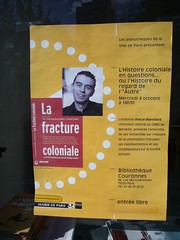
Yesterday brought me no less than two très belles coïncidences. First – as I told yesterday – the issue of Le Monde I got on the Air France flight had assigned a whole page to my research object, the very reason for which I was coming down to France again this week; the French slam scene. (Today it’s Libération’s turn). The second coincidence was almost as belle; as I strolled around in my beloved Belleville/Ménilmontant neighbourhood I spotted a poster in a window announcing that the historian Pascal Blanchard, coeditor of La fracture coloniale, was having at talk at the local library 2 hours later. La fracture coloniale was in fact the very book I decided at the last moment not to bring with me here, as I would have little time for reading, – but which I’ll have to read as soon as I get back, since I’m writing an essay on the current struggle over history going on here.
[teaserbreak]

So, before I took the metro down to The Seine and the junk (i.e. boat), La Guinguette Pirate, for the weekly Wednesday slam session there, I went over to Bibliothèque Couronnes to listen to Blanchard. It was in fact the fourth time in 12 months that I heard him. It was however the first time that he came to a community library right in the neighbourhood where I carry out my fieldwork.

(At La Guinguette, by the way, one of the slammers managed to convince me that the Le Monde article I just had thought was quite well, was quite bad. “It just tells the same old story, and doesn’t even mention all the regular soirées going on, just the star appearance this week. It’s hardly based on any research other than reading the Internet. Your study, on the other hand…” It indeed pleased me to hear that my research is taken seriously, especially since my French obviously not yet is up to the whole complexity of the slam performance repertoire…)

Yesterday was thus packed with significant happenings, and it reminded me of how overwhelming this field often felt when I stayed here last time. In the local neighbourhood, the news, politics on all levels, and in the arts world: everywhere in France these days issues of the colonial past and the cosmopolitan (or lack of cosmopolitan) present are discussed, fought over, – and lived out.

When I come back for my last 8 months of fieldwork from December onwards, I think I have to shield myself from all this noise constantly diverting my attention, and keep the focus narrowly on my specific topic of research. It suits me well that the main topic – the (Parisian) slam poetry scene – almost exclusively is situated in popular neighbourhoods in the vicinity of my favourite boulevard where I’ve spent quite a lot of time studying the social geography, as well as out in two popular suburbs. (Then I can even do a tiny little bit of research in the infamous les banlieues, the gate-keeping concept (à la Arjun Appadurai) par excellence for this kind of research in France…).

Yesterday brought me no less than two très belles coïncidences. First – as I told yesterday – the issue of Le Monde I got on the Air France flight had assigned a whole page to my research object, the very…

Read more

Some French slam poetry web sites

Oh, no not one of those days… Here I sit, it’s Friday evening, people I know get together to drink beer not far from here right at this moment, I could be there, or I could go to see Resistance(s), a screening of short films from North Africa and the Middle East at the Cinemathèque, but no, what am I doing, yes, I sit at my office, looking out of the window at the excellent weather… – well, now the full moon is up… – doing some kind of silly quasi-academic work… And it will take me ages to get all these links right…

Time is overripe for finding out more about slam poetry, the phenomenon by way of which I’ll try to understand and describe La France Métissée. I bumped into the Parisian slam scene with almost no prior knowledge, and for two months I hung around at various slam soirées in eastern Paris and her hot suburbs, just experiencing what was going on.
[teaserbreak]
As I’ve returned to university office life for a couple of months, hoping to start turning my field experiences into science, it’s high time I start finding out what this poetry scene is about. Tuesday I’ll present my fieldwork for my colleagues in the anthropology department, and in addition to telling them what I have experienced, I thought I’d better explain them a little what slam is about as well. I’ve not found much printed literature on the subject, but Internet is of course full of information, as is fitting for this so-called post-modern literary phenomenon. (I’ll return to what’s post-modern about it, as soon as I get a clue). In fact, when I started searching for information on slammeurs and slammeuses today, I discovered the Internet social networking phenomenon MySpace, of which Wikipedia has this to say:

MySpace is also home to various independent musicians, independent filmmakers, and up and coming comedians who upload songs, short films, and other work directly onto their profile. These songs and films can also be embedded in other profiles, an interconnectedness which adds to MySpace’s appeal for musicians, filmmakers, and comedians alike.

Hence, obviously a perfect post-modern place for post-modern poetry…

From the languages presenting articles on slam poetry on the online encyclopaedia wikipedia, I understand that the genre is most vibrant in the USA, where it was created, and in Sweden, Germany and France where it was initiated in the mid- to late 1990s. (In Norway slam exist, but it’s not very big – however as a form of spoken word tradition it has existed in various shapes since time immemorial, at least since the Viking skald or bard. Apropos that époque, slam is apparently also an old Norse word, meaning hitting hard, like in slam the door (slamre med døren, in contemporary Norwegian).

Now to the websites I’ve come across on French slam poetry – only in French, unfortunately… (when I get hold of my usually so present Webmaster, I’ll include some of them in a blog roll):

Grand corps malade made it to the bestseller lists with his album released this spring, thus making slam poetry known to a large public. He has even got an entry on French wikipedia. I strongly recommend his poem on his native banlieue nord, Saint-Denis (sound) and Enfant de la ville(text).

The collective 129H Production (with a new and an older website, apparently with the same content): “Supportive structure for artistic production in France and West Africa”. Hear some of their texts on their sites on myspace.com: Néobled (listen, blog with agenda, bio etc, Rouda (listen to a text on slam sauvage, blog with agenda, bio etc) and Lyor (listen, blog with agenda, bio etc). (The three of them also have blogs on the website Haut et fort, but my iBook refuses to link to them for some reason…)

Le meilleur ami des mots (Myspace with Qui est le meilleur ami des mots ?, France Fiction or two other texts): Souleymane Diamanka (listen) and John Banzai (listen).

Some general information pages on the French slam scene: Planète Slam (a very instructive site if one gets past the initial annoying pop-up ads… ;) ), Fédération français de slam poésie and Keep it green. UPDATE: Le-slam.org Universlam
And some more sites on Myspace with soundtracks, videos, bios etc: Rahman, site de l’homme-soleil, Rahman on My Space, Le Robert on Myspace (Le petit prince listen and read the poem), Rara Fonpanié on Myspace

And finally, I found a site on My space with the usAmerican slammer, Soul Williams – for those who don’t understand French ☺

(I’ve probably overlooked loads of important sites, and then there is one more question; where are the ladies?!)

Afterword: I’ll probably very soon have to make a revised version of this post, as I get to know the slam scene at the web, until then I just have to mention that I’ve found at least some of the slammeuses – on Slam ô feminin, of course…

Oh, no not one of those days… Here I sit, it’s Friday evening, people I know get together to drink beer not far from here right at this moment, I could be there, or I could go to see Resistance(s),…

Read more