search expand

– my research project so far (part 2): Parisian slam poetry vs British Asian ethnogenesis

In the second part of my presentation, I moved on to the particular field where I hung around and conducted anthropological fieldwork proper; thus participated as I observed or vice versa. As some will already know, that field is a slam poetry scene in Paris. I’ve written about it here already, and I’ll surely return to it, so I’ve not found it worth translating that part of my presentation here. Instead, I’ll reflect a little around the comparison I’m intending to make between the slam poetry phenomenon in Paris and the cultural expressions which constituted a core element in my study in London. In the third and final part of this post, I’ll try to recall the questions I got after my presentation.
[teaserbreak]
In my MA/MPhil thesis I looked at the creation (i.e. the ethnogenesis) of a home-grown British Asian identity – thus a new way of being British –, where cultural expressions, particularly music, with influences from south Asia played an important part. Without cutting corners in my future analysis, these two artistic phenomena – the wave of British Asian music, London 1999, and the slam poetry scene, Paris 2006 – show interesting similarities and differences.

In both phenomena, people create a space where they can express themselves. I’d say that it can be described as a, more or less, free space, and it reminds me of my favourite (anarcho-)philosophical quote:

Maybe the target nowadays is not to discover who we are, but to refuse what we are. We have to imagine and to build up what we could be to get rid of this kind of political “double bind,” which is the simultaneous individualization and totalization of modern power structures. The conclusion would be that the political, ethical, social, philosophical problem of our days is not to try to liberate the individual form the state, and from the state’s institutions, but to liberate us both from the state and from the type of individualization which is linked to the state. We have to promote new forms of subjectivity through the refusal of this kind of individuality which has been imposed on us for several centuries (Foucault 1982, “The subject and power”).

I’ve already sketched the outline of an analysis of to what degree some British Asian cosmopolitans in my study, represented attempts at such new forms of subjectivities. I think Foucault’s perspective can be a constructive approach to my Parisian field as well.

Another similarity between the two phenomena is that they were in vogue (when I did my research), seemingly just about to reach the top before they get commercialised, get too big and turn stale, with too many jump the bandwagon… The knowledge of how trends, commercial forces and bourgeoisation work probably worry participants in all such artistic waves.

On the other hand, the differences are also interesting: The slam poetry scene in Paris seems to have little to do with identity politics, and its cosmopolitan and heterogeneous (thus non ethnic/communitarian) nature is striking. All this, I find characteristic of the French society, and in contrast to the British.

I know this overview of the two fields is extremely sketchy, but this theme is not at all what I will be working on at the moment. The point has just been to justify my choice of the slam scene as suitable for a comparison with my London ethnography.

In the second part of my presentation, I moved on to the particular field where I hung around and conducted anthropological fieldwork proper; thus participated as I observed or vice versa. As some will already know, that field is a…

Read more

Back home part 2 – presenting my project so far (part 1)

Each time I tell about my fieldwork, I end up saying different things to different people, and usually I feel that it turns out quite messy, whatever I say. That was certainly the case when I tried to sum up the main points to my supervisor. So before my first seminar presentation (in front of a small multidisciplinary audience), the time had come to structure all I had experienced neatly into a comprehensible – and hopefully quite comprehensive – format.

My presentation was almost purely empirical, as I’ve not been reading much else than newspapers the last 9 months. The structuring principle I chose was to first give a socio-political overview of the bigger social events that took place during my fieldwork (October 05 to July 06), before I shifted to a more concrete micro focus on what and whom I’ll focus my research on (due to a need to anonymize at the web, I’ll be a little less concrete in this English version). I see the major socio-political events as forming a backdrop to my ethnographic micro focus, which – I hope – in turn can contribute to the understanding of these larger events. The first part of this post gives an English version of the first, events focuses, part of my presentation. The next part moves on to the micro focus, with a few words on my intended comparison with London as well as an attempt to sum up some of the comments I got after my presentation.

This is roughly what I said:
[teaserbreak]
I have not changed the fundamental focus of my project, thus I still focus on societal integration in two postcolonial European metropolises, particularly aspects of identity (formation) and belonging. However, my narrow focus on the so-called second generation (of one ethnic category; British Asians) in London, seemed – as predicted – of little relevance in Paris. [And coming to think of it, neither “identity” nor “belonging” is of that much importance to me anymore… We’ll see now, after summing up, if not “Communities in the making: Space, time and revolt” isn’t after all a more fitting title.]

During my 9-10 months of fieldwork, several large political events with huge relevance for my project took place. In the end of October, three weeks of rioting – car burning (which French youth are particularly keen on doing on a regular basis) and burning of schools and the like took place in deprived suburbs characterised by high unemployment and a large proportion of habitants of non-European decent.

In the spring, we had several weeks of massive protests against the new labour law, which had the intention of liberalising and increasing the flexibility of the labour market, but were seen as creating more insecurity (insécurité).

In addition, I would like to mention the abrogation, by President Chirac, of the less than a year old law paragraph saying that schools should teach the positive effects of colonisation. Until it’s abrogation, the paragraph and the protests it caused, never ceased to make it to the headlines. For instance, scheduled protests by the Martiniquais, including the poet Aimé Césaire, made Interior Minister Sarkozy to cancel his trip to the (French!) island.

The first day in commemoration of slavery (as a crime against humanity) took place the 10th of May. I had been looking forward to the day, anticipating it as a key event in my fieldwork. It was perhaps due to my great expectations that the day – for me – turned out to be almost a non-event.

The latter two events – the controversial paragraph about the teaching of history and the commemoration of slavery – give evidence to how important the struggle around the definition of (the correct and official version of) history is in France. I read into these events, as well as the last one I’ll mention – the active mobilisation against the new immigration law –, an increased demand for recognition of the transnational foundation of the French nation. [If this appears opaque at the moment, I’ll probably return to it in later posts, as I’m planning to work on what I’ll claim is a transnational appropriation of time and space this autumn…].

(Contrary to what was the case in the UK – and Norway! – the caricature affaire was no big event in France.)

I was struck by the constant focus on crisis and the feeling of anger and frustration present in the French society. The feeling of economic insecurity was present to a completely different degree there than what I was used to from Norway. In the beginning, the protests against the liberalisation of working conditions, seemed of little importance to my research (despite the fact that the law was part of Prime Minister de Villepin’s project on “égalité de chances”). However, as the protests gained ground, they pointed me in directions of important aspects of French social and political life:

*) Mobilising and protest: the belief that it’s possible, worthwhile and even correct and a good thing for proper citoyens to protest (i.e. it had already worked against the paragraph on colonialism).

*) Revolutions and riots as central aspects of the French national narrative, which is echoed on various levels in society, from the enthusiasm with which the pedestrians cross the street on red light – often dragging their children along, to the widespread (acceptance of) civil disobedience when “godfathering” and hiding sans-papiers children who are threatened by expulsion. For instance, many parents, teachers and other middle-aged people described the (sometimes quite violent) protests in the spring as a learning experience of democracy for the young. Apropos the riots in the banlieues: many commentators saw – utterly seriously, which surprised me – the riots as a positive sign: they riot against injustice, donc they are very French indeed!

*) Explicit and active scepticism against “(economic) liberalism”, partly as a so-called “Anglo-Saxon” phenomenon. (I.e. also “the republican model of integration” is also seen in contrast to the “Anglo-Saxon” multiculturalisms.

The two waves of protest and riot were easily interpreted within ideological discourses – not only by social scientists, but also not least in the public discourse. Both the two large events were frequently lifted up to a higher politico-philosophical level: For instance, one could readily hear that the riots in the banlieues were a proof that the French model of integration was destitute and France needed to turn in more in direction of multiculturalism. Equally, instead of the typically (so it went) French line of confrontation in politics – resulting with 1-3 millions in the streets against the CPE/first employment contract – needed to learn more from the “Scandinavian line of consensus”.

I find it interesting – particularly to my British/French comparison – that an excellent newspaper like the Guardian in my opinion not wholly grasps some particularities of French society in this respect. They wondered about the fact that 70% of French youth wished for something as boring and safe as a position as a public servant, and interpreted the protests as conserving and backward looking. My point is not whether their interpretation is right or not, but I find it quite ethnocentric and in lack of a native French point of view. (But that’s what we have anthropologists for ☺ )

My analysis is still at an embryonic or even less developed state, but it seems to me that these differing interpretations indicate a different relationship to the state, thus different state traditions, amongst British and French youth. I also have suspicion that one might read into the attitudes differences in visions of what constitutes a good life: perhaps in terms of more focus on career versus leisure, on consumption versus other forms of expressivity…. Well, probably I’m idealising the French context…

I hope to get a better grasp of these larger socio-political issues by looking at them though an ethnographic micro focus. However, it took me many months of fieldwork before I found such an ethnographic focus where I would be able to grasp what I saw as significant in the present situation. I went to loads of meetings and various gatherings and hung around in various places, but I found neither a suitable environment nor a suitable focus – until two months before I left the field.

I know this post can do with some links, but I’ll have to leave that for later… sorry

Each time I tell about my fieldwork, I end up saying different things to different people, and usually I feel that it turns out quite messy, whatever I say. That was certainly the case when I tried to sum up…

Read more

Boulevard phenomenology


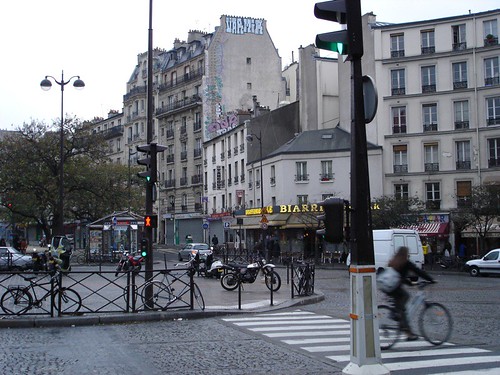
Place de Ménilmontant in the autumn (with bikes and cyclists…)

It’s been ages since I’ve been walking down the boulevard, but today I was doing it again. My bike has been stolen! And it was stolen from one of my favourite places, Place de Ménilmontant. Well, such things happen, and anyway it was a too small, but it feels strange that it should happen less than 48 hours before my departure. It’s the third (attempted) crime that happens to me after I came here. First I was robbed for my deposit (1300€!) for a flat that was way too expensive in the first place, then a kid tried to nick my camera during an anti-CPE demonstration (we both looked the same surprised – me because why would someone nick a fellow demonstrator’s camera, him because the camera was attached with a string around my neck so he didn’t get it…) and now my funny little green bike…
[teaserbreak]
Cherry blossoms at Place de Ménilmontant in the spring

Walking down the boulevard again made me think a lot of things. I thought about the very first time I walked that part of it, mid November eight and a half months ago. I was going from my previous flat in bobo (i.e. quite gentrified/emborgeoisé) Ménilmontant to Charonne, which is neither gentrified, neither nothing else – just okey, quite boring. After I’ve left the familiar area around Place de Ménilmontant which is not yet gentrified, but just full of cafés anyway, I passed the main entrance to the cemetery Père Lachaise at the time of the soup kitchen. The queues for free food are divided by gender, which surprised me at the time. Now I’ve passed the soupe populaire outside the Père Lachaise so many times that to not have to pay special attention to the people sitting in the bicycle lane around dinner-time around 20H would have been more surprising than to actually see them there.

Rue de Ménilmontant, in direction of Place de Ménilmontant, with Centre Pompidou in the background

There are some quite deserted areas after Père Lachaise and down to my present flat. I rarely had to pass areas like that where I lived before, so I remembered it made me a bit anxious that first evening mid November, even though the time was hardly more than 8 o’clock in the evening. I remember the anxiety, and it’s funny to think about it now. Now everything is familiar, and it takes more than an empty stretch of the boulevard to make me uneasy. – Just now, on that stretch I passed a blonde and large threesome German family, sweaty and bewildered looking at a map, towards whom I acted Parisian and local and asked if I could help them. They looked for the night bus, and I told them the way – 5 minutes from where we were. I saw a friend off on that bus less than a week ago. How different everything feels now, after some months. – I remember the first time we (my travel company and I) were at Place the Ménilmontant. We felt to be so far east that we hardly imagined that we would dare to go further… And I remember the first time we actually dared to go further east, up the Rue de Ménilmontant, and how I, after a while, should start to say hello to the local Asiatic greengroser there, and how I should see the graffiti change and how I even, at the end, should start to know people in some of the local cafés in nearby Rue des Panoyaux

It’s amazing how quickly we get used to places and how the perception of these places changes completely as we get to know them. One of my – far to many, far to ambitious – plans for the autumn is to write an academic article based on Alfred Schutz’ The Stranger (on how the stranger slowly makes him- or herself at home in a new environment), and Tim Ingold’s notion of dwelling, (on how people, when making themselves at home in that environment also changes that environment a bit). For in a not very long while, I’ll not wander around getting to feel at home in Parisian boulevards, I’ll sit at my office making anthropology of my ethnographic field notes… (And people will not be able to make fun of me saying are you awake now when I send them an e-mail or sms at 10:30 in the morning – but anyway, I’ll still be able to make fun of them for knowing the Parisian streets better than the Parisians themselves ☺ )

Me when I still had my funny little green bike (photo from Pharo in Marseille)

This is not the last post you’ll read about this favourite boulevard of mine, stretching almost all the way through eastern Paris, from Place de la Nation up to Place de Stalingrad and Bassin de la Villette. I hope to soon write a comparison between this Haussmanian grandiose, three-linen and very French boulevard with the cheapest road on the English monopoly board – the hideously gorgeous Old Kent Road, and perhaps my local Oslo street Trondheimsveien. All lively, cosmopolitan east end streets I’ve had the pleasure to live next to for a while in my life.

Place de Ménilmontant in the autumn (with bikes and cyclists...)

It’s been ages since I’ve been walking down the boulevard, but today I was doing it again. My bike has been stolen! And it was stolen from one of my favourite…

Read more

My blog, my project and I, part 3 – I and Politics

Another warm night, and it seems like insomnia strikes again despite however little storm and poèsie infused sleep I had last night. I’ve been too snotty to go to the jazz concert in Parc Floral and hang around somewhere in East Paris until the early hours, as would have been suitable for this hot Saturday. And I regret it a lot, especially since it’s my second last weekend here (and only three more jazz concerts to go, amongst all the other things I’ll be missing…). Instead I make use of my sleeplessness to finish a blog post I’ve been planning for months.
[teaserbreak]
As my fieldwork is soon coming to an end, it’s time to take a step back and look at what I’ve been doing here, and why I’ve been doing these things and not others. It’s been a lot of politics, in my blog as well as in my experiences here.

As I’ve mentioned before, my initial intention to study peaceful and harmonious cosmopolitanism as it is played out in people’s everyday life, quickly faded into the background since I had been fortunate to step right into the largest revolts and demonstrations in the time of the Fifth Republic (1958-). (And probably, simple harmony sans rebellion would have made a poor representation of French society, anyway. Apropos, the almost free jazz concerts in Parc Floral constitute exactly such a harmonious cosmopolitan space. There is every colour on the planet present, and the number of mixed couples, babies and circles of friends equals Marseille ☺. The styles of dress vary from the banlieusard’s trainers, tracksuit bottoms and t-shirt to chic west end babes with sunglasses and expensive skirt and top, via almost everything else. And, as I’ve noticed to my delight at an east Paris hub like Place de Ménilmontant as well, all colours/ethnic backgrounds are represented – though not equally numerous – in all styles and functions. Thus, no multiculturalist neat little boxes to put the people inside. Though, I should add that this mix might have decreased with the summer reaching its zenith, as more and more Parisians are leaving for vacation and being replaced by more and more groups of tourists and foreign western students).

Besides, as more than one post on this blog have tried to show, it doesn’t take long to start sensing the reasons behind people’s frustration and anger. Policing and security is one such issue. After a quiet week in Corsica, it took one night out in Marseille for my Norwegian company not yet accustomed to the present government’s “securitarian” measures to get a feel of this situation. We watched the world cup football semi-final Portugal-France in the Vieux Port. After the match we stuck around for a while with a few thousand others, sharing our last can of beer while watching the celebrations. Teenagers on scooters drove around in corteges waving flags and hooting. Kids were running around while their parents were chatting. – I saw a brother yelling at his little sister for walking around alone shooting pictures of the crowd with the family’s digital camera, while their mother just laughed at it. There were firecrackers and drums, and a little (very little compared to where I come from) drinking and a little (much more than where I come from) cannabis smoking. A group of thirty-something were just about to light their joint next to us, and I was just about to say to my company that sooner or later someone will throw something in the direction of the Robocop-looking CRS police who are never far away on such occasions, who will in turn start charging, which again will provoke more projectiles from the crowd… when a group of CRS suddenly ran up right behind us with all their riot gear. So less than 45 minutes after France had beat Portugal, the CRS found it opportune to start clearing the Vieux Port. There were still children there, I even saw a father carrying his 3 months old baby away from the tear gas… A large section of the crowd had involuntarily been trapped on the opposite side of the port of their way home, but I also think some families with older children stuck around for their kids to see what France is like these days. My company, who had not yet become used to see the police in action on almost every night out, was surprised and a little bit upset and angry: It was utterly incomprehensible to us why we couldn’t go on with our little celebratory street party a little longer…

So, all this writing on politics of resistance has come naturally, from the circumstances. In addition, of course, it’s due to my own social and political concerns and interests. It’s not the first time I become politicised when I leave the peripheral Norway and go to Europe. (This has got more to do with Norway than with Britain and France, “remember, it’s Norway that is exotic,” my old French teacher used to say when we were surprised by some strange ways of the French). It happened on my previous fieldwork as well, in London in 1999, although then overt politics didn’t make its way into my final texts the same way as it undoubtedly will this time.

My fieldwork (amongst British Asians) and my life in our communal house was so far apart when it came to political activism, that on a demonstration where I went with one of my flatmates (a British Pakistani), he was so excited about seeing one other South Asian looking guy there, that he wanted to go straight over to him and try to get him to be my informant. This was on the great Carnival against capitalism, at the day of the G8 meeting on June 18, 1999, which together with the Seattle meeting in November the same year, marked the beginning of a new era of anti-capitalist and anti-(economic) globalisation protest. It was inspired by the anarchic street party approach of the Reclaim the streets anti-capitalist, anti-corporation, anti-car phenomenon in Britain from the mid 1990s, and it was to become increasingly transnationalised, – epitomised by the slogan “Our Resistance is as Transnational as Capital”. For me, the experience of spending a whole day in the enjoyable, but conscious, atmosphere at this do-it-yourself street party right between the corporate giants in City, woke up my old anarchist political consciousness that had been slumbering ever since my teenage years of naïve reveries had ended. After that moment, I understood perfectly well Durkheim’s analysis of how participating in rituals make individuals feel that they are part of something bigger, which can give them a certain sense of meaning in their lives.

In London, I met loads of people who believed it was worthwhile making the world – as well as the local community – a better place to live. In my ears, it sounded like people were discussing things that mattered, things worth living and fighting for – and they often tried to live accordingly, not just exist to consume… Well, what happened when I got back to Norway after my previous fieldwork? We all seem so bourgeois there, caught in our narrow, bourgeois lives, – to put it with an everyday French term. But perhaps it’s just got to be like that, in a society without foreign debt, where the buying power is just rising and rising and where we seem to be so comfortably far away from the misery of the world.

Here, the world is on our doorsteps – if not in our own house: the misery of it as well as its diversity, its resistance, its hopes… The cosmopolitanism, the transnational connections, the creativity, the political consciousness, the sociability, the poetics – all this constitute for me sensations, emotions, atmospheres and everyday routines – as I wrote in this blog some days ago – which I’ll miss immensely when I leave. Because I know, as I also wrote, that it takes no time at all for this state of mind to be replaced, as soon as I step back into my Oslo way of life, to such an extent that my Paris experience – as with London some years ago – appears as a parallel but distinctly separate universe.

Another warm night, and it seems like insomnia strikes again despite however little storm and poèsie infused sleep I had last night. I’ve been too snotty to go to the jazz concert in Parc Floral and hang around somewhere in…

Read more

Slam poetry


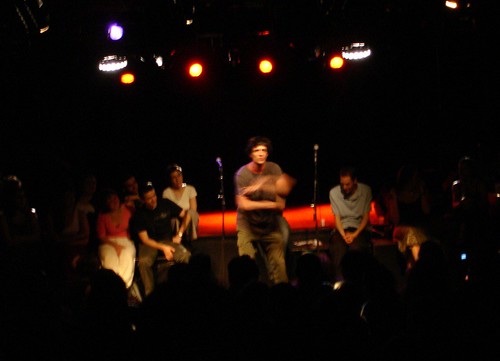
Slam ‘aleikum – slam poetry soirée in Saint Denis (93)

I realised last night – dozing uncomfortably under rather dramatic circumstances, in the midst of a thunderstorm lightening the sky and with the wind making slamming windows and shutters throughout the street, and not to mention the pool of sweat from the perpetual heat wave as well as my untimely cold – that it’s about high time I write about what I’m actually doing here.
[teaserbreak]
At the end of the slam poetry soirée I had just attended, one of the slameurs – in one of his usual, but extraordinarily forceful performances – had ran onto the chairs among the audience and screamed the end of his poem standing on his knees on two chairs right in front of me. I can’t say for certain that I understood exactly what his text was about, I must to admit (I was outside when he started, and due to the seemingly explicit content I’d like to be sure before I go into it. My illness made me a rather bad researcher as well as bad company yesterday….). Images from his performance, the incredible heat in the small exhibition locale, the animated audience and many of the others – slammers, poets, story-tellers, toasters, mc’s, rappers – made its way into my imagination last night and disturbed my sleep in an unpleasant, but not uninteresting way.

I find the slam poetry scene in Paris rather extraordinary. The mix of people – from school children to pensioners, with a peak around the age of 30 I’d guess, women and men, and all colours and with seemingly no social or class bias – is amazing, so is the variety and authenticity in many of the texts and performances. People slam about personal or everyday experiences, issues of identity, history, love and sex… I’m so optimistic about my research project after I discovered this looking-glass by which I hope to better understand as well as describe some important aspects of French society. As I’ve found my research focus, the biggest challenge now is to understand the depth and nuances of what these slameuses et slameurs are saying, – as their rhymes and rhythms, poetics, imageries, slang and verlan not exactly make French more accessible for a foreigner. Having said that, it’s hard to find a scene more inspiring for expanding my understanding of the language of Baudelaire… (And as passionate I am about literature as well as social issues, I’m also a rather classically trained anthropologist, so it pleases me to do research on such a human universal phenomenon as spoken word performances.)

Cycling home in the night, I cursed my poor state of health and wondered what could have happened if I had hung around outside the locale a little longer as people stood chatting or if I had joined the group who went down to Canal Saint Martin to do a slam sauvage there. (I just got two enthusiastic, though apparently tired, text messages from one who had been by the canal: “Quelle nuit,”…). I think these regrets, as well as the anxiety about the project and sadness for having to leave just now when things are so great, contributed to my stormy sleep.

I’ll probably provide some links and stuff for the slam poetry scene later, but for the moment I’m not yet sure how I’ll go about the important issue of anonymity if this is really what my Ph.D. project will focus on.

I’m hesitating before writing the final paragraph. In several posts earlier in this blog, I’ve made reference to the skin colour of the people present. I’ll to that now as well, but with a reluctance which I’ll explore somewhere else: The group going down to the canal consisted of eight people with the following traits: black, Chinese, North African (the only girl except from me), one seemingly white (10-22 years older than the rest of us) and one seemingly Latin American and three European/whites (East, half Balkan and North (me)). The ethnic mix among the ones hanging around after closing time was about as diverse.

Slam 'aleikum - slam poetry soirée in Saint Denis (93)

I realised last night – dozing uncomfortably under rather dramatic circumstances, in the midst of a thunderstorm lightening the sky and with the wind making slamming windows and shutters throughout the…

Read more