search expand

14th of July


[teaserbreak]
Someone asked me if I wasn’t going to write a post on the 14th of July, He had read somewhere that there use to be a military parade in Paris that day, but on my blog he only saw some funny photos that didn’t really looked like a military parade, so he didn’t really understand what was going on…

Yes, there is a military parade at Champs Elysées in the morning at 14th of July – I could hear the fighter jets all the way into my sleep on the other side of town. Due to lack of personal – as well as professional interest – in military parades, I chose not to go, but I saw a little of it at the news before I headed off to another parade. During the months I’ve been here – thus after the November riots – French media has finally decided to make a little effort in showing that non-whites can do other things than play football or make rap music, so quite a few of those interviewed as either participating in the parade or as audience, were black or of north African origin. That was quite interesting to observe, but as an angry young (and white) man I know says, while getting a little bit angry: yes, they have started showing blacks and Arabs on tv the last months, but it’s just normal that they represent the diversity in the country! (I can understand why he is upset, particularly if one looks at all the fuss there has been about a new news presenter on the biggest channel, because of his black skin colour.)

Neither did I go and look at the fireworks in the evening the 14th, nor did I go to one of the traditional fire brigade balls which take place all over the city the night before. The latter I think could have been very anthropologically interesting, but I was in stead at a slam/spoken word session and afterwards I was hanging around outside until the early hours, seeing the city go to sleep as well as waking up. At the slam soirée, they took very little notice of that fact that it was the night before Bastille Day, instead they celebrated that it was their own third anniversary and gave away a piece of cake to every performing poet.

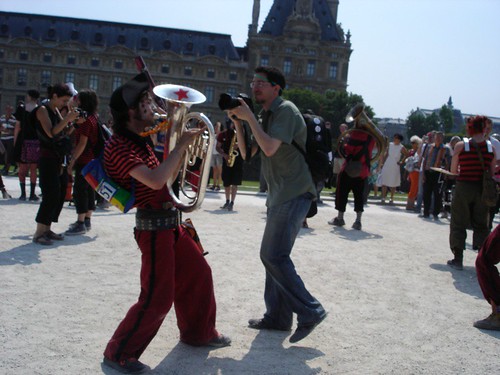
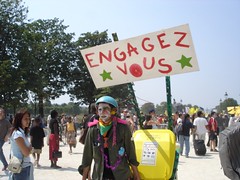
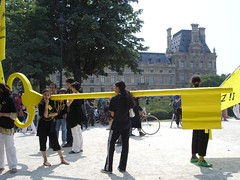
So, after sleeping soundly through the exhibits of France’s military splendour, I went to a quite different and very nice activist event nearby Louvre, with the revolutionary motto “France is like a baby, if you love it change it!”, where various anti-elites were gathered. It was various groups of sans papiers (Droits Devant! and Le 9ème Collectif des sans-papiers, a couple of groups for the right to proper housing (Comité des sans logis and Droit au logement bicycle activists (Véloroutions vélo means bike in French), other enviromentalists against nuclear power and France’s attept to export it’s old ship Clemenceau full of asbestos to India, AIDS north-south and gay-activists (Act-up), anti-militarists, and of course the Brigade activiste des clowns (BAC, which also connotes Brigade anti-criminalité), for the day I think renamed to Clown à Résponsabilité Sociale (CRS)(photo).

[teaserbreak]
Someone asked me if I wasn’t going to write a post on the 14th of July, He had read somewhere that there use to be a military parade in Paris that day, but on my blog he only saw some…

Read more

Seasonal sensations

The summer heat has come to Paris. For some days no, it’s been so hot in the afternoon that the boulevards are almost empty. Only in the shade under the trees are there a few pedestrians strolling slowly. However the Jehovah’s Witness people with their Watchtower are as usual in place by the metro Père Lachaise: A black man and a blonde woman, both decently dressed – in shirt and trousers, blouse and skirt – as usual with these missionaries. Metro Père Lachaise is about as far as I get up the deserted boulevard. This is not the time to be outside. Only some sweaty tourists defy the climatic condition and walk in the sun. I return home, and wait a couple of hours in front of my laptop, with all the windows wide open, mixing the music from my trashy little ghetto blaster with voices and other people’s music in the courtyard. (All these open windows facing the yard are great now during the Championship; the neighbourhood is reverberating when the right team scores – which unfortunately for the moment is not France…).
[teaserbreak]
But in the evening, the streets and parks and public spaces buzz with life. It was such a pleasure cycling through the city last evening, that I just kept on lazily watching the people drinking beer and wine along the canal, a whiff of cannabis coming my way once in a while, children of all colours were playing in the playgrounds, watched by chatting parents equally of all colours and in the costumes of the world (though the West African women are definitely the best at keeping up their proud dress traditions, with their brightly coloured and neatly cut dresses, and perhaps a intricately tied headscarf in the same fabric and maybe a child at the back – by the way, many here, mostly women but also men, have taken up this tradition of tying their child to the back or front without more equipment than a large scarf. When I see someone with a complicated baby carrying-equipment, I always suppose it’s a tourist). In Parc de la Villette, I can hear drums, someone is playing football, people are training, some men are showing off, but most are just lazily hanging around. It’s in the middle of the week, but it feels like the end of it… As I write now, I realise that the ever-present summer-in-the-park odour in Norway, is absent here. By googling barbecue jetable I get confirmed my suspicion that this is a very Norwegian phenomenon, indeed. One of the first hits on “barbecue jetable” was a blog by a French in Norway: “My Norwegian Wood”.

About two months ago, late April, I had another strong sensation that the season was about to change. It was Friday and afternoon, and standing on the crossroad of the boulevard up the street here, in the sun and busy monde, I suddenly felt like coming out into the world after a long hibernation. I don’t know exactly what gave me that feeling; the unfamiliar heat of the afternoon sun, the expressions in people’s faces and in their movements – a regained enthusiasm, energy, excitement, I don’t know – or just the atmosphere of the street-life… or perhaps even all the sirens? As it was in the middle of the anti-CPE mobilisations, the sirens that afternoon caught my attention. In a few hours, Chirac was going to make his long anticipated speech where he possibly would abrogate the CPE… The sensation that something was about to happen increased as all the passengers were thrown off the bus at Bastille because there was supposed to be a demo somewhere around. (Most passengers don’t seem to be very surprised by such changing bus itineraries, as a demonstration now and then is quite an ordinary happening).

The sound of sirens continued at Bastille. As I had an hour or two before I was supposed to be on a conference on France and slavery at Centre Pompidou, I walked around for a while around La Sorbonne and the Latin Quarter, trying to get at the heart of all this spring-like police activity. However, it just seemed to be everywhere so I gave up and went to the conference. (It was interesting, despite that Edouard Glissant didn’t show up in person).

When I got out on the street again I understood that something had happened, but unfortunately I didn’t find out what exactly it was before the day after when I read euphoric reports on Paris.Indymedia. After Chirac had said very little indeed in his speech, a so-called manif sauvage had set off from Bastille (where the speech had been broadcasted on a screen). All anthropologists who has read Levi-Strauss, La pensée sauvage (The savage mind, Den ville tanke), are familiar with the concept sauvage (it’s neither the equivalent of English “savage” nor “primitive, nor the Norwegian “vill”, I don’t know how to translate it), thus they would understand that a manif sauvage ought to be pretty cool. The un-cultivated demo had moved from Bastille, to the Presidential Palace where they got dispersed by the police, in order to meet again in front of La Sorbonne, and finally cross the whole city up to Sacre Coeur… thus crossing the city from east to west, and from south to north, and finishing in the early hours. It seemed to have been a little bit for everybody; a good street-party, a little fighting with the police, and a little wreckage of an office belonging to a depute from the ruling party. Thus, a real Parisian spring experience ;)

However, I shouldn’t perhaps joke too much about the recurrent sound of sirens. I’ve never seen so much police in my life before, as in the last 6 months. I even wonder if the reason for the town-hall to not put up the usual giant screen for the World Cup has anything to do with fear of public law and order… I watched almost every match in front of the town-hall here four years ago and it was so very, very nice that I just cannot understand why they’re not doing the same thing this year. (Another less romantic reason might be that the French team doesn’t really deserve a giant screen this year, as they’re really playing le foot de spleen as a Norwegian friend and Baudelaire fan suggested).

It’s amazing how much street-life here has changed with the season. I’ve always thought that there can’t be any place on earth where the seasons change more than in Norway. After endless months with ice, snow, sleet, darkness and the question why on earth have the human kind settled on this god-deserted place nagging my mind, spring in Norway just comes as a divine revelation (almost) every year. It’s a really strong experience, and of course the habitants change with it. So it came as a surprise to me that Parisians change perhaps even more. They speak even more to each other in public spaces.

– I’m starting to realise that Norwegians tend to smile to each other in situations where Parisians rather would express themselves with words. The smile is not a valid form of communication among strangers in public spaces. Only suggesting the shadow of a smile to any male above the age of, I don’t know… somewhere before adolescence I guess, is sheer country bumpkin stupidity. However, neither women seem to understand exactly how to respond if I try a little Norwegian smile in order to say, for instance, “sorry for being in the way” or any other fleeting bit of communication. When I think of it, it’s obvious; why not use words when you can? Because that’s exactly the point; a smile among strangers here occurs only when it’s impossible to speak: Amongst other occasions, I’ve got smiles from a man inside a car trying to get out of my bike’s way, a teacher whose pupils stared at my little bike with awe, and who understood it was my bike but was too far away to say something to me, and from a surprisingly large number of CRS and other police at the end of demos who noticed that I was looking at them. Well, that was today’s digression, on the incomprehension of the Scandinavian smile. –

The final and probably most important seasonal change is, again, the intensification of la drague (“picking up someone…”). It should be said that Parisians don’t only find their future partners in the streets, but they find friends there as well. I suspect that this sounds completely natural to people around the world – and Brazilians for instance, or French from the province, tend to find Parisians cold, inward-looking and non-communicative – however, for a Norwegian, all this street interaction is not an everyday experience. Just after spring had set in for real, I noticed that quite a lot of the male Parisians seemed to be so moved by the seasonal change that they couldn’t avoid expressing it, and not at all necessarily in order to chat me up. For instance, the number of people who jokingly tried to hitchhike with my tiny little bike in one single springy day was quite surprising. (And apropos the meaning of smiles; at such occasions I think I communicated correctly by responding with a smile).

As I had a strong impression that people – or rather, men – were in a hurry to find une femme, it was quite funny to hear a friend mention how he observed people in a bar he passes every day: According to his perspective, it started with the women wearing lighter and lighter clothes, and then more and more couples were formed, and soon all the opportunities will be gone, so if you hadn’t found someone before the end of June, you’re in trouble…

Studying French masculinities wasn’t my intention at the outset, but I’m starting to find certain differences between how (certain) men behave here and how they behave in Norway (and Britain), striking enough to be worth a study. And, well… as I have an inquisitive nature, I guess it goes without saying that I don’t mind very much the prospect of finding out more about it :D

The summer heat has come to Paris. For some days no, it’s been so hot in the afternoon that the boulevards are almost empty. Only in the shade under the trees are there a few pedestrians strolling slowly. However the…

Read more

“Elle va se faire draguer”

Every blog post I’ve tried to write on gender strands for some reason or another before they reach the web. The following text was meant to be a simple and silly account of a quick bike trip around Belleville. However, when I let it rest for a moment in order to start sorting out the huge heap of paper – flyers, magazines, newspapers, brochures… -that was threatening to cover more and more of the surface space in my little office-cum-livingroom-cum-kitchen, I came a cross an old article about a café that I had just passed on my trip. This café reached the national media right after the Mohammad caricature affaire because they put up an exhibition with blasphemous caricatures right in the heart of Belleville. Well, the article in itself wasn’t enough to put me off track. It was rather it’s point of view, or framing, that threatened to put my experiences on my little trip in a new light. I started worrying that my silly little text had to become a bit more complicated.
[teaserbreak]
In one of my French classes in the autumn, my teacher made my research into a little subject of discussion. According to her, a fieldwork in Belleville would be difficult for me, as the local boys would “try to chat me up” (elle va se faire draguer). I’ve been reminded of her words recently, as the season of la drague obviously is well on its way.

The way men and women communicate or not communicate in public spaces in this city is a part of French society I can’t really get my grips on. People exchange glances, or look casually at each other or around themselves, far less in the street here than I’m used to. I think men as well as women feel that that they should keep their eyes to themselves – unless they have certain intentions, that is – but it seems obvious to me that men’s gaze is far freer than women’s.

When I cycled through Belleville the other day, I wasn’t more than giving a young boy a little resigned smile after he – who probably was almost half my age – had leaned out in the street in front of me and called me ma chérie, before he found it opportune to announced to the whole street that one est chaude!. In my hometown Oslo, this – which in my opinion can be categorised as light verbal sexual harassment – has happened to me only a couple of times. At one occasion, when I told the kids to have some respect, they quickly excused themselves. Here, I avoid all further exchanges. I don’t know if that is the best way, but as I said, I don’t understand this interaction. And at occasions when I have answered back, it usually comes to some kind of scene where the man for some reason feels obliged to display a lot of hurt feelings and start an argument.

In another French class we discussed these strange Latin gender relations in public spaces, and una bella Italiana said she appreciated attention in the street. I don’t know if the attention the two of us get is exactly the same, but I didn’t get much support in my class – which for the day consisted of various Latins – for the view that this is limiting women’s freedom.

The kid who called me chaude (“hot”) was probably of North-African origin (either Muslim or Jew, I don’t know – it was right in the Jewish Tunisian part of Belleville). A Danish woman (mid twenties) I discussed this with, said she mostly got attention from men of North-African origin. However, I must say that I’ve experienced approaches by French men of all colours and ages – from old men coming close and almost whispering bonjour (as if I was looking like a prostitute?! – a less “prostitute-like” desscode than mine is hard to find), to such kids – and it happens all over the city. My worst experience took place when I was 17, when two men literally tried to abduct me at Les Halles (they were white French, a point I remember because the police asked specifically about their skin colour).

And it was around here my post stranded some weeks ago. From this point I can wrap up with some more comments on French gender relations in public spaces, – or I can change the framing towards the question of class relations in Belleville, and ask, as they did on posters in a similar quarter in Marseille; à qui appartient la rue? (“to whom belongs the street?”)

I can’t tell how the guy’s sexualising insult should be interpreted. Certainly, it was not a good point of departure for really trying to me draguer. I guess he was probably acting cool in front of his mates. (But why is that a way to act cool, one can ask?) However, the article I found in Le Nouvel Observateur looked at the controversy around public spaces in Belleville in a class perspective.

There is a process of gentrification going on in Belleville and Ménilmontant, where the bourgeois-bohemians are moving into this working-class and cosmopolitan area. And just by Parc de Belleville, a new chic café had decided to make their own little caricature affaire, where they put up religious caricatures on their bright red walls, clearly visible for the passers-byes. (Part of) the local Muslim youth didn’t think that was such a good idea. And then there were discussions (à la français – i.e. loud arguments) and a little destruction, and some national media coverage.

This was certainly a negotiation of space going on, which I, when I read the article, felt was reverberating down to my own recent bike trip. Coincidentally, perhaps, I never experienced any similar incidents on my many trips around Belleville last autumn. Initially, I took all this male expressiveness to be signs of spring, (which seems to affect the locals stronger than elsewhere :D ), but as one of the opening lines in the article went: “the intellos come there with their bikes, while the roughs charge with their Vespas…” I suddenly felt part of a bigger scheme.

As I’ve decided to get this first text on gender relations out on the web now, I’ll not linger any further…

Every blog post I’ve tried to write on gender strands for some reason or another before they reach the web. The following text was meant to be a simple and silly account of a quick bike trip around Belleville. However,…

Read more

Space, time and revolt: – My blog, my project and I, part 2

The working title of my project has been Communities in the making: Identity and belonging in postcolonial Paris and London. Initially, the idea was to do a similar project to the one I had done for my master thesis. However, after I came to Paris I quickly learnt that the situation here is quite different from the one in London 6 years ago. The first thing I realised was that it was no wonder my first fieldwork went pretty well, but – hélas – I yet don’t see any reasons for this one to follow suit…
[teaserbreak]
In London 1999, I stumbled right upon the climax in the creation of a home-grown British Asian identity. And what chance, because that kind of identity politics was exactly what I had prepared for. Before I crossed the North Sea to arrive in London I had read Paul Gilroy’s brilliant There ain’t no black in the Union Jack almost to pieces, and what I found amongst the second generation British Asians was a situation quite similar to the one Gilroy described amongst black Britons 10-15 years earlier. (Gilroy shows how a way of being black and British had been created through political struggles, a process where music and social/political movements played an important role. The British Asian identity politics I found going on in London in the second half of the 1990s was formulating a strategic, or political identity, as a response to stigmatisation (for a large part).

And then I went happy go lucky to Paris to find a French, republican equivalent…

Perhaps the Marche pour l’Egalité in 1983 (also called “march for the Beurs (French Arabs)”) can be compared to the identity political process I witnessed in London, but there are so many differences that perhaps it would be a too gross simplification to equate the two phenomena. To the extent that there are or have been identity political movements here in France, I think they would take a very different shape.

These different shapes are of course exactly what I’m here to look at, but until now I have had problems finding a nice little comparable and “studiable” phenomenon. Instead of something small, manageable and significant, I’ve become utterly overwhelmed by noteworthy phenomena and processes going on, and – of course – by an accelerating amount of academic literature on whatever imaginable and relevant subject. For instance, it’s been written books on the situation of French Arabs and the situation in the banlieues at least since 1983… And every month there are new publications coming – I have lost track of books and journals already published on the November 2005 riots; Banlieue, lendemains de révolte, La République brûle-t-elle?… (I’ve got four of them but there are many more).

So, after I had become aware of – through the confrontation with the French context – how focused and pertinent my previous field study had been, I understood that I needed a sharper and more locally adapted focus for my approach here. My first idea was to look at interaction in, and appropriation of, space. The first two months of my fieldwork I lived next to the neighbourhood of Belleville, and every day I crossed through a field of ethnic, cultural and social diversity with is perhaps one of the most complex on earth: Relatively recently arrived East Asians establishing new enterprises, recently arrived West Africans and equally recently arriving bobos (bohemian bourgeoisie artists and professionals – predominantly, but not exclusively white (and quite a few of them seem to live in ethnically mixed couples)), the long-staying North African Muslims and North African (Tunisian) Jews and the old white artisan and working class, apparently all together… (Apropos the working class element; funnily, at an exhibition at the Town Hall recently, I heard an interview with the photographer Willy Ronis who recounted that he had lived next to Belleville 70-80 years ago, but had been prohibited to go there from his middleclass father, presumably because of it’s working-class shabbiness. Luckily, for those of us who appreciate good photos from Paris he started hanging around there as an adult).

In addition to a research focus on the appropriation of space, I was also thinking of looking at the re-appropriation of history, which was also a phenomenon that quickly grabbed my attention. Before I came here I had just read the anthropological classic Europe and the people without history by Eric Wolf (which as brilliant as Gilroy’s book, here my favourites turn up, one after the other…). And the funny thing was that while only a few of my informants in London said, to quote Asian Dub Foundation; “we’re only here ‘cause you were there”, the theme of France’s dependence on it’s colonies, the atrocious history of slavery, the work the (former) colonial subjects have done and still do here reverberates everywhere – from rap songs to what the local cornershop owner easily will chat to you about… So yes, the re-appropriation of the history of France seemed like a relevant approach.

My contemplation had come about this far when the banlieues seemed to explode last autumn. Whatever I’d been thinking concerning focus for my research until then just drowned in an overload of information. The angry kids outside Paris didn’t seem directly relevant in my comparative study (just as the riots in Bradford, Burnley and Ilford hadn’t made much impact on my findings in London), however the bearings the November riots have had on the media as well as the politics is worth a research project in itself…

(As I write this, on one of the numerous talk-shows which goes on for hours and hours into the night, I can hear them mentioning the autumn’s revolt as they’re discussing the CPE (“All that for that”, as they somewhat self-ironically have dubbed the discussion)… Right now, Alain Finkielkraut – with messy, half long hair, round glasses and a broad stripy tie, a French intellectual, obviously… – seems to be suggesting that the French youth is malleable and easy to seduce; – the president of the student organisation is shaking his head, the porte-parole of the ruling party is looking almost bored… I’m about to lose track of the task of finishing this, absorbed as I easily become of these French discussions… I ought to study one of them anthropologically, as a ritual. If they don’t talk all at once sooner or later, the event has not been very successful). The law on “equal opportunities” (l’égalité de chances) where the CPE has been part and which has been messing up the whole country for more than a month, is meant to be an answer to the problem of the banlieues. The response is rejected by a majority of the French population, including quite a few of the banliusards themselves.

Maybe the law obliging schools to teach the positive sides of colonisation would have been scraped sooner or later anyway, and maybe the silent non-celebration of the centenary of the law on laïcité (separation of state and church) and the bicentenary of Napoleon’s victory at Austerlitz would as well have been subdued anyway, but my impression is that the sensitivity to colonial/historical issues is nothing but gaining in importance at the moment.

So, yes, a focus on a re-appropriation of history could be a well-founded choice for this fieldwork. It fits well in with the larger, comparative object of my research project as well, as this new scrutiny of the history of France also can be seen as a next step in identity politics: British Asians (e.g.) made it possible to be British in new ways – they widened the boundaries of “Britishness” – through reversing and removing the stigmas that for a long time had been attached to their South Asian origins and which had excluded them from being British. The critique that is being lanced against French national history – devoirs de mémoire, “the duty to remember” – can be interpreted as a challenge to the omissions and forgetfulness incorporated into the national history of former colonial powers (as well as other nations). To be French is not what one thinks it is… And by what right can one exclude the descendants of slavery, descendants of soldiers fighting for France in numerous wars, the migrant workers participating in the glorious growth of the post-Second World War period and so on from being citizens of this nation/republic? The empirical phenomenon almost fits too well with my new infatuation for Eric Wolf’s perspective, as well.

For a while much of my attention has been on this re-appropriation of first space, and then more and more of time. But then suddenly, France erupts again. A friend of mine reminded me that all these demonstrations and revolts fit perfectly with my research focus on communities in the making… Yes, she’s right. And I start to reflect on all the anger, revolt and political commitment I have come across here. In fact it’s been so much of it that I’m considering revising the working title of my project to Revolt and belonging in postcolonial Paris: community in the making.

The working title of my project has been Communities in the making: Identity and belonging in postcolonial Paris and London. Initially, the idea was to do a similar project to the one I had done for my master thesis. However,…

Read more

Busy week

It’s been a busy week. While the youth in this country have been blocking and occupying schools and universities – or protesting against those blocking their universities – or been out in the streets demonstrating, burning paper cars or real cars, tagging, breaking a few bus shelters and windows or robbing demonstrators for their mobiles, I’ve been indoors at various prestigious Parisian venues listening to people discussing discrimination.
[teaserbreak]
And my, oh my how the French excels when it comes to discussing! They’ve been criticising themselves lately, for not being able to come to agreement and solve their conflicts like they allegedly do in other European countries. “The Scandinavian model” is said to be such a good approach to compromise. “The Scandinavian model” means the Danish and Swedish economic way of mixing a strong social welfare state with entrepreneurial creativity and a flexible labour market. (I’m not sure why Norway isn’t included in this model; either – as often is the case – the non-European member is just forgotten, or the spectacular oil economy just makes it a case apart).

(However blissfully ignorant I am of all but a few political events up north there in Scandinavia at the moment, I have to say that I personally prefer the French model of vehement and violent discussion a thousand times to the Norwegian way of showing discontent(?) by silently turning towards the far right party… (which verges on being the largest party in Norway at the moment). Neither the economic liberalist and war mongering climate in Britain seems to be a good example to follow, as I see it, but I’m too tired to go into that now).

Anyway, back to the week for vivre ensemble and “fighting against discriminations”: It’s been an amazing affair with two to four panel discussions every day for five days, starting (15-30 minutes delayed – always, as always is the case here) at ten and ending at half past eight, with a long lunch break. And the listeners – or the participants, as they deserve to be called in this case – have been incredibly involved; in asking questions and in showing so much anger that I sense my utter Norwegianness from head to toe. But anger is just a part of it; to me it seems like the French engage with the surroundings more actively than I’m used to. This might seem strange, but I’ll try to explain: The French talk to strangers much more than Norwegians do. At this seminar I quickly noticed that the sideperson, whoever it was, usually sooner or later started mumbling to him- or herself. The right thing then, I found out after a short while, is of course to give some kind of sign of interaction. And people expressed themselves with engagement and intensity. As they do in the streets now.

My impression is that the political life in France is very much alive and vibrant – c’est-à-dire very different from what I’m used to. There were many other aspects of these seminars that caught my attention as well, as for instance various forms of lopsided-ness, which no one commented (despite commenting almost everything else…), for instance extreme gender bias and a tendency to theorise rather high above the people concerned instead of actually listening to what they are saying or letting them speak for themselves. (I’ll probably nuance this appreciation later)). But all together it’s been an amazing affair, to listen to more than 100 discussants and all the contributions from the audience.

(Finally it’s spring… It’s been so wonderfully hot and humid (19°C) that I’ve had the window open all day, and now there is thunder and lightening…).

In the evening, after coming home from all these mind-boggling discussions, I’ve tried to follow the debates on the demonstrators and casseurs (rioters at making trouble at demonstrations), and the students from the banlieues and the casseurs from the banlieues and who are the casseurs and so on… that are taking place in the media as well as on the discussion forums around.

In addition, I’ve tried to deal with the news that the person who should have given me back the huge deposit for a flat I rented months back, is bankrupt and depressed(!) – so he says… And I’ve become completely hooked on flickr, a very interesting site for photo sharing, indeed… So, yes, my last week has been rather busy.

It’s been a busy week. While the youth in this country have been blocking and occupying schools and universities – or protesting against those blocking their universities – or been out in the streets demonstrating, burning paper cars or real…

Read more