search expand

Mars – “mois chaud”

It wasn’t the climate the newspaper Le Parisien was thinking of when they some weeks ago wrote that March would be a “hot” month. And indeed they were right…
[teaserbreak]
I must admit that I leave the demonstrations as soon as there are any sign of violence. (Luckily, there are some observers left – I came across these terrific photos on flickr today!) It’s partly due to the fact that my wretched skeleton isn’t fit for running and partly that the situation on the ground becomes completely unclear and confusing. Only after a few days of searching the net and following the news, do I get some understanding of what actually was happening. For instance, the happy atmosphere (“bon enfant” as they say here) last Thursday (16/03, when the lycée and university students were out in the streets against the CPE again), quickly changed when the procession suddenly was encouraged to divert and disperse…

I noticed many had started going in the opposite direction and others stood waiting. And then I scented the teargas and noticed that the riot police (CRS) had taken position in all the side streets. A guy who had obviously got the gas right in his face asked a CRS what was going on. The policeman just lifted his shoulders. (I wonder if they’ve been instructed not to talk to people when the situation is tense. I noticed the same reaction two days later at Place the la Nation, as well. The armoured CRS just utter one-syllabic words, if they utter anything at all.)

I still haven’t found an explanation for why the final part of the procession was met with an air full of teargas and riot police (apparently) blocking most ways out that Thursday. This chronology doesn’t completely fit with the official version, which says that the situation didn’t intensify before “casseurs” (“breakers”/rioters) at the very end of the procession started making trouble… So, yes, the situation on the ground is so confusing that it’s better to go home in time and start searching the net… ☺

The atmosphere changed even quicker at the demonstration two days later (18/03, when the unions joined the students, still against the CPE). The weather had been wonderful (full of pollen in the air, so I wasn’t ready to wait for the teargas this time…), and the crowd really huge (maybe as many as 350 000, which means a 5 km long avenue filled with people for 5 hours). At the moment I arrived at Nation I noticed a lot of people suddenly moving in one direction. I saw black smoke from a fire. A car? Not easy to tell at the moment. As I reluctantly moved in homeward direction, some men came running –had to be undercover policemen, I thought –, and further down the street I saw they had put a boy up against the wall. In fact, first I only saw his trainers, as there were so much police, with and without riot gear, covering him. I couldn’t make myself take any pictures when he was escorted to the police car right in front of me. But others were, so also at the second arrest I saw a while afterwards. This boy wore ski goggles (in case of teargas) and he was shouting something about La France. Strangely, one of the police officers present at arrest of the other boy muttered something about La France as well. (Unfortunately, I must admit that when the French are agitated their language turn almost incomprehensible to me.)

Early next morning it was so quiet at Place de la Nation that I could hear a blackbird sing in top of one of the trees. And it would still take almost one and a half day before the news that the trade unionist Cyril Ferez was in a coma after being trampled underfoot by the CRS would break…

A television crew hung around at the centre of the roundabout, filming the flags and banners still left at the monument (The triumph of the Republic, I think it’s called). A couple of photographers were taking pictures of the damage, – which were nothing really, compared to what were to come at Les Invalides some days later. As I was waiting for the bus to take me into town, I watched the locals out walking their dog or just on a morning stroll, stopping chatting to each other in front of the burnt out car. To elderly women were talking by the shattered bus shelter: “It’s the casseurs. They always come at the end, and they haven’t got anything to do with the demonstration…” Neither of them mentioned the banlieues, (even though the two issues – the revolt in the banlieues (see earlier in this blog) and the student revolt against the CPE 4 months later – in many ways are related).

Who these casseurs might be seem to be of interest to many these days. And who were the ones who apparently caused quite a lot of damage when they occupied the prestigious EHESS (Ecole des Hautes Etudes en Sciences Sociales)?

I got off the bus nearby La Sorbonne and stopped by at the closed off Place de la Sorbonne on my way to the Sénat (for the first day in a week of seminars on discrimination). The façades in boulevard Saint Michel were – and still are, I think – full of graffiti and some of the shop windows (mainly clothes shops, there aren’t many libraries left in The Latin Quarter anymore…) were broken. It wasn’t yet 10 o’clock, but the new Parisian attraction was already drawing an audience.

And since then, the trouble has got worse…

It wasn’t the climate the newspaper Le Parisien was thinking of when they some weeks ago wrote that March would be a “hot” month. And indeed they were right…
[teaserbreak]
I must admit that I leave the demonstrations as soon as…
Read more

“The martyrs of Charonne”

Yesterday, I had planned an academic expedition to L’École des Hautes Études en Sciences Sociales again, this time for a lecture on the sociological use of documentaries where they would also screen a “cinema verité” film on young Parisians’ vision on happiness from 1960 (Chronique d’un été). But chances wanted that I should stay in the neighbourhood and, in fact, be witnessing the making of a documentary on recent French history.
[teaserbreak]
Not long ago, I had included the communist newspaper L’humanité to my RSS desktop reader (that every morning kindly fills my laptop with hundreds of news in English and French). L’humanité appears for some reason high on that list of news, just under BBC and À toutes les victimes. In this instance that was luck, because about 20 minutes from the time I was turning on my computer and having my morning coffee there were to take place a commemoration ceremony for 9 people who died due to police brutality in a demonstration 8th of February 1962, during the Algerian war… It had happened at Métro Charonne, just 10 minutes from where I live. And I had no idea about it…

(The Internet was conspicuously silent on the ceremony to take place, but I found out that Indymedia had published a text the one day that I was unable to access the web (or even leaving the bed due to some stomach ailment anthropologists possibly are subjected to experience qua anthropologists in the field, wherever that field might be).)

What is the point of this long intro? Apart from making a (methodological) point of the importance of serendipity in fieldwork, I of course also want to make a claim about the invisibility of certain facts in the collective memory and history of this country.

In the autumn, I learnt that on 17th of October 1961 the Parisian police threw more than 200 (we will never know the exact number) peaceful Algerian demonstrators into the river. The recentness of such a brutality in a European capital is shocking to me. So is the lack of attention devoted to it. After the commemoration ceremony yesterday, I scrutinised the buildings around the metro entrance to see if there were a memorial plaque there. I found nothing that would remind the passer-byes of what had happened just some 40 years ago (but it seems there is one on the inside of the station, I’ll have to go and check…). However, at the open debate/meeting at the town hall afterwards I was to hear that the intersection between Boulevard Voltaire and Rue Charonne is to be named Place de 8 février 1962.

After the crushing of the demonstrators (150 wounded, in addition to the 9 deaths) the police tried to make up the most ridiculous lies, as they had after La nuit noire, 17th October 1961. However, between 500 000 and 1 million people participated in the funeral cortège to the cemetery Père Lachaise. But the chief of police, Maurice Papon continued in his job for years afterwards… (The same Papon – and this is something I must admit I don’t understand – had also had a high position during the Vichy Nazi collaborating government and taking part in sending more than 1500 French Jews to extinction…) These facts are known to the French today, but I must admit that they are so shocking to me that I don’t understand why they haven’t got more attention.

The French state has probably known better than most that l’oubli (forgetfulness, oblivion, omission, oversight) is fundamental for any nation (Ernest Renan, 1882: Qu’est-ce qu’une nation?) But over and over again the recent years, not to say months, it has become apparent that this long lasting and biased oblivion has to come to an end.

(As I write this, France 2 is broadcasting a critical American documentary on the laïque (secular) French state, at the moment focusing on the controversy around the Muslim headscarf. I hear a veiled girl say; “Integration, that’s finished. That was our parents’ generation. I am French. I’m born here”).

Yesterday, I had planned an academic expedition to L’École des Hautes Études en Sciences Sociales again, this time for a lecture on the sociological use of documentaries where they would also screen a “cinema verité” film on young Parisians’ vision…

Read more

The city (long) before lunchtime

A friend of mine said that he’d like to leave a comment on my blog suggesting that my fieldwork could have benefited by some knowledge of what happens in the city before lunchtime. As I have in fact been out there many times before 12 o’clock, I have informed him that such a comment is totally ill-informed. Today I’ll even prove that I was out before dawn on a Saturday. (Since it’s in the middle of winter – and winter indeed, since emergency measures are put into action with Plan Grand Froid niveau 2 and alerte orange (in this country not concerning terror dangers, but exceptional snowfall) in half of France – dawn comes not too early).
[teaserbreak]
What did I find out? As I crossed the city between 8 and 9 o’clock in the morning, I had the chance to take a look at a few peculiarities of French society that I only had knowledge of from films and other secondary sources. For instance, there are people living and carrying out their daily life all over the city, even in the most touristy streets of the Latin Quarter (I know already that people live in the most touristy quarters of the Jewish area, which I’ve done myself). All along the way I saw locals joining their tiny Parisians dogs for a morning stroll, and there were even a man walking his unleashed brown and black lapdogs across Boulevard Saint Michel, where I really didn’t think there were any flats. (I’ve already become so accustomed to the clothes of the dogs that I have lost track of how usual dogcoates actually are, but I’m not sure if I can claim that a majority are wearing them despite the fact that we live under Plan Grand Froid niveau 2). Parents are bringing their children and even toddlers to primary and nursery school at dawn on a Saturday. And yes, there are really baskets with fresh croissants and pain au chocolat at the counter of most/all bistros (as I have seen on so many French films from all times). And many people do in fact have their breakfast in the local café perhaps at the corner. From the bus, I could see customers at the café tables engage in lively conversation long before 9 o’clock. And again, it happens all over the city, and I don’t know how early in the day they started this sociability.

This mix of habitable and commercial areas, of housing and public facilities, seem are more thorough in this city than other cities I know. It’s also something which separates Paris proper from some of its deprived banlieues, and which separates the 19th century cities from the modern style Le Corbusier suburbs… I don’t know too much about this yet, but it’s for sure something I’ll return to.

As I was one hour wrong about when the lecture I was going to this morning started, I had the chance to have a second breakfast – croissant beurre and café allongé – and see the bistro morning life from the inside. I found a very typical looking one run by two Chinese (one of them could have been an actor in a film by Wong Kar-Wai) just nearby the EHESS where the lecture would take place. (A lecture, by the way, on the social sciences and the crisis in the banlieues, which I will return to as well).

In the bistro, most people stand along the counter. Some, like the two young, green dressed street cleaners are following the lottery draw on a TV screen. (I’ve noticed that it’s common for the street cleaners and the postmen to drop by at a bistro and have a coffee by the bar on their morning round). Except from the white and native speaking street cleaners, there are two middle-aged men speaking Arab and two women and a man, all in their twenties, speaking Rumanian, I think (it sounds like a mix between a Slavic and a Latin language), and several French speakers. It’s so cold that people keep their overcoats and even woollen hats on, and none stay for long.

At half past nine, the bistro has quieted down. La grisaille du jour has settled, and it has become too unbearably cold to sit here.

At 10 o’clock, life has regained the daytime mode I know well: shops are opening and people – tourists and locals – are strolling along the streets. But a homeless man, just in his sleeping bag, outside a nearby school has not yet woken up. He’s obviously neither benefited from Plan Grand Froid (emergency housing for the homeless), nor from the tents distributed by “Doctors of the world” (with a little not saying, pertinently though sadly “each tent is a roof lacking”).

A friend of mine said that he’d like to leave a comment on my blog suggesting that my fieldwork could have benefited by some knowledge of what happens in the city before lunchtime. As I have in fact been out…

Read more

My blog, my project and I, part 1

The name of my blog is a sort of homage to the field diary that inspired me to start blogging: Jon Henrik among the Ifugaos. Lorenz, my Webmaster and the editor of www.antropologi.info, asked me ages ago to write a few words on why I decided to write a blog from my fieldwork. In fact, the answer isn’t as well-considered as Lorenz, a dedicated net publicist, might have thought. I just thought that what Jon Henrik had done was such a cool thing to do: It was nice to see what he was doing among the Ifuagos. However, after I started I have noticed that blogging sharpens the attention, just like taking a lot of photos (and probably painting) does; One starts to see motifs everywhere, and then one has to reflect on how to make the motif into a story so other people can understand what you want to tell them.
[teaserbreak]
This brings me to a question some people have asked me; is your blog your fieldnotes? No, my notes don’t look like my blog at all. My fieldnotes are very sketchy and cover a vast array of themes, and they’re not at all as coherent and focused as I try to make the posts in the blog. The texts here can perhaps be described as somewhere between fieldnotes and academic texts in terms of stringency, but not in terms of analysis. My posts are meant to be descriptive rather than analytic. (I’m not in that phase on the project yet.) The idea is to describe the process of discovery that I’m going through during my stay here. This includes ethnographic discovery, as well as day-do-day theoretical and methodological reflections. It made me happy to hear a friend of mine say that she found my reflections on the fieldwork situation and research process helpful. Nothing is better than students or others being inspired or learning something from what I write.

After I started blogging, I’ve become aware that there is a whole world of bloggers out there (for instance, one in ten Frenchpersons have their own blog!) Certainly, this must have a chaotic and anarchic democratising effect on public communication. And I can imagine that there must be yet undiscovered effects on individual reflection and social integration as well, (just like the diary had in its time, and text-messages and e-mails have now). For an anthropologist, this has theoretical implications as well as interesting methodological possibilities. – I hope some native Parisians sooner or later would talk back to me on my blog, but I guess they’re so busy blogging themselves, that they haven’t got the time to read other people’s blogs…

That was my blog, now on to my project. But since this post is long enough, the middle part of the presentation will have wait for later. The only thing I want to reveal for now is that its working title is Communities in the making: Identity and belonging in postcolonial Paris and London.

The name of my blog is a sort of homage to the field diary that inspired me to start blogging: Jon Henrik among the Ifugaos. Lorenz, my Webmaster and the editor of www.antropologi.info, asked me ages ago to write a…

Read more

A forgotten link

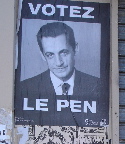
In my previous entry I had forgotten to paste in a link, which would have given more sense to the claim that choosing between Le Pen and Sarkozy isn’t much of a choice to some radical commentators. This omission gives me the possibility to return for a second to the poster put up around Paris just before Christmas, which didn’t make the ruling party very happy: Votez Le Pen.

The first time I saw the poster on the wall, someone – in typical French public, democratic tradition – had embellished Sarkozy’s face with the facial characteristics of Dracula. (The streets of Paris are full of such popular voicing of opinion, on posters or as comments written on the wall or on other signs or posters). Quite understandably, the poster has created a number of discussions on the Internet, as well (see further down).

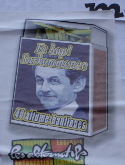
Picture to the right: A sticker on the wall with a drawing of a matchbox with Sarkozy’s face and the text: 40 banlieue matches.

A non-exhaustive list of sites on the Internet discussing the controversy:
– An article on the matter in The Guardian (in English!)

– Articles (in French) from the political group (Act up, for HIV positives, who made the poster in order to protest against the immigration policy of Sarkozy: The press release “A poster to denounce a racist discourse and a fatal policy” and an article on all the controversy it stirred.

– Le Monde’s article (in French) “Act up withdraws the poster from their site

– An interview with Sakrozy in Liberation (in French) “I know better than Thuram what’s happening in the banlieues” and the reply from Act Up the day after: “Sarkozy caricatures himself“.

– A number of discussions in Internet chat rooms and blogs: France TV 5, samizdat.net, les indigenes de la republique,
Indymedia, rebellyon.info, grioo.com, and so on…

In my previous entry I had forgotten to paste in a link, which would have given more sense to the claim that choosing between Le Pen and Sarkozy isn’t much of a choice to some radical commentators. This omission gives…

Read more