search expand

Now what?

Two weeks ago, at the time I finished my French lessons, I had planned to quietly sit down and rethink my research project. The goals of the project still seemed justified, but I was not sure about the approach; I felt I was about to suffer from a severe information overload.

[teaserbreak]

The evening 16 days ago, the 28th of October, I watch the news as usual. In addition to a reportage about an amateur theatre group for youth in a banlieue, two episodes catch my attention. The Interior Minister’s seems unreserved in his backing of the police version of events when two young boys were accidentally electrocuted in a transformer station the previous evening. I note down my surprise. No investigation is yet concluded, and both the two TV channels I watch take care to mention that two versions of the event still exist. (Since then, we’ve learnt that Sarkozy’s version was not the true one. The police had been physically pursuing the boys, whereas they had not been involved in any break-in but were running from an identity control.)

The second brief note I make from the news concerns the attacks on police and fire fighters in Clichy-sous-bois the night before. It calms down almost immediately in Clichy-sous-bois, but the apparently self-destructive rioting spreads to “sensitive areas” (“quartiers sensibles”) all over France. The unrest has been on the wane for several days now. But we are only starting to see the political repercussions. As I read on a chat forum on Beur FM (=French Arab radio): “In the presidential election in 2007, who will you vote for; Sarkozy or Le Pen?” And political populism and the Front National are only some of the possible political consequences I have in mind.

So, if I thought the research approach needed a rethink two weeks ago, the Clichy-sous-bois event has not made me change my mind. The research question is more justified than ever, in my opinion: what influences senses of belonging and community making in a cosmopolitan city like Paris? But how can I best study it? So far, I’ve considered, and rejected, three possible approaches: 1) Hanging around in a (multi ethnic) music or artist collective, preferably with political objectives. 2) A neighbourhood study in the cosmopolitan area Belleville. 3) Participating in two (multi ethnic) political groups working towards recognition of the colonial era in France. Yesterday, when I asked to local (Maghrebi) baker if he would help me with my research, I messed it up a bit and confused my three approaches. It was easier when I just asked the greengrocer what he thought about the present situation… Anyway, now it seems to me that I just have to live with the information overload some more time, to see what will happen.
To be continued…
[teaserbreak]

Two weeks ago, at the time I finished my French lessons, I had planned to quietly sit down and rethink my research project. The goals of the project still seemed justified, but I was not sure about the approach; I…

Read more

Information overload 2 / internet fieldwork

A day at work…: I was about to get outside (its freezing, but sunny). Unfortunately, it was time for 12 o’clock news before I managed to escape.

[teaserbreak]

Oh, here we go again. La ligue de droits de l’homme and MRAP (Mouvement contre le Racisme et pour l’Amitié entre les Peuples) are interviewed concerning the expulsion of troublesome foreigners with or without their residence permit in order. Ok, that’s certainly very interesting, but it’s not news to me.

But then the journalist mentions that a gathering is to take place at Champs de Mars tomorrow. That I’ve not heard before. I’ve got to search the Internet. Nothing on the sites of MRAP or Le ligue de droits de l’homme, but on Paris.indymedia I find something interesting. It starts right on: “Putain, are you all in front of the TV-set or what?” Then he(?) goes on to recount to the indymedia radicals his voyages in cyberspace of a very different France, skyblog. (See for instance cites2france.skyblog.com . Skyblog has, for some reason still unknown to me, become the site for the banlieue bloggers.) Obviously, this guy(?) is mad at his commerades at indymedia: « banlieues, villes et campagnes tous ensemble » et personne n’y répond… But now we’ve got the chance, he says, and reveals the news he found on skyblog about the upcoming gathering. For this indymedia-blogger, the event is already inscribed in the revolutionary French history (he refers to the fight for one week paid holiday in 1936, 1968 and of course the commune…). Ok, that was sociologically interesting, but I still don’t know much about what will take place tomorrow. I try google: “rassemblement tour eiffel”.

And what do I find? Great, I’m doing a whole sociological la distinction tour d’internet here. Le Weblog du 7ème Arrondissement (a posh district indeed…) refers to another blog, the Parisist. The Parisist asks if Paris will burn on Friday, since les banlieues are planning to pay us a visit, – with reference of course to messages circulating on skyblog. On the 7th Arrondissement blog one can read this: “There are good reasons for organizing such an event for all the honest citizens who have had enough of all this violence. On the other hand, certain others seems to want to use this gathering in order to throw gunpowder on the fire.” And it cites: ON VA CRAME PANAME COUSIN ON VA VENIR ENCULER SARKO CHEZ LUI (we’ll burn Paris (cousin= cousin or police informer), we’ll go fuck Sarko at his place). The Parisist one the other hand, seems a little less sensational as it drily comments the same citation; “evidently, we prefer the second suggestion.”

It’s already two o’clock. I still don’t really know what will happen tomorrow. So what should I do now; continue searching or finally manage to get out of here?

A day at work…: I was about to get outside (its freezing, but sunny). Unfortunately, it was time for 12 o’clock news before I managed to escape.

[teaserbreak]

Oh, here we go again. La ligue de droits de l’homme and MRAP (Mouvement…

Read more

TV fieldwork

Apart from a visit to the cemetery with about 50% of the French population on All Saints’ Day (La fête de la Toussaint) and a visit to the Institut du monde arabe for the exhibition L’âge d’or des sciences arabes, fieldwork the last week has mostly consisted of watching TV and reading newspapers. If it weren’t for the media, I would have no idea that the Paris region is making it to the headlines many places in the world. The media, on the other hand, is – not surprisingly – full of it.

[teaserbreak]

I find the unrest spreading from the sad Clichy-sous-bois incident a complex issue to write about. Its contested meanings; its strong element of class – and half-heartedly glossed over element of what the Anglo-Saxons would call “race” –; the political rivalry; l’insécurité versus la précarité (read: right- versus left-wing rhetoric); the stereotypical scenario of police harassment and no-future young men in the Parisian banlieues (which has become such an icon of French integration problems that, for instance, quite a few people here as well as in Norway can’t get their heads around the fact that I’m doing fieldwork in Paris proper, and not some banlieue); and finally, the evocation of colonial times with the curfew. It’s all at the heart of what I’m here to find out about. So, how to start untangling it?

The media coverage was the first thing that surprised me. From when I came here I have to admit that I found French national TV rather crappy. Every possible break, even between regional and national news is filled with commercials. But the journalistic treatment of the riots has been a far cry from commercially exploitative speculation, as I see it. There have been interviews with every possible actor in the drama. One of the first I remember was the unlucky Lille-supporter finding his car reduced to smoking ashes after seeing his team beat Manchester United in a Champion’s League match in Stade de France (the grand stadium is situated next to the sad, sad, sad towerblocks in Seine Saint Denise, both can be seen from the train to Charles de Gaulle airport). His astonishing calmness caught my attention; it’s been a good day which ended badly, but luckily no one got hurt… Then the hooded rioters themselves, never very articulate, posing for the camera; nique “Sarko”… it’s for the two kids who died… la colère… les flics… – Ok, those scenes are perhaps a bit over the top. But then there are all the reportages with the grand frères and local mediators putting the not very likable kids into a bigger sociological picture; they have no other means to express their anger at the police stopping and searching them all the time, at Sarkozy who wants to “clean the banlieues with a high-pressure cleaner…” (“nettoyer au Kärcher”, an expression being repeated almost as many times as voyous and racailles the last weeks… Even the footballer and world champion Liliam Thuram appeared on TV last night and expressed his anger at this way of talking about les banlieues and its inhabitants (himself an old banlieusard)). Not to forget the endless number of young and old seemingly representative banlieusards expressing their frustration over their burnt down workplaces, shops, kindergartens, gyms and cars. (For the record; their views are varied, but of course they soon started to get tired of it all. A survey today showed that 73% of the French population are in favour of the curfew if it can return order. 89% are in favour of re-establishing local organisations helping with employment and housing issues – which make part of the long-term propositions from the Villepin government).

In addition, French media is full of long, thorough and profound analyses and discussions, from every possible angle. The discussions range from sociology and economics, to philosophy (of course, these people are French) and architecture. – Can it really be that history is missing…? Historic memories are at least evoked now with the curfew: The law dates back to l’un du pire moment de notre vie publique – one of the worst moments in French public life, the Algerian war. (That’s what I heard from the clock radio when it’s work related relevance forced me to wake up this morning). So, yes, historic memories are not far away, but I think the only place I’ve heard an historic explanation is at the greengrocer’s.

The journalists’ carefulness to expose positive sides, like solidarity and creative initiatives, in the banlieues has also surprised me (though I doubt that the grocer would share my view here). For instance, the reportage of the tragic death of an elderly man a few days ago showed how the neighbours (“incidentally” of all colours and ages) came to pay their respect to the widow (white). A teenage boy of Maghrebi origin kissed her on the cheeks, an old African woman in traditional dress put her arms around her.

So, I think I’ve been a little bit surprised by the breadth, depth and serenity of the coverage. But what has surprised me the most is the patience and understanding expressed by analysts, journalists and many of the people in the streets. The economic crisis and the social problems in its wake are indeed acknowledged here. In addition, just after the riots had started I got an inkling impression that some commentators tacitly approved of the clear signs of Frenchness shown by the rioters. It’s no secret that many here seem to be proud of the French eagerness to demonstrate and revolt. Every week there are perturbations to the Parisian bus routes because of a manif for some political, economic or social cause. And of course there is always une grève going on. So, I wouldn’t be surprised if some middle-aged people – soixante-huitards to be precise – are a bit relieved and think that finally is this generation issue de l’immigration acting real French. Anyway, what is a generation of youth without their own riot? (As a friend of mine jokingly wrote me, when she heard about the contagious effects in Berlin; it wouldn’t surprise her if the ones torching the cars were in fact nostalgic middle-aged people).

Apart from a visit to the cemetery with about 50% of the French population on All Saints’ Day (La fête de la Toussaint) and a visit to the Institut du monde arabe for the exhibition L’âge d’or des sciences arabes,…

Read more

Information overload 1

Between “civil war” and “end of republicanism” – and the state of emergency paragraph from the war in Algeria…

“Civil war” is of course Le Pen polemic. But besides that, Front National has been taking it very easy lately; perhaps they don’t really have to say much at all in the present situation. So to my long time favourite, the well-oriented and critical The Guardian: Why do they ask if this is the end of the republican model of integration? From quite a few French perspectives it seems paradoxical that these riots, class riots almost, should mean the end of striving towards equality and solidarity. Why not interpret it as the end of hyper liberalism, or indeed capitalism, instead? And last; the law paragraph now in use, dates from the war in Algeria, a fact mentioned over and over again, in newspapers, TV and radio. What does that mean? Not to forget; what does it mean to grandsons of the Algerians experiencing the state of emergency in 1955?

Between “civil war” and “end of republicanism” - and the state of emergency paragraph from the war in Algeria...

“Civil war” is of course Le Pen polemic. But besides that, Front National has been taking it very easy lately; perhaps they…

Read more

Bienvenue à mon blog de Ménilmontant

-or maybe I should say Salaam Aleikum in appreciation of Ramadan, which began a few days ago.

Finally it seems like I’m getting the online diary from my east Paris fieldwork up and going. For the next six weeks I’m settled in an Art Déco building in the hill of Ménilmontant. (Fieldwork will continue for eight more months, from a flat in the neighbouring area Charonne, right on the other side of the famous cemetery Père Lachaise).

[teaserbreak]

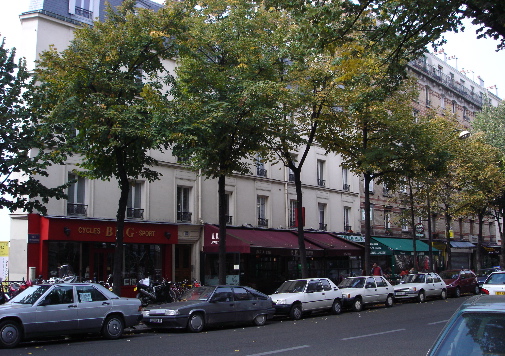
The part of the street where I live is quiet. Just across my Art Déco there is a small, well-ordered French park. Further up, there is an École Elémentaire – from where I can hear a really incredible noise in the breaks, coming from the small, walled off yard common for Parisian schools – and a lycée where the pupils speak the strangest of Parisian dialects (which I can’t imagine I’ll ever understand). I hear them in the local Alimentation Générale (cornershop) where they come to buy sweets and single cigarettes (and sometimes rizlas in the evening).

The alimentation has lovely Muscat grapes (I think it must be the season) and an all right selection of Algerian wine. The owner is North African, I would guess, and perhaps quite newly arrived? In the evening most customers I’ve seen, drop by to buy cans of beer or a bottle of wine. – An adolescent, who sometimes mind the shop in the evening, presumably for his father the owner, became a bit embarrassed when a quite drunk, but amicable white Frenchman tipped over my grocery bag and filled the shop with an odour of old wine when excusing himself.

Next to the alimentation there is a Bistrot Général serving meze, Greek yoghurt with honey, baklava, and other Greek specialities. The family running it are not Greek I think perhaps they are of Turkish origin. (I’m thinking of doing a lifestory/areastudy interview with the merchants of the street. I presume it will comprise most continents…). The newsagent and bike repairer further down seem fairly français du souche (“root/winestock French”) to me. Then there are a book-crossing café-restaurant with Spanish or most likely Argentinean inspiration, a tea and Narguile (water pipe) café, a couple of Senegalese or other west African internet and mobile phone shops, and a number of other cafés, restaurants and bistros which I haven’t got the hang on yet. In addition to a hairdresser, a plumber and other service providers. And believe it or not, this part of the street is short…

-or maybe I should say Salaam Aleikum in appreciation of Ramadan, which began a few days ago.

Finally it seems like I’m getting the online diary from my east Paris fieldwork up and going. For the next six weeks I’m settled…

Read more