search expand

High summer

It’s high summer and hot, and I don’t feel like doing what I’m supposed to do (I’m supposed to write a book review on Being a Hindu in Oslo.) High summer makes me melancholic. At least in one area of life I see the glass as half empty, and that’s when it comes to summers. The Norwegian summers are so short, that for half-empty-glass persons like myself, it’s only really May and the beginning of June one can enjoy fully without a bittersweet aftertaste of “soon it’s over…”. July in Norway is the time for 3-4 weeks of general holiday, and Norwegian workplaces, public offices and roads and streets (where there aren’t tourists) are as empty as they are in August in Paris or Athens.

The idea and implementation of paid holidays are at least as old in Norway as it is in France. However, I didn’t hear and care about the struggle for paid holidays before I lived in France in 2006 during the 70th anniversary for the left wing coalition Le Front Populaire. They lasted for only one year, and I think – as with many things in France – their symbolic importance outclass their actual political relevance. The film La vie est à nous (The life is ours, or The people of France) by Jean Rénoir from 1936 documents the life under The Popular Front, and the photographer Willy Ronis documented the first paid vacations, together with other famous photographers. I can’t think of any social democratic reform which is really celebrated here in Norway. And it’s not until confronted with the surprise of non-European visitors I find it strange that the country slows down and the functions close off to a minimum during July. Of course, it’s the general holidays!

(I’m hooked on the page-turning writing of Balzac at the moment – perhaps another reason why my book review isn’t progressing as fast as it should – and from his description of political and social divisions and hierarchies in early 19th century France, I get a clearer understanding of why social reforms have become such potent political symbols.)

It’s already the end of July, and in mid August already the summer is waning up here in the North. I’ve never mind going to school and I even love my job, but the end of summer has always been such a melancholic period that I’ve already started giving it an occasional sad thought. Why can’t July have at least 8 weekends? Well, it’s time to go back to the book review and get done with it. Afterwards, I’ll let myself start contemplating on the epistemological reasons behind why my fieldwork in Paris has started to get a rosy shade after having been left mostly in peace in notebooks and videos for a year.

to Burma Shave by Tom Waits (whom the new opera house said no thanks to this July!!!) – no much to do with this post, everything to do with summer moods

It’s high summer and hot, and I don’t feel like doing what I’m supposed to do (I’m supposed to write a book review on Being a Hindu in Oslo.) High summer makes me melancholic. At least in one area of…

Read more

Existence! Resistence! …eh back in Oslo


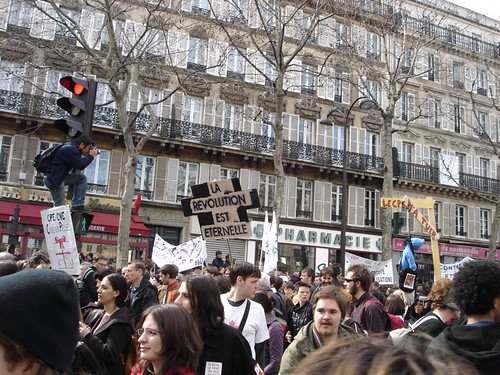
4th of April 2006, from one of the many demonstrations against the new labour law

It’s almost two months since I left Paris and time is overdue to get going with the second phase of this blog. One thing is certain; one will always have Paris, but for the time being it will be a long-distance relationship, slowly withering into a mythical landscape which hopefully will help me making some anthropological sense of it. (A landscape I hope will be fuller of poetry and revolt, than social organisation, cultural artefacts and postcolonial theory :-) ).
[teaserbreak]
As some squandered drops of water unfortunately landed on my thereafter defunct laptop, the unfinished blog post from my last day in Belleville is no longer accessible. I’m now unable to get back to how I felt having my last croissant beurre and coffee at Zorba, my last walk through the street market at the boulevard and the narrow, winding streets of the hill above, my extravagant last lunch (almost raw grilled tuna [never, ever complain that something is too raw in France, if you want to keep up apparences being at least partly cultivated despite some obvious traits of the noble savage from up North]) at the local Asian/fusion restaurant. Luckily, the highlights from the conversation with the Moroccan taxi-driver on the way to the airport are still safe in my little cahier. While drinking my glass of white wine at the restaurant, I remember thinking about the expression “a heavy heart”. I was feeling it physically. Not sorrow or sadness. Just a heavy feeling in my chest.

This evening I revived some of the sentiment of being in Paris, when I saw Je suis né d’une cigogne by Tony Gatlif (Eng. wikipedia) at the cinematheque. The film is from 1998, but the themes appear to be ever-present in France the last 20 or even 30 years. The first scene in the film was a demonstration, with people carrying huge banners proclaiming Existence! Résistance! while shouting tous ensemble tous ensemble (“everybody together”) just like they did during my fieldwork. In the banlieues life was drab and the flats crammed. The unemployed protagonist was selling L’Itineraire (a local version of The Big Issue, or =Oslo), an Arab immigrants felt pas chez nous (not at home), while another replaced his son’s name Ali with Michel (“because everyone here’s called that”) while eating pork with his family (the director’s real name is Michel, and he is of Algerian Andalusian Roma origin), and an old lady guarded her last Luis XVI chair from the insensitive bailiff while claiming she knew [the socialist] Jaurès, [the anarchist and communard] Louise Michel and fought for the commune and the intellectual little Ali, after having torched his father’s car, read La société du spectacle and listened to anarchists on Radio Libertaire talking about Algeria. The characters were angry and a little bit crazy and it was all recognisable and quite French to me.

This anarchic atmosphere, the anger and revolt, is the first aspect of Paris I’ll try to describe. In the four weeks, I’ll have ready a paper for a seminar with the – oh! gosh – so romantic title “Revolutionary Paris”. But before that brief return to Paris (to intellectual – and bourgeoise – rive gauche this time, except for a guided visit to Le mur de fédérés where the last communards got shot) for the seminar, I’ll get through the final stage of the local election campaign, half a ton of monographs and anthropological literature for the seminars I teach, colder autumn days (cyclists are already wearing gloves in the morning) and perhaps some more blog posts.

4th of April 2006, from one of the many demonstrations against the new labour law

It’s almost two months since I left Paris and time is overdue to get going with the second phase of this blog. One thing is certain;…

Read more

Sunny Sunday – cycling and les techniques du corps


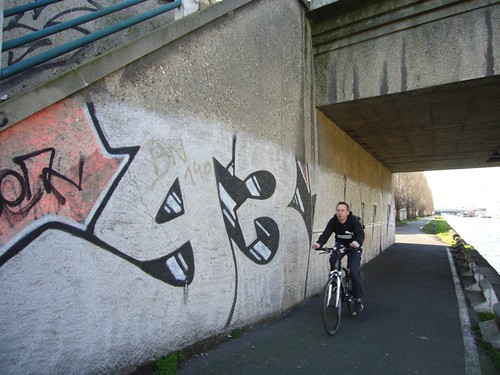
Cycling in the banlieues, neuf-trois (93)

Many months ago, I mentioned that I wanted to write about cycling in Paris versus Oslo, from the perspective of Marcel Mauss’ techniques du corps (available for download in French here). I’m reminded of this old classic each time I go from my Norwegian bike to my French one. Most bikes in Norway have an extra angle on the handle, putting it more in front, thus making the cyclist lean more forward. In Paris, the cyclists sit with their back straight. The majority of bikes in Oslo are some kind of – rather fancy – sport bikes. In Parisian streets, the sport bikes are rare, and you see men and women cycle on anything on two wheels – men on what usually is considered a woman’s bike are for instance not unusual. (And sure, after having my foldable, and expensive indeed, bike stolen after just a couple of months, the last thing I want is a new fancy looking one. What I’ve got now is a cheap retro looking inconspicuous one, – which a friend immediately condemned as bourgeoisie-looking. My only justification was that it was the cheapest I could find.)
[teaserbreak]
In addition to leaning forward on their seat, many Norwegian cyclists use a helmet. Surveys show that cyclists with helmets are more likely to suffer serious injuries, – obviously because they cycle faster. And of course the cyclists in Oslo – forward leaning and with sport bikes – cycle far faster than their Parisian counterparts. Here’s of course the connection to les techniques du corps, where Mauss in 1934 described how what we think are “natural” ways of moving the body, are highly social (physiological + social + individual (or psychological), I think he writes.

I often think of cycling in Paris as a flâneur-like activity, -as the bike itself and the way ones sits, in addition to some general mood, perhaps, don’t encourage one to cycle very fast. The pedestrians also are generally strolling around rather than hurrying. And if someone hurries past you, you very often hear a pardon – yesterday the person in hurry even bothered to turn around to excuse himself to me face to face.

If cycling in Paris has a character of flânerie, in London it’s closer to extreme sport. In Oslo I’ve until now thought of it as simple transportation, but after having read Dag Østerberg’s socio-material analysis of Oslo I realise that our way of everyday city cycling can be read as a an example of our “naturalness”. On my bicycle trip along the canal far into the suburbs today, I noticed that many Parisian cyclists put on helmets and sports gear and get their sport bikes out the cellar in order to go out of the city, as a Sunday activity. In Norway, fast cycling with helmets takes place inside the city. Østerberg writes about the Norwegian bourgeoisie (my translation):

The distinguished naturalness is a characteristic of the women and men of the Norwegian bourgeoisie: They engaged in sport and open-air activities to a far more than the rest of the European bourgeoisie. No other bourgeoisie lives in a forest (Østerberg 1993: 48-9). (For those who are interested, an additional explanation follows in an extended quote at the bottom of this post).

This “naturalness”, in perhaps less “distinguished” versions, permeates the Norwegian society. I wonder if it’s that which makes street life in Norway less communicative, less filled with meaning/significance, thus not social situations, while here in contrast, such small situations are “cultivated” into a little grain of social interaction. One example is the man saying sorry for just walking quickly past me in the street. “How many doors have you got in the face today,” is a standing joke at the Centre Culturel Français in Oslo, as many Norwegians ignore if someone is coming behind them through the door. It’s a lack of politeness, of course, but it’s also a lack of acknowledging that you are interacting with others in a social environment. The notion of living together “vivre ensemble” is everywhere here in Paris; from a core value at school to municipal politics.

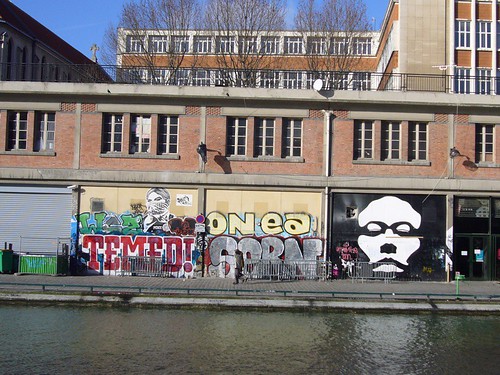
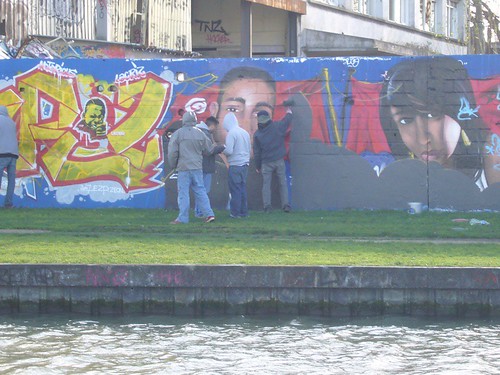
I notice that I’m deviating a little from my sunny Sunday bike trip now, and I’ll end this post with one more comment on socio-materiality. It’s so flat to cycle here that I didn’t realise where I was until I was far out in the in the banlieues in Seine-Saint-Denis. However, what I had noticed was that the highly varied east Parisian street art suddenly had turned to pure graffiti “pieces”, and at times even tags and simple scribbling were predominant.


Street art and graffiti at Canal Saint Martin (75010)


Graffit artists at work in Seine-Saint-Denis

More photos from “neuf-trois” here

When I got back to Paris, I passed Place de la République, and guess what? There were police as well as demonstrators present. (This time it was an anti-abortion demonstration).

The nature impression of Oslo is strengthened by the fact that parts of the economic, political and cultural ruling strata live in the hills, among trees and forest. These strata legitimise themselves party through “nature” and naturalness, in contrast to what is the case in many other countries. The bourgeoisie legitimised themselves from the 18th Century by appealing to “nature”, that we are born equal etc. The powder perukes and the rest of the baroque and the rococo were seen as unnatural, and were consequently left behind. However, around 1850 this changed. The bourgeoisie discovered that nature was and “vulgar”, because one found it among the farmers and the threatening labour movement. From now on, the bourgeoisie legitimated themselves with cultivatedness, with manners in contrast to raw nature. The bourgeoisie of Oslo and the leading stratum, on the other hand, still legitimises itself partly with nature, houses with a forest, Tyrol-looking houses, cabins in the mountain, long cross-country skiing trips. More precisely: It legitimises itself with distinguished naturalness, with carefully prepared natural look (my – quick, sorry – translation, Østerberg 1993: 114).

Cycling in the banlieues, neuf-trois (93)

Many months ago, I mentioned that I wanted to write about cycling in Paris versus Oslo, from the perspective of Marcel Mauss’ techniques du corps (available for download in French here). I’m reminded of this…

Read more

Back home part 2 – presenting my project so far (part 1)

Each time I tell about my fieldwork, I end up saying different things to different people, and usually I feel that it turns out quite messy, whatever I say. That was certainly the case when I tried to sum up the main points to my supervisor. So before my first seminar presentation (in front of a small multidisciplinary audience), the time had come to structure all I had experienced neatly into a comprehensible – and hopefully quite comprehensive – format.

My presentation was almost purely empirical, as I’ve not been reading much else than newspapers the last 9 months. The structuring principle I chose was to first give a socio-political overview of the bigger social events that took place during my fieldwork (October 05 to July 06), before I shifted to a more concrete micro focus on what and whom I’ll focus my research on (due to a need to anonymize at the web, I’ll be a little less concrete in this English version). I see the major socio-political events as forming a backdrop to my ethnographic micro focus, which – I hope – in turn can contribute to the understanding of these larger events. The first part of this post gives an English version of the first, events focuses, part of my presentation. The next part moves on to the micro focus, with a few words on my intended comparison with London as well as an attempt to sum up some of the comments I got after my presentation.

This is roughly what I said:
[teaserbreak]
I have not changed the fundamental focus of my project, thus I still focus on societal integration in two postcolonial European metropolises, particularly aspects of identity (formation) and belonging. However, my narrow focus on the so-called second generation (of one ethnic category; British Asians) in London, seemed – as predicted – of little relevance in Paris. [And coming to think of it, neither “identity” nor “belonging” is of that much importance to me anymore… We’ll see now, after summing up, if not “Communities in the making: Space, time and revolt” isn’t after all a more fitting title.]

During my 9-10 months of fieldwork, several large political events with huge relevance for my project took place. In the end of October, three weeks of rioting – car burning (which French youth are particularly keen on doing on a regular basis) and burning of schools and the like took place in deprived suburbs characterised by high unemployment and a large proportion of habitants of non-European decent.

In the spring, we had several weeks of massive protests against the new labour law, which had the intention of liberalising and increasing the flexibility of the labour market, but were seen as creating more insecurity (insécurité).

In addition, I would like to mention the abrogation, by President Chirac, of the less than a year old law paragraph saying that schools should teach the positive effects of colonisation. Until it’s abrogation, the paragraph and the protests it caused, never ceased to make it to the headlines. For instance, scheduled protests by the Martiniquais, including the poet Aimé Césaire, made Interior Minister Sarkozy to cancel his trip to the (French!) island.

The first day in commemoration of slavery (as a crime against humanity) took place the 10th of May. I had been looking forward to the day, anticipating it as a key event in my fieldwork. It was perhaps due to my great expectations that the day – for me – turned out to be almost a non-event.

The latter two events – the controversial paragraph about the teaching of history and the commemoration of slavery – give evidence to how important the struggle around the definition of (the correct and official version of) history is in France. I read into these events, as well as the last one I’ll mention – the active mobilisation against the new immigration law –, an increased demand for recognition of the transnational foundation of the French nation. [If this appears opaque at the moment, I’ll probably return to it in later posts, as I’m planning to work on what I’ll claim is a transnational appropriation of time and space this autumn…].

(Contrary to what was the case in the UK – and Norway! – the caricature affaire was no big event in France.)

I was struck by the constant focus on crisis and the feeling of anger and frustration present in the French society. The feeling of economic insecurity was present to a completely different degree there than what I was used to from Norway. In the beginning, the protests against the liberalisation of working conditions, seemed of little importance to my research (despite the fact that the law was part of Prime Minister de Villepin’s project on “égalité de chances”). However, as the protests gained ground, they pointed me in directions of important aspects of French social and political life:

*) Mobilising and protest: the belief that it’s possible, worthwhile and even correct and a good thing for proper citoyens to protest (i.e. it had already worked against the paragraph on colonialism).

*) Revolutions and riots as central aspects of the French national narrative, which is echoed on various levels in society, from the enthusiasm with which the pedestrians cross the street on red light – often dragging their children along, to the widespread (acceptance of) civil disobedience when “godfathering” and hiding sans-papiers children who are threatened by expulsion. For instance, many parents, teachers and other middle-aged people described the (sometimes quite violent) protests in the spring as a learning experience of democracy for the young. Apropos the riots in the banlieues: many commentators saw – utterly seriously, which surprised me – the riots as a positive sign: they riot against injustice, donc they are very French indeed!

*) Explicit and active scepticism against “(economic) liberalism”, partly as a so-called “Anglo-Saxon” phenomenon. (I.e. also “the republican model of integration” is also seen in contrast to the “Anglo-Saxon” multiculturalisms.

The two waves of protest and riot were easily interpreted within ideological discourses – not only by social scientists, but also not least in the public discourse. Both the two large events were frequently lifted up to a higher politico-philosophical level: For instance, one could readily hear that the riots in the banlieues were a proof that the French model of integration was destitute and France needed to turn in more in direction of multiculturalism. Equally, instead of the typically (so it went) French line of confrontation in politics – resulting with 1-3 millions in the streets against the CPE/first employment contract – needed to learn more from the “Scandinavian line of consensus”.

I find it interesting – particularly to my British/French comparison – that an excellent newspaper like the Guardian in my opinion not wholly grasps some particularities of French society in this respect. They wondered about the fact that 70% of French youth wished for something as boring and safe as a position as a public servant, and interpreted the protests as conserving and backward looking. My point is not whether their interpretation is right or not, but I find it quite ethnocentric and in lack of a native French point of view. (But that’s what we have anthropologists for ☺ )

My analysis is still at an embryonic or even less developed state, but it seems to me that these differing interpretations indicate a different relationship to the state, thus different state traditions, amongst British and French youth. I also have suspicion that one might read into the attitudes differences in visions of what constitutes a good life: perhaps in terms of more focus on career versus leisure, on consumption versus other forms of expressivity…. Well, probably I’m idealising the French context…

I hope to get a better grasp of these larger socio-political issues by looking at them though an ethnographic micro focus. However, it took me many months of fieldwork before I found such an ethnographic focus where I would be able to grasp what I saw as significant in the present situation. I went to loads of meetings and various gatherings and hung around in various places, but I found neither a suitable environment nor a suitable focus – until two months before I left the field.

I know this post can do with some links, but I’ll have to leave that for later… sorry

Each time I tell about my fieldwork, I end up saying different things to different people, and usually I feel that it turns out quite messy, whatever I say. That was certainly the case when I tried to sum up…

Read more

Back home part 1 – blogging continues

Since October 2005, I’ve been blogging from my fieldwork experiences right amongst the Parisians, but from now on this is – hélas – no longer the case. I’ve returned to Oslo with all my fieldnotes, photos, impressions and sentiments, and after living and working autonomously for 10 months, I’m now trying to reintegrate into the office environment (as well as my Oslo life). Since my intention with this blog has been to document not only how my fieldwork developed, but also the rest of the research process, I’ll try to keep on blogging from the office.
[teaserbreak]
From my (new) office at the University of Oslo, I’m looking down at one of Oslo’s more well-off neighbourhoods, with multicoloured wooden villas, all with neat gardens dotted with apple- and various other trees. (While (the lack of) mixité social seemed to be an ever-present matter of concern in Paris, I don’t find it to be that much of an issue here).

From one corner of my office window, I see the light blue Oslo tramway passes every fifth minute or so, and from the other I see a red brick church at a small tree-covered hill. When I lean a bit over my desk, I get a glimpse of the clear blue Oslo fjord with some blue hills on the other side. Far away, climbing up another hill, I see what must be a banlieue, with its high-rise buildings from the 1960s. The university campus itself is situated up-hill from the centre as well. All these hills I’m describing remind me of a funny incident when someone who knew my street in Paris described it as “the one that goes up”. I was struck by surprise for a second, when he said that. Yes, elle monte un peu, but what surprised me was that I had never even noticed the slight rise. Looking at the geography of Oslo – and even more so at the hilly city of Trondheim, where I lived the first twenty or so years of my life – one easily understands why.

So, from this office with this view, I hope to get on with stage two of my research project. From documenting research-in-progress during fieldwork, where theoretical and analytical discussions have been scarce or absent, I think the blog posts the next months will take two distinct but intertwined directions. On the one hand, I’ll write explicitly research-focused posts on how the project develops as I read, write and discuss my work. On the other hand, my mind keeps creating small (phenomenological) blog posts on my experiences in Oslo and how that contrasts with Paris. I think writing about such ethnographic contrasts can have several functions. As I experience them, they will probably take part in shaping my attention in the following stage of the research process. They can also perhaps be stepping-stones for a possible future fieldwork in Oslo. We’ll see we’ll see. I don’t know if I even can manage to experience, and write about, Oslo as I experienced and wrote about Paris.

The two following posts will be one in each direction: First a research centred post about the ethnographic status quo of my project, as I presented it at a multidisciplinary seminar last week, then a Norway/Paris contrast-focused post on techniques du corps (where cycling plays a part, of course).

Since October 2005, I’ve been blogging from my fieldwork experiences right amongst the Parisians, but from now on this is - hélas – no longer the case. I’ve returned to Oslo with all my fieldnotes, photos, impressions and sentiments, and…

Read more