search expand

Slow attempts at making sense: Oslo 22/7

Blomsterhav
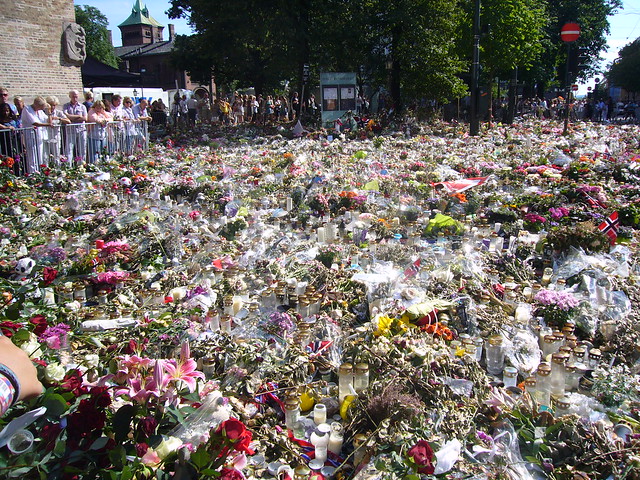
People meditating the sea of flowers outside Oslo Cathedral a week after the bomb blast and massacre

This research diary has until now exclusively treated the various facets of my PhD research project in Paris. When the numbness began to lose its grip, I started to realise why I feel so terribly concerned. Of course, I think most Norwegians, many Europeans and even many, many fellow world citizens feel deep concern when an atrocity like this strikes, even when they or their closest aren’t struck personally. This concerns us as fellow humans (of both the victims and the perpetrator…), and it concerns us as political beings. But I also realised that this concerns me profoundly in terms of the career I’ve chosen: What good is it to devote my professional life to understanding nationalism, belonging, community cohesion, conceptions of difference and the like when I have done nothing to prevent the worst thinkable acts of violence to take place in my own country? Especially since I think – or I’m sure – that I’ve felt there was a need for worry (but of course, not to this unconceivable degree…). For several days now I’ve been thinking about how I can contribute. How can I contribute in the best way with my knowledge (of living with difference in Europe), my concern (for the future of us all) and my devotion (to work for a better world)? I know need to think much more about this in the coming days and weeks, and I know that I need to act.

When I very soon finish my present project, I will – hopefully – be able to do research in Oslo. And there are few places on earth than here I’d rather do this kind of research right now. I don’ think there’s a coincidence that the last huge act of terrorism in Europe was committed by a rightwing nationalist in the name of anti-Islamism. And I even don’t think it was that big a coincidence that it happened in Scandinavia.

Now, after eight days of numbness (and reading of philosophy of difference) it’s time to get back to the main task: finishing the Paris project and get on with life. (Or rather, get on with life and finish the Paris project.)

Blomsterhav

People meditating the sea of flowers outside Oslo Cathedral a week after the bomb blast and massacre

This research diary has until now exclusively treated the various facets of my PhD research project in Paris. When the numbness began to lose…
Read more

The long and winding road of a research project

My previous research project followed a typical comedy structure. It was a difficult but steady upward struggle, with hard work overcoming challenges and a quite happy ending. The present one, however, staggered right from the outset into a maze of existential brooding and substantive challenges. Some of the challenges pertaining to the research in Paris as compared to the study in London, I’ve written about elsewhere. But there’s more to a life in research than just research difficulties.
[teaserbreak]
The Monday I started my PhD, I learnt that a friend of mine and her two years old child were lost in Thailand after the Tsunami. Within a few days, I was also told that my supervisor-to-be was seriously ill with cancer again. I turned 33 that month, and I started wondering if it was no coincidence that Buddha’s as well as Jesus’ existential brooding started in their early thirties. When Buddha was around 30, he discovered old age, illness and death. His life had been shielded until then, so the discovery made a profound impact. When death and illness came into my life, I had already been pondering over the viciousness of old age for some months. This was really just too much to accept and cope with without giving it some deep thought. In Norwegian, the concept of a generation (mannsalder – “age of man”) counts 33 years. Maybe that what’s it takes to realise and understand the last mysteries of life?

What I was looking for, wasn’t some religious explanation à la what the equally aged Jesus and Buddha found, but I needed to set my mind at peace with the existence of these phenomena in our life here on earth. Maybe I also started feeling restless in my own life. Had I made the right choices on how to live in the face of possible illness, probable old age and certain death? In the comedy structure of my research in my twenties, such matters never disturbed me. Luckily, I’ve never questioned myself if anthropology was the right career for me. On the contrary, anthropology had risen as the luminous answer to my existential worries of my twenties. That research in cosmopolitan Paris was what I wanted to do, was clear, however, fieldwork now also needed to be existential work.

When I finally found my focal point in the field, the gloom was long gone. And as if to put a final end to it, strangely, the host for the first slam poetry night I attended was called MC Tsunami, and the person who had taken me there and also truly liven up my Paris stay in general, shared the name with the two years old child who had disappeared.

But the winding road of the research project wasn’t finished with finding meaning in life in the face of death and finding a suitable field for research. Then, there was the 25% teaching as part of the Ph.D-detour. And there was a baby-detour. And now finally, a titan hip-detour. The longest, and hopefully last of this maze of a project. A comedy, it’s certainly not, but I’m quite sure it’s neither a tragedy. I think it’s just time I get hold of Ariadne’s thread and start winding it up.

My previous research project followed a typical comedy structure. It was a difficult but steady upward struggle, with hard work overcoming challenges and a quite happy ending. The present one, however, staggered right from the outset into a maze of…

Read more