search expand

Fieldwork fatigue …and outline from the end to the beginning

“[O]ur work cannot transcend being a human endeavor, with attendant costs as well as benefits” (Wolcott 2005: 141)
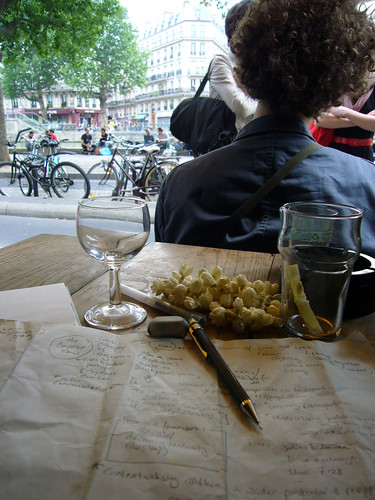
Earlier this week, I got ditched on one of my first interview rendezvous. [I later learnt that yes, he had been there, in exactly that huge, rather kitschy Indochinese colonial style bar … My incapacity to find him just proves that I’m suffering from fieldwork fatigue…]. Since it’d been a hard day after another sleepless night, I decided to neither wait longer than 25 minutes, nor phone the person, but instead walk off into the busy street at Place de Pigalle. For once, I was in a place without my bike and with nothing planned. I decided to walk back east, following a boulevard one probably cannot find anything like anywhere else in the world, through Pigalle and Anvèrs (tourists, sexshops, local Americans and ordinary inhabitants), Barbès (French Arab quarter for several generations) and La Chapelle and Stalingrad (crowded, noisy and polluted with traffic, known for its social deprivation and heroin). By quieter and gentrified Canal Saint Martin (where students and artists, tourists and homeless picnic side by side), I know a nice little bar, with three tables outside and a few more on the inside, wooden, brown and sympathetically worn down. They play mostly French music, a little bit punkish, a little bit of Mano Negra, some French Tom Waits, a little bit of Balkan-gipsy style that is so popular here… While I wouldn’t dream of drinking a glass of wine alone in public at Zorba or Les Folies 10 minutes away up in Belleville, I don’t hesitate at Café Jemmapes. After my 40 minutes stroll, I sat down quietly and listen to the chattering around me and watched the people sitting by the canal. I started on this blog post but soon realised that perhaps following an advice from The Art of Fieldwork could help me in my state of fieldwork fatigue:
[teaserbreak]

…think through your entire study in the reverse order of the way you intend to carry it out. Begin with a careful consideration of where you want to end up… Try to anticipate as specifically as you can the outcomes you want to achieve. Then back up a step to identify the kinds of data and range of experience you will need to support or illustrate those outcomes. Then back up one more step to ascertain how to get that information (Wolcott 2005: 194-5).

That morning, the first thing I did was to reschedule my return flight back home, thus shortening my stay with 16 days. I had woken up really early, after only a few hours sleep. Faubourg du Temple might be a nice street for strolling, and a perfect street for sitting down for a coffee, but it’s far from perfect to sleep five floors above. Too vibrant, too cobbled-stoned, too picturesque… In addition, I’ll have to move house again soon, since the propriétaire will move back in, after a thorough refurbishment of the worn down place. Hearsay tells that his parents bought the flat for 90 000€ in 1999, and now – even before it’s refurbished – it’s worth 270 000€. That says about it about the housing market in Paris. I’ve not had success in re-entering it for the last month of my stay, so I end up shortening my stay and spending the last ten nights in an hotel around the corner. I’m a bit tired of it all…

I’ve lived so many strange places in this city, with mice, mould, and mites, only to mention the problems starting on m. The fieldworker is his or her own worst enemy (as well as her best asset, on good days of course), as Wolcott states somewhere in his book on method. And I think he also says something about the field, with all its nuisances, getting in the way of doing fieldwork. I feel a certain fieldwork fatigue at the moment. I have realised – possibly because the end is so close – that it is “only” fieldwork. With that insight it suddenly became work more than anything else for me. Gone is the attempt to try to live it. There are many other reasons for this fatigue as well. Living conditions, the extra effort to wrap it all up and pursuing all the people and events that I haven’t come across naturally or by chance until now, my life situation, the fieldworker role (being there for everybody without anyone really being there for me… – I remember how depended I was on my flatmates back in Freemantle street in London as an outlet for this self-effacing role. Here I don’t have any such outlet, in addition my role is even more self-effacing as I’m a far better listener than a speaker when it comes to French).

At the moment, reflecting on my growing feeling of detachment, I get a sad taste of failure. Professionally, I think I’m doing fine, the failure is rather on the human side of it. I feel I’ve failed in really living here which is probably connected to my failure in improving my French as much as I hoped to. Too much of my days have disappeared at home, in front of the computer, working on the videos. I’m thinking about another quote from The Art of Fieldwork:

Every choice is also a sacrifice… Every articulation precludes not only its own alternatives but all sorts of developments they would have made viable (Susanne Langer quoted in Wolcott 2005: 257).

Whatever the reasons might be, the northern immigrant to East Paris has retreated (with a bowed head), and it’s the anthropologist that is sitting down drinking a glass of white wine at Café Jemmapes, thinking about Wolcott’s questions; where do I want to end up and what are the outcomes I want to achieve?

I started focusing on the slam poetry scene because I wanted to study a cosmopolitan milieu. (In my view, cosmopolitanism is – in contrast to the national identity craze hitting politicians in France and Britain at the moment – the future of Europe. We have no other choice.)

My preliminary main claim is that the slam soirées can be seen as an appropriation of time and space; – time through story telling (thus the creation of narratives, which is a creation of meaning) and space through being together, sharing with and listening to others, many with a very different background from your own. It is an appropriation because it is free and democratic/accessible for all. Elements of this appropriation can be termed a postcolonial re-appropriation: Spatially because the scene is uniquely cosmopolitan, and because many of the texts re-describe public space on French soil in cosmopolitan as opposed to national/monoethnic/”white”… terms. The re-appropriation is also temporal as personal history and French history are being told from various “immigrant” (or e.g. descendants of slaves’) perspectives.

The slam often seems to be a personal as well as collective response to social and personal problems. In this sense, it provides a solution to the individualising/atomising forces in our time hindering collective movements.

I will contextualise the slam phenomenon within a wider postcolonial re-appropriation or time and space that has been going on in France for a while. (What will happen now, when one of the first points in Sarkozy’s victory speech was that we will now finish with all this repentance, and a few days afterwards his Ministry of national identity and immigration was set up.) I’ll support the description of the struggles surrounding French history by the historical and theoretical framework in Eric Wolf’s Europe and the People without history: European modernity and the history of Europe itself must be viewed within the context of European expansion from the 16th century onwards. For instance, the industrial development in Britain is intrinsically tied with sugar plantation in the Caribbean. Just as French post-war economic growth must be seen in relation to labour immigration from the former colonies.

What “kinds of data and range of experience” do I need “to support or illustrate those outcomes” and how will I get that information? I must describe the soirées – the people present and the interaction and their texts. I’ve been to open microphone sessions at almost 30 different bars and cafés at least once, in addition to sessions at a museum, a mental hospital, a metro station, theatres… in addition to concerts, workshops and plays, and I’ve filmed around 35 of the sessions (so I can take it easy about the 6 hours of so with film I erased by accident the evening before the fieldwork fatigue hit with force). In addition, the slammers are kind enough to provide the foreigner with written versions of their texts, which I’ll study more in depth when I get back up north, in the wintertime I can imagine when the teaching in the autumn semester is finished, sitting at my office at the sixth floor in the social sciences building at the University of Oslo, thinking about the Parisians I for a while was living among… When I’ve written a first draft and gone through all the texts, I’ll ask for a new round of interviews and conversations to verify what I’ve come up with so far. What is left for me to do, are the interviews with as many people I can. I’ll leave that part for another blog post.

I’ve met a few parents and other family members, and I’ve been in a couple of homes, but that kind of background information has been hard to get here, and it will also be practically impossible to write about, since I’ll not anonymise any of the participants….

“[O]ur work cannot transcend being a human endeavor, with attendant costs as well as benefits” (Wolcott 2005: 141)

Earlier this week, I got ditched on one of my first interview rendezvous. [I later learnt that yes, he had been…
Read more

The art of fieldwork

For 3-4 months I’ve been so immersed in fieldwork that I’ve taken it to be my one and only life. Vaguely, I’ve remembered that there exist a parallel universe up north (which seem to be my one and only life when I’m not elsewhere), but it wasn’t before I actually dipped back into that life for 9 days that it all crashed back into my conscience: There is an office there waiting to host me at inhumane working hours in just a few months time. There are students to be taught and colleagues to exchange with, and loads and loads of books to read… (Unfortunately, there isn’t any home with a view over Oslo to hibernate me, my plethora of succulents and dusty books anymore…).

When I entered the field again after a short trip outside of it, I couldn’t get one sentence from a book on anthropological method and the darker arts of fieldwork out of my head:
[teaserbreak]

“Is seduction one of our darker arts? As craftspeople, are we so crafty that others don’t know when they are being seduced?” (Wolcott 2005: 141).

I realised that I’m so crafty when doing fieldwork that the participant role of my persona seduces even me. I appear so sincere because I belive it myself. I want to stay here (or in London when I was there), it’s my genuine one and only wish. For the moment. I also tell people that I’m here to write a thesis and yes, it is actually my paid work to hang around in bars listening to slam poetry. But I forget at the same time that what I’ve been doing the last months, is not part of my life-to-come but part of my academic career. I suspect people around me are more aware of the fact that I’m simply dropping in and then out of their lives again, than I am myself. But I wouldn’t be surprised that the genuine enthousiasm I express by saying that I want to settle here helps strengthening my relationships with people. Wolcott calls this superficiality and seduction the darker arts of fieldwork. I was surprised to realise that my self-deception actually is treated in a book on fieldwork methods.

Both my fieldworks have been in environments close to my own interests. I could have been – and I surely would have loved to be –hanging around with policial activists in Brixton and mucisians in Tower Hamlets as well as slammeurs and slammeuses in Belleville, even without the excuse of doing fieldwork. Partly, I see this as a more honest anthropology as it is entirely based on the idea of an anthropology without radical difference, and more so, I don’t have to fake or hide anything – not what kind of information I’m looking for, neither my political views, my artistic interests and my way of life in any sense. On the other hand, as I’ve found myself asking the last week; what if I’m faking it all (so well that I believe it myself!), getting access through this perhaps naïve enthusiasm.

“Fieldworkers willing to make research commitments on such a grand scale [as to spend at least 12 months away from home] are also likely to be overcommitted in other aspect os their lives,” Wolcoff writes (2005: 117), and he continues further down: “Fieldworkers have an understandable but perhaps unfortunate tendency to represent themselves not only as different from those who do quick-and-dirty studies but somehow as more sensitive and caring humans as well.”

So, maybe this self-deception, the going native, is part of the darker arts of fieldworkers’ repertoir?

Ever since my early teens, perhaps my whole life, there has been a tension between the safe framework of academia and the attraction of adventurous escapes. In Oslo, the adventurer apparently does the head in on my entourage, and here she has been pushing the academic in the background for a while now. But almost as the conflict is about to be won, the adventurer evaporates into a cunning and crafty anthropologist…? Is that how it is?

Participant observation:
The anthropologist as Slammeuse,
at Lou Pascalou 11.04.07

For 3-4 months I’ve been so immersed in fieldwork that I’ve taken it to be my one and only life. Vaguely, I’ve remembered that there exist a parallel universe up north (which seem to be my one and only life…

Read more

Hierarchy… work ethics and myths… and fieldwork

I realise – as I read an interesting comment in Le Monde on, of all things, why the Toyota model can’t be French – that I haven’t written any posts on hierarchy yet. My cahiers and mind are full of speculations of quite another sort than on French business and work place interaction – for instance I’m thinking about what I can make out of the coincidence that the two last books I’ve read are called the art of something (loving and fieldwork to be precise). Thus, I’m relieved to find another reason for choosing this subject for a post after such a long silence in the blogsphere; it’s unforgivable to have written 69 blog-posts from France without mentioning hierarchy and arrogance!
[teaserbreak]
I’m up in the air again, with Air France, my for all reasons favourite air company for the time being. It’s awfully sunny up here, we haven’t seen any of the thunderstorm and turbulence they announced at Gardermoen, and the French (slightly) arrogant steward has served me chilled Chardonnay from Pay d’Oc – an excellent remedy against turbulence – and I’m not sure what I feel about going back to Faubourg du Temple after 9 days up north which seemed like an eternity at the other side of the galaxy (in terms of mind set of the anthropologist. Perhaps more on that later. I’ve realised that what anthropologists call going native, lay people like my Mom and ex call the Stockholm syndrome – surely this makes important data for a blog on fieldwork and anthropological research, but right now we’ll return to hierarchy). It’s not only the chilled Chardonnay that explains my fancy for Air France. I just love to serve myself unashamedly with a pile of French newspapers and go through all of them as I’m forced to do little else for 2 hours and 25 minutes. The great thing with newspaper in paper versions – compared to the e-version I usually consult through my rss feed thingy – is that I read articles I never would have clicked on deliberately. Pourquoi Toyota n’est pas français is a typical example.

At a dinner party light-years ago, an economist I know told me about a survey he’d read about in the Norwegian economist newspaper Dagens Næringsliv, explaining France’s economic and business retard as a lack of confidence between the echelons in the workplace hierarchy. The analysis in Le Monde seems to refer to the same or a very similar survey (perhaps this view is common knowledge in the financial world outside France): The gap between the managers/employers and the employees are wider in France than most other countries in the western world. There are archaic social relations in this country, the analysis claims, which keeps the French from working well together. The cadres don’t give any freedom to their subordinates, as they do not trust their capacities, and the lower employees are mistrustful of those above them. “Of course I wouldn’t use his first name and tu (second person singular as opposed to vous, the polite second person plural),” a friend of mine said about his – quite clearly idiot – boss, “he’s not my pal!”

The radical labour unions are another division holding back French business, according to the analysis. The labour unions in France have little interest in improving the work conditions for the labourers, as that would just help capitalism and le patronat… The unions here – les syndicates – are very different from the ones we’ve got back in Scandinavia. Here, less than 10% of the workforce is organised, while back home I think there are only 10% who are not in a union. I don’t know too much of what they do here, but they seem far more radical than my own “Union for researchers” which mostly care about salaries (in addition to some grumbling over the worsening conditionings for doing research after the university reform). In France, les syndicates are feared for their strike force. A relatively large portion of the French are fierce strikers, and many people count on – or worry for – what will happen to his reforms when the striking season sets off in the autumn.

Thus, it’s this archaism and divisions that are to blame, and not decline of work ethics, as the new president complains. He proclaims a rupture with the past and wants – like leaders before him in history – to restore the values of travail, famille, patrie (work, family and fatherland…). To the contrary, claims the analysis: In the developed world, the French are among those who gives most importance to work and many think it important to instil in their children the value of working hard. (Perhaps in contrast to the oil bubble Norway, if you ask my aging teacher parents…).

Interestingly, it’s not only the president who thinks that the French don’t value work sufficiently. The Guardian loves to portray the French as non-protestant hedonists who know that one should work in order to live and not live in order to work. (For instance Goodbye to la Belle France? on the possible effects of Sarkozy’s reforms). I would agree that the pace of life appears slower – and frequently comes completely to a halt on pavement cafés, just for idle conversation for hours – here than in Oslo or London. (It would be interesting to count people walking around with paper cups with coffee in the three capitals. Oops, here I can feel the urge for a digression on espresso at the counter in Latin countries, but I’ll retain myself). However, diverging from what appears to the eye of The Guardian and me – but in line with the argument that strong work ethic still exists – productivity per work hour is higher in France than in the US and Britain (but the same as in Norway).

I’ve landed in freezing cold France days ago, and when I opened the document in order to round up this post and put it online, I could no longer remember where I initially had planned to end it. I probably had tons to say about how hierarchy and “archaic social relations” shape social life here. I’m sure it also shapes the slam poetry scene, and my relations there. A few indications: French slam poetry is an east end, popular phenomenon in a country with high youth unemployment. In stark contrast to my previous fieldwork, I have markedly more education than the majority of the people who surround me, in some cases more than ten years of formal schooling and education. And where to place poetry in the French field of archaic hierarchies?

I realise – as I read an interesting comment in Le Monde on, of all things, why the Toyota model can’t be French – that I haven’t written any posts on hierarchy yet. My cahiers and mind are full of…

Read more

Finally a slam poetry video: Ucoc at L’Atelier du Plateau

L’Atelier du Plateau is a little neighbourhood theatre on top of hilly Belleville, near Parc Buttes Chaumont. After going down a narrow, cobbled-stoned cul-de-sac, one enters one, large white painted room under a high ceiling. A bar and a small kitchen (serving for the occasion quiche lorraine, vegetarian pizza, each for 3€, massalé de fruits de mer 7€ and gateau chocolat, also 3€), occupies a corner of the room, while low chairs circling red, oriental carpets marking the “stage” take up the rest of the space.

[teaserbreak]
Every sixth week or so, the slammeur and rappeur Dgiz hosts a slam poetry session here. Last Monday – the blue, blue day after the elections – it was packed, with more people standing than sitting. While many presented newly written texts about the elections or at least made reference to it, the example I will give here did not. (The lyrics of “Destiny” ).

Ucoc was one of the first slammeurs I discovered. Late a Friday night in early June 2006, I was standing in the open doorway in the tiny bar Plex y Glass in Rue Oberkampf, when a screaming man fought himself through the crowd right towards me. I had just returned to Paris after an adventurous trip in the suburb Fontenay-sous-Bois (find the post here), where I had attended my (second) first soirée slam. Ucoc’s colère (anger) convinced me instantly that finally, after many months of searching, I had found a focus for my research. As I post more videos here, it will be clear that Ucoc has a very particular style… Enjoy, or bon courage.

The saxophonist is the jazz musician Louis Sclavis. (The cellist Vincent Courtois did not play on this track).

Ucoc’s Myspace site can be found here and OMind, his cooperation with Chantal Carbon, here (with more videos). He is also a frequent contributor to the site www.generationslam.com

The introduction to slam, I can thank a person I had just met on a punk concert, just around the corner from where I lived at the time, in support of the accused after the anti-CPE protests (labour law) some months earlier. After discussing the protests for a while, he said – despite having participated in them himself – that he would like to introduce me to something that was far more important than street protests: poetry! (after quite a few months of dissatisfaction with this incomprehensible society, I had finally started to like it, so a comment like that pleased me immensely). A few days afterwards, he, a friend and colleague of him and the anthropologist headed for the suburbs and back to town again – and since then I haven’t been a week in Paris without attending at least one soirée slam

L’Atelier du Plateau is a little neighbourhood theatre on top of hilly Belleville, near Parc Buttes Chaumont. After going down a narrow, cobbled-stoned cul-de-sac, one enters one, large white painted room under a high ceiling. A bar and a small…

Read more

Elections


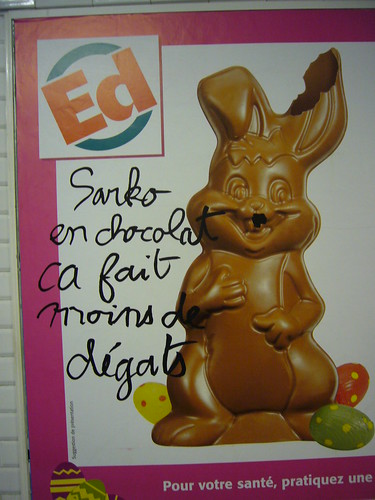
Sarkozy in chocolate makes less damage

Blogging is hard these days. I’m busy, I’ve had visitors and I’m experiencing a personal earthquake*. And when all this is going on in the fieldworker’s life, the presidential election is approaching.
[teaserbreak]
However, contrary to what I expected after the previous stormy spring in Paris, not much is actually going on. I have a pressing feeling of silence before the storm, while a more sinister friend of mine made up the metaphor of the silence of the tiptoeing of slippers before the reverberation of the boots…. His dark vision is that France will wake up and go to work just as normal when the catastrophe hits, – and it will hit, according to him. On a far more positive note, another acquaintance said that Sarkozy was too extreme to be voted president of France. He guessed that he wouldn’t even to through to the second round.

As I’ve mentioned before, the most frequent reproach against Sarkozy I hear, is that he divides the population (the worst faut pas in the indivisible republic) – between for instance “the good and the bad” (editorial in Libération 18/04).

The adversary candidates Royal (socialist) and Bayrou (centrist), said on their last meetings that France could not have a president with a mask of fear and who’s project is himself (Royal) and someone who loves power more than he loves France (Bayrou). Heavy criticism of this sort is coming up from various angles in the press at the moment. I just can’t imagine that he will go through, and if he does, I certainly can’t imagine what will happen…

The situation is tense everywhere and quite unlikely people are appealing to voter utile (“vote usefull” – thus gathering around the one candidate on the “left” who has a chance to go through to the second round, i.e. Ségolène Royal).

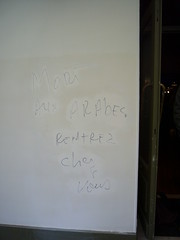
Racist slur on the wall outside the café Nuits Blanches
The slam scenes seem as much waiting and seeing as the rest of society. Some people claim that opportunists are turning up with political texts just to jump on the bandwagon (slam is highly hyped at the moment, and there are presumably agents from record companies and other possible sources of employment present on the soirées). Personally, I haven’t noticed that the texts are more political now than they were when I started seven months ago.

The climate of fear has however killed off one of my favourite slam venues, the weekly night at Les Nuits Blanches nearby Gare de Lyon. After complaints about noise from neighbours, which is one thing, and the shockingly plain racist threat – written with adult handwriting on their wall – mort aux Arabes rentez chez vous (death to the Arabs. go home), they decided to cancel the event. The owner immediately related the threat to the climate of the election campaign…

——–

*)

Oh, how could I be so stupid to put on Gainsbourg for writing at such a time? At the momen I hit the keyboard with this very sentence, his Chanson de Prévert (

) hit like an aftershock…

Å jeg vil at mens du minnes
Denne sange som var din
Jeg tror det var din favoirtt
At den er av Prévert og Kosma
Og at hver gang Dødt Løv [feuilles mortes]
Minner deg om meg
Slutter død kjærlighet [amours mortes]
Ikke å dø

[…]

Kan man aldri vite hvor den begynner
Og hvor den slutter, likegyldigheten
Høst går til vinter
Og når sangen til Prévert
Dødt Løv
Viskes ut av minnet mitt
Den dagen har de sluttet å dø
Mine døde kjærligheter

Sarkozy in chocolate makes less damage

Blogging is hard these days. I’m busy, I’ve had visitors and I’m experiencing a personal earthquake*. And when all this is going on in the fieldworker’s life, the presidential election is approaching.
[teaserbreak]
However, contrary to…

Read more