search expand

Vivre ensemble after school time


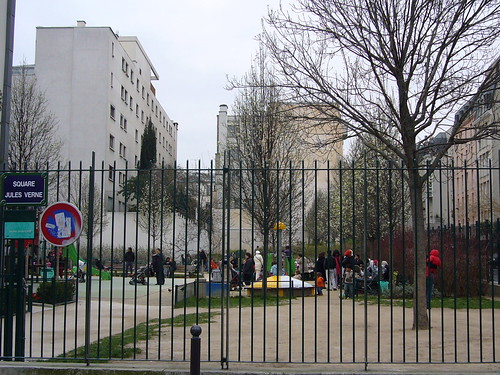
The playground 10 days ago, before spring came for real

Le square français was the second post I wrote on this blog, but as I’ve spent a sunny spring afternoon on one again, I just have to share my enthusiasm once more.
[teaserbreak]
After school, parents and grandparents in France as well as Norway, pick up their small children. Instead of going straight home, as is normally the case where I come from, many here spend an hour or so at the local playground before they go home to make dinner, several hours after the north European equivalent.

This is a square in Belleville, not so far away from the school where the Chinese grandfather was brutally brought in by the police a couple of days ago, when he came to pick up his two grandchildren after school. As the headmaster was also put in police custody for seven hours for protesting against the arrest, the brutality of Sarkozy’s measures against the sans-papiers has provoked such a widespread political debate that it has reached the election campaign. (For better of for worse…).

This playground in Belleville is the extreme opposite of Sarkozy’s election campaign – which has gone as far as proposing a Ministry for National Identity and Integration… – because here sheer coexistence exists. (A frequent critique I hear of Sarkozy, is that he divides the population, the outright opposite of the sought after vivre ensemble, living together). There is not one skin colour or hair colour missing here in the square – but as we are in Belleville, I hear almost as much Arabic as French amongst the parents, and a Swedish looking father was just saying Yalla! to his two blonde daughters. Judging from parents and children’s dressing – as well as behaviour to some extent – there is a thorough social mix as well.

It pleases me to see this mixed local community, but the phenomenon of coming together like this, of children and parents, on an ordinary Tuesday afternoon, just as part of the routine of everyday life, pleases me even more. It’s such a sociable, nice little everyday thing to do… Hanging around for unreasonably long time in whatever place on earth one can find to watching humans interact, is a habit I’ve inherited from my father (biologist, with interest in every aspect of nature). When I tell him about the French square (perhaps as an unconscious attempt to prepare him so he won’t be too surprised if I end up moving to France in order to provide a good growing up environment for my eventual children :) ), he asks me if I think it’s Mediterranean cultural trait. It might very well be, since in Greece and Spain as well, children, youth and grownups come together on public places and spend time side-by-side and together, long past sleeping time for Scandinavian children. But rather than being Mediterranean, I think actually that it’s the climate in Scandinavia making us standing out from most other societies in the world. (I think we can also include the Anglo-Americans to this. A survey I’ve heard cited on the radio here in France several times recently shows that scepticism and even fear of teenagers, based on the lack of contact between teenagers and adults, are far more widespread in Britain that other countries in Europe). And it’s not a Scandinavian exception I’m particularly fond of.

The playground 10 days ago, before spring came for real

Le square français was the second post I wrote on this blog, but as I've spent a sunny spring afternoon on one again, I just have to share my…

Read more

Discussing slam poetry on TV and the schism in French slam

When I was contemplating a title for this post, the first thing that came to mind was the revolution will not be televised (Gil Scott-Heron’s eternal phrase). This association might seem a bit far off, but watching TV as rarely as I do, makes me surprised how crappy that medium is to pass on intelligible and sensible information. (Apropos French elitism versus Norwegian anti-elitism which I wrote about some posts ago; stating that one doesn’t watch TV is commonplace and almost expected in my circles in France, in Norway on the other side it’s seen as verging on elitism :D )

The show in question is a 30 minutes “debate” on French slam between four slameurs and an interrupting and not very knowledgeable journalist, called “Slam: from the bistro to the telly” (Slam: du bistrot à la télé). It was broadcasted 13.11.06 on France 3, and to my knowledge it’s not widely discussed in slam circles, and when it’s brought up it’s mostly in order to diss the fourth participant, which will also be my subject in this post (in addition to dissing TV in general)… I found it on the Internet here. In addition to a lot of interruptions and all-speaking-at-the-same-time (typical French TV entertainment), it also contains some throwing of water and some short slam performances. I’ll give a short résumé…
[teaserbreak]
The show is recorded just after Toni Morrison invited the slam poets with her to Louvre, and it starts with a reportage from the event, first showing Yo (who hangs around in bars in Belleville and whom I just saw animating the monthly open microphone soirée Slam Caravane taking place in the banliues in Seine-Saint-Denis (9-3)), then Astien [myspace] (whom I just met at a huge slam tournament in Le Mans) and ending with D’ de Kabal (who is one of the initiators of Slam Caravane as well as the event at Louvre, my photo here).
The latter was also present in studio, together with Grand Corps Malade (a photo from the soirée in Saint Denis here), Dgiz [myspace, his old site with some old songs] and Pilote Le Hot. The four seems to me a fairy representative choice, except from – as Dgiz remarked during the séance – où sont les slameuses? (“Where are the female slammers?”) GCM is the blockbuster guy, D’ the one initiating a million events, Dgiz for his personal and artistic trajectory and Pilote le Hot for being (one of) the first to introduce slam poetry to France and for being the central figure in a huge slam network. (Links to Slameur and Fédération Française du Slam Poésie).

It’s not a coincidence that I haven’t mentioned Pilote Le Hot before. The network he belongs to is – with very few people overlapping – almost entirely separated from the milieus I’m frequenting. I don’t know yet how I’ll incorporate this other milieu in my thesis. Initially, I was thinking of making it a small comparative case, but I’m not sure if I’ve got time to treat it properly (Any suggestions?)

The TV programme serves as a good introduction to this schism in French slam, as it turned out to be just a big fight over the definition of slam: For D’, it as a space for free speech (espace de parole libre), GCM emphasised the word partage (“sharing”) – of a text, words and emotions and of a stage – as well as free access to speech (accès libre à la parole) and Dgiz defined slam as taking place through l’écoute ((attentive) listening) and as an ephemeral, poetic moment. He continued by pointing to how representative he found the four slammers present there; un black (D’), un blanc (“white”, GCM), un beur (“Arab”, Dgiz) et un animal (Pilote – who quickly became on edge with everyone) [it was here Dgiz asked where the female slammers were]. D’ de Kabal followed by saying that the slammers is not a community like les jeunes (“the young”) and les rebeus (“the Arabs”) [he’s of course ironic here…], they have different opinions. Neither do they have a leader who tells them how to do things… Pilote on the other hand insisted – by interrupting, monologuing and not listening to the others – to such a degree on the original US-American definition of slam poetry as a competition with a jury in the audience, that GCM ended up calling him a fundamentalist (integriste).

Sharing, listening, free speech and the cosmopolitan environment are characteristics I often hear about the French slam scene. However, for Pilote le Hot, apparently only the rules set down in by Mark Smith Chicago in 1984 counts [wikipedia on history of American slam]. For an anthropologist this conflict between purism and cultural translation is of course interesting, but as I said, I don’t yet know how I best can integrate that other scene into my study – and if I’m not already to integrated myself into one part after the schism to cross the boundary to the other.

Towards the end of the program, the four slammers perform a text (Pilote, with a paper on what he claims slam is, D’ knows his – in rememberance of slavery – by heart, Dgiz improvises on the situation and GCM performs the start of Attentat Verbal – also on slam – from his record). As Pilote is not listening to D’, he throws him a glass of water, Pilote retaliates and later says to GCM that in your text you say that whoever can come and do whatever on stage and say that is slam, but that is not the case… and the slam will soon be a competition in elitisme d’underground… GCM calls him an integriste, Dgiz says that you can slam in French and you’ve got French slam now where you can do whatever you want… GCM says Pilot; you’ve certainly given a beautiful picture of what slam is tonight, but he also invites everyone to come to the small bars and cafés where the real slam is going on and see for themselves what it is. D’ almost gets the last word by saying something like (it’s hard to hear because of the noise…) slam is like a large pavement where everyone can find their place but where one sometimes finds a dog turd, and points in direction of Pilote…

Compared to the law of 20 sec concentration span obviously ruling on talk shows on TV, the three minutes recommended time for a slam seems like ages. But the journalist was perhaps happy with the noisy, distracted show he got…

When I was contemplating a title for this post, the first thing that came to mind was the revolution will not be televised (Gil Scott-Heron’s eternal phrase). This association might seem a bit far off, but watching TV as rarely…

Read more

L’anthropologue se cache pour écrire…


Friday 9th of March, Café Culturel, Saint Denis (93)

This evening I should have been on the 129H’s monthly slam session at Lou Pascalou, in Rue Panoyaux next to Metro Ménilmontant. 129H is one of the older slam collectives. I’ve seen the members around on various events, but not yet on their monthly open microphone soirée.

However, I’m almost a little relieved that I finally have caught the Parisian spring cold, so I can spend a few days at home, trying to catch up with what has been going on the last week. I’m starting to get the reputation of being on all events “everywhere”. It’s a nice reputation to have, but very tiring indeed to keep up with….
[teaserbreak]

Dgiz with the classical flutist Sylvaine Helary at L’Olympic Café.

The last five days, I’ve listened to at least 12 hours of slam poetry performances. Yesterday, I was at L’Atelier du Plateau, in a neighbourhood theatre in Rue de Plateau, (in 20eme Arr., not so far from where I live), where the slammeur and rapper Dgiz [site myspace – the second video from the top is a promotion for his slam session at l’Atelier] hosts a session about every sixth week. His soirées are said to be among the best in Paris. Yesterday he had invited an excellent cellist to accompany the poems. If I had remembered to take a photo (I was busy filming), you would have seen a fine example of the combination of high art and banlieue streetart I mentioned in a previous post. Dgiz looks and talks as someone who’s grown up in the ‘hood, but his soirée slam goes well with cello music and poetry from people of all ages and social backgrounds. (A contrast and combination I’m quite sure he accentuates with purpose). For instance, of the more than 40 performances yesterday, about 1/4 were by people at least 50 years old…

There is of course a lot more than the age of the participants to be said about this soirée, but I’ll not go into detail here. Instead, I’ll move back one day to the l’après midi slam I attended at the History and Art Museum in the suburb Saint Denis. It was the third time in four days I’d taken metro line 13 to Saint Denis: This afternoon was hosted by Ami Karim and John Pucc’Chocolat, colleagues of the 500 000 copies-selling slammeur Grand Corps Malade who had won two prizes on the French music award ceremony the night before for his album Midi 20. (Prizes for album and artist discovery of the year.) The slameur-euses at the museum were predominantly from Grand Corps Malade’s weekly workshop for writing in Saint Denis, consisting of pensioners and youth, while the audience was from the age of 7 to at least 70.

One of the things I find great about this workshop (where I sometimes participate/observe) is how it brings together the (white) elderly people of Saint Denis and the youth (of all colours) of today’s France.

Saturday I didn’t go to Saint Denis, but filmed a poetry show on request from the performing poetess at Theatre de la Providence just up the road here in Belleville. La Providence hosts slammeur-ueses throughout Le printemps de poètes. I was there filming another performance last Monday (O-Mind with Ucoc and Chantal Carbon).

On the international woman’s day on Thursday, I listened to members of the Saint Denis writing workshop again, as well as the all woman slam collective Slam ô Feminin. Slam ô Feminin was created 4 years ago, at the 8th of March, exactly at the Café Culturel in Saint Denis where I heard them now. This café, next to the old basilica in Saint Denis, is a corner stone in French slam – they’ve been hosting slam sessions for several years.

On Friday, the oldest cohort of slammeur-euses was gathered at the same café on a closed event (which stirred some resentment, as one of the definitions of French slam is that it’s an open mic…). Grand Corps Malade, Souleymane Diamanka, Dgiz, Chantal Carbon from Slam ô Feminin… and almost 40 others performed their texts. I was watching the crowded café from an excellent view in a staircase amongst the slammeurs whom I now exchanges la bise with, and was thinking about the first time I was here at Café Culturel in the summer, listening to the poems from the outskirts of the circle, not being able to see much else than the peoples’ backs, the Saint Denis shopping centre and the basilica… After finally finding a focus for my thesis in early June and got back to Paris after an autumn in Norway, my research is progressing so rapidly that I have a hard time following…

This week I hope to make use of my timely cold to stay at home and keep still for a moment to get an overview over what I’m doing. (For instance; am I going to focus on open microphone events, on poetry workshops, on persons extending to the theatre and other performances they do… I have already a pile of poetry texts I’ve just started to look at and which I certainly must read all of before I start interviewing people…). All there is on the agenda the first half of this week is a workshop with homeless people arranged by Slam ô Feminin, and a slam session at the Mental Hospital Sainte Anne in relation to Le Printemps de Poètes. I finally hope to get some rest and some order.

Friday 9th of March, Café Culturel, Saint Denis (93)

This evening I should have been on the 129H’s monthly slam session at Lou Pascalou, in Rue Panoyaux next to Metro Ménilmontant. 129H is one of the older slam collectives. I’ve seen…

Read more

Fieldwork and (little) blogging

I’m happy to hear that some Master students read my blog in order to prepare for their own first fieldwork. The idea of this blog has never been to inform about what’s going on in France, neither on findings in my own research, but rather to show snapshots from an anthropological fieldwork-in-progress – so I would love that other fieldworkers (to be) find inspiration here. As the research has moved into a new stage after I returned to Paris in mid January, the time is therefore overdue to provide some news from the progress.
[teaserbreak]
My low blogging frequency recently is partly due to lack of time. Since I held my breath (out of fieldwork anxiety) and dived back into the Parisian slam poetry scene the 24th of January, I haven’t had many idle moments. As I mentioned in the previous post, French slam poetry has really taken off recently. I’ve started to film the soirées, in order to better capture what “slamming” is about. Just as blogging brings about (unforeseen) consequences for the fieldwork, so does of course also filming. It takes up incredible much time, but lets me study in detail the texts, but the performance, gestures, ways of dressing and interaction with the audience. Perhaps it was a bit shortsighted of me to not realise that the time I knew I would have to spend on filming would have be taken from some other fieldwork related task (as I’ve never had any free, non-fieldwork related time here, unless I’ve had visitors).

I still spend a lot of time in front of my computer, but instead of reading news on Indymedia or in the dailies and weeklies (on the election for instance…) or write for this blog, I write notes or convert and organise my videos. And of course, the more time I spend outside, the more material have I to work on when I come home.

However, I’m not sure if lack of time is the main reason for my reluctance to post here. I rather think it’s the stage of fieldwork I’ve reached at the moment. I’ve all the time been cautious to blog too close to my fieldwork proper, thus I practically never mention people I know well and go into detail on events I participate in. I think there are many reasons for this prudence and reluctance, some of which I’m probably not even conscious, just uncomfortable… One is that I want to avoid imposing premature interpretations which undoubtedly will happen if I write text to publish here. Further, the unpredictability of anthropological fieldwork does that I never know who will get an important role in my research later, and again I would feel uncomfortable publishing a premature description. So now, when I spend all my time with/studying people I know, I get fewer ideas for suitable subjects to write about.

I’m happy to hear that some Master students read my blog in order to prepare for their own first fieldwork. The idea of this blog has never been to inform about what’s going on in France, neither on findings in…

Read more

Art in the suburbs


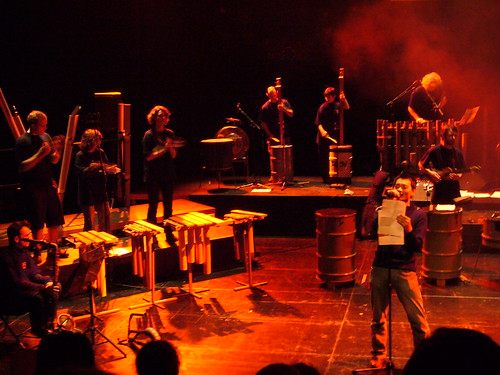
Slameur and musicians in a forum culturel in the suburb

Following the Parisian slam scene immediately led me to the suburbs. During my 9 months long first stay here, I crossed la pheripherique (ring road) only five times (except to go to the airport). Three times in the summer I attended open microphone slam events; two in Saint Denis (by Stade de France which one can se on the way to the airport) and one in Fontenay-sous-Bois (to the south east). Saint Denis is well connected to the metro system, Fontenay-sous-Bois is not, and it was a true galère to get there, according to one I travelled with. (One of our adventures dans la galère, I recounted here in Nouvelle France).
[teaserbreak]
Before I discovered the slam phenomenon, I went extra muros only twice, both with a friend visiting from Norway. Partly we wanted to have a look at the places where the youth were so angry, partly we went traditional sightseeing. In Saint Denis we dropped by at the famous basilica there where all the French kings have been crowned, and in Val-de-Marne we went to Mac/Val, a contemporary arts museum.

It seems quintessential of for this state, built on the ideal of Enlightenment to the people, to put such avant-garde institutions far into suburbia. It costs (practically) nothing to enter, which is probably a way of encouraging the locals to come to this place. I think they succeeded to some degree. While the exhibition was rather playful, the restaurant was minimalist, in terms both of its interior and the food. Someone told me that the highbrow restaurant was an attempt at encouraging Parisians to take the trip. However, the atmosphere (and prises?) didn’t encourage the locals I observed to feel at home there. (I remember this incident, but I can no loner remember what made me think certain visitors were locals belonging to certain social strata –at the time, I obviously didn’t follow my own note-taking advise and described instead of categorised….)

To get to this museum, one takes a metro line to its final destination (Choisy – Chinatown, in fact, which we discovered also made it a poor target for our angry youth expedition – perhaps the sino-français haven’t yet become second or third generation on the dole?), and then walk or take a bus even further into the (sub)urban sprawl.

The same travelling procedure, I’ve followed several times the last three weeks. First, I take the metro all the way to its terminus, then I go on by feet, bus or tramway – through names of places one remembers from the November ‘05 riots –, until I am at a Place de la Liberation or Place de la Résistance…(I’ll leave these interesting place names, full of national remembrance, for another post), where I find some more or less grandiose cultural centre where all kinds of experimental artistic activities take place. The slam poetry is not at all seen as an experimental activity, but rather to “invite the street in and listen to it”.

In one of these places, Le Blanc-Mesnil, the whole affair appeared slightly absurd to me: Outside the very grandiose Forum culturel there were groups of predominantly black youth dressed hip-hop style inside, well, the percentage of black hip-hop style was not very high.

The Norwegian arts scene is probably one of the least elitist in the world, while the French is probably quite high on the other end of the spectrum. So, while I find a bit bewildering the time and place to perform some rather experimental jazz jam or modern ballet or whatever, the French seem to react if it is completely normal.

Slameur and musicians in a forum culturel in the suburb

Following the Parisian slam scene immediately led me to the suburbs. During my 9 months long first stay here, I crossed la pheripherique (ring road) only five times (except to go…

Read more