search expand

Back home part 1 – blogging continues

Since October 2005, I’ve been blogging from my fieldwork experiences right amongst the Parisians, but from now on this is – hélas – no longer the case. I’ve returned to Oslo with all my fieldnotes, photos, impressions and sentiments, and after living and working autonomously for 10 months, I’m now trying to reintegrate into the office environment (as well as my Oslo life). Since my intention with this blog has been to document not only how my fieldwork developed, but also the rest of the research process, I’ll try to keep on blogging from the office.
[teaserbreak]
From my (new) office at the University of Oslo, I’m looking down at one of Oslo’s more well-off neighbourhoods, with multicoloured wooden villas, all with neat gardens dotted with apple- and various other trees. (While (the lack of) mixité social seemed to be an ever-present matter of concern in Paris, I don’t find it to be that much of an issue here).

From one corner of my office window, I see the light blue Oslo tramway passes every fifth minute or so, and from the other I see a red brick church at a small tree-covered hill. When I lean a bit over my desk, I get a glimpse of the clear blue Oslo fjord with some blue hills on the other side. Far away, climbing up another hill, I see what must be a banlieue, with its high-rise buildings from the 1960s. The university campus itself is situated up-hill from the centre as well. All these hills I’m describing remind me of a funny incident when someone who knew my street in Paris described it as “the one that goes up”. I was struck by surprise for a second, when he said that. Yes, elle monte un peu, but what surprised me was that I had never even noticed the slight rise. Looking at the geography of Oslo – and even more so at the hilly city of Trondheim, where I lived the first twenty or so years of my life – one easily understands why.

So, from this office with this view, I hope to get on with stage two of my research project. From documenting research-in-progress during fieldwork, where theoretical and analytical discussions have been scarce or absent, I think the blog posts the next months will take two distinct but intertwined directions. On the one hand, I’ll write explicitly research-focused posts on how the project develops as I read, write and discuss my work. On the other hand, my mind keeps creating small (phenomenological) blog posts on my experiences in Oslo and how that contrasts with Paris. I think writing about such ethnographic contrasts can have several functions. As I experience them, they will probably take part in shaping my attention in the following stage of the research process. They can also perhaps be stepping-stones for a possible future fieldwork in Oslo. We’ll see we’ll see. I don’t know if I even can manage to experience, and write about, Oslo as I experienced and wrote about Paris.

The two following posts will be one in each direction: First a research centred post about the ethnographic status quo of my project, as I presented it at a multidisciplinary seminar last week, then a Norway/Paris contrast-focused post on techniques du corps (where cycling plays a part, of course).

Since October 2005, I’ve been blogging from my fieldwork experiences right amongst the Parisians, but from now on this is - hélas – no longer the case. I’ve returned to Oslo with all my fieldnotes, photos, impressions and sentiments, and…

Read more

Boulevard phenomenology


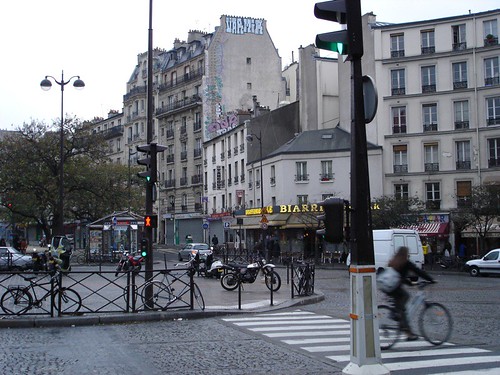
Place de Ménilmontant in the autumn (with bikes and cyclists…)

It’s been ages since I’ve been walking down the boulevard, but today I was doing it again. My bike has been stolen! And it was stolen from one of my favourite places, Place de Ménilmontant. Well, such things happen, and anyway it was a too small, but it feels strange that it should happen less than 48 hours before my departure. It’s the third (attempted) crime that happens to me after I came here. First I was robbed for my deposit (1300€!) for a flat that was way too expensive in the first place, then a kid tried to nick my camera during an anti-CPE demonstration (we both looked the same surprised – me because why would someone nick a fellow demonstrator’s camera, him because the camera was attached with a string around my neck so he didn’t get it…) and now my funny little green bike…
[teaserbreak]
Cherry blossoms at Place de Ménilmontant in the spring

Walking down the boulevard again made me think a lot of things. I thought about the very first time I walked that part of it, mid November eight and a half months ago. I was going from my previous flat in bobo (i.e. quite gentrified/emborgeoisé) Ménilmontant to Charonne, which is neither gentrified, neither nothing else – just okey, quite boring. After I’ve left the familiar area around Place de Ménilmontant which is not yet gentrified, but just full of cafés anyway, I passed the main entrance to the cemetery Père Lachaise at the time of the soup kitchen. The queues for free food are divided by gender, which surprised me at the time. Now I’ve passed the soupe populaire outside the Père Lachaise so many times that to not have to pay special attention to the people sitting in the bicycle lane around dinner-time around 20H would have been more surprising than to actually see them there.

Rue de Ménilmontant, in direction of Place de Ménilmontant, with Centre Pompidou in the background

There are some quite deserted areas after Père Lachaise and down to my present flat. I rarely had to pass areas like that where I lived before, so I remembered it made me a bit anxious that first evening mid November, even though the time was hardly more than 8 o’clock in the evening. I remember the anxiety, and it’s funny to think about it now. Now everything is familiar, and it takes more than an empty stretch of the boulevard to make me uneasy. – Just now, on that stretch I passed a blonde and large threesome German family, sweaty and bewildered looking at a map, towards whom I acted Parisian and local and asked if I could help them. They looked for the night bus, and I told them the way – 5 minutes from where we were. I saw a friend off on that bus less than a week ago. How different everything feels now, after some months. – I remember the first time we (my travel company and I) were at Place the Ménilmontant. We felt to be so far east that we hardly imagined that we would dare to go further… And I remember the first time we actually dared to go further east, up the Rue de Ménilmontant, and how I, after a while, should start to say hello to the local Asiatic greengroser there, and how I should see the graffiti change and how I even, at the end, should start to know people in some of the local cafés in nearby Rue des Panoyaux

It’s amazing how quickly we get used to places and how the perception of these places changes completely as we get to know them. One of my – far to many, far to ambitious – plans for the autumn is to write an academic article based on Alfred Schutz’ The Stranger (on how the stranger slowly makes him- or herself at home in a new environment), and Tim Ingold’s notion of dwelling, (on how people, when making themselves at home in that environment also changes that environment a bit). For in a not very long while, I’ll not wander around getting to feel at home in Parisian boulevards, I’ll sit at my office making anthropology of my ethnographic field notes… (And people will not be able to make fun of me saying are you awake now when I send them an e-mail or sms at 10:30 in the morning – but anyway, I’ll still be able to make fun of them for knowing the Parisian streets better than the Parisians themselves ☺ )

Me when I still had my funny little green bike (photo from Pharo in Marseille)

This is not the last post you’ll read about this favourite boulevard of mine, stretching almost all the way through eastern Paris, from Place de la Nation up to Place de Stalingrad and Bassin de la Villette. I hope to soon write a comparison between this Haussmanian grandiose, three-linen and very French boulevard with the cheapest road on the English monopoly board – the hideously gorgeous Old Kent Road, and perhaps my local Oslo street Trondheimsveien. All lively, cosmopolitan east end streets I’ve had the pleasure to live next to for a while in my life.

Place de Ménilmontant in the autumn (with bikes and cyclists...)

It’s been ages since I’ve been walking down the boulevard, but today I was doing it again. My bike has been stolen! And it was stolen from one of my favourite…

Read more

My blog, my project and I, part 3 – I and Politics

Another warm night, and it seems like insomnia strikes again despite however little storm and poèsie infused sleep I had last night. I’ve been too snotty to go to the jazz concert in Parc Floral and hang around somewhere in East Paris until the early hours, as would have been suitable for this hot Saturday. And I regret it a lot, especially since it’s my second last weekend here (and only three more jazz concerts to go, amongst all the other things I’ll be missing…). Instead I make use of my sleeplessness to finish a blog post I’ve been planning for months.
[teaserbreak]
As my fieldwork is soon coming to an end, it’s time to take a step back and look at what I’ve been doing here, and why I’ve been doing these things and not others. It’s been a lot of politics, in my blog as well as in my experiences here.

As I’ve mentioned before, my initial intention to study peaceful and harmonious cosmopolitanism as it is played out in people’s everyday life, quickly faded into the background since I had been fortunate to step right into the largest revolts and demonstrations in the time of the Fifth Republic (1958-). (And probably, simple harmony sans rebellion would have made a poor representation of French society, anyway. Apropos, the almost free jazz concerts in Parc Floral constitute exactly such a harmonious cosmopolitan space. There is every colour on the planet present, and the number of mixed couples, babies and circles of friends equals Marseille ☺. The styles of dress vary from the banlieusard’s trainers, tracksuit bottoms and t-shirt to chic west end babes with sunglasses and expensive skirt and top, via almost everything else. And, as I’ve noticed to my delight at an east Paris hub like Place de Ménilmontant as well, all colours/ethnic backgrounds are represented – though not equally numerous – in all styles and functions. Thus, no multiculturalist neat little boxes to put the people inside. Though, I should add that this mix might have decreased with the summer reaching its zenith, as more and more Parisians are leaving for vacation and being replaced by more and more groups of tourists and foreign western students).

Besides, as more than one post on this blog have tried to show, it doesn’t take long to start sensing the reasons behind people’s frustration and anger. Policing and security is one such issue. After a quiet week in Corsica, it took one night out in Marseille for my Norwegian company not yet accustomed to the present government’s “securitarian” measures to get a feel of this situation. We watched the world cup football semi-final Portugal-France in the Vieux Port. After the match we stuck around for a while with a few thousand others, sharing our last can of beer while watching the celebrations. Teenagers on scooters drove around in corteges waving flags and hooting. Kids were running around while their parents were chatting. – I saw a brother yelling at his little sister for walking around alone shooting pictures of the crowd with the family’s digital camera, while their mother just laughed at it. There were firecrackers and drums, and a little (very little compared to where I come from) drinking and a little (much more than where I come from) cannabis smoking. A group of thirty-something were just about to light their joint next to us, and I was just about to say to my company that sooner or later someone will throw something in the direction of the Robocop-looking CRS police who are never far away on such occasions, who will in turn start charging, which again will provoke more projectiles from the crowd… when a group of CRS suddenly ran up right behind us with all their riot gear. So less than 45 minutes after France had beat Portugal, the CRS found it opportune to start clearing the Vieux Port. There were still children there, I even saw a father carrying his 3 months old baby away from the tear gas… A large section of the crowd had involuntarily been trapped on the opposite side of the port of their way home, but I also think some families with older children stuck around for their kids to see what France is like these days. My company, who had not yet become used to see the police in action on almost every night out, was surprised and a little bit upset and angry: It was utterly incomprehensible to us why we couldn’t go on with our little celebratory street party a little longer…

So, all this writing on politics of resistance has come naturally, from the circumstances. In addition, of course, it’s due to my own social and political concerns and interests. It’s not the first time I become politicised when I leave the peripheral Norway and go to Europe. (This has got more to do with Norway than with Britain and France, “remember, it’s Norway that is exotic,” my old French teacher used to say when we were surprised by some strange ways of the French). It happened on my previous fieldwork as well, in London in 1999, although then overt politics didn’t make its way into my final texts the same way as it undoubtedly will this time.

My fieldwork (amongst British Asians) and my life in our communal house was so far apart when it came to political activism, that on a demonstration where I went with one of my flatmates (a British Pakistani), he was so excited about seeing one other South Asian looking guy there, that he wanted to go straight over to him and try to get him to be my informant. This was on the great Carnival against capitalism, at the day of the G8 meeting on June 18, 1999, which together with the Seattle meeting in November the same year, marked the beginning of a new era of anti-capitalist and anti-(economic) globalisation protest. It was inspired by the anarchic street party approach of the Reclaim the streets anti-capitalist, anti-corporation, anti-car phenomenon in Britain from the mid 1990s, and it was to become increasingly transnationalised, – epitomised by the slogan “Our Resistance is as Transnational as Capital”. For me, the experience of spending a whole day in the enjoyable, but conscious, atmosphere at this do-it-yourself street party right between the corporate giants in City, woke up my old anarchist political consciousness that had been slumbering ever since my teenage years of naïve reveries had ended. After that moment, I understood perfectly well Durkheim’s analysis of how participating in rituals make individuals feel that they are part of something bigger, which can give them a certain sense of meaning in their lives.

In London, I met loads of people who believed it was worthwhile making the world – as well as the local community – a better place to live. In my ears, it sounded like people were discussing things that mattered, things worth living and fighting for – and they often tried to live accordingly, not just exist to consume… Well, what happened when I got back to Norway after my previous fieldwork? We all seem so bourgeois there, caught in our narrow, bourgeois lives, – to put it with an everyday French term. But perhaps it’s just got to be like that, in a society without foreign debt, where the buying power is just rising and rising and where we seem to be so comfortably far away from the misery of the world.

Here, the world is on our doorsteps – if not in our own house: the misery of it as well as its diversity, its resistance, its hopes… The cosmopolitanism, the transnational connections, the creativity, the political consciousness, the sociability, the poetics – all this constitute for me sensations, emotions, atmospheres and everyday routines – as I wrote in this blog some days ago – which I’ll miss immensely when I leave. Because I know, as I also wrote, that it takes no time at all for this state of mind to be replaced, as soon as I step back into my Oslo way of life, to such an extent that my Paris experience – as with London some years ago – appears as a parallel but distinctly separate universe.

Another warm night, and it seems like insomnia strikes again despite however little storm and poèsie infused sleep I had last night. I’ve been too snotty to go to the jazz concert in Parc Floral and hang around somewhere in…

Read more

Slam poetry


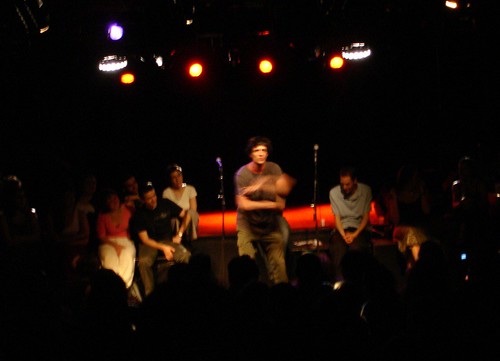
Slam ‘aleikum – slam poetry soirée in Saint Denis (93)

I realised last night – dozing uncomfortably under rather dramatic circumstances, in the midst of a thunderstorm lightening the sky and with the wind making slamming windows and shutters throughout the street, and not to mention the pool of sweat from the perpetual heat wave as well as my untimely cold – that it’s about high time I write about what I’m actually doing here.
[teaserbreak]
At the end of the slam poetry soirée I had just attended, one of the slameurs – in one of his usual, but extraordinarily forceful performances – had ran onto the chairs among the audience and screamed the end of his poem standing on his knees on two chairs right in front of me. I can’t say for certain that I understood exactly what his text was about, I must to admit (I was outside when he started, and due to the seemingly explicit content I’d like to be sure before I go into it. My illness made me a rather bad researcher as well as bad company yesterday….). Images from his performance, the incredible heat in the small exhibition locale, the animated audience and many of the others – slammers, poets, story-tellers, toasters, mc’s, rappers – made its way into my imagination last night and disturbed my sleep in an unpleasant, but not uninteresting way.

I find the slam poetry scene in Paris rather extraordinary. The mix of people – from school children to pensioners, with a peak around the age of 30 I’d guess, women and men, and all colours and with seemingly no social or class bias – is amazing, so is the variety and authenticity in many of the texts and performances. People slam about personal or everyday experiences, issues of identity, history, love and sex… I’m so optimistic about my research project after I discovered this looking-glass by which I hope to better understand as well as describe some important aspects of French society. As I’ve found my research focus, the biggest challenge now is to understand the depth and nuances of what these slameuses et slameurs are saying, – as their rhymes and rhythms, poetics, imageries, slang and verlan not exactly make French more accessible for a foreigner. Having said that, it’s hard to find a scene more inspiring for expanding my understanding of the language of Baudelaire… (And as passionate I am about literature as well as social issues, I’m also a rather classically trained anthropologist, so it pleases me to do research on such a human universal phenomenon as spoken word performances.)

Cycling home in the night, I cursed my poor state of health and wondered what could have happened if I had hung around outside the locale a little longer as people stood chatting or if I had joined the group who went down to Canal Saint Martin to do a slam sauvage there. (I just got two enthusiastic, though apparently tired, text messages from one who had been by the canal: “Quelle nuit,”…). I think these regrets, as well as the anxiety about the project and sadness for having to leave just now when things are so great, contributed to my stormy sleep.

I’ll probably provide some links and stuff for the slam poetry scene later, but for the moment I’m not yet sure how I’ll go about the important issue of anonymity if this is really what my Ph.D. project will focus on.

I’m hesitating before writing the final paragraph. In several posts earlier in this blog, I’ve made reference to the skin colour of the people present. I’ll to that now as well, but with a reluctance which I’ll explore somewhere else: The group going down to the canal consisted of eight people with the following traits: black, Chinese, North African (the only girl except from me), one seemingly white (10-22 years older than the rest of us) and one seemingly Latin American and three European/whites (East, half Balkan and North (me)). The ethnic mix among the ones hanging around after closing time was about as diverse.

Slam 'aleikum - slam poetry soirée in Saint Denis (93)

I realised last night – dozing uncomfortably under rather dramatic circumstances, in the midst of a thunderstorm lightening the sky and with the wind making slamming windows and shutters throughout the…

Read more

14th of July


[teaserbreak]
Someone asked me if I wasn’t going to write a post on the 14th of July, He had read somewhere that there use to be a military parade in Paris that day, but on my blog he only saw some funny photos that didn’t really looked like a military parade, so he didn’t really understand what was going on…

Yes, there is a military parade at Champs Elysées in the morning at 14th of July – I could hear the fighter jets all the way into my sleep on the other side of town. Due to lack of personal – as well as professional interest – in military parades, I chose not to go, but I saw a little of it at the news before I headed off to another parade. During the months I’ve been here – thus after the November riots – French media has finally decided to make a little effort in showing that non-whites can do other things than play football or make rap music, so quite a few of those interviewed as either participating in the parade or as audience, were black or of north African origin. That was quite interesting to observe, but as an angry young (and white) man I know says, while getting a little bit angry: yes, they have started showing blacks and Arabs on tv the last months, but it’s just normal that they represent the diversity in the country! (I can understand why he is upset, particularly if one looks at all the fuss there has been about a new news presenter on the biggest channel, because of his black skin colour.)

Neither did I go and look at the fireworks in the evening the 14th, nor did I go to one of the traditional fire brigade balls which take place all over the city the night before. The latter I think could have been very anthropologically interesting, but I was in stead at a slam/spoken word session and afterwards I was hanging around outside until the early hours, seeing the city go to sleep as well as waking up. At the slam soirée, they took very little notice of that fact that it was the night before Bastille Day, instead they celebrated that it was their own third anniversary and gave away a piece of cake to every performing poet.

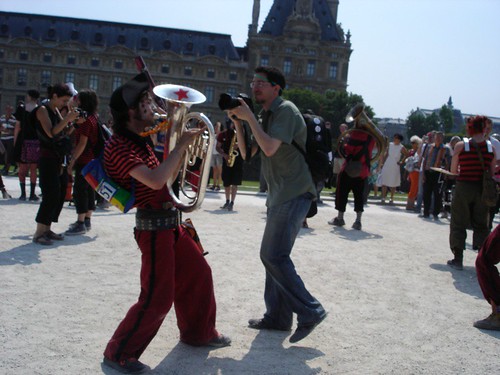
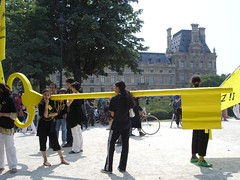
So, after sleeping soundly through the exhibits of France’s military splendour, I went to a quite different and very nice activist event nearby Louvre, with the revolutionary motto “France is like a baby, if you love it change it!”, where various anti-elites were gathered. It was various groups of sans papiers (Droits Devant! and Le 9ème Collectif des sans-papiers, a couple of groups for the right to proper housing (Comité des sans logis and Droit au logement bicycle activists (Véloroutions vélo means bike in French), other enviromentalists against nuclear power and France’s attept to export it’s old ship Clemenceau full of asbestos to India, AIDS north-south and gay-activists (Act-up), anti-militarists, and of course the Brigade activiste des clowns (BAC, which also connotes Brigade anti-criminalité), for the day I think renamed to Clown à Résponsabilité Sociale (CRS)(photo).

[teaserbreak]
Someone asked me if I wasn’t going to write a post on the 14th of July, He had read somewhere that there use to be a military parade in Paris that day, but on my blog he only saw some…

Read more