search expand

Contrat premiere embauche – Protesting à la français

Initially, I hadn’t planned to go to the major demonstration against the CPE (“contract ‘first employment'”) as it only tangentially touches the focus of my fieldwork (tangentially, as the CPE – Contrat Première Embauche – is part of Prime minister Villepin’s plan for égalité des chances: youth unemployment is high in France and even higher in the Zones sensible which is in need of the equal opportunities). But as the echoes of the chanted slogans reached all the way to my flat – situated at least 20 minutes away from the standard demo route Place de la République/Bastille/Place de la Nation – and I saw the diverted traffic as I leaned out of the window, I realised that the scale of the event made it worth defying the heavy rain and head for Nation.
[teaserbreak]
The ten minutes walk down Avenue Philippe Auguste, I was thinking about how different French politics are from what I’m used to. The implementation of the CPE is a good example. In L’Assemblée Nationale the politicians can speak loudly, clap, make noise and sometimes shout, and – most exotically – even express themselves with eloquence. In this, France is similar to Britain. The importance they give to demonstrations is however different.

One month ago, there was a discussion in the National Assembly on the government plan of implementing the CPE and other “equal opportunity” measures, which went something like this: A socialist politician shouted to prime minister Villepin (the architect of the CPE): – You should listen to the streets! (alluding to the first demonstration against the CPE taking place at the time). Villepin, Monsieur l’éloquence personally, replied, with oratorical pathos: I am listening to the streets… – but I also hear the ones who are not down at the streets (pointing to the rather feeble support for the demo). Demonstrations have thus an important political role to play in this country. (I’d like to give some other examples, but as this is meant to be a quick post, I’ll leave it for another time).

As I arrived at Nation, I noticed that 7 of the 8 boulevard and avenues running into the square were lined with the CRS – riot police – standing around, looking after their helmets, shields, batons and other riot gear… (The 8th street was of course the one where the protesters entered). I don’t think such demonstrations, full of healthy (though leftwing) pupils and students and more or less bourgeois labour unionists often turn violent, but the Republic obviously wants to put her measures at display. – So also with her boulevards and avenues, constructed broad and straight as they were in order to easily suppress popular rebellion…

I think about the republic and her broad boulevards, full of politics, as I linger for a while in Place the la Nation: I once participated in a tiny little demonstration in London (I think there were 16 000, which would hardly count as a demo in a country where hundreds of thousands take to the streets many times a year) making City a drum’n’bass dance party and consequently a no-go area for the police for hours… as the narrow and winding streets of City is not made for riot police.

After taking some blurred, grey and rainy photos of the last part of the demo down Rue du Faubourg Saint Antoine from Bastille, I hurried home in order to change shoes, socks, trousers and umbrella (ready for the dustbin) before I went to a neighbourhood democracy meeting in a nearby school, which of course turned out to be full of people discussing, objecting and protesting and talking about art and the importance of preserving small-scale artisan affairs for hours…

Initially, I hadn’t planned to go to the major demonstration against the CPE ("contract 'first employment'") as it only tangentially touches the focus of my fieldwork (tangentially, as the CPE – Contrat Première Embauche – is part of Prime minister…

Read more

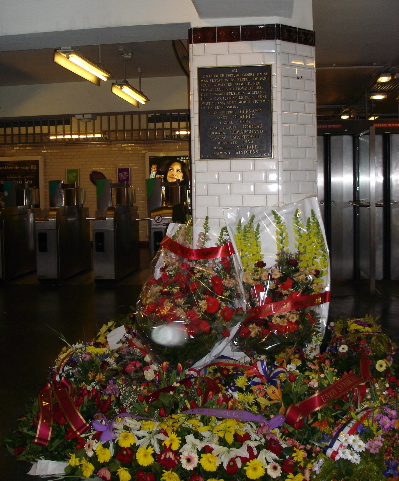
Métro Charonne, 8 février 1962

“Here, the 8th of February 1962, in the middle of a demonstration for peace in Algeria by the people of Paris, 9 male and female workers; communists and union activists, of whom the youngest was 16 years, were killed in the repression. CGT, PCF.”
[teaserbreak]
They were mainly pensioners at the commemoration Wednesday, more men than women, mostly white, but also quite a few Maghrebins. A Maghrebi father had brought his two sons in their early teens. Apart from them, there were no children and not many young people (11 o’clock being of course in the middle of work for most people). I spotted a couple of other students or researchers like me (white women), with their notebook and camera, and a handful of photographers or journalists (non-white men of varous ages – one from France 3 (who has a strong regional news coverage) asking an elderly woman in front of me for an interview. To my knowledge it hasn’t been shown yet. There was also a cameraman there, filming for a documentary, I heard later).

I arrived late, and the loudspeakers were of not very good quality. Thus as I stood in the back of the crowd of maybe some hundreds(?), I didn’t hear much of what was said. However, the member of the Communist Party concluding the event spoke in a loud voice and I heard him make reference to the ongoing realities of everyday discrimination and the deportations of sans papiers (see manif). But above all, he spoke of the commemoration as a travail de mémoire (memory work) to force awareness upon the nation and also an effort to make “the martyrs of Charonne” recognised by state.

Where are the young Maghrebins?”, a white female pensioner asked at the meeting at the townhall afterwards. As I’m reading a book for the moment on the lack of collective memory of this generation (Abdellali Hajjat, 2005: Immigration Postcoloniale et mémoire), I think it’s a good question. But, it shouldn’t go for only the young French Maghrebins; it goes for all the young French. The participants were all but a very few of a certain age, and the memory of the events in 1961-2 is about to perish with them. The meeting took place at the hall of festivities at the town hall of the 11th arrondissement, an imposing place imbued with symbolic meaning that I haven’t got time to go into now. After two brief speeches by an historian (Alain Dewerpe at EHESS, 2006: Charonne, 8 février 1962, anthropologie d’un massacre d’État) and a journalist (Jean-Luc Einaudi: La bataille de Paris, on 17th of October 1961), numerous people in their 60s and 70s testified of their experiences of the time.

Finally, before I go out and take a photo of the memorial plaque at the station, a few words on what took place that day in February, 44 years ago. It was state of emergency in France and 6 weeks later a ceasefire was to be signed. From what I have read, the outcome of the war was already given and acknowledged – except by the illegal OAS (Organisation de l’armée secrete, who in fact has been in the news again lately in relation to the law from February last year on colonialism… more on that later) who were fighting to keep Algeria French. The demonstration was held against the continuous attacks and assassinations carried out by the OAS at the time, and it was organised by a number of trade unions and the Communist Party.

“Here, the 8th of February 1962, in the middle of a demonstration for peace in Algeria by the people of Paris, 9 male and female workers; communists and union activists, of whom the youngest was 16 years, were killed in…

Read more

“The martyrs of Charonne”

Yesterday, I had planned an academic expedition to L’École des Hautes Études en Sciences Sociales again, this time for a lecture on the sociological use of documentaries where they would also screen a “cinema verité” film on young Parisians’ vision on happiness from 1960 (Chronique d’un été). But chances wanted that I should stay in the neighbourhood and, in fact, be witnessing the making of a documentary on recent French history.
[teaserbreak]
Not long ago, I had included the communist newspaper L’humanité to my RSS desktop reader (that every morning kindly fills my laptop with hundreds of news in English and French). L’humanité appears for some reason high on that list of news, just under BBC and À toutes les victimes. In this instance that was luck, because about 20 minutes from the time I was turning on my computer and having my morning coffee there were to take place a commemoration ceremony for 9 people who died due to police brutality in a demonstration 8th of February 1962, during the Algerian war… It had happened at Métro Charonne, just 10 minutes from where I live. And I had no idea about it…

(The Internet was conspicuously silent on the ceremony to take place, but I found out that Indymedia had published a text the one day that I was unable to access the web (or even leaving the bed due to some stomach ailment anthropologists possibly are subjected to experience qua anthropologists in the field, wherever that field might be).)

What is the point of this long intro? Apart from making a (methodological) point of the importance of serendipity in fieldwork, I of course also want to make a claim about the invisibility of certain facts in the collective memory and history of this country.

In the autumn, I learnt that on 17th of October 1961 the Parisian police threw more than 200 (we will never know the exact number) peaceful Algerian demonstrators into the river. The recentness of such a brutality in a European capital is shocking to me. So is the lack of attention devoted to it. After the commemoration ceremony yesterday, I scrutinised the buildings around the metro entrance to see if there were a memorial plaque there. I found nothing that would remind the passer-byes of what had happened just some 40 years ago (but it seems there is one on the inside of the station, I’ll have to go and check…). However, at the open debate/meeting at the town hall afterwards I was to hear that the intersection between Boulevard Voltaire and Rue Charonne is to be named Place de 8 février 1962.

After the crushing of the demonstrators (150 wounded, in addition to the 9 deaths) the police tried to make up the most ridiculous lies, as they had after La nuit noire, 17th October 1961. However, between 500 000 and 1 million people participated in the funeral cortège to the cemetery Père Lachaise. But the chief of police, Maurice Papon continued in his job for years afterwards… (The same Papon – and this is something I must admit I don’t understand – had also had a high position during the Vichy Nazi collaborating government and taking part in sending more than 1500 French Jews to extinction…) These facts are known to the French today, but I must admit that they are so shocking to me that I don’t understand why they haven’t got more attention.

The French state has probably known better than most that l’oubli (forgetfulness, oblivion, omission, oversight) is fundamental for any nation (Ernest Renan, 1882: Qu’est-ce qu’une nation?) But over and over again the recent years, not to say months, it has become apparent that this long lasting and biased oblivion has to come to an end.

(As I write this, France 2 is broadcasting a critical American documentary on the laïque (secular) French state, at the moment focusing on the controversy around the Muslim headscarf. I hear a veiled girl say; “Integration, that’s finished. That was our parents’ generation. I am French. I’m born here”).

Yesterday, I had planned an academic expedition to L’École des Hautes Études en Sciences Sociales again, this time for a lecture on the sociological use of documentaries where they would also screen a “cinema verité” film on young Parisians’ vision…

Read more

A day in commemoration of slavery

The 10th of May is from now on going to be the national day in commemoration of abolition of slavery. 10th of May in 2001 was the day slavery was declared crime against humanity in France, which was the first country in the world to adopt such a law. It was the deputy from French Guiana, Christiane Taubira, who proposed the law, and its been named Loi Taubira after her.

In his speech, President Chirac proclaimed that “the greatness of a country is to take on all its history, the glorious pages as well as the dark parts. Our history is that of a great nation. Look at her with pride. And look at her as she is. That’s the way a people can unite and become more close(-knit).”

(As a foreigner, I do find interesting this constant return to the greatness of the French nation, and I can’t forget another of Chirac’s speeches lately on the issue of nuclear weapons, but be that as it may).

Le Monde greets Chirac’s speech and holds it together with two other speeches as strong and important moments of his reign as President: 16th July 1995 when he for the first time recognised the French state’s role in the deportation of thousands of Jews during the Second World War; 15th August 2004 when he honoured the North African and African veterans’ contribution to the liberation of France and the speech 30 January 2006.

(Again, many others in this country will not remember Chirac for these three speech, but rather for the one 19 June 1991, gone into history as “le bruit et l’odeur” (the noise and the smell), where the President lately so famous for his antiracist stance made speech worthy of Le Pen. I’d really like to say a lot about it, but be that as well as it may for the moment).

The 10th of May is from now on going to be the national day in commemoration of abolition of slavery. 10th of May in 2001 was the day slavery was declared crime against humanity in France, which was the first…

Read more

Literature and I, hors sujet 1

– For those who are more interested in my research project than in my person, I hope you’ll excuse this post as it’s got very little to do with my fieldwork. It’s a too long (an delayed, as I’d forgotten to post it…) reply to a post on the anthropology blog Savage Minds.
[teaserbreak]
The questions from Savage Minds go: What were he books that changed your life, and which books (or films) turned you on to anthropology? I find the questions intriguing as they set off a reflection on the intersections of literary and academic trajectories in my life; can I find any significant connections between what I’ve read and what I have become? Since it often feels better to not do (exactly) as you’re told – especially since it’s my old supervisor who’s asking the question – I’ll neither start with literature nor with film, but with a photo exhibition I visited, not in the formative years, but a couple of days ago.

Sebastiao Salgado mostly photographs people under way of doing some mundane chore in their natural and cultural environment. Many of his pictures are of human beings under hard conditions – of refugees fleeing drought and hunger or manual labourers in developing countries – however; his enormous artistic feat is to portray them with so much human dignity that the viewer never forgets that it’s a complete human being that is depicted in front of her. The way Salgado manages to show toil/everyday life and dignity is amazing. Perhaps it’s his aesthetisicism – the lights, the perspectives, the geometries – which makes us see the humans and their world in this way. I find this achievement very inspiring for my own work. – But how can words convey the same complexity, the same richness… that is a challenge for academic writing, which however, I think anthropology is far better equipped to do than for instance sociology ☺… So, yes, in my opinion aesthetics and form matter.

Coming to think of it, it is this kind of ethnographic realist – however very artistic/aesthetic – depiction of humans and their (everyday) life I appreciate in most art forms. It would have been interesting to reflect similarly on the films I like. Do they have the same realist though aesthetic bend? Perhaps in another post…

I’ve read some really good, inspiring and thought provoking books after even I’ve turned thirty, and both authors I have in mind right now have ethnographic qualities: That is certainly the case with Honoré de Balzac and his Comédie Humaine, but also Michel Houellebecq, in a peculiar manner (my lack of literary education is palpable when I try to express myself on literature in this manner). In my opinion, Houellebecq is describing and commenting upon society in a similar way to Balzac, how unlikely that perhaps sounds to those who are familiar with the two authors. – By a funny coincidence, after I started drafting this post, I read a suggestion that Pierre Bourdieu is today’s Balzac or Flaubert. The argument goes that realist literature – à la the great authors of 19th century France – has become redundant: the social sciences have taken their place as today’s society has become too complex to be rendered comprehensible in a novel (Kjetil Jakobsen,2002, in the foreword to the Norwegian translation of Bourdieu’s Distinctions).

The books that changed my life and the books that turned me towards anthropology? Perhaps a couple of easily read Norwegian books about growing up published when I was 13-4 have given a particular direction to my life, if nothing else, just by the sheer number of times I read them. Until I turned 18, I read White Niggers by Ingvar Ambjørnsen and Beatles by Lars Saabye Christensen about 7 times each. (For the moment, I’d never dream of reading a book more than once. It’s got something to do with age, and my father, in his late 60s, has in fact started reading books over again).

A landmark in the intersection of my literary and academic (and thinking) trajectories came when I was made to write an essay for my baccalaureate on “outsiders in literature”. If it hadn’t been for it being a national exam I would have guessed that it was my favourite teacher who had come up with this title for me personally. The assignment made me reflect on the role of literature in creating acceptance for diversity in society. Through the means of empathy, literature can teach you understanding for people and ways of life which at first seemed strange and beyond your understanding. Anthropology can, I was later to discover, do the same thing; – sometimes through analysis and explanation, but often, I think, through emphatic writing. (The books I made use of in my exam essay was of course White Niggers, which I knew by heart, and Crime and Punishment by Dostoyevsky. As by providence I also mentioned the first Norwegian novel written by a second generation Norwegian Pakistani (Khalid Hussain) – Paki – and I still remember writing that we’ll probably see much more of this kind of literature in the future. (For the readers who don’t know my field, this “second generation” type literature is closely connected to what I do research on at the moment…) – So yes, I think the reflection sparked off by this baccalaureate essay has been a more important milestone in my life than any particular book I’ve read).

My taste for the bizarre (i.e. Houellebecq) – rather than the complete surreal – as was perhaps sparked off at 12, when I read a strange book my mother told me not to read. It was Homo Falsus or the story about the perfect murder, by Jan Kjærstad. It’s about a woman living out scenes from films by Greta Garbo as she travels to faraway places – it’s the kind of completely unintelligible book any 12 year old who wants to have their imagination shaken, should read.

After that, the classics followed as I went for the favourite authors of my pop culture idols (music has had a more noticeable effect on my life than literature, which perhaps has worked more subtly): The Stranger by Camus (Robert Smith, The Cure); The Process by Kafka (discovered through a Norwegian punk band named Kafka Process); The picture of Dorian Gray by Wilde (Morissey, The Smiths); Anna Karenina by Tolstoy (who was an anarchist, mentioned, I think by Ingvar Ambjørnsen). In Anna Karenina by the way, I remember a scene worthy of an attentive social scientist: a young girl is about to enter her very first ball. On the way down the stairs to the hall, she looks in the mirror and deliberately unstraightens on of the ribbons on her dress… Attention to significant details makes good literature, as well as good anthropology.

At the time my hang-up on growing up as an outsider-novels, as well as classics I was too young to understand, was waning, I turned to the author who became my favourite for a long time and who maybe, maybe is the reason why I’m in Paris at the moment. (I know for sure that the reason why I ended up doing fieldwork in London was music. Perhaps my interest in Paris is of a more “literate” bend?) Henry Miller writes about himself, apparently, (later I read a biography (Robert Ferguson’s) saying his books were mostly made up and that his intensely interesting life in New York and Paris in the 1930s for a large part took place in his own head), and in that sense his books can perhaps be classified as quite realist, or ethnographic, in the way that autobiography is. I haven’t read Miller for 10 years, but thinking back I’d guess that his description of people, places and everyday life is not at all bad ethnography. – If it wasn’t his own life, at least he was good at describing the life of others.

Though obviously, I’m not like the previous comments to this post; science fiction or fantasy have never been my cup of tea. Instead, thinking back, I seem to appreciate ethnographic-like realism.

In my early 20s, thus in the mid 1990s, I can’t remember I read much besides from my studies. (Well, I remember a few: one is American Psycho, by Brett Easton Ellis. A lot could be said about that one – I would say it’s poignant and horrid in the same manner as Houellebecq, but I won’t go into that now…). On a different note; I read of course the stars of the Indian wave; Vikram Seth’s A suitable young man, Rushdie’s Midnight Children and Satanic Verses and Arundhati Roy’s The god of small things. Did they turn me in direction of British South Asians? No, I don’t think so. Music did that. But I think perhaps the Seth and Roy taught me something about how to create a narrative. And really, isn’t A suitable young man a Comédie Humaine of 20th century India?

However, it was early in this epoch of my life that I decided on anthropology. It was one of the five different subjects I listed to my dad at the dinner table when I was still at school (the others were astrophysics (great cosmology), nuclear physics (working for Greenpeace), medicine (working for Médecins sans frontiers) or literary theory (probably something on Henry Miller)), but then anthropology slipped my mind for some years, until I had a conversation with a professor in chemistry. She told me that she had tended her various intellectual interests – in her case French literature and chemistry – until she became a researcher. After that she had little time for anything else than chemistry. At that very moment, I understood that I had to find a profession in which I could integrate my wide range of interests. Thus, no more natural science for me…

And of course the chauvinist answer is; anthropology. And anthropology really turned out to be the answer to my most pressing existential problem at the time: The “what do I want to do with my life” found its resolution at the moment I read the first chapters in my first textbook in anthropology (Small places, large issues by Eriksen, which, in Norwegian at least, is very well written!). Maybe it was all the ethnographic-like fiction I had read that immediately made me feel at home in anthropology. Or maybe it’s got nothing at all to do with the books I’ve read ☺

And finally, my favourite anthropological literature, listed partly by preference; “Putting hierarchy in its place” (article) by Arjun Appadurai, Europe and the people without history by Eric Wolf (a book I wished was written before I learned that it reallly existed!), Cosmologies in the making by Fredrik Barth, Soulside by Ulf Hannerz. Perhaps I’ll come back to why they’re important to me later (but its certainly not for their prose – when it comes to style of writing, I think my favourite is Evans Pritchard! It’s so realist, so full of detail…).

- For those who are more interested in my research project than in my person, I hope you’ll excuse this post as it’s got very little to do with my fieldwork. It’s a too long (an delayed, as I’d forgotten…

Read more