search expand

The poetics of revolt

A journalist just phoned and reminded me that the riots in the French suburbs started this day five years ago. [teaserbreak] The 27th of October 2005, two teenagers, Zyed Benna and Bouna Traoré, were burnt to death in a transformer after having been pursued by the police for an identity control. I still remember the very strange TV appearance of the then interior minister Sarkozy, who just hours after their death could state with certainty a lot of things (no police had followed them, they had a criminal record…) without waiting for any inquiry. Then the burning, of cars, schools and public building, started and lasted for three weeks.

I had just cycled through the rain from the kindergarten, under an incredibly dark and low autumn sky, and I was very far away from revolt and poetry that the journalist on the phone wanted to know about. – Yesterday, someone asked about what’s going on in Malmö. In-between the intense and consuming writing of a methods chapter, the exploration of a therapeutic space in slam poetry and the ontological possibilities hidden within slam as ritual in its own right, a 2-years-old’s infectious enthusiasm of everything around us and the necessities of everyday life, I have a vague impression that something’s going on in Malmö, but I can happily admit that I’ve nothing to say about it. The poetics of revolt, on the other hand, one must always be able to say something about.

And I think a little bit about how much I appreciate that the French (and the Greeks) exist, and that they do what we all should be doing. “How can they make all this fuss about having to work until… [that the age of retirement is delayed from 60 to 62 is a journalistic, or political, simplification, but that is not the point here],” people say. It’s not only that, of course. Have we all forgotten how much money the banks got recently? And of course they are fed up with President “clear-with-high-pressure-cleaner” & “Ministry-of-National-Identity” Sarkozy. But neither that is my point here. The point is that they do it, and I like thinking about it as I watch the rain and gray sky and get ready to jump back into the anthropology of therapy and ritual. (And smile while I listen to

by Keny Arkana :-) )

A journalist just phoned and reminded me that the riots in the French suburbs started this day five years ago. [teaserbreak] The 27th of October 2005, two teenagers, Zyed Benna and Bouna Traoré, were burnt to death in a transformer…

Read more

Fieldwork – a moveable feast?

Maybe away from Paris I could write about Paris as in Paris I could write about Michigan. I did not know it was too early for that because I did not know Paris well enough. But that was how it worked out eventually (A moveable feast, 2007, p. 4).

It took Hemingway several decades to write about Paris. [teaserbreak]I wonder if it was Paris as such or the kind of life he’s had there, which made it so hard to write about. I’ve only read about 1/3 of Hemingway’s memoirs of his young years in the city, but I’m eager to know his view on the subject. After my year in London, it took me about a year of philosophical chinoiseries before I managed to approach the real stuff. With Paris, I suddenly had a breakthrough some months ago and I haven’t stopped writing since. Even if I subtract all the things that I’ve been through the last years, it still can’t explain why it had to take me so long. I think, for me, the difficulties of getting to the core of the matter after field work is related to the existential journey that the field experience has brought about on both occasions.

In an unfinished post from some years back, I criticise the anthropologists Akhil Gupta and James Ferguson for their attack on what they call “the standard anthropological tropes of entry into and exit from ‘the field’” (Gupta and Ferguson 1997: 12). If I remember correctly, their point is that these stories exotize the field experience and enhance the strange- and otherness of the field site. That is probably the case in much anthropological writing (the first entry story that came to my mind is Evans Pritchard among the Azande, and there the Azande are far more alive and at least as recognisable in the intro than elsewhere in the book, so that was a bad example.) But that is surely not whole role of these stories. For me, the entry to as well as the exit from the field were surely full of existential experiences that readily can be likened to odysseyic voyages.

Anyway, I’m looking forward to seeing if Hemingway can contribute anything to my disagreement with Gupta and Ferguson, but it will take me a while to find out, because I’m so busy writing that there’s hardly any time to read… :-)

Maybe away from Paris I could write about Paris as in Paris I could write about Michigan. I did not know it was too early for that because I did not know Paris well enough. But that was how it…

Read more

Presentation presence – and Catania!

P1070111.JPG
It’s not always easy to say why some presentations feel like they go well while others feel just bland and indifferent. [teaserbreak]In Maynooth, I wasn’t stressed by restless movements among the audience or anything, but neither did I feel that I nor the audience was present in what I was telling them. I don’t know why. This time, I’d even had others to read the paper in advance, and they all said that it was ok and well-written and all that. But then, it was something that failed. Or, I felt that it was something that failed in my attempt to put something across.

Sweden some weeks earlier, it was the other way around. I was less sure about my paper, but during the presentation I felt there was something there, some kind of spark, between my words and the audience. I felt present in what I was doing and I felt… perhaps listened to? (Even thought I noticed very well each movement people made in their chairs.) Strange. Maybe that’s what is meant by the “stage presence” in English and French? To believe in one’s words and impersonate what one wants to convey probably have a lot to say. The two texts I recited in Linköping are two of my favourite slam texts (by “7:28” by Ucoc Lai and “L’Hiver Peul” by Souleymane Diamanka), and they bore their message, despite my lousy translation.

But I’ll get the chance to test my theories of presence again soon. First on a Scandinavian library conference here in Oslo (with the paper: ”The library and suburban place-making: An escape or a source for belonging and community?”…) and then – oh my, how much I’m looking forward to seeing the Ionian sea again, this time from the foot of Mount Etna – on a conference on borders, in Sicily in January (my paper: “The borders of Frenchness: Lines of inclusion and exclusion in Paris and her suburbs”).

P1070111.JPG

It’s not always easy to say why some presentations feel like they go well while others feel just bland and indifferent. [teaserbreak]In Maynooth, I wasn’t stressed by restless movements among the audience or anything, but neither did I feel that…

Read more

Adieu again

The clouds hang low over Oslo Airport. Typical nice autumn weather, the captain called it. The weather is not necessarily so nice in Paris either, so I’ll not jump to any easy comparison…
[teaserbreak]
But these last weeks, the weather has been very nice in Paris, particularly the evenings and nights. And it was even not too bad when we early, early this morning left the flat and got on our way to the airport. It’s Saturday, and at the bakery (in the upper end of Rue Oberkampf, highly recommended! Their croissants au beurre are the kind that melt in your mouth), there are more noctambules (see this post) than morning birds dropping by. I stand behind a tired young man, leaning over the counter struggling to decide between an orange or apple juice to go with his pastry. The saleswoman keeps her cool and retains all the polite phrases, but she looks a bit apprehensively up at the hooded youth.

Outside, while the bars closed some hours ago, other cafés are opening their doors, putting out chairs and tables at the pavement. Most night wanderers seemed to disappear at dawn, and we get on the bus taking us across the city, Paris is awake. Eager students hop off in the university area, and I see shoppers pull their trolleys along to the street market already burgeoning of flowers, groceries and the rest.

Paris never sleeps, I thought when I went to the bakery in this intermediate zone between nightlife and early morning. Perhaps there are streets in Oslo which gradually transforms like this as well. Oberkampf, where I lived now, can in many respects be compared to Grünerløkka (which is close to where I live in Oslo), but how often does one see old, completely ordinary people sit down on more or less trendy cafés in Grünerløkka? There are plenty of elderly inhabitants in Oberkampf, talking part in the local life, as there are plenty of children going to school there in the morning. I think it is something there, which is more than an easy comparison; this mixing of old and young, of hip and ordinary, of noctambules and parents with pushchairs, that is weaving the distinctive fabric of the Parisian street life, giving it its very particular feel. Which I don’t even have to say that I miss.

The clouds hang low over Oslo Airport. Typical nice autumn weather, the captain called it. The weather is not necessarily so nice in Paris either, so I’ll not jump to any easy comparison…
[teaserbreak]
But these last weeks, the weather has…

Read more

The multilingual playground

P1130473
(Early Sunday morning. Where are my playmates?)

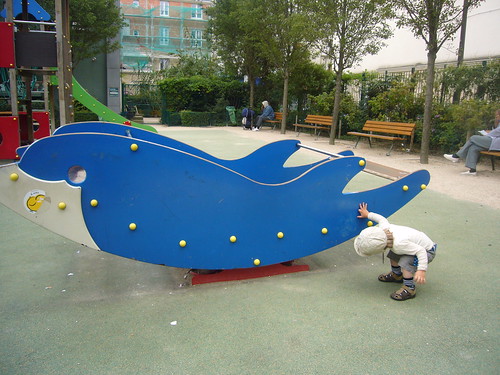
It’s not the first time I write about how I enjoy hanging out in Parisian playgrounds (see posts from 2005 and 2007). They’re small to middle sized and every neighbourhood seem to have one. So, if you’re looking for a green and shady place to relax for a while and observe the local way of life, a playground can be recommended. Earlier, I haven’t paid much attention to the standard of the equipment, but this time I quickly noticed that all the parks in this part of the town have got new, exciting and very varied games for the different age sets. Perhaps this is part of an renovation of the public spaces in the Northeastern and poorer districts of Paris?
[teaserbreak]

Parc de Belleville in full blossom

Parc de Belleville for instance, has always had very well kept and diverse flower beds compared to comparable spots in Oslo’s poorer neighbourhoods, but now they’ve planted flowers and plans all over it – presumably in relation to the biodiversity plan of the city of Paris. (I see on the municipal net site that Père Lachaise is participating from the 20th Arrondissement, but they haven’t written anything about Parc de Belleville yet.) But I presume also as part of an over-all refurbishment of this part of the city. Anyway, back to the playgrounds.


Leo adds to the diversity and learns to drink running water from watching the older children at the playground

It happens that our local playground is the same one I wrote about in 2007, and I can only repeat what I wrote about diversity at that time. The first friend my son made in France, was a little French Japanese girl with a nice Japanese bug on wheels which she swapped for a while for Leo’s excavator. Another day, Leo talked to himself as he played with cars side by side some older children. One of the north African looking ones asked what language he spoke, and he was so amazed to hear that it was something called Norwegian that he had to boast of his knowledge in Chinese. Whereupon he said something and the Chinese looking boy present (who were even a little older, and not too nice towards the smaller ones) laughed acknowledgingly. Today, he played around two girls where one of them was bilingual in German. And so on. The playground bears witness both to the increasing gentrification and the high Chinese presence in the area, in addition to the North African Muslim as well as Jewish immigration. An many others.

P1130473

(Early Sunday morning. Where are my playmates?)

It’s not the first time I write about how I enjoy hanging out in Parisian playgrounds (see posts from 2005 and 2007). They’re small to middle sized and every neighbourhood seem to have…

Read more