search expand

Pieces into place: Décroissance, another life and another politics – And making sense of the data

(Writing is progressing so fast now, that I’m not able to keep up here. This post I wrote several weeks ago, but haven’t found a free moment to post it before now. I’ll try to find some more time to keep up the blog in this final stage, as it would be good to document this part of the project as well. I’ll see what I can manage.)

Smaller and larger parts of the puzzle find their place at the moment. Phenomena that have only flickered past my attention in a superficial, disconnected manner suddenly add up to a larger picture.[teaserbreak] The last of these epiphanies was triggered by a request to hold a seminar at National Institute of Consumer Research (SIFO). They asked me because they’ve a project running on migration and consumption, and certainly, migration is relevant in my research on Paris as postcolonial. On consumption on the other hand, I wasn’t so sure what I could come up with. When I discussed some bland idea I’d got with a fellow anthropologist, he said right away that it’s exactly the lack of consumption in one of the large consumer countries of the west that it interesting here. Of course! One of the definitions of French slam is that it should be for free.

About the same time, a Norwegian journal published an article on the French Décroissance (Degrowth) movement. Although I had noticed the thought-provoking term around, for instance in demonstrations, I wasn’t aware that it concerned a socio-political movement. I started wondering if parts of the slam milieu was inspired by this movement, as several texts make similar statements to their “live better consume less” ideas, as well as mocking contradiction in terms like a “fair trade” (J’aime ma planète, j’achète, “I love my planet, so I buy it” by Zéor, for instance).
"Productivisme - deadly dangerous: Let's enter degrowth"
“Productivisme – deadly dangerous: Let’s enter degrowth”
From a demonstration in Paris in October 2005

I had also noticed the relatively low material standard of living (without going into detail) many slammers lived under. These observations had made an impression on me, but they didn’t start to make sense before I read Sociologie de Paris (Pinçon and Pinçon-Charlot) and connected them to the brute reality of the cost of life in Paris proper compared to the poorer suburbs: Even in the cheapest arrondissments in the north and east of the city is the price per square metre double compared to in the suburban towns in Seine-Saint-Denis.

But the observations still weren’t more than signs of relative poverty in an affluent society, added perhaps some traits of degrowth-ideas present in some texts. Until I was told (by a man almost double my age, what a humiliation!) that I had to free my analysis because what I was observing seems much more radical than old ways of thinking about politics. He commented on another part of the thesis (republicanism and cosmopolitanism), but it’s pertinent in relation to the question of consumption as well. From this perspective, all these disparate observations click together in the puzzle to such a degree that it all seems utterly banal, and how come I haven’t seen it before? Maybe particularly since I’ve even proclaimed here before that I recognise in the slam scene something of Foucault’s dictum (1982) to refuse what we are and find new subjectivities liberated from the state and its individualisation.

A life with less material goods is certainly not only “relative poverty”, it is also part of larger ethical questions on local and global solidarity, ecology, how to lead the good life and so on. The Décroissance movement and the slam phenomenon are probably just different expressions of larger currents in French and western society. Suddenly, I see the slam scene as even deeper situated within a long and broad history of poetic and eventful rebellion. And the great thing for the progress of my thesis is that all these recent epiphanies don’t seem to broaden the scope of my work, spreading it out in unmanageable directions. Quite the contrary, they tie the loose ends into a nuanced and detailed tapestry and click seemingly unfitting pieces into the puzzle.

"Productivisme - deadly dangerous: Let's enter degrowth"

(Writing is progressing so fast now, that I’m not able to keep up here. This post I wrote several weeks ago, but haven’t found a free moment to post it before now. I’ll try to find some more time to…
Read more

Create expectations for the reader

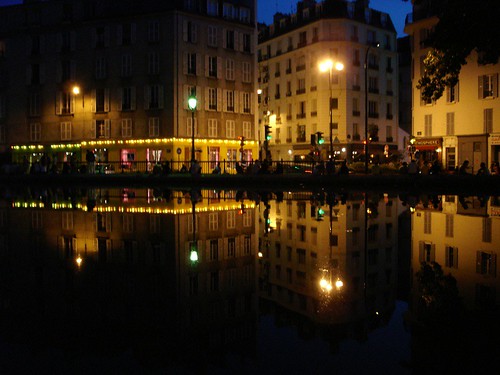
Canal St. Martin, summer in Paris

I wrote about my expectations of Hemingway’s little book from his early years in Paris, A moveable feast, a while ago. Silly me thought I would find the reason why it was particularly hard to write about Paris in his book, as he wrote so evocatively: [teaserbreak]

Maybe away from Paris I could write about Paris as in Paris I could write about Michigan. I did not know it was too early for that because I did not know Paris well enough. But that was how it worked out eventually (A moveable feast, 2007, p. 4).

It took me quite a while – silly me – after finishing the book to understand what kind of answer he had given, because the answer wasn’t straight, as I had hoped it to be. It was in Paris that he decided to quit reportage and journalism, at which he seemed quite successful, and test his luck in literature – despite having a wife and child to support. And it was in Paris he acquired his characteristic style of writing and building up a story:

Then I started to think in Lipp’s [he’s writing in the old cafés in the old artist and intellectual quarters at the west bank :-)] about when I had first been able to write a story after losing everything. … It was a very simple story called ‘Out of Season! And I had omitted the real end of it which was that the old man hanged himself. This was omitted on my new theory that you could omit anything if you knew that you omitted and the omitted part would strengthen the story and make people feel something more than they understood (A moveable feast, 2007, 43).

Of course he wouldn’t answer my question, I realised. Merde. Now I have to figure it out myself, and that would probably take me a whole lifetime. Because, after all:

If you are lucky enough to have lived in Paris as a young man, then wherever you go for the rest of your life, it stays with you, for Paris is a moveable feast (Hemingway, in a letter to a friend

On the more positive side, I got an excellent lesson in the important skill of creating expectations for the reader. Before Christmas, the feedback I got on one of the core chapters in my thesis surprised me to the extent of first annoy and discourage me, then – and I hope I’m there now – spurring me on to produce better texts. I had described in detail a slam session where I highlighted a handful of texts and people in order to go more in depth. But what had grasped people’s attention was not at all what I had found interesting when being present that night, neither what I had wanted to convey to the readers. If I had managed to create any expectations at all through my chapter, it had certainly been the wrong ones…

After some days of gloomy afterthought, I came to the conclusion that the whole core of the thesis needed to be restructured. I don’t think it’s very much work, but it will alter the way people read my argument (if there is any?!) fundamentally. And readers’ expectations and their gradual fulfilment (which in the case of literature can be days, weeks or even years after you finished the book) are everything.

Canal St. Martin, summer in Paris

I wrote about my expectations of Hemingway’s little book from his early years in Paris, A moveable feast, a while ago. Silly me thought I would find the reason why it was particularly hard to write about Paris in his…

Read more

Fieldwork – a moveable feast?

Maybe away from Paris I could write about Paris as in Paris I could write about Michigan. I did not know it was too early for that because I did not know Paris well enough. But that was how it worked out eventually (A moveable feast, 2007, p. 4).

It took Hemingway several decades to write about Paris. [teaserbreak]I wonder if it was Paris as such or the kind of life he’s had there, which made it so hard to write about. I’ve only read about 1/3 of Hemingway’s memoirs of his young years in the city, but I’m eager to know his view on the subject. After my year in London, it took me about a year of philosophical chinoiseries before I managed to approach the real stuff. With Paris, I suddenly had a breakthrough some months ago and I haven’t stopped writing since. Even if I subtract all the things that I’ve been through the last years, it still can’t explain why it had to take me so long. I think, for me, the difficulties of getting to the core of the matter after field work is related to the existential journey that the field experience has brought about on both occasions.

In an unfinished post from some years back, I criticise the anthropologists Akhil Gupta and James Ferguson for their attack on what they call “the standard anthropological tropes of entry into and exit from ‘the field’” (Gupta and Ferguson 1997: 12). If I remember correctly, their point is that these stories exotize the field experience and enhance the strange- and otherness of the field site. That is probably the case in much anthropological writing (the first entry story that came to my mind is Evans Pritchard among the Azande, and there the Azande are far more alive and at least as recognisable in the intro than elsewhere in the book, so that was a bad example.) But that is surely not whole role of these stories. For me, the entry to as well as the exit from the field were surely full of existential experiences that readily can be likened to odysseyic voyages.

Anyway, I’m looking forward to seeing if Hemingway can contribute anything to my disagreement with Gupta and Ferguson, but it will take me a while to find out, because I’m so busy writing that there’s hardly any time to read… :-)

Maybe away from Paris I could write about Paris as in Paris I could write about Michigan. I did not know it was too early for that because I did not know Paris well enough. But that was how it…

Read more

The multilingual playground

P1130473
(Early Sunday morning. Where are my playmates?)

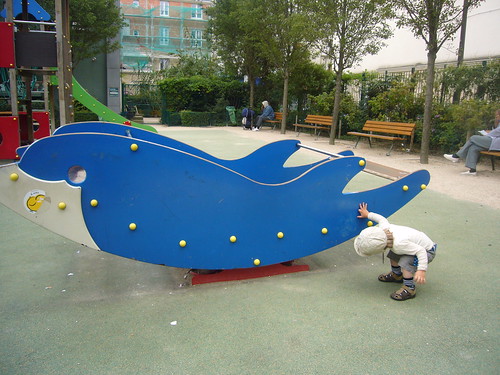
It’s not the first time I write about how I enjoy hanging out in Parisian playgrounds (see posts from 2005 and 2007). They’re small to middle sized and every neighbourhood seem to have one. So, if you’re looking for a green and shady place to relax for a while and observe the local way of life, a playground can be recommended. Earlier, I haven’t paid much attention to the standard of the equipment, but this time I quickly noticed that all the parks in this part of the town have got new, exciting and very varied games for the different age sets. Perhaps this is part of an renovation of the public spaces in the Northeastern and poorer districts of Paris?
[teaserbreak]

Parc de Belleville in full blossom

Parc de Belleville for instance, has always had very well kept and diverse flower beds compared to comparable spots in Oslo’s poorer neighbourhoods, but now they’ve planted flowers and plans all over it – presumably in relation to the biodiversity plan of the city of Paris. (I see on the municipal net site that Père Lachaise is participating from the 20th Arrondissement, but they haven’t written anything about Parc de Belleville yet.) But I presume also as part of an over-all refurbishment of this part of the city. Anyway, back to the playgrounds.


Leo adds to the diversity and learns to drink running water from watching the older children at the playground

It happens that our local playground is the same one I wrote about in 2007, and I can only repeat what I wrote about diversity at that time. The first friend my son made in France, was a little French Japanese girl with a nice Japanese bug on wheels which she swapped for a while for Leo’s excavator. Another day, Leo talked to himself as he played with cars side by side some older children. One of the north African looking ones asked what language he spoke, and he was so amazed to hear that it was something called Norwegian that he had to boast of his knowledge in Chinese. Whereupon he said something and the Chinese looking boy present (who were even a little older, and not too nice towards the smaller ones) laughed acknowledgingly. Today, he played around two girls where one of them was bilingual in German. And so on. The playground bears witness both to the increasing gentrification and the high Chinese presence in the area, in addition to the North African Muslim as well as Jewish immigration. An many others.

P1130473

(Early Sunday morning. Where are my playmates?)

It’s not the first time I write about how I enjoy hanging out in Parisian playgrounds (see posts from 2005 and 2007). They’re small to middle sized and every neighbourhood seem to have…

Read more

Noctambulism (viewed from a balcony on 7th floor)

There’s a time for everything, I’ve thought many times the last two years: One does one thing for a while, and then things change again. This time, I hear the night birds down in the street slowly making their way home after a night out in Paris, while I sit at the balcony listening to my child talk about the – for him – new wonders of twilight: “Look! Stal!”, “Play in the darkt!” and “Go down there!” – probably not because he wants to join the people hanging around down there, but because the street sweepers have turned on the water to flow through the gutter before they comes with their green broom at places where the little green sweeper and high pressure water cars can’t reach. He likes this early morning procedure (apparently earlier in weekends than in the week, as it usually happens a little later, at the when we go to the bakery to get breakfast. Maybe it’s because it’s more debris after Friday and Saturday night.) And I like it too, and I think about all the work that has to be done continuously to maintain good living conditions in an urban environment where the population density is as high as it is here (Around 40 000 per km2).
[teaserbreak]
6:30 in the morning is a time I’ve seen very rarely in Paris, only when I’ve been out the whole night myself. I don’t think there’s anywhere I’ve spent the whole night outdoors as many times as in Paris, – perhaps only beaten by the town where I spent my teens, far up north with its light summer nights. Maybe because noctambulism is quite common here – they’ve even got a word for it. The hot July I spent in Paris when I was 17, we hung around at Beaubourg, outside Centre Pompidou – under a large art installation of a dangling planet earth – until we could get on the first metro together with the friends we’d made and eat steaming fresh croissants from an early bakery and warm ourselves at their place. During the fieldwork, there were some nights of wandering as well, of just going from place to place and hanging around and meeting people.

But now I see the other side of it. Once again, I’m living in an extremely noisy street, and this time it’s the night life. (But it doesn’t bother me, because I’m finally in a position where I both need and can afford a certain comfort, so contrary to in Faubourg du Temple the windows here can be properly closed.) In the beginning of the week it ends reasonably early, but already on Wednesday night it intensifies, and Thursday is a small weekend, whereas at Friday and Saturday it culminates when most bars close about 3-4. Then the chatting of the noctambules go on long after the morning has started here at my place and the street sweepers have come with their brooms.

There’s a time for everything, I’ve thought many times the last two years: One does one thing for a while, and then things change again. This time, I hear the night birds down in the street slowly making their way…

Read more