search expand

Saturday food market


See more photos from the local food market here.

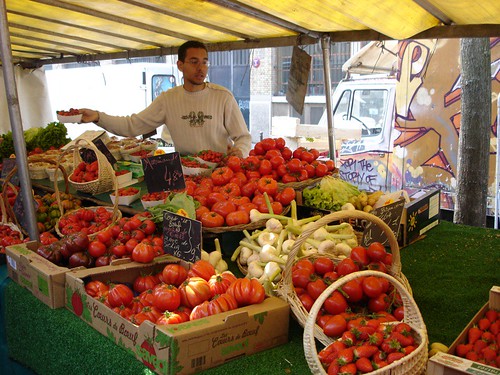
It’s around midday a sunny Saturday in October. The terrace of my regular café-cum-office is still in the shadow, so I decided to take a stroll up the food market which is situated in the middle part of the boulevard. I’ve probably written about these foodmarkets before, but I’ll do it again – this time coming straight from Eastern Oslo and I find their abundance even more striking.
[teaserbreak]
The stretch of boulevard (de Charonne, de Ménilmontant, de Belleville and de la Villette) going all the way from Place de la Nation until Canal St. Martin, houses three food markets, each organised 2 times a week. In addition, there are of course other local food markets all over the place. And we are talking a quite hard core East End, popular area here, and it’s that I find so fascinating. Oslo has the same social fracture between east and west as Paris (and London as well), with the East end being far poorer and far more disadvantaged. According to a newspaper article I read some years ago, the fracture in Oslo in fact mounts to a difference in expected age of no less than 10 years between East and West! I’ve heard surprisingly little talk about it, and I don’t know if the truth can be really that extreme. However, I keep on thinking about the eating habits of the traditional eastenders in Oslo and how different they must be from what they eat here. The food markets here are bourgeoning with fresh fruits and vegetables from all over, with an unimabinable variety of olives, nuts, beans all that, with fresh fish and shellfish of a variety I’ve rarely seen, meat, flowers… everything, and very appetising indeed.

The east end in Oslo has of course changed a lot after the arrival of the immigrants and their fresh fruit and veg shops. And even these shops has spread far into the west end and surroundings now, it’s still a small phenomenon compared to the large outdoor markets here. But I really wonder how my life in Oslo would have been without these shops…

See more photos from the local food market here.

It’s around midday a sunny Saturday in October. The terrace of my regular café-cum-office is still in the shadow, so I decided to take a stroll up the food market which is…

Read more

Marseille (communications)

I’ve spent Easter time in Marseille. In 3 hours and 10 minutes the TGV takes you more than 800 km south from Paris to the Mediterranean city, through the French countryside, past a few villages, a castle or two on top of a cliff, a viaduct, blooming apple orchards, the river Rhone and loads of white cows. “Quite why, you might wonder,” the Guardian wrote in the heat of the CPE-affaire, “is a country with wonderful infrastructure, beautiful towns and countryside, world-class companies and highly productive workers tearing itself apart again?” I do find that paradox intriguing, and the comfort of the Train Grande Vitesse was an apt opportunity to give the transportational part of it a thought. Most major train itineraries in France take around 3 hours, an infrastructural feat I – perhaps because I come from a country made of massive granite – find very fascinating. I wonder how people can bother to take domestic planes at all from the capital in this country, not to mention to London, when they can just jump on the efficient metro to one of the grandiose railway stations and get on a double-decker TGV, and get off at an equally grandiose station at their destination a few hours later. (Public transport in this country is one of the very few things that run on time – after 6 months here I still haven’t figured out exactly when the TV news starts, and I’m still not sure how delayed the conference, demo, meeting etc. will be – but public transport is reliable indeed, as long as there isn’t a strike or a manif blocking the way).
[teaserbreak]
Thinking of what I have planned writing about from Marseille I realise that this post could equally been titled “communication” (…which I add at this moment…). “Communication” can stand for all the three features that we noticed in particular on our weeklong holiday in Marseille. All the three of them are common in Paris as well, but in Marseille they’re somehow amplified:

First: I’ve got the impression that les Marsaillais are quite chatty. In Paris too people say things to strangers in public spaces. (This is perhaps normal in many countries in the world, but again, Norway is not only made of granite, it’s also very sparsely populated so we haven’t really discovered the finesse of human interaction yet ;-) ) I’ve written earlier that many people speak to themselves on meetings and conferences, apparently in order to get contact with their side-person so they have someone to share their opinions with (expressing opinions is undoubtedly very important in France). In public spaces people aren’t usually trying to enter into long term exchanges, they’re just saying a few words: In the supermarket today a boy around twenty commented that my nutritional intake today surely would be well-balances (I had some cartons of juice and a big bag of salad in my shopping basked, in order to fight of a threatening cold. He bought a packet of biscuits). And if people – kids, youth or adults – double you on a narrow pavement, chances are that they would say Pardon! or Excusez-moi! as they pass. If I carry flowers from the market, someone will possibly make a joke, usuallyare they for me? But particularly I appreciate all the passers-bys giving a Bon appétit! when they see someone eat in public. A couple of days ago, when we had lunch on the pavement outside a local bistrot someone even shouted bon appétit from a passing car.
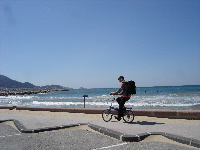
Foldable pocket bike at the beach in Marseille

These examples are from Paris, but my impression is that the Marseillais talk even more to strangers. When I stayed in France some years ago, I spoke more French in one week in Marseille than I had done the previous 4 months in Paris. This time, apart from all the ordinary bon appétit it was our small foldable pocket bikes that made quite a few Marseillais talk to us. Even a busdriver leaned out of the window at a red light and said he had always wanted such a bike and now he would like to know where we had got them. All the interest our bikes generated would probably have inspired someone a little more entrepreneurial than us to start a local import firm and live happily for the rest of our lives down there.

The second feature we noticed about Marseille is how calm people are in the traffic. It’s quite a Zen experience to cycle in Marseille, – but also in Paris, I should add, which I noticed when I unfolded my little green pocket bike and started cycling here as well. The contrast couldn’t have been bigger to cycling in London, which is almost an extreme sport experience (at least at the time I was there, which was just before Major Livingstone got to power). The bikes here are often older and of a more classical city bike posture than the typical off road or hybrid bikes in Oslo or London. That makes people sit more straight and almost backward leaning. In addition, many cycle really slow. And all kinds of people cycle; from elderly men and ladies to kids via businessmen. But this is Paris I’m talking about again. In Marseille there aren’t that many people on bikes, and the infrastructure for bikes are much worse than in the capital, with no bicycle lanes and at the moment the whole city centre is just a construction site for the new pride, the tramway. But despite all this, the drivers have surprisingly a lot of patience with us cyclists (perhaps they were just staring at our attractive foldable pocket bikes?).

I find it surprising that the city traffic in France give this Zen impression at the moment, because that was certainly not how I remember it from my first visits to Paris in the late 1980s.

Initially, I was thinking of writing a comparison between “multicultural” Belleville (social demographer Patrick Simon’s description) and cosmopolitan Marseille, but the only thing I’ll say about the cosmopolitan feature of the city for now is that les Marseillais apparently see it as some kind of public duty to make metissée babies. It wasn’t even the anthropologist, who is supposed to notice such things, but her companion who remarked the high number of people of mixed origins in the city of 2600 years of immigration.

I’ve spent Easter time in Marseille. In 3 hours and 10 minutes the TGV takes you more than 800 km south from Paris to the Mediterranean city, through the French countryside, past a few villages, a castle or two on…

Read more

Busy week

It’s been a busy week. While the youth in this country have been blocking and occupying schools and universities – or protesting against those blocking their universities – or been out in the streets demonstrating, burning paper cars or real cars, tagging, breaking a few bus shelters and windows or robbing demonstrators for their mobiles, I’ve been indoors at various prestigious Parisian venues listening to people discussing discrimination.
[teaserbreak]
And my, oh my how the French excels when it comes to discussing! They’ve been criticising themselves lately, for not being able to come to agreement and solve their conflicts like they allegedly do in other European countries. “The Scandinavian model” is said to be such a good approach to compromise. “The Scandinavian model” means the Danish and Swedish economic way of mixing a strong social welfare state with entrepreneurial creativity and a flexible labour market. (I’m not sure why Norway isn’t included in this model; either – as often is the case – the non-European member is just forgotten, or the spectacular oil economy just makes it a case apart).

(However blissfully ignorant I am of all but a few political events up north there in Scandinavia at the moment, I have to say that I personally prefer the French model of vehement and violent discussion a thousand times to the Norwegian way of showing discontent(?) by silently turning towards the far right party… (which verges on being the largest party in Norway at the moment). Neither the economic liberalist and war mongering climate in Britain seems to be a good example to follow, as I see it, but I’m too tired to go into that now).

Anyway, back to the week for vivre ensemble and “fighting against discriminations”: It’s been an amazing affair with two to four panel discussions every day for five days, starting (15-30 minutes delayed – always, as always is the case here) at ten and ending at half past eight, with a long lunch break. And the listeners – or the participants, as they deserve to be called in this case – have been incredibly involved; in asking questions and in showing so much anger that I sense my utter Norwegianness from head to toe. But anger is just a part of it; to me it seems like the French engage with the surroundings more actively than I’m used to. This might seem strange, but I’ll try to explain: The French talk to strangers much more than Norwegians do. At this seminar I quickly noticed that the sideperson, whoever it was, usually sooner or later started mumbling to him- or herself. The right thing then, I found out after a short while, is of course to give some kind of sign of interaction. And people expressed themselves with engagement and intensity. As they do in the streets now.

My impression is that the political life in France is very much alive and vibrant – c’est-à-dire very different from what I’m used to. There were many other aspects of these seminars that caught my attention as well, as for instance various forms of lopsided-ness, which no one commented (despite commenting almost everything else…), for instance extreme gender bias and a tendency to theorise rather high above the people concerned instead of actually listening to what they are saying or letting them speak for themselves. (I’ll probably nuance this appreciation later)). But all together it’s been an amazing affair, to listen to more than 100 discussants and all the contributions from the audience.

(Finally it’s spring… It’s been so wonderfully hot and humid (19°C) that I’ve had the window open all day, and now there is thunder and lightening…).

In the evening, after coming home from all these mind-boggling discussions, I’ve tried to follow the debates on the demonstrators and casseurs (rioters at making trouble at demonstrations), and the students from the banlieues and the casseurs from the banlieues and who are the casseurs and so on… that are taking place in the media as well as on the discussion forums around.

In addition, I’ve tried to deal with the news that the person who should have given me back the huge deposit for a flat I rented months back, is bankrupt and depressed(!) – so he says… And I’ve become completely hooked on flickr, a very interesting site for photo sharing, indeed… So, yes, my last week has been rather busy.

It’s been a busy week. While the youth in this country have been blocking and occupying schools and universities – or protesting against those blocking their universities – or been out in the streets demonstrating, burning paper cars or real…

Read more

The strange nature of politics in France – Protesting, part 2

One thing that struck me during the November riots was the high level of understanding they were shown in the French public debate. It seemed to me that quite a few who participated in the public discourse quickly interpreted the burning of state institutions, private cars and local companies in the banlieues as – not acceptable, but, yes understandable – expressions with some sort of political meaning. A friend of mine familiar with politics in Germany asked me if no one had demanded the demission of the Interior Minister, as it is he who is responsible for law and order. And in a German context, according to her, three weeks of youths rioting all over the country would have been an obvious sign that he didn’t do his job properly…
[teaserbreak]
(But not in France: Interior Minster Sarkozy’s popularity grew during the riots. He certainly condemned what happened, but he didn’t crush the riot with police force, which my friend guessed would have happened in Germany. In fact, I’ve heard that the riots were neither halted by the police nor the state of emergency. Rather the youth themselves decided to stop.)

I should ad that some (whites) I spoke to had not much understanding for the pampered youth who had been given money for nothing for so long…

I came to remember this – to me – striking acceptance for protest now that the students “are in the streets” again. As I wrote in the previous post, politics in this country should – it seems to me – to a larger degree than many other places be played out in the streets. And politics is, in fact, a public and popular concern in this country. Demonstrations, and notably student demonstrations, have made governments withdraw laws several times since 1968. This is one aspect of “the French exception” which is being played out right now. Another aspect is the strong opposition in the French opinion against the (neo-)liberal weakening of the labour regulations. (I forgot to explain the Contrat Premier Embauche in the previous post: it’s a contract for people under the age of 26, which gives the employer the right to dismiss the employee without explanation during the two first years.) However, that is another story I’ll not go into here.

In upcoming posts I’ll come back to other aspects of French society, which I find strikingly different from what I’m used to.

One thing that struck me during the November riots was the high level of understanding they were shown in the French public debate. It seemed to me that quite a few who participated in the public discourse quickly interpreted the…

Read more

Contrat premiere embauche – Protesting à la français

Initially, I hadn’t planned to go to the major demonstration against the CPE (“contract ‘first employment'”) as it only tangentially touches the focus of my fieldwork (tangentially, as the CPE – Contrat Première Embauche – is part of Prime minister Villepin’s plan for égalité des chances: youth unemployment is high in France and even higher in the Zones sensible which is in need of the equal opportunities). But as the echoes of the chanted slogans reached all the way to my flat – situated at least 20 minutes away from the standard demo route Place de la République/Bastille/Place de la Nation – and I saw the diverted traffic as I leaned out of the window, I realised that the scale of the event made it worth defying the heavy rain and head for Nation.
[teaserbreak]
The ten minutes walk down Avenue Philippe Auguste, I was thinking about how different French politics are from what I’m used to. The implementation of the CPE is a good example. In L’Assemblée Nationale the politicians can speak loudly, clap, make noise and sometimes shout, and – most exotically – even express themselves with eloquence. In this, France is similar to Britain. The importance they give to demonstrations is however different.

One month ago, there was a discussion in the National Assembly on the government plan of implementing the CPE and other “equal opportunity” measures, which went something like this: A socialist politician shouted to prime minister Villepin (the architect of the CPE): – You should listen to the streets! (alluding to the first demonstration against the CPE taking place at the time). Villepin, Monsieur l’éloquence personally, replied, with oratorical pathos: I am listening to the streets… – but I also hear the ones who are not down at the streets (pointing to the rather feeble support for the demo). Demonstrations have thus an important political role to play in this country. (I’d like to give some other examples, but as this is meant to be a quick post, I’ll leave it for another time).

As I arrived at Nation, I noticed that 7 of the 8 boulevard and avenues running into the square were lined with the CRS – riot police – standing around, looking after their helmets, shields, batons and other riot gear… (The 8th street was of course the one where the protesters entered). I don’t think such demonstrations, full of healthy (though leftwing) pupils and students and more or less bourgeois labour unionists often turn violent, but the Republic obviously wants to put her measures at display. – So also with her boulevards and avenues, constructed broad and straight as they were in order to easily suppress popular rebellion…

I think about the republic and her broad boulevards, full of politics, as I linger for a while in Place the la Nation: I once participated in a tiny little demonstration in London (I think there were 16 000, which would hardly count as a demo in a country where hundreds of thousands take to the streets many times a year) making City a drum’n’bass dance party and consequently a no-go area for the police for hours… as the narrow and winding streets of City is not made for riot police.

After taking some blurred, grey and rainy photos of the last part of the demo down Rue du Faubourg Saint Antoine from Bastille, I hurried home in order to change shoes, socks, trousers and umbrella (ready for the dustbin) before I went to a neighbourhood democracy meeting in a nearby school, which of course turned out to be full of people discussing, objecting and protesting and talking about art and the importance of preserving small-scale artisan affairs for hours…

Initially, I hadn’t planned to go to the major demonstration against the CPE ("contract 'first employment'") as it only tangentially touches the focus of my fieldwork (tangentially, as the CPE – Contrat Première Embauche – is part of Prime minister…

Read more