search expand

Art in the suburbs


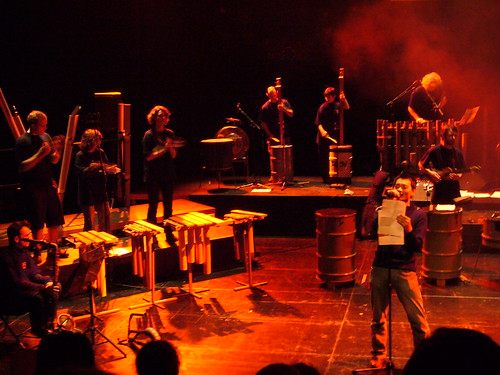
Slameur and musicians in a forum culturel in the suburb

Following the Parisian slam scene immediately led me to the suburbs. During my 9 months long first stay here, I crossed la pheripherique (ring road) only five times (except to go to the airport). Three times in the summer I attended open microphone slam events; two in Saint Denis (by Stade de France which one can se on the way to the airport) and one in Fontenay-sous-Bois (to the south east). Saint Denis is well connected to the metro system, Fontenay-sous-Bois is not, and it was a true galère to get there, according to one I travelled with. (One of our adventures dans la galère, I recounted here in Nouvelle France).
[teaserbreak]
Before I discovered the slam phenomenon, I went extra muros only twice, both with a friend visiting from Norway. Partly we wanted to have a look at the places where the youth were so angry, partly we went traditional sightseeing. In Saint Denis we dropped by at the famous basilica there where all the French kings have been crowned, and in Val-de-Marne we went to Mac/Val, a contemporary arts museum.

It seems quintessential of for this state, built on the ideal of Enlightenment to the people, to put such avant-garde institutions far into suburbia. It costs (practically) nothing to enter, which is probably a way of encouraging the locals to come to this place. I think they succeeded to some degree. While the exhibition was rather playful, the restaurant was minimalist, in terms both of its interior and the food. Someone told me that the highbrow restaurant was an attempt at encouraging Parisians to take the trip. However, the atmosphere (and prises?) didn’t encourage the locals I observed to feel at home there. (I remember this incident, but I can no loner remember what made me think certain visitors were locals belonging to certain social strata –at the time, I obviously didn’t follow my own note-taking advise and described instead of categorised….)

To get to this museum, one takes a metro line to its final destination (Choisy – Chinatown, in fact, which we discovered also made it a poor target for our angry youth expedition – perhaps the sino-français haven’t yet become second or third generation on the dole?), and then walk or take a bus even further into the (sub)urban sprawl.

The same travelling procedure, I’ve followed several times the last three weeks. First, I take the metro all the way to its terminus, then I go on by feet, bus or tramway – through names of places one remembers from the November ‘05 riots –, until I am at a Place de la Liberation or Place de la Résistance…(I’ll leave these interesting place names, full of national remembrance, for another post), where I find some more or less grandiose cultural centre where all kinds of experimental artistic activities take place. The slam poetry is not at all seen as an experimental activity, but rather to “invite the street in and listen to it”.

In one of these places, Le Blanc-Mesnil, the whole affair appeared slightly absurd to me: Outside the very grandiose Forum culturel there were groups of predominantly black youth dressed hip-hop style inside, well, the percentage of black hip-hop style was not very high.

The Norwegian arts scene is probably one of the least elitist in the world, while the French is probably quite high on the other end of the spectrum. So, while I find a bit bewildering the time and place to perform some rather experimental jazz jam or modern ballet or whatever, the French seem to react if it is completely normal.

Slameur and musicians in a forum culturel in the suburb

Following the Parisian slam scene immediately led me to the suburbs. During my 9 months long first stay here, I crossed la pheripherique (ring road) only five times (except to go…
Read more

Rue du Faubourg du Temple

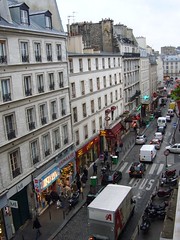
I’m not yet tired of Parisian street-life. That’s good, because it’s only four floors separating my bedroom-cum-office from a very noisy, or let’s rather say lively, street indeed.

Rue du Faubourg du Temple, view from my window.

Rue du Faubourg du Temple runs, as I’ve already mentioned, between the significant places Place de la République – where an enormous bronze Marianne La République resides with the three strong marble ladies La Liberté, L’Égalité and La Fraternité – and Belleville. Most demonstrations of whatever size start at Place de la République. When I lived next to the square for a fortnight in December, I stumbled upon a substantial number of police cars right outside my gate every third day or so. One day it was no less than 16 vans from the CRS, another day just 10 or so from La Gendarmerie, and yet another it was the Police Nationale. Only at one of the occasions did I see the demonstrators. The same happened actually a couple of days ago. I had read at Paris.Indymedia that the college students and the sans-papiers would demonstrate against the immigrations policies, so I went over to see what was happening. Maybe I was too late, because at the time I arrived there was very few lycéens to see. On the other hand, the forces of order were heavily represented; the CRS with at least 15 vans, a bus and some other equipment were creating a noisy traffic jam driving south-east down Avenue de la République (direction Père Lachaise and perhaps Place de la Nation). The demonstrations of national importance usually go between Place de la République to Place de la Nation, via Bastille – thus it’s not only the police who can stage a political struggle symbolically (however, with their Robocop uniforms they’re hard to beat when it comes to costumes).
[teaserbreak]
A few demonstrations start other places than at République. According to my flatmate, there is one passing down Faubourg du Temple about every second week. Judging from the slogans he mimicked, it usually concerns les sans-papiers, which is reasonable since it’s coming from Belleville/the East and going to Place de la République. I actually joined one of these demonstrations (described here), just a few weeks after arriving in Paris the previous autumn. Funnily, I took a photo of the building I’m now living in, because of the nice flowerpots and the Chinese restaurant at the ground floor. And that makes the transition to the next point in this post.

The restaurant in this building seems almost to be an outpost for the higher concentration of Chinese restaurants and shops a little up the street in Belleville. Down here, Pakistani shops are at least as numerous. For some strange reason, many Pakistanis in Paris run these cheap, thrashy plastic utensil etc. shops (I have no idea what to call this genre of shops in English). I’ve seen them everywhere in East working-class Paris, and most of them seem to be Pakistani owned. One can probably find some neat Fredrik Barthian explanation for why the Pakistanis have ended up in this particular ethnic niche in this city. Neither in London, nor in Oslo is that the case. Interestingly, it was in neither British hip-hop nor Norwegian, but French, that I was to hear the first sample of a Bollywood song (Rohff (Rohff on last.fm here): Bollywood style.)

The highest presence of Pakistanis is at the other side of Place de la République, in the direction of Gare de Nord. While I’ve just seen one not very conspicuous Bollywood video sale and rental around here, on the other side of République there are more, until you get some street which are almost exclusively Indian, Pakistani and Sri Lankan. (According to Le Monde à Paris – in the nicely titled guide series Paris est à nous (“Paris is ours”) – from 2004, there are 50 000 from the subcontinent in Paris. – One guesses that there is equally many Chinese clandestines here, in addition to the 450 000 who are registrered).

As usual when I start writing a post, I quickly lose focus of the initial idea and the post end up wandering about. I had no intention at all to write about the police again, for instance. This blog post was in fact inspired by a quick walk up the road and the no less than overwhelming amount of impressions it inspired – including the initial thought that opened this post; the Paris street life never stops intriguing me…. I’ve discussed the bad winter mood of the Parisians with a couple of people lately. – They rarely smile, many are arrogant or aloof and the level of aggression and nervousness is high. (For instance, often when I approach a young woman on the street to ask for a direction, she first looks visibly anxious before she notices that I’m just another young woman). – When a friend of mine explained this mood by referring to sheer dense materiality of this city – “packed as sardines on the metro, the person next to you just wished you weren’t there” – it echoed Dag Østerberg’s “socio-material interpretation of Oslo”, which I’d just been reading. Paris is far denser than Oslo, and people behave very differently on the street here. Whether it comes down to a material explanation, I don’t know. It can also have something to do with sexism and different gender relations, with revolutions and education for revolts, with a continuous construction of “living together” through talking to each other (a bit à la Cicero’s republic perhaps) etc… all of which I’ve touched upon here before and which I’ll undoubtedly return to. However not now, as this post has become long enough.

I’m not yet tired of Parisian street-life. That’s good, because it’s only four floors separating my bedroom-cum-office from a very noisy, or let’s rather say lively, street indeed.

Rue du Faubourg du Temple, view from my window.

Rue du Faubourg du…

Read more

Social geography – Place de la République

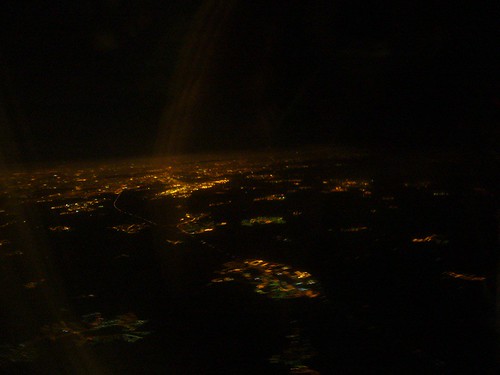
Under me, Europe spreads, slightly convexly, out. The cities look like illuminated versions of ancient town maps. It’s such a nice weather to fly in. I don’t feel like doing what I usually do on this 2 hours and 20 minutes flight between Paris and Oslo, (which is to go through the generous little pile of newspapers Air France is providing – Le Monde (centre-left, a bit intellectual), Le Figaro (right), Libération (left, 68-ish) and once in a while L’Humanité (communiste) or the economist paper L’Echo. There are always a number of issues very relevant to my thesis. Instead, I’ll flash around with my chic (loaned) white MacBook and get some writing done.
[teaserbreak]
This time in Paris, I tried living at Place de la République. It wasn’t extremely successful as I at least once a day found myself following the same trajectories eastwards or north. Purely geographically, Place de la République is situated in East Paris, but socio-geographically it constitutes an interesting border phenomenon. At the corner of the huge Hausmannian square I was unfortunate to live – westwards in the direction of Les Grandes Boulevardes with Gallerie Lafayette and the likes – there are loads of tourists and shoppers and quite fancy looking people. Just a little north of this, up Boulevard de Magenta in the direction of Gare de Nord, one passes one ethnic community after the other, particularly various South Asians and West Africans. I cycled up Major Delanoë’s nice new bicycle lane along the boulevard several times – to visit a friend in the 18th district just behind the shimmering white Sacre Coeure, and to attend a couple of events (slam poetry, of course and a discussion of art and migration with Edouard Glissant…) at the festival in relation to the international day of migrants in the strongly African Goutte d’Or neighbourhood. The direction I went even more often, however, was straight east, across the Canal where Amelie went to throw her little stones (in order to relax :-) ) and into Belleville. In January, I’ll be moving 10-15 minutes by foot from Place de la République, just in this direction! And I’m looking so much forward to it!

Of all the 6-7 places I’ve been living in Paris, there is none I’ve looked so much forward to move to as this flat in Rue du Faubourg du Temple (faubourg means in fact inner suburb, and when a street is called faubourg something it means that it’s sort of the suburb of the street with the same name – thus there exists a Rue du Temple). Rue du Faubourg du Temple goes from Place de la République, a space even more significantly on the border than I’ve described until now, and Place de Belleville. Place de Belleville is a symbol of immigrant Paris, of course, with Jews and Muslims and East Asians (and the anarchic regionally migrated artisans during the Paris Commune…).

(For some reason, it’s such a convivial atmosphere on this Air France flight. The purser and captain are once in a while proclaiming that they’re so sorry for the delay, and the crew comes around checking if we’ve got enough water of French wine, and now the shaven headed North African French steward is doing magic tricks for the little girl sitting on my row – which she afterwards retells to her father, who has been sleeping. I prefer Air France so much to the other companies flying to Paris. – He’s really an entertainer; now he makes a little Christmas bonhomme stand up in his hand, to the enjoyment of more passengers than the little girl –. Not just because of all their newspapers, French wine and the fact that they’re the only company flying to terminal 2 (making the arrival at Charles de Gaulle very much easier). I think perhaps I like flying Air France because the continental experience lasts longer. When you enter an SAS plane you’re already home, sort of.)

Well, east-west Rue du Faubourg du Temple runs between mainstream republican Paris (Place de la République) and the epitome of Belleville. South-north it separates sort of a classical Parisian neighbourhoodesque (according to my soon-to-be flatmate) area, where, as I mentioned, Amelie Poulain trew the small stones in the canal to calm down, and a more “ethnic Paris” (again according to this flatmate).

– Wops, there Oslo is coming up, small and brightly shining… I see the stadium Valle Hovin very brightly lit, so my home shouldn’t be so far from that. I hear the good-humoured stewards practice some Norwegian (“Garrrderrrmoen”… “tusen takk…”), and talk about laisser les gens detendre…. – When they pronounce the “thank you very much” in Norwegian, some people start clapping so obviously they don’t mind the little delay and is relaxing all right…). Now, I should wrap up this post, before we land. I hear the girl retells what the great magician did to some of the friends of the family.

Under me, Europe spreads, slightly convexly, out. The cities look like illuminated versions of ancient town maps. It’s such a nice weather to fly in. I don’t feel like doing what I usually do on this 2 hours and 20…

Read more

Slam at Louvre (me in Oslo)

As some might have discovered, I’m not exactly flooding this site with new texts at the moment. That’s because I’m busy writing some other stuff (in fact nothing less than starting on la grande oevure which will be my thesis in due time…), before I’m off for Paris again in a few weeks. Right now, sitting in my green coach, googling for some information for a text I must hand in over the weekend, I wish I were already there. Not because writing this text is so terrible, not at all, but because Toni Morrison has been at Louvre, and last Friday she invited along a number of slam poetry artists to slam about classical French paintings and about being étranger chez soi (translated “a foreigner’s home”).

The free newspaper 20 minutes has published a quite nice photo series of the event.

I found the series here (while searching for Café Culturel in Saint Denis for my text in fact). (Excellent site for finding info on the French slam scene by the way, but I’ve got to get back to my text to be handed in soon, no more getting lost at the web for me…).

Well, just one more remark: The French urban art forms seem finally to get a little bit of highbrow acknowledgement. The day I left Paris, at the 13th of October, Le Grand Palais (Eng.) invited in the street, and dedicated a whole weekend to rappers, skaters, graffiti artists, and yes, slammers: La rue au Grand Palais. – A lot to be said about this, of course, but not now.

UPDATE:

I just found out that Mary Stevens has written an interesting post on another event during Toni Morrison’s residency at Louvre in her excellent research blog. Amongst other things, I learnt that it’s not the English title “A Foreigner’s Home” that is a strange translation of the French, it’s the other way around:

From the start, the title chosen by Morrison for her residency caused much debate. In English the title is ‘The Foreigner’s Home’; this has been incompletely rendered in French as the much more limited ‘Etranger chez soi’. The use of the apostrophe makes the English much more interesting: it implies both possession and a temporal relation (’the foreigner has come home’ – and hence is perhaps both foreign and no-longer foreign at the same time). It could also perhaps be read as a comment on the nature of museums, particularly in the post-colonial context. In addition, the English seems to me to place the emphasis on the concept of home, whereas the French stresses the ‘etranger’.

As some might have discovered, I’m not exactly flooding this site with new texts at the moment. That’s because I’m busy writing some other stuff (in fact nothing less than starting on la grande oevure which will be my thesis…

Read more

More poetry

Today I’ve had a quick look at two extremes of the French slam phenomenon. First, I went to an atelier slam in a local activity centre ( Centre d’animation) close to where I lived until August. For two hours every Tuesday, MC Tsunami, the orchestrator of various slam soirées and host of the website planteteslam.com, leads a workshop for youth in Eastern Paris. (However, as he told me, and as I could observe myself, most of those coming have strictly speaking passed the age of youth).
[teaserbreak]
The workshop so rewarding for a novice to poetry that the anthropologist felt a bit torn between participation and observation, but concluded that she wasn’t completely up for playing with la langue de Molière et al. yet. However, I did learn some important features of poetry concerning alliterations (repetition of particular syllables or consonants – a frequent means in French poetry as the articulation is based a lot more on syllables than e.g. English and Norwegain…) and phases (particular phrases or segments of phrases). (Right now I listen to Grand Corps Malade’s at-least-300000-copies-selling album Midi 20, where I just heard him describe himself as just “amongst loads of others, a simple seeker of phases”). I’ll return to syllables, alliterations, phases and the rest of the poetic universe when I get more into it…

Amongst other subjects they discussed and practiced, there was of course also a discussion on slam is and is not (it’s to share and to appear in front of others… – interestingly, the battle aspect which defines slam poetry in the USA, where also the word originates from, has much less importance here in France).

Then over to the other extreme end of the slam phenomenon (which indeed has taken off during the two months I’ve been away): After the atelier at the community centre, I hurried up Boulevard Voltaire (still 11th Arrondissement) to the concert venue Le Bataclan to try to get a ticket to Grand Corps Malade’s show (not slam, since a show doesn’t imply exchange…, as they all say, including GCM himself). Even though Le Bataclan houses a few thousand, and GCM is on stage for 9 evenings between 3rd and 14th October, I could not get a ticket, not even on the street, which has worked well before. The queue for entering was winding far down the pavement and it comprised men in suit and tie (perhaps they hadn’t had time to change after work?) and women in party dresses and hair full of hairspray, to grandparents and children going with their family. With the price ranging from 29 to 39€, it wasn’t surprising that the audience looked a bit different from the slam soirées I’ve been hanging around at. And it looked even more different from the extremely varied audience at the monthly sessions GCM himself hosts at a local cultural centre – centre culturel – in his native banlieue Saint Denis. (For those interested, GCM can be seen in the background to the right on this photo).

As it was sold out today, I’ll not have the chance to see GCM when I’m here this time. Tomorrow, I’ll be at La Guinguette Pirate for another round in the qualification for the slam championship taking place in December. (On Saturday, I was at the qualification round at La Milonga, in the banlieue Fontenay-sous-Bois (94)). On Thursday, I can choose between the weekly slam soirée at Café de Paris (not sufficiently à la mode for having their own website…) and a live show (thus not slam! ☺ ) called “The slam was better before”, apparently with some of the old guys in the game, just around the corner from metro Belleville. (Anyway, I’ve already missed out on a couple of the slam related events popping up all over eastern Paris at the moment: …I was thinking of making a list, but as I quickly looked through all the flyers I’ve got hold of, I realise that I don’t bother…).

Today I’ve had a quick look at two extremes of the French slam phenomenon. First, I went to an atelier slam in a local activity centre ( Centre d’animation) close to where I lived until August. For two hours every…

Read more