search expand

Saturday food market


See more photos from the local food market here.

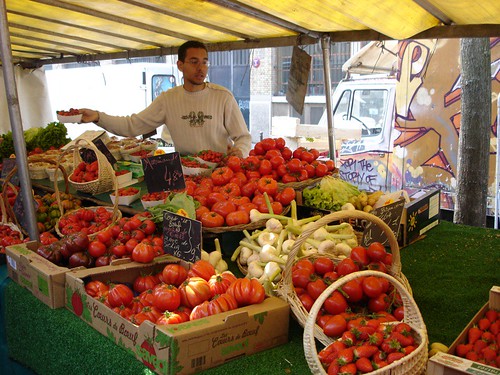
It’s around midday a sunny Saturday in October. The terrace of my regular café-cum-office is still in the shadow, so I decided to take a stroll up the food market which is situated in the middle part of the boulevard. I’ve probably written about these foodmarkets before, but I’ll do it again – this time coming straight from Eastern Oslo and I find their abundance even more striking.
[teaserbreak]
The stretch of boulevard (de Charonne, de Ménilmontant, de Belleville and de la Villette) going all the way from Place de la Nation until Canal St. Martin, houses three food markets, each organised 2 times a week. In addition, there are of course other local food markets all over the place. And we are talking a quite hard core East End, popular area here, and it’s that I find so fascinating. Oslo has the same social fracture between east and west as Paris (and London as well), with the East end being far poorer and far more disadvantaged. According to a newspaper article I read some years ago, the fracture in Oslo in fact mounts to a difference in expected age of no less than 10 years between East and West! I’ve heard surprisingly little talk about it, and I don’t know if the truth can be really that extreme. However, I keep on thinking about the eating habits of the traditional eastenders in Oslo and how different they must be from what they eat here. The food markets here are bourgeoning with fresh fruits and vegetables from all over, with an unimabinable variety of olives, nuts, beans all that, with fresh fish and shellfish of a variety I’ve rarely seen, meat, flowers… everything, and very appetising indeed.

The east end in Oslo has of course changed a lot after the arrival of the immigrants and their fresh fruit and veg shops. And even these shops has spread far into the west end and surroundings now, it’s still a small phenomenon compared to the large outdoor markets here. But I really wonder how my life in Oslo would have been without these shops…

See more photos from the local food market here.

It’s around midday a sunny Saturday in October. The terrace of my regular café-cum-office is still in the shadow, so I decided to take a stroll up the food market which is…

Read more

Indigènes

I’ve just been to see the film Indigènes. I don’t cry very often at the cinema, but I must admit that I had problems stopping weeping during the last part. I, and probably the rest of the audience, knew just too well how the film would end and how the story it self would go on for decades afterwards. I saw it on a cinema nearby, with pensioners (white) and local lycéens (of all colours). It shows on 31 cinemas in Paris, with 4-8 screenings each + two in the weekends.
[teaserbreak]
Indigene is the shameful juridical assignation used for Muslims in French North Africa. Muslims, being indigenes and not citizens like the Christians and Jews, didn’t enjoy equal rights until 1945. It’s incredible, isn’t it, in the country priding itself with the slogan libérté, égalité, fraternité? The entire story of the combatants from the colonies is an incredible account of the failure of this beautiful idea… – Just for instance, this example of France in a nutshell: the soldiers get to view a classical ballet show at the casern, while teaching them to read and write, however, is not a concern.

The film starts with recruitment of soldiers in North Africa. A mother doesn’t want her son to go, as his father had died in the First World War, – for France, probably, and we later learn that the family has been left in misery). But he leaves to fight for La mère Patrie, together with fellow villagers as they shout Vive la France. (I probably got a tear in my eye already at this point, as one is to understand the disappointments that are to come…).

All the four protagonists represent various versions of the failure of France the idea: the petty criminal recollects with his brother how the village was killed by the French, to “pacify” them.

The handsome one falling in love with a white girl at the liberation of Marseille never gets her letters – nor she his – as they are being “censured”. As she is about to unbutton his shirt someone enters the room and he jumps up, in North Africa they’re not allowed to have anything to do with French women. But it’s different here in the mother country, at least for the men coming to liberate her…?

The last disappointment – or treason – is the saddest of them all, and it echoes somehow the disillusionment of all the non-whites with “non-French” surnames in the banlieues who have taken an education as the French dream says, but still see very little of the égalité they’ve been promised: The intelligent, but hèlas so naïve colonel decides to continue on an impossible mission into Alsace, because then, finally, “we will get what we merit” – as they over and over of course not has got until then. His troop gets killed. Another French regiment who enters when the German battalion has been beaten gets all the glory (except from a few of the villagers who thank the only surviving Tunisian), and then we jump 60 years in time and the film ends with the never-more-than-a-colonel sitting on the bed in his little, sparsely furnished room; living-conditions which most French probably recognise from TV reportages on the ancient combatants and migrant workers…

The captain also represents an interesting angle: He passes as a pied noir (a French born in Algeria), but we learn that he is in fact an Arab. That’s an aspect of his identity he keeps close to heart – literally, as a photo of his North African mother he keeps in his breast pocket, and as a secret, that would have kept him from advancing in the army hierarchy had it been known.

Last week, when the film opened, President Chirac decided that the pensions of the ancient combatants finally should be equal to that of the French veterans. Since 1959 their pensions have been “frozen”, as some kind of revenge for the independence…

The four protagonists, Sami Bouajila, Roschdy Zem, Samy Naceri and Jamel Debbouze are all French descendants of North Africans. At Cannes this year the four of them won the prize for the best male protagonist.

The film is not only important it is also very good, and as it concerns the liberation of the whole of Europe from Nazism, I suppose it will be screened in Norway as well. I wasn’t really aware of the important contribution of the soldiers form the colonies before I saw The English Patient, which perhaps not coincidentally, is written by a Sri Lankan author.

The film has created a discussion of course (read some of it in English in The Guardian) – for instance with L’Express devoting their frontpage to the headlines “Should we be ashamed of being French?”

I’ve just been to see the film Indigènes. I don’t cry very often at the cinema, but I must admit that I had problems stopping weeping during the last part. I, and probably the rest of the audience, knew just…

Read more

Boulevard phenomenology


Place de Ménilmontant in the autumn (with bikes and cyclists…)

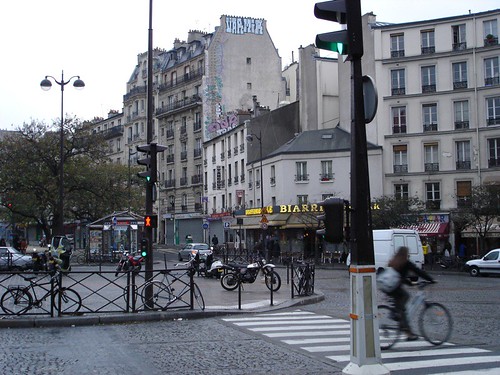
It’s been ages since I’ve been walking down the boulevard, but today I was doing it again. My bike has been stolen! And it was stolen from one of my favourite places, Place de Ménilmontant. Well, such things happen, and anyway it was a too small, but it feels strange that it should happen less than 48 hours before my departure. It’s the third (attempted) crime that happens to me after I came here. First I was robbed for my deposit (1300€!) for a flat that was way too expensive in the first place, then a kid tried to nick my camera during an anti-CPE demonstration (we both looked the same surprised – me because why would someone nick a fellow demonstrator’s camera, him because the camera was attached with a string around my neck so he didn’t get it…) and now my funny little green bike…
[teaserbreak]
Cherry blossoms at Place de Ménilmontant in the spring

Walking down the boulevard again made me think a lot of things. I thought about the very first time I walked that part of it, mid November eight and a half months ago. I was going from my previous flat in bobo (i.e. quite gentrified/emborgeoisé) Ménilmontant to Charonne, which is neither gentrified, neither nothing else – just okey, quite boring. After I’ve left the familiar area around Place de Ménilmontant which is not yet gentrified, but just full of cafés anyway, I passed the main entrance to the cemetery Père Lachaise at the time of the soup kitchen. The queues for free food are divided by gender, which surprised me at the time. Now I’ve passed the soupe populaire outside the Père Lachaise so many times that to not have to pay special attention to the people sitting in the bicycle lane around dinner-time around 20H would have been more surprising than to actually see them there.

Rue de Ménilmontant, in direction of Place de Ménilmontant, with Centre Pompidou in the background

There are some quite deserted areas after Père Lachaise and down to my present flat. I rarely had to pass areas like that where I lived before, so I remembered it made me a bit anxious that first evening mid November, even though the time was hardly more than 8 o’clock in the evening. I remember the anxiety, and it’s funny to think about it now. Now everything is familiar, and it takes more than an empty stretch of the boulevard to make me uneasy. – Just now, on that stretch I passed a blonde and large threesome German family, sweaty and bewildered looking at a map, towards whom I acted Parisian and local and asked if I could help them. They looked for the night bus, and I told them the way – 5 minutes from where we were. I saw a friend off on that bus less than a week ago. How different everything feels now, after some months. – I remember the first time we (my travel company and I) were at Place the Ménilmontant. We felt to be so far east that we hardly imagined that we would dare to go further… And I remember the first time we actually dared to go further east, up the Rue de Ménilmontant, and how I, after a while, should start to say hello to the local Asiatic greengroser there, and how I should see the graffiti change and how I even, at the end, should start to know people in some of the local cafés in nearby Rue des Panoyaux

It’s amazing how quickly we get used to places and how the perception of these places changes completely as we get to know them. One of my – far to many, far to ambitious – plans for the autumn is to write an academic article based on Alfred Schutz’ The Stranger (on how the stranger slowly makes him- or herself at home in a new environment), and Tim Ingold’s notion of dwelling, (on how people, when making themselves at home in that environment also changes that environment a bit). For in a not very long while, I’ll not wander around getting to feel at home in Parisian boulevards, I’ll sit at my office making anthropology of my ethnographic field notes… (And people will not be able to make fun of me saying are you awake now when I send them an e-mail or sms at 10:30 in the morning – but anyway, I’ll still be able to make fun of them for knowing the Parisian streets better than the Parisians themselves ☺ )

Me when I still had my funny little green bike (photo from Pharo in Marseille)

This is not the last post you’ll read about this favourite boulevard of mine, stretching almost all the way through eastern Paris, from Place de la Nation up to Place de Stalingrad and Bassin de la Villette. I hope to soon write a comparison between this Haussmanian grandiose, three-linen and very French boulevard with the cheapest road on the English monopoly board – the hideously gorgeous Old Kent Road, and perhaps my local Oslo street Trondheimsveien. All lively, cosmopolitan east end streets I’ve had the pleasure to live next to for a while in my life.

Place de Ménilmontant in the autumn (with bikes and cyclists...)

It’s been ages since I’ve been walking down the boulevard, but today I was doing it again. My bike has been stolen! And it was stolen from one of my favourite…

Read more

Monday

What a drama, and what a deception! People were so eager for a party and it seemed to be so much at stake…

[teaserbreak]
Yesterday afternoon while the preparations for the match was going out outside, I sat at home, absorbed in the excess of newspaper articles reporting and commenting on the political fallouts of the merits of the French national team. Will France be more tolerant and less discriminatory and racist due to its multicoloured team? Will its success lead to optimism and economic growth? I’d guess neither of the two, but the last couple of days have convinced me that there is much more than football at stake. Perhaps it is right that the French national team is the team of the real, but yet unrecognised, France? Here, in East Paris where I live, if you see someone in the national football shirt you should not be surprised if he (or she) has a skin colour in shades darker than white. And who have been fiercest celebrators of the victories so far if not the kids from the infamous banlieues?

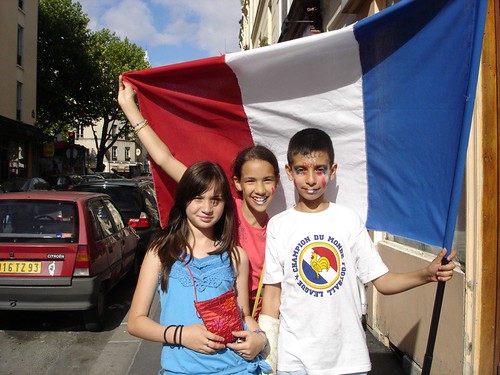
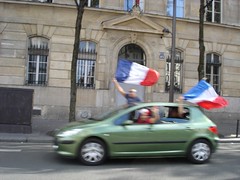
A couple of hours before the match, when I finally tore myself away from the media and got down on the street into the real world, I was met by three children singing and waving Le tricolore just outside my door. Le tricolore was waving from the local greengrocer’s and bistro too, as well as from numerous cafés, shops and flats along the boulevard. Flags were waving from cars and scooters, and the drivers were hooting at every possible and impossible opportunity. Amongst the tricolores, there were a couple of Algerian flags as well, apparently with at least one of the passengers wearing the French national jersey (which reminded me about a newspaper report I had just read from a bar in Marseille: after Zidane scored against Portugal someone had shouted “the ones who doesn’t jump now is not Kabyle” (Zidane’s parents were immigrants from Kabylia)…). From the fourth floor, a three year old (Chinese) was shouting Allez les Bleus! and a smiling father in a car was teaching his toddler the same chant.

All along the boulevard through eastern Paris the preparation for the match was well on its way. Two elderly ladies in a bistro at Place de Ménilmontant had – like so many others – drawn the flag on their cheeks. Some large blacks all in blue football shirts and with rastas, drunk on prematurely shared bottles of champagne, had painted their faces with red, white and blue stripes. A drunkard had put on an old blue jersey for tonight’s reunion with his drinking mates by Gare de Nord. The trip up the boulevard made me think that this was surely a team for everybody, even the most excluded, and I was probably smiling all the way.

We saw the match in a Kabylian bistro up north in the 18th arrondissement, behind Sacré Coeur. The atmosphere was tense. The manager, dressed in Thuram’s shirt, was among the anxious who went in and out, and who ended up seeing the penalty shootout from outside through the windows of the bar. The trickery and theatrics of the Italians didn’t go well with the French supporters: one called them “casseurs”, and another commented on how they where the ones who committed faults as well as falling afterwards and receiving the free kick. And today, the day after, quite a few here in France, as probably elsewhere in the world, ask themselves what Materazzi could have said that made Zidane entirely loose his temper and turn to such an unacceptably act as a headbutt to conclude his career. And in the media today, Zidane’s inexplicable exit undoubtedly adds an extra dimension to the huge disappointment people are expressing.

What a drama, and what a deception! People were so eager for a party and it seemed to be so much at stake…

[teaserbreak]
Yesterday afternoon while the preparations for the match was going out outside, I sat at home, absorbed…

Read more

“Elle va se faire draguer”

Every blog post I’ve tried to write on gender strands for some reason or another before they reach the web. The following text was meant to be a simple and silly account of a quick bike trip around Belleville. However, when I let it rest for a moment in order to start sorting out the huge heap of paper – flyers, magazines, newspapers, brochures… -that was threatening to cover more and more of the surface space in my little office-cum-livingroom-cum-kitchen, I came a cross an old article about a café that I had just passed on my trip. This café reached the national media right after the Mohammad caricature affaire because they put up an exhibition with blasphemous caricatures right in the heart of Belleville. Well, the article in itself wasn’t enough to put me off track. It was rather it’s point of view, or framing, that threatened to put my experiences on my little trip in a new light. I started worrying that my silly little text had to become a bit more complicated.
[teaserbreak]
In one of my French classes in the autumn, my teacher made my research into a little subject of discussion. According to her, a fieldwork in Belleville would be difficult for me, as the local boys would “try to chat me up” (elle va se faire draguer). I’ve been reminded of her words recently, as the season of la drague obviously is well on its way.

The way men and women communicate or not communicate in public spaces in this city is a part of French society I can’t really get my grips on. People exchange glances, or look casually at each other or around themselves, far less in the street here than I’m used to. I think men as well as women feel that that they should keep their eyes to themselves – unless they have certain intentions, that is – but it seems obvious to me that men’s gaze is far freer than women’s.

When I cycled through Belleville the other day, I wasn’t more than giving a young boy a little resigned smile after he – who probably was almost half my age – had leaned out in the street in front of me and called me ma chérie, before he found it opportune to announced to the whole street that one est chaude!. In my hometown Oslo, this – which in my opinion can be categorised as light verbal sexual harassment – has happened to me only a couple of times. At one occasion, when I told the kids to have some respect, they quickly excused themselves. Here, I avoid all further exchanges. I don’t know if that is the best way, but as I said, I don’t understand this interaction. And at occasions when I have answered back, it usually comes to some kind of scene where the man for some reason feels obliged to display a lot of hurt feelings and start an argument.

In another French class we discussed these strange Latin gender relations in public spaces, and una bella Italiana said she appreciated attention in the street. I don’t know if the attention the two of us get is exactly the same, but I didn’t get much support in my class – which for the day consisted of various Latins – for the view that this is limiting women’s freedom.

The kid who called me chaude (“hot”) was probably of North-African origin (either Muslim or Jew, I don’t know – it was right in the Jewish Tunisian part of Belleville). A Danish woman (mid twenties) I discussed this with, said she mostly got attention from men of North-African origin. However, I must say that I’ve experienced approaches by French men of all colours and ages – from old men coming close and almost whispering bonjour (as if I was looking like a prostitute?! – a less “prostitute-like” desscode than mine is hard to find), to such kids – and it happens all over the city. My worst experience took place when I was 17, when two men literally tried to abduct me at Les Halles (they were white French, a point I remember because the police asked specifically about their skin colour).

And it was around here my post stranded some weeks ago. From this point I can wrap up with some more comments on French gender relations in public spaces, – or I can change the framing towards the question of class relations in Belleville, and ask, as they did on posters in a similar quarter in Marseille; à qui appartient la rue? (“to whom belongs the street?”)

I can’t tell how the guy’s sexualising insult should be interpreted. Certainly, it was not a good point of departure for really trying to me draguer. I guess he was probably acting cool in front of his mates. (But why is that a way to act cool, one can ask?) However, the article I found in Le Nouvel Observateur looked at the controversy around public spaces in Belleville in a class perspective.

There is a process of gentrification going on in Belleville and Ménilmontant, where the bourgeois-bohemians are moving into this working-class and cosmopolitan area. And just by Parc de Belleville, a new chic café had decided to make their own little caricature affaire, where they put up religious caricatures on their bright red walls, clearly visible for the passers-byes. (Part of) the local Muslim youth didn’t think that was such a good idea. And then there were discussions (à la français – i.e. loud arguments) and a little destruction, and some national media coverage.

This was certainly a negotiation of space going on, which I, when I read the article, felt was reverberating down to my own recent bike trip. Coincidentally, perhaps, I never experienced any similar incidents on my many trips around Belleville last autumn. Initially, I took all this male expressiveness to be signs of spring, (which seems to affect the locals stronger than elsewhere :D ), but as one of the opening lines in the article went: “the intellos come there with their bikes, while the roughs charge with their Vespas…” I suddenly felt part of a bigger scheme.

As I’ve decided to get this first text on gender relations out on the web now, I’ll not linger any further…

Every blog post I’ve tried to write on gender strands for some reason or another before they reach the web. The following text was meant to be a simple and silly account of a quick bike trip around Belleville. However,…

Read more