search expand

Pieces into place 2

Now, all but one chapter have found their final form, with only minor polishing and weaving together left to do. As this blog has helped me to keep a more coherent and exterior perspective on what I’m doing throughout the various stages of the project, I would very much have liked to keep this diary updated as the nuts and bolts, long lines and small steps took shape. But although this final phase has been all about making sense of and making accessible all the preceding work – thus the writing of the small posts in this research blog writ large – it’s been difficult to find time to write here. Since August last year the writing has been flowing almost seamlessly (after I lost my presentation due to a ridiculous back-up mistake the day before I headed off to a conference, and I had no choice but to speed up considerably and quickly fill the gaps with top-of-the-head translations of French slam poetry). And the pieces have fallen into place with astonishing precision. – Here comes a few examples, from the remaining chapter which I’m working on now and which is still in a mess: The seemingly low level of education has puzzled me (although none of the people I asked about it agreed that it was particularly low). Then I – a bit late perhaps, but some differences are less obvious to look out for than others – found out that there’s a far lower percentage of university degrees and even final general high school exams in France than in both the US and Norway. In the same book where I read this – The Dignity of Working Men, a comparison of working class moral boundaries in the US and France – I also learnt that class solidarity and class struggle are still overwhelmingly present in France, despite the decline of the communist parties and the exceptionally low percentage of labour union membership. This puts the emphasis on solidarity and equality of the slam sessions into a far broader context than I initially thought and lead me to re-read The Distinction by P. Bourdieu. And oh my, what exhilarating surprises! Almost on every page there were things to enter into discussion with, and I started to wonder if the slam milieu could provide an example of an community and art form of liquid modernity (Z. Bauman) – thus were coherent boundaries have dissolved – but which has retained a strong sense of (class) solidarity… Well, well, more on this later when the bits and pieces of this chapter also find their place.

The point of this post was to state that I’m still here, thinking about this fieldwork and writing up blog has followed me through thick and thin of the last five, soon six, years. Now, it’s no more than a few months left, and I hope to be able to leave a trace of this final phase, as the last threads find their places in the tapestry.

Now, all but one chapter have found their final form, with only minor polishing and weaving together left to do. As this blog has helped me to keep a more coherent and exterior perspective on what I’m doing throughout the…

Read more

Pieces into place: Décroissance, another life and another politics – And making sense of the data

(Writing is progressing so fast now, that I’m not able to keep up here. This post I wrote several weeks ago, but haven’t found a free moment to post it before now. I’ll try to find some more time to keep up the blog in this final stage, as it would be good to document this part of the project as well. I’ll see what I can manage.)

Smaller and larger parts of the puzzle find their place at the moment. Phenomena that have only flickered past my attention in a superficial, disconnected manner suddenly add up to a larger picture.[teaserbreak] The last of these epiphanies was triggered by a request to hold a seminar at National Institute of Consumer Research (SIFO). They asked me because they’ve a project running on migration and consumption, and certainly, migration is relevant in my research on Paris as postcolonial. On consumption on the other hand, I wasn’t so sure what I could come up with. When I discussed some bland idea I’d got with a fellow anthropologist, he said right away that it’s exactly the lack of consumption in one of the large consumer countries of the west that it interesting here. Of course! One of the definitions of French slam is that it should be for free.

About the same time, a Norwegian journal published an article on the French Décroissance (Degrowth) movement. Although I had noticed the thought-provoking term around, for instance in demonstrations, I wasn’t aware that it concerned a socio-political movement. I started wondering if parts of the slam milieu was inspired by this movement, as several texts make similar statements to their “live better consume less” ideas, as well as mocking contradiction in terms like a “fair trade” (J’aime ma planète, j’achète, “I love my planet, so I buy it” by Zéor, for instance).
"Productivisme - deadly dangerous: Let's enter degrowth"
“Productivisme – deadly dangerous: Let’s enter degrowth”
From a demonstration in Paris in October 2005

I had also noticed the relatively low material standard of living (without going into detail) many slammers lived under. These observations had made an impression on me, but they didn’t start to make sense before I read Sociologie de Paris (Pinçon and Pinçon-Charlot) and connected them to the brute reality of the cost of life in Paris proper compared to the poorer suburbs: Even in the cheapest arrondissments in the north and east of the city is the price per square metre double compared to in the suburban towns in Seine-Saint-Denis.

But the observations still weren’t more than signs of relative poverty in an affluent society, added perhaps some traits of degrowth-ideas present in some texts. Until I was told (by a man almost double my age, what a humiliation!) that I had to free my analysis because what I was observing seems much more radical than old ways of thinking about politics. He commented on another part of the thesis (republicanism and cosmopolitanism), but it’s pertinent in relation to the question of consumption as well. From this perspective, all these disparate observations click together in the puzzle to such a degree that it all seems utterly banal, and how come I haven’t seen it before? Maybe particularly since I’ve even proclaimed here before that I recognise in the slam scene something of Foucault’s dictum (1982) to refuse what we are and find new subjectivities liberated from the state and its individualisation.

A life with less material goods is certainly not only “relative poverty”, it is also part of larger ethical questions on local and global solidarity, ecology, how to lead the good life and so on. The Décroissance movement and the slam phenomenon are probably just different expressions of larger currents in French and western society. Suddenly, I see the slam scene as even deeper situated within a long and broad history of poetic and eventful rebellion. And the great thing for the progress of my thesis is that all these recent epiphanies don’t seem to broaden the scope of my work, spreading it out in unmanageable directions. Quite the contrary, they tie the loose ends into a nuanced and detailed tapestry and click seemingly unfitting pieces into the puzzle.

"Productivisme - deadly dangerous: Let's enter degrowth"

(Writing is progressing so fast now, that I’m not able to keep up here. This post I wrote several weeks ago, but haven’t found a free moment to post it before now. I’ll try to find some more time to…

Read more

An Ariadne’s thread?


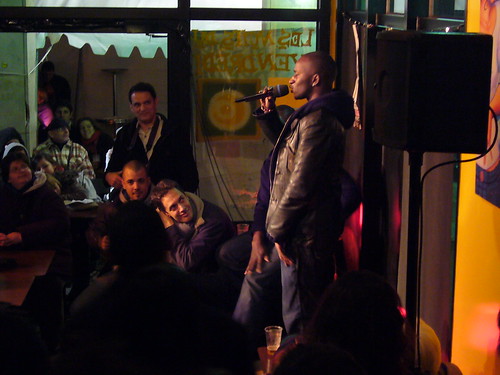
Souleymane Diamanka at Café Culturel in Saint Denis in the suburbs outside Paris

Haven’t I claim that French slam poetry can be seen as a commentary on and/or a representation of French society? Yes, certainly I have. From my very first slam session, I’ve felt that there was a strong connection between scene and society. And then, when I was exploring further the relations between anthropology and literature I wrote about in the previous post (and which I’ll come back to soon), I made a giant step forward in getting to grips with the relationship. Suddenly, I saw a clear connection between the slam scene in the years 2006-2007 and the riots in the autumn 2005 and the deepest oppositions in French society. All thanks to the ritual and performance theorist who for a long time has been looming in the background, or rather in the middle of the heaps of books I’m building my project upon. This is not to reduce the artistic element of the slam phenomenon. On the contrary, good ol’ Victor Turner conjoins the two – theatre and social drama – on a deeper level and shows how the two actually feed off each other.

Souleymane Diamanka at Café Culturel in Saint Denis in the suburbs outside Paris

Haven’t I claim that French slam poetry can be seen as a commentary on and/or a representation of French society? Yes, certainly I have. From my very first…

Read more

Parisian performance poetry: a republican space for encounters?

Another presentation which I blatantly will fail to give (see this post), were to take place at a conference in Oxford in about one week’s time, Encounters and Intersections: Religion, Diaspora and Ethnicities.

The problematics of this paper give me the opportunity to look at two other aspect of the space created during a slam session: the particular quality of the encounters taking place. While only a very few of the participants talked explicitly about the political and subversive character of the slam phenomenon (see previous post), many more will describe it as a quite unique place for encounters. This is thus more of a native’s point of view than what is treated in the previous post. The ways many people describe the soirées echoes in my opinion important values of the French Republic. This is the next aspect I’ll introduce in the analysis of the space created during a session. In the previous post, I looked in the direction of connections between the local socio-political environment of the city and the soirées, in this it’s the connections between the soirées and the Republic herself I postulate. These problematics will go into chapter 2 and Chapter 5 (see the outline at the end of this post). Here’s my abstract for the conference:

Parisian performance poetry: a republican space for encounters?
Cicilie Fagerlid

In this paper, I will explore the space for encounters created during Parisian slam poetry sessions. Many participants characterise this performance poetry scene as a medium for rencontres (encounters) of people of different backgrounds. The sessions are among the most mixed events one can find in France, in terms of social and ethnic background as well as age and gender. It can thus be seen as an arch expression of the French republican ideal of mixité sociale and the value of vivre ensemble (“living together” – a term with similarities to the British notion of “community cohesion”).
The performances treat a vide variety of issues, expressed with a variety of different artistic styles, from rap to French traditional poetry via experimental theatre. However, seen from a British multiculturally inspired paradigm, the issues of collective religious or ethnic identities are conspicuously absent.
I will place the poetry sessions within the socio-political geography of East Paris (a popular, bohemian and increasingly gentrified area shaped by immigration) and the French republican paradigm of social integration. The paper is based on 16 months of fieldwork in East Paris. In addition, I will draw on my previous research project on British Asians in London.

Contact details:
Cicilie Fagerlid
Department of Social Anthropology/Cultural Complexity in the New Norway
Postboks 1091 Blindern
N-0317 Oslo
Norway

Cicilie Fagerlid is working on her PhD thesis with the preliminary title Society in the Making: Post Colonial Paris and the Slam Poetry Scene. She is employed at the Department of Social Anthropology and Cultural Complexity in the New Norway, strategic research programme, both at the University of Oslo.

Another presentation which I blatantly will fail to give (see this post), were to take place at a conference in Oxford in about one week’s time, Encounters and Intersections: Religion, Diaspora and Ethnicities.

The problematics of this paper give me…

Read more

Ethnography under colonialism: what did Evans-Pritchard think of it all?

“When the Government of the Anglo-Egyptian Sudan asked me to make a study of the Nuer I accepted after hesitation and with misgivings” (Evans-Pritchard 1940: 7).

“A Government force surrounded our camp one morning at sunrise, searched for two prophets who had been leaders in a recent revolt, took hostages, and threatened to take many more if the prophets were not handed over. … It would at any time have been difficult to do research among the Nuer, and at the period of my visit they were unusually hostile, for their recent defeat by Government forces and the measures taken to ensure their final submission had occasioned deep resentment. Nuer had often remarked to me, ‘You raid us, yet you say we cannot raid the Dinka’; ‘you overcame us with firearms and we had only spears. If we had had firearms we could have routed you’; and so forth. When I entered a cattle camp it was not only as a stranger but as an enemy, and they seldom tried to conceal their disgust at my presence, refusing to answer my greetings and even turning away when I addressed them” (ibid. p. 11).

There is no other anthropologist I’ve read so extensively and thoroughly as Evans-Pritchard. I love how he makes reference to his arguments over witchcraft with members of the Azande community. His ethnographic descriptions of situations and even individuals in Witchcraft, Oracles, and Magic among the Azande are so “thick”, that you are allowed judge by yourself whether you agree with his theoretical analysis or not. When I reread The Nuer a couple of weeks ago, my hero disappointed me.

The book is nothing but generalisations – there isn’t one event, one situation, one individual mentioned after the short introductory chapter. Not even his one “constant companion in Nuerland” Nhial (p.10), who must have been indispensable in acquiring knowledge of the fierce and hostile Nuers appears in the text proper. He leaves us with an image of Nuer society as a seamless, timeless whole* devoid of real human beings. But as we know from his own introduction, Nuerland is in full anti-colonial revolt at the moment of writing. And in Evans-Pritchard’s own tent, young and proud Nuer men “endlessly visit”, talking about nothing but cattle and girls (which “led inevitably to that of cattle” :D ) and asking for tobacco without bothering to answer his questions.

Like anyone who’s been through a graduate course in social anthropology, I was of course familiar with the critique. However, my recent interest in colonial encounters gives an extra edge to reading 70 years old ethnographic descriptions by a white Brit in East Africa (Bourdieu among the Kabyle has certainly moved up on my reading list).

“I … never succeeded in training informants capable of dictating texts and giving detailed descriptions and commentaries. This failure was compensated for by the intimacy I was compelled to establish with the Nuer. As I could not use the easier and shorter method of working through regular informants I had to fall back on direct observation of, and participation in, the everyday life of the people. … Information was thus gathered in particles, each Nuer I met being used as a source of knowledge, and not, as it where, in chunks supplied by selected and trained informants. … Azande would not allow me to live as one of themselves ; Nuer would not allow me to live otherwise. … Azande treated me as a superior ; Nuer as an equal” (Ibid. p. 15).

Between the lines of this cold and “objective” ethnography, I read a lot of respect for the Nuers. But how on earth could this brilliantly alert and bright anthropologist not reflect on his own position as employed by the colonial – and so obviously repressive and violent – government. And equally puzzling: how can he treat the fact that he moves around with black servants (not Nuers, of course!) as such a matter of course? From the previous quote it even sounds like he usually treated his informants as servants… (This classical photo from Monica’s blog apparently gives a good indication of his relationship with the Azande).

A student alerted me to the fact that Evans-Pritchard lead African troops against the Italians in Eastern Africa during the WWII (Wikipedia). After seeing the French film Indigènes (see earlier blog post) on how the French colonial troops were treated during the war, I cannot but wonder how my predecessor treated his own soldiers.

*) This seamless whole is in fact what he wanted, as he writes that he wanted to write a new kind of monograph where the development of theory isn’t drowned in ethnographic detail.

“When the Government of the Anglo-Egyptian Sudan asked me to make a study of the Nuer I accepted after hesitation and with misgivings” (Evans-Pritchard 1940: 7).

“A Government force surrounded our camp one morning at sunrise, searched for two prophets who…

Read more