search expand

Rainy day and interviews

It’s pouring down in Paris, and there is no sign of the heat wave that struck us a year ago. I’m stranded at the local bistro, wishing I had brought my woollen jacket. If the best thing to do when it rains like this is to cuddle up at home with a cup of tea, living alone in a hotel is perhaps one of the least pleasant things. (However, seeing all the people sleeping rough in this city, sometimes right on the pavement outside this bistro, it could have been very much worse. And I’m planning a sizzling hot fish tagine for lunch – if I just could get down to the restaurant – so I’m not complaining).
[teaserbreak]
Since my last post, I’ve done four interviews: two quite good and long ones with people I know at least a little bit and who – at least as importantly, I think – has seen me around on various venues for 6 months, and two with people who have rarely if ever seen me working. The latter were of course far shorter and less good, not due to the interviewees, but not surprisingly to the interaction and dynamic between us. My mediocre French also hinders me in creating a very constructive dialogue there and then, which could have counterbalanced the lack of confidence between two strangers. In London, I conducted interviews with three people I’d only been emailing with beforehand which resulted in excellent material. They knew I would anonymize them, and also that we probably would never meet again, so they used me a little bit like a psychologist, when telling about their experiences of growing up. The slammers can in most cases of course not be anonymized, so the interviews develop completely differently, not deviating much from their public persona. And in the cases where I know people well, both sides know there are strict limits to what I can reveal about them, and obviously also to what seems relevant to my study. One of the explicit issues in London was identity formation. Here identity is relevant as well, but only implicitly. In addition, many will say that they tell about this and that – more or less poetically expressed – in their texts.

I concentrate so hard when interviewing that I feel dizzy afterwards. In order to grasp (almost) all they are saying – often in a café that appeared calm and quiet until I find myself face-to-face with a surprisingly softly spoken slammer – I’ve realised that I scrutinise people’s face, following their mouth as if reading on their lips. Sunday, I listened to people talking for almost 6 hours – at a balcony overlooking Canal d’Ourcq in the northeast, and in a café off Rue Moufftard, in the southeast – with only a 40 minutes bikeride in-between. The morning after, I woke up feeling like I’d been drinking until the early hours. Strange.

Today, I’ll go at an end-of-the season soirée at a small bar at Barbès, where I’ll meet up early to finally do the interview I ditched (unwillingly!) at Pigalle some weeks ago. – Under the counter in this bar, a slammeuse told me, there lays a Paris Match from mid October 1961 saying nothing about the hundreds of French Algerians thrown into the Seine by the police after the peaceful demonstration the 17th (see this post). The barman had shown it to the eldery slammeuse after she had performed a text on the police chief of the time, Maurice Papon (who has such a dark record that the fact that he died peacefully in a hospital bed without having been severely punished makes certain aspects of French politics utterly incomprehensible to me). The barman showing her the magazine had moved her, she said. He in return was surely moved by her performance, although it’s nothing new that White Frenchmen also were concerned about the plight of the Algerians. (For instance, all the 9 killed by the police at metro Charonne in February 1962 had traditional French names. See this post). He can’t have been old, if he was born at all, in 1961. The magazine must thus have been laying in the bar or having been kept in his family from that time, probably in order to remember that although it mentions the demonstration, it said nothing, nothing about what really happened. Knowledge I’m sure was widespread amongst the French Algerians at Barbès at the time. This knowledge, together with the more than 40 years silencing of it, continues to live on, under counters at bars in Barbès, as well as elsewhere… “Finish with the repentance…” (as Sarkozy says – see a post or two ago), well, I don’t know if the time is due yet.

Instead of moving on to the third café with wifi (after a late breakfast in the neighbourhood, I hurried through the rain for a late lunch at picturesque and rain wet Place Sainte Marthe), I think I’ll post this now and take benefit of the surely temporary stop in the downpour to move on.

It’s pouring down in Paris, and there is no sign of the heat wave that struck us a year ago. I’m stranded at the local bistro, wishing I had brought my woollen jacket. If the best thing to do when…
Read more

Hierarchy… work ethics and myths… and fieldwork

I realise – as I read an interesting comment in Le Monde on, of all things, why the Toyota model can’t be French – that I haven’t written any posts on hierarchy yet. My cahiers and mind are full of speculations of quite another sort than on French business and work place interaction – for instance I’m thinking about what I can make out of the coincidence that the two last books I’ve read are called the art of something (loving and fieldwork to be precise). Thus, I’m relieved to find another reason for choosing this subject for a post after such a long silence in the blogsphere; it’s unforgivable to have written 69 blog-posts from France without mentioning hierarchy and arrogance!
[teaserbreak]
I’m up in the air again, with Air France, my for all reasons favourite air company for the time being. It’s awfully sunny up here, we haven’t seen any of the thunderstorm and turbulence they announced at Gardermoen, and the French (slightly) arrogant steward has served me chilled Chardonnay from Pay d’Oc – an excellent remedy against turbulence – and I’m not sure what I feel about going back to Faubourg du Temple after 9 days up north which seemed like an eternity at the other side of the galaxy (in terms of mind set of the anthropologist. Perhaps more on that later. I’ve realised that what anthropologists call going native, lay people like my Mom and ex call the Stockholm syndrome – surely this makes important data for a blog on fieldwork and anthropological research, but right now we’ll return to hierarchy). It’s not only the chilled Chardonnay that explains my fancy for Air France. I just love to serve myself unashamedly with a pile of French newspapers and go through all of them as I’m forced to do little else for 2 hours and 25 minutes. The great thing with newspaper in paper versions – compared to the e-version I usually consult through my rss feed thingy – is that I read articles I never would have clicked on deliberately. Pourquoi Toyota n’est pas français is a typical example.

At a dinner party light-years ago, an economist I know told me about a survey he’d read about in the Norwegian economist newspaper Dagens Næringsliv, explaining France’s economic and business retard as a lack of confidence between the echelons in the workplace hierarchy. The analysis in Le Monde seems to refer to the same or a very similar survey (perhaps this view is common knowledge in the financial world outside France): The gap between the managers/employers and the employees are wider in France than most other countries in the western world. There are archaic social relations in this country, the analysis claims, which keeps the French from working well together. The cadres don’t give any freedom to their subordinates, as they do not trust their capacities, and the lower employees are mistrustful of those above them. “Of course I wouldn’t use his first name and tu (second person singular as opposed to vous, the polite second person plural),” a friend of mine said about his – quite clearly idiot – boss, “he’s not my pal!”

The radical labour unions are another division holding back French business, according to the analysis. The labour unions in France have little interest in improving the work conditions for the labourers, as that would just help capitalism and le patronat… The unions here – les syndicates – are very different from the ones we’ve got back in Scandinavia. Here, less than 10% of the workforce is organised, while back home I think there are only 10% who are not in a union. I don’t know too much of what they do here, but they seem far more radical than my own “Union for researchers” which mostly care about salaries (in addition to some grumbling over the worsening conditionings for doing research after the university reform). In France, les syndicates are feared for their strike force. A relatively large portion of the French are fierce strikers, and many people count on – or worry for – what will happen to his reforms when the striking season sets off in the autumn.

Thus, it’s this archaism and divisions that are to blame, and not decline of work ethics, as the new president complains. He proclaims a rupture with the past and wants – like leaders before him in history – to restore the values of travail, famille, patrie (work, family and fatherland…). To the contrary, claims the analysis: In the developed world, the French are among those who gives most importance to work and many think it important to instil in their children the value of working hard. (Perhaps in contrast to the oil bubble Norway, if you ask my aging teacher parents…).

Interestingly, it’s not only the president who thinks that the French don’t value work sufficiently. The Guardian loves to portray the French as non-protestant hedonists who know that one should work in order to live and not live in order to work. (For instance Goodbye to la Belle France? on the possible effects of Sarkozy’s reforms). I would agree that the pace of life appears slower – and frequently comes completely to a halt on pavement cafés, just for idle conversation for hours – here than in Oslo or London. (It would be interesting to count people walking around with paper cups with coffee in the three capitals. Oops, here I can feel the urge for a digression on espresso at the counter in Latin countries, but I’ll retain myself). However, diverging from what appears to the eye of The Guardian and me – but in line with the argument that strong work ethic still exists – productivity per work hour is higher in France than in the US and Britain (but the same as in Norway).

I’ve landed in freezing cold France days ago, and when I opened the document in order to round up this post and put it online, I could no longer remember where I initially had planned to end it. I probably had tons to say about how hierarchy and “archaic social relations” shape social life here. I’m sure it also shapes the slam poetry scene, and my relations there. A few indications: French slam poetry is an east end, popular phenomenon in a country with high youth unemployment. In stark contrast to my previous fieldwork, I have markedly more education than the majority of the people who surround me, in some cases more than ten years of formal schooling and education. And where to place poetry in the French field of archaic hierarchies?

I realise – as I read an interesting comment in Le Monde on, of all things, why the Toyota model can’t be French – that I haven’t written any posts on hierarchy yet. My cahiers and mind are full of…

Read more

Elections


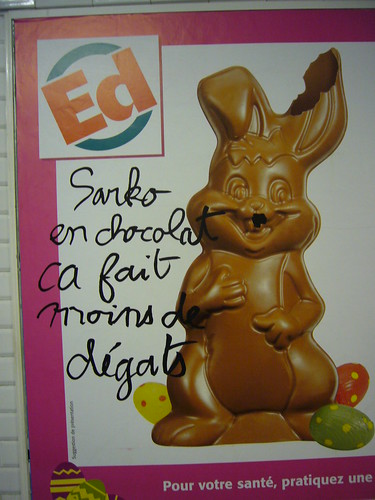
Sarkozy in chocolate makes less damage

Blogging is hard these days. I’m busy, I’ve had visitors and I’m experiencing a personal earthquake*. And when all this is going on in the fieldworker’s life, the presidential election is approaching.
[teaserbreak]
However, contrary to what I expected after the previous stormy spring in Paris, not much is actually going on. I have a pressing feeling of silence before the storm, while a more sinister friend of mine made up the metaphor of the silence of the tiptoeing of slippers before the reverberation of the boots…. His dark vision is that France will wake up and go to work just as normal when the catastrophe hits, – and it will hit, according to him. On a far more positive note, another acquaintance said that Sarkozy was too extreme to be voted president of France. He guessed that he wouldn’t even to through to the second round.

As I’ve mentioned before, the most frequent reproach against Sarkozy I hear, is that he divides the population (the worst faut pas in the indivisible republic) – between for instance “the good and the bad” (editorial in Libération 18/04).

The adversary candidates Royal (socialist) and Bayrou (centrist), said on their last meetings that France could not have a president with a mask of fear and who’s project is himself (Royal) and someone who loves power more than he loves France (Bayrou). Heavy criticism of this sort is coming up from various angles in the press at the moment. I just can’t imagine that he will go through, and if he does, I certainly can’t imagine what will happen…

The situation is tense everywhere and quite unlikely people are appealing to voter utile (“vote usefull” – thus gathering around the one candidate on the “left” who has a chance to go through to the second round, i.e. Ségolène Royal).

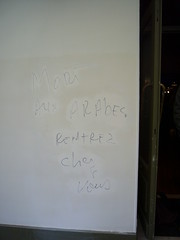
Racist slur on the wall outside the café Nuits Blanches
The slam scenes seem as much waiting and seeing as the rest of society. Some people claim that opportunists are turning up with political texts just to jump on the bandwagon (slam is highly hyped at the moment, and there are presumably agents from record companies and other possible sources of employment present on the soirées). Personally, I haven’t noticed that the texts are more political now than they were when I started seven months ago.

The climate of fear has however killed off one of my favourite slam venues, the weekly night at Les Nuits Blanches nearby Gare de Lyon. After complaints about noise from neighbours, which is one thing, and the shockingly plain racist threat – written with adult handwriting on their wall – mort aux Arabes rentez chez vous (death to the Arabs. go home), they decided to cancel the event. The owner immediately related the threat to the climate of the election campaign…

——–

*)

Oh, how could I be so stupid to put on Gainsbourg for writing at such a time? At the momen I hit the keyboard with this very sentence, his Chanson de Prévert (

) hit like an aftershock…

Å jeg vil at mens du minnes
Denne sange som var din
Jeg tror det var din favoirtt
At den er av Prévert og Kosma
Og at hver gang Dødt Løv [feuilles mortes]
Minner deg om meg
Slutter død kjærlighet [amours mortes]
Ikke å dø

[…]

Kan man aldri vite hvor den begynner
Og hvor den slutter, likegyldigheten
Høst går til vinter
Og når sangen til Prévert
Dødt Løv
Viskes ut av minnet mitt
Den dagen har de sluttet å dø
Mine døde kjærligheter

Sarkozy in chocolate makes less damage

Blogging is hard these days. I’m busy, I’ve had visitors and I’m experiencing a personal earthquake*. And when all this is going on in the fieldworker’s life, the presidential election is approaching.
[teaserbreak]
However, contrary to…

Read more

Vivre ensemble after school time


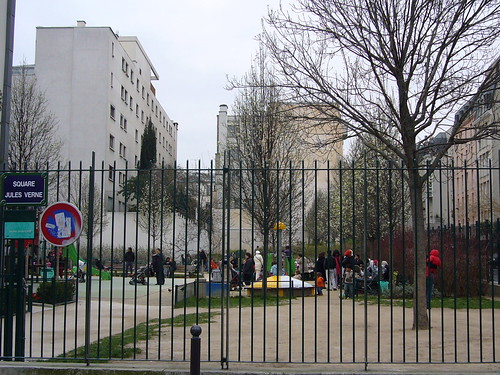
The playground 10 days ago, before spring came for real

Le square français was the second post I wrote on this blog, but as I’ve spent a sunny spring afternoon on one again, I just have to share my enthusiasm once more.
[teaserbreak]
After school, parents and grandparents in France as well as Norway, pick up their small children. Instead of going straight home, as is normally the case where I come from, many here spend an hour or so at the local playground before they go home to make dinner, several hours after the north European equivalent.

This is a square in Belleville, not so far away from the school where the Chinese grandfather was brutally brought in by the police a couple of days ago, when he came to pick up his two grandchildren after school. As the headmaster was also put in police custody for seven hours for protesting against the arrest, the brutality of Sarkozy’s measures against the sans-papiers has provoked such a widespread political debate that it has reached the election campaign. (For better of for worse…).

This playground in Belleville is the extreme opposite of Sarkozy’s election campaign – which has gone as far as proposing a Ministry for National Identity and Integration… – because here sheer coexistence exists. (A frequent critique I hear of Sarkozy, is that he divides the population, the outright opposite of the sought after vivre ensemble, living together). There is not one skin colour or hair colour missing here in the square – but as we are in Belleville, I hear almost as much Arabic as French amongst the parents, and a Swedish looking father was just saying Yalla! to his two blonde daughters. Judging from parents and children’s dressing – as well as behaviour to some extent – there is a thorough social mix as well.

It pleases me to see this mixed local community, but the phenomenon of coming together like this, of children and parents, on an ordinary Tuesday afternoon, just as part of the routine of everyday life, pleases me even more. It’s such a sociable, nice little everyday thing to do… Hanging around for unreasonably long time in whatever place on earth one can find to watching humans interact, is a habit I’ve inherited from my father (biologist, with interest in every aspect of nature). When I tell him about the French square (perhaps as an unconscious attempt to prepare him so he won’t be too surprised if I end up moving to France in order to provide a good growing up environment for my eventual children :) ), he asks me if I think it’s Mediterranean cultural trait. It might very well be, since in Greece and Spain as well, children, youth and grownups come together on public places and spend time side-by-side and together, long past sleeping time for Scandinavian children. But rather than being Mediterranean, I think actually that it’s the climate in Scandinavia making us standing out from most other societies in the world. (I think we can also include the Anglo-Americans to this. A survey I’ve heard cited on the radio here in France several times recently shows that scepticism and even fear of teenagers, based on the lack of contact between teenagers and adults, are far more widespread in Britain that other countries in Europe). And it’s not a Scandinavian exception I’m particularly fond of.

The playground 10 days ago, before spring came for real

Le square français was the second post I wrote on this blog, but as I've spent a sunny spring afternoon on one again, I just have to share my…

Read more

My blog, my project and I, part 3 – I and Politics

Another warm night, and it seems like insomnia strikes again despite however little storm and poèsie infused sleep I had last night. I’ve been too snotty to go to the jazz concert in Parc Floral and hang around somewhere in East Paris until the early hours, as would have been suitable for this hot Saturday. And I regret it a lot, especially since it’s my second last weekend here (and only three more jazz concerts to go, amongst all the other things I’ll be missing…). Instead I make use of my sleeplessness to finish a blog post I’ve been planning for months.
[teaserbreak]
As my fieldwork is soon coming to an end, it’s time to take a step back and look at what I’ve been doing here, and why I’ve been doing these things and not others. It’s been a lot of politics, in my blog as well as in my experiences here.

As I’ve mentioned before, my initial intention to study peaceful and harmonious cosmopolitanism as it is played out in people’s everyday life, quickly faded into the background since I had been fortunate to step right into the largest revolts and demonstrations in the time of the Fifth Republic (1958-). (And probably, simple harmony sans rebellion would have made a poor representation of French society, anyway. Apropos, the almost free jazz concerts in Parc Floral constitute exactly such a harmonious cosmopolitan space. There is every colour on the planet present, and the number of mixed couples, babies and circles of friends equals Marseille ☺. The styles of dress vary from the banlieusard’s trainers, tracksuit bottoms and t-shirt to chic west end babes with sunglasses and expensive skirt and top, via almost everything else. And, as I’ve noticed to my delight at an east Paris hub like Place de Ménilmontant as well, all colours/ethnic backgrounds are represented – though not equally numerous – in all styles and functions. Thus, no multiculturalist neat little boxes to put the people inside. Though, I should add that this mix might have decreased with the summer reaching its zenith, as more and more Parisians are leaving for vacation and being replaced by more and more groups of tourists and foreign western students).

Besides, as more than one post on this blog have tried to show, it doesn’t take long to start sensing the reasons behind people’s frustration and anger. Policing and security is one such issue. After a quiet week in Corsica, it took one night out in Marseille for my Norwegian company not yet accustomed to the present government’s “securitarian” measures to get a feel of this situation. We watched the world cup football semi-final Portugal-France in the Vieux Port. After the match we stuck around for a while with a few thousand others, sharing our last can of beer while watching the celebrations. Teenagers on scooters drove around in corteges waving flags and hooting. Kids were running around while their parents were chatting. – I saw a brother yelling at his little sister for walking around alone shooting pictures of the crowd with the family’s digital camera, while their mother just laughed at it. There were firecrackers and drums, and a little (very little compared to where I come from) drinking and a little (much more than where I come from) cannabis smoking. A group of thirty-something were just about to light their joint next to us, and I was just about to say to my company that sooner or later someone will throw something in the direction of the Robocop-looking CRS police who are never far away on such occasions, who will in turn start charging, which again will provoke more projectiles from the crowd… when a group of CRS suddenly ran up right behind us with all their riot gear. So less than 45 minutes after France had beat Portugal, the CRS found it opportune to start clearing the Vieux Port. There were still children there, I even saw a father carrying his 3 months old baby away from the tear gas… A large section of the crowd had involuntarily been trapped on the opposite side of the port of their way home, but I also think some families with older children stuck around for their kids to see what France is like these days. My company, who had not yet become used to see the police in action on almost every night out, was surprised and a little bit upset and angry: It was utterly incomprehensible to us why we couldn’t go on with our little celebratory street party a little longer…

So, all this writing on politics of resistance has come naturally, from the circumstances. In addition, of course, it’s due to my own social and political concerns and interests. It’s not the first time I become politicised when I leave the peripheral Norway and go to Europe. (This has got more to do with Norway than with Britain and France, “remember, it’s Norway that is exotic,” my old French teacher used to say when we were surprised by some strange ways of the French). It happened on my previous fieldwork as well, in London in 1999, although then overt politics didn’t make its way into my final texts the same way as it undoubtedly will this time.

My fieldwork (amongst British Asians) and my life in our communal house was so far apart when it came to political activism, that on a demonstration where I went with one of my flatmates (a British Pakistani), he was so excited about seeing one other South Asian looking guy there, that he wanted to go straight over to him and try to get him to be my informant. This was on the great Carnival against capitalism, at the day of the G8 meeting on June 18, 1999, which together with the Seattle meeting in November the same year, marked the beginning of a new era of anti-capitalist and anti-(economic) globalisation protest. It was inspired by the anarchic street party approach of the Reclaim the streets anti-capitalist, anti-corporation, anti-car phenomenon in Britain from the mid 1990s, and it was to become increasingly transnationalised, – epitomised by the slogan “Our Resistance is as Transnational as Capital”. For me, the experience of spending a whole day in the enjoyable, but conscious, atmosphere at this do-it-yourself street party right between the corporate giants in City, woke up my old anarchist political consciousness that had been slumbering ever since my teenage years of naïve reveries had ended. After that moment, I understood perfectly well Durkheim’s analysis of how participating in rituals make individuals feel that they are part of something bigger, which can give them a certain sense of meaning in their lives.

In London, I met loads of people who believed it was worthwhile making the world – as well as the local community – a better place to live. In my ears, it sounded like people were discussing things that mattered, things worth living and fighting for – and they often tried to live accordingly, not just exist to consume… Well, what happened when I got back to Norway after my previous fieldwork? We all seem so bourgeois there, caught in our narrow, bourgeois lives, – to put it with an everyday French term. But perhaps it’s just got to be like that, in a society without foreign debt, where the buying power is just rising and rising and where we seem to be so comfortably far away from the misery of the world.

Here, the world is on our doorsteps – if not in our own house: the misery of it as well as its diversity, its resistance, its hopes… The cosmopolitanism, the transnational connections, the creativity, the political consciousness, the sociability, the poetics – all this constitute for me sensations, emotions, atmospheres and everyday routines – as I wrote in this blog some days ago – which I’ll miss immensely when I leave. Because I know, as I also wrote, that it takes no time at all for this state of mind to be replaced, as soon as I step back into my Oslo way of life, to such an extent that my Paris experience – as with London some years ago – appears as a parallel but distinctly separate universe.

Another warm night, and it seems like insomnia strikes again despite however little storm and poèsie infused sleep I had last night. I’ve been too snotty to go to the jazz concert in Parc Floral and hang around somewhere in…

Read more