search expand

The strange nature of politics in France – Protesting, part 2

One thing that struck me during the November riots was the high level of understanding they were shown in the French public debate. It seemed to me that quite a few who participated in the public discourse quickly interpreted the burning of state institutions, private cars and local companies in the banlieues as – not acceptable, but, yes understandable – expressions with some sort of political meaning. A friend of mine familiar with politics in Germany asked me if no one had demanded the demission of the Interior Minister, as it is he who is responsible for law and order. And in a German context, according to her, three weeks of youths rioting all over the country would have been an obvious sign that he didn’t do his job properly…
[teaserbreak]
(But not in France: Interior Minster Sarkozy’s popularity grew during the riots. He certainly condemned what happened, but he didn’t crush the riot with police force, which my friend guessed would have happened in Germany. In fact, I’ve heard that the riots were neither halted by the police nor the state of emergency. Rather the youth themselves decided to stop.)

I should ad that some (whites) I spoke to had not much understanding for the pampered youth who had been given money for nothing for so long…

I came to remember this – to me – striking acceptance for protest now that the students “are in the streets” again. As I wrote in the previous post, politics in this country should – it seems to me – to a larger degree than many other places be played out in the streets. And politics is, in fact, a public and popular concern in this country. Demonstrations, and notably student demonstrations, have made governments withdraw laws several times since 1968. This is one aspect of “the French exception” which is being played out right now. Another aspect is the strong opposition in the French opinion against the (neo-)liberal weakening of the labour regulations. (I forgot to explain the Contrat Premier Embauche in the previous post: it’s a contract for people under the age of 26, which gives the employer the right to dismiss the employee without explanation during the two first years.) However, that is another story I’ll not go into here.

In upcoming posts I’ll come back to other aspects of French society, which I find strikingly different from what I’m used to.

One thing that struck me during the November riots was the high level of understanding they were shown in the French public debate. It seemed to me that quite a few who participated in the public discourse quickly interpreted the…
Read more

Contrat premiere embauche – Protesting à la français

Initially, I hadn’t planned to go to the major demonstration against the CPE (“contract ‘first employment'”) as it only tangentially touches the focus of my fieldwork (tangentially, as the CPE – Contrat Première Embauche – is part of Prime minister Villepin’s plan for égalité des chances: youth unemployment is high in France and even higher in the Zones sensible which is in need of the equal opportunities). But as the echoes of the chanted slogans reached all the way to my flat – situated at least 20 minutes away from the standard demo route Place de la République/Bastille/Place de la Nation – and I saw the diverted traffic as I leaned out of the window, I realised that the scale of the event made it worth defying the heavy rain and head for Nation.
[teaserbreak]
The ten minutes walk down Avenue Philippe Auguste, I was thinking about how different French politics are from what I’m used to. The implementation of the CPE is a good example. In L’Assemblée Nationale the politicians can speak loudly, clap, make noise and sometimes shout, and – most exotically – even express themselves with eloquence. In this, France is similar to Britain. The importance they give to demonstrations is however different.

One month ago, there was a discussion in the National Assembly on the government plan of implementing the CPE and other “equal opportunity” measures, which went something like this: A socialist politician shouted to prime minister Villepin (the architect of the CPE): – You should listen to the streets! (alluding to the first demonstration against the CPE taking place at the time). Villepin, Monsieur l’éloquence personally, replied, with oratorical pathos: I am listening to the streets… – but I also hear the ones who are not down at the streets (pointing to the rather feeble support for the demo). Demonstrations have thus an important political role to play in this country. (I’d like to give some other examples, but as this is meant to be a quick post, I’ll leave it for another time).

As I arrived at Nation, I noticed that 7 of the 8 boulevard and avenues running into the square were lined with the CRS – riot police – standing around, looking after their helmets, shields, batons and other riot gear… (The 8th street was of course the one where the protesters entered). I don’t think such demonstrations, full of healthy (though leftwing) pupils and students and more or less bourgeois labour unionists often turn violent, but the Republic obviously wants to put her measures at display. – So also with her boulevards and avenues, constructed broad and straight as they were in order to easily suppress popular rebellion…

I think about the republic and her broad boulevards, full of politics, as I linger for a while in Place the la Nation: I once participated in a tiny little demonstration in London (I think there were 16 000, which would hardly count as a demo in a country where hundreds of thousands take to the streets many times a year) making City a drum’n’bass dance party and consequently a no-go area for the police for hours… as the narrow and winding streets of City is not made for riot police.

After taking some blurred, grey and rainy photos of the last part of the demo down Rue du Faubourg Saint Antoine from Bastille, I hurried home in order to change shoes, socks, trousers and umbrella (ready for the dustbin) before I went to a neighbourhood democracy meeting in a nearby school, which of course turned out to be full of people discussing, objecting and protesting and talking about art and the importance of preserving small-scale artisan affairs for hours…

Initially, I hadn’t planned to go to the major demonstration against the CPE ("contract 'first employment'") as it only tangentially touches the focus of my fieldwork (tangentially, as the CPE – Contrat Première Embauche – is part of Prime minister…

Read more

A day in commemoration of slavery

The 10th of May is from now on going to be the national day in commemoration of abolition of slavery. 10th of May in 2001 was the day slavery was declared crime against humanity in France, which was the first country in the world to adopt such a law. It was the deputy from French Guiana, Christiane Taubira, who proposed the law, and its been named Loi Taubira after her.

In his speech, President Chirac proclaimed that “the greatness of a country is to take on all its history, the glorious pages as well as the dark parts. Our history is that of a great nation. Look at her with pride. And look at her as she is. That’s the way a people can unite and become more close(-knit).”

(As a foreigner, I do find interesting this constant return to the greatness of the French nation, and I can’t forget another of Chirac’s speeches lately on the issue of nuclear weapons, but be that as it may).

Le Monde greets Chirac’s speech and holds it together with two other speeches as strong and important moments of his reign as President: 16th July 1995 when he for the first time recognised the French state’s role in the deportation of thousands of Jews during the Second World War; 15th August 2004 when he honoured the North African and African veterans’ contribution to the liberation of France and the speech 30 January 2006.

(Again, many others in this country will not remember Chirac for these three speech, but rather for the one 19 June 1991, gone into history as “le bruit et l’odeur” (the noise and the smell), where the President lately so famous for his antiracist stance made speech worthy of Le Pen. I’d really like to say a lot about it, but be that as well as it may for the moment).

The 10th of May is from now on going to be the national day in commemoration of abolition of slavery. 10th of May in 2001 was the day slavery was declared crime against humanity in France, which was the first…

Read more

Security à la français: précarité and insécurité

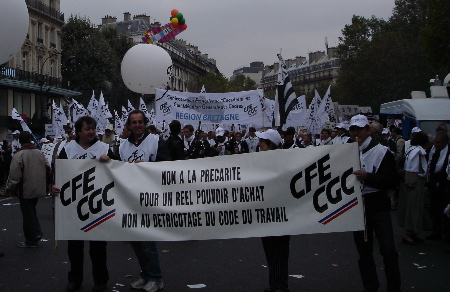
From a large demonstration 04/10/05: “against uncertainty, for a real increase in buying power and against dismantling of the labour regulations”.

Last week I was back home for a few days, and I went to a seminar on the wide-ranging notion of safety/security (“trygghet”). As it happens, two aspects of “security” play important roles in French politics and society; however, these aspects do not seem to be very high on a security agenda in a Norwegian context. I think this difference in emphasis points to interesting economical and social differences between the two societies.
[teaserbreak]
It was in fact at language school at l’Alliance française, amongst middle class students from all over the world, that I realised the insecurity the middle classes is experiencing at the moment, perhaps almost globally, but particularly in continental Europe. The buying power of the majority of the population is in many countries going down. (Excuse me for appearing naïve, but the accelerating consumerism in the Norwegian society must have blinded me to the situation elsewhere). Large parts of the population can no longer take for granted the growth and upward social mobility from one generation to the next, which has been such important forces in the capitalist societies since the second world war.

In France, unemployment among the under-25-year-olds is 21% (and of course doubled in the so-called “problem areas” (zones sensibles)). Thus précarité (insecurity, uncertainty, particularly concerning social issues, like job security) is a key aspect of French political discourse, especially among the left.

The news coverage before Christmas frequently returned to the issue of the dropping buying power, and at Christmas time the TV news showed report after report about the homeless (les SDF; sans domicile fixe). A typical story of a SDF shown on the news is about a normally well-dressed and well-kept male perhaps around the age of 40 who had “everything a few years ago, but then he lost his job…” According to a friend of mine, such stories are not common at German television. Despite high rates of unemployment, homelessness is apparently not such a big problem there. The atmosphere of la précarité in France is obviously reinforced by the enormous lack of suitable housing, a problem Germany does not suffer from.

The other aspect of security in French politics and society is l’insécurité. If the notion of précarité appeals to the left, insécurité is a winner on the right. For some reason, insécurité has particularly come to mean urban violence (but it can also be used in relation to road safety and food safety). (Since the French can’t talk about “race” and ethnicity, they have come up with a whole range of terms that can connote “race” and ethnicity… I think insécurité sometimes have such connotations, but probably not always. I will certainly return to this particular French way of talking about social and ethnic issues, which is very different from the Anglo-Saxon way).

“Insecurity” has not been very important in French politics the last 4 years (thanks to some clever political stunts by Interior Minister Sarkozy), but after an absurd incident of violence and harassment on a train in Southern France New Year’s Eve, it’s up on the agenda again – 15 months before the next presidential election, as the journalist commented. It was probably the overwhelming focus on “insecurity” in the media and in the political discourse that made the socialist candidate loose to the extreme right candidate in the 2002 elections (see “It’s better to vote than to burn cars”). Thus, if French politics are returning to the issue of insecurity now, it means that it’s taking a turn in a particular direction.

In the news today, Prime Minister Dominique de Villepin announced a new employment policy for the young unemployed, a move which of course can be latched on to the précarité debate. Interior Minister Sarkozy, on the other hand, announced 700 new positions in a kind of railroad police, and a few days ago he suggested the creation of a school police as well, thus clearly an issue of l’inséurité.

Neither précarité nor insécurité have such prominent positions in the Norwegian society. As I mentioned, the difference in focus – and reality – epitomises differences between the two societies: Norway has an oil economy apparently in safe distance from the vagaries of the world (when oil prices are rising with consequences for populations all over the world, Norway is making a bigger profit than ever). The French society is noticeably part of to the rest of world – culturally, economically, politically and physically – in a different way than Norway.

From a large demonstration 04/10/05: “against uncertainty, for a real increase in buying power and against dismantling of the labour regulations”.

Last week I was back home for a few days, and I went to a seminar on the wide-ranging notion…

Read more

A forgotten link

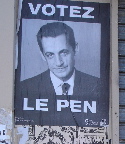
In my previous entry I had forgotten to paste in a link, which would have given more sense to the claim that choosing between Le Pen and Sarkozy isn’t much of a choice to some radical commentators. This omission gives me the possibility to return for a second to the poster put up around Paris just before Christmas, which didn’t make the ruling party very happy: Votez Le Pen.

The first time I saw the poster on the wall, someone – in typical French public, democratic tradition – had embellished Sarkozy’s face with the facial characteristics of Dracula. (The streets of Paris are full of such popular voicing of opinion, on posters or as comments written on the wall or on other signs or posters). Quite understandably, the poster has created a number of discussions on the Internet, as well (see further down).

Picture to the right: A sticker on the wall with a drawing of a matchbox with Sarkozy’s face and the text: 40 banlieue matches.

A non-exhaustive list of sites on the Internet discussing the controversy:
– An article on the matter in The Guardian (in English!)

– Articles (in French) from the political group (Act up, for HIV positives, who made the poster in order to protest against the immigration policy of Sarkozy: The press release “A poster to denounce a racist discourse and a fatal policy” and an article on all the controversy it stirred.

– Le Monde’s article (in French) “Act up withdraws the poster from their site

– An interview with Sakrozy in Liberation (in French) “I know better than Thuram what’s happening in the banlieues” and the reply from Act Up the day after: “Sarkozy caricatures himself“.

– A number of discussions in Internet chat rooms and blogs: France TV 5, samizdat.net, les indigenes de la republique,
Indymedia, rebellyon.info, grioo.com, and so on…

In my previous entry I had forgotten to paste in a link, which would have given more sense to the claim that choosing between Le Pen and Sarkozy isn’t much of a choice to some radical commentators. This omission gives…

Read more