search expand

“It’s better to vote than to burn cars”

Two days ago President Jacques Chirac proclaimed the end of the state of emergency which has been in place in France for almost two months. At the same press conference, the president also announced that the law paragraph obliging teachers to “teach the positive effects of colonialism on the former French overseas territories” should be rewritten. The paragraph was implemented in February last year and has made it to the headlines once in a while since then. However, it wasn’t until after the November revolts that mainstream politicians, really started giving much attention to the controversial issue.
[teaserbreak]
“The paragraph divides the French,” Chirac said, “that’s why it should be rewritten.” Would it have been suggested rewritten if it wasn’t for the revolts? And would the notion of a divided French people have been so prominent if it wasn’t for the burning cars making headlines around the world and threatening the tourist industry? It’s no doubt the social fracture, which increasingly has been interpreted as a colonial fracture, has climbed even higher on the public agenda the last months. From the 27th of October and three weeks onwards, France experienced the biggest social revolt since the Second World War, rivalled only by May 1968. On short term, the revolt has had an effect on the president’s speeches, but the interesting research question now is what its long-term legacies will be.

Just before Christmas one of the big news headlines was “it’s better to vote than to burn cars”. A collective of celebrities originating from the banlieues – amongst them a footballer (Lilian Thuram), a rapper (Joey Starr, NTM), a director (Mathieu Kassovitz (link in English!)) and an actor (Jamel Debbouze) – organised a media happening in Clichy-sous-Bois (where the deaths of two boys sparked off the riots), in order to make the young banlieuesards register for an election card. (To have the right to vote, the French born before a certain reform need an election card, which they get by signing up at the town hall).

The next presidential election doesn’t take place before spring 2007, but with the previous one still fresh in memory it’s better to be well prepared. In the infamous 2002 presidential election, 37% of the 18-24 years old didn’t vote in the first round – the round that eliminated the socialist candidate (Lionel Jospin) and gave the French a choice between a candidate from the Right (Jacques Chirac) and the Extreme Right (Jean-Marie Le Pen). Or, between a crook and a fascist, as many put it. (If you google “crook” and “fascist” in French – hence escroc and facho – you get hundreds of sites from around election time, appealing for people to vote for the “crook, not the fascist!”). Many have already started to dread a possible repetition of that shameful affair. But this time, the stakes can be even higher; the choice might be between Sarkozy and Le Pen. (Which according to some radical commentators isn’t much of a choice.)

Back to Clichy-sous-Bois before Christmas: “If we don’t take care of politics, politics will take care of us,” the celebrity collective stated. The youngsters seem well aware of being taken care of by the authorities, but do they believe in the power of the voting ballot? According to newspaper reportages they didn’t welcome the stars very heartily: – To vote for whom? Who represents us? Why weren’t you here earlier, during the riots? One even accused the actor Jamel Debbouze of being “un Arabe de service” (which I think must be an equivalent of Malcolm X’s notion of house negro, the slave who protects the master and his suppressive system even more eagerly than the master does himself. Perhaps coincidentally, it was Debbouze who played the slightly retarded greengrocer assistant in the highly successful The Fabulous Amelie of Montmartre, a character which in fact was the only non-white in a film accused of white-washing France).

Whether it’s thanks to the stars, or just to the riots themselves, the last month it has been more people than usual signing up for election cards. If nothing else at least they can vote against “Sarko and Le Pen”, as quite a few has put it on their way to the townhall. But we’ll have to wait and see if it’s really better to vote than to burn cars.

Two days ago President Jacques Chirac proclaimed the end of the state of emergency which has been in place in France for almost two months. At the same press conference, the president also announced that the law paragraph obliging teachers…

Read more

Meetings, conferences, debates, demonstrations, concerts…

One month ago I had problems leaving the house in order not to lose out on some heated debate or in-depth reportage covering the riots on TV or radio. Now the debates have entered the public spaces in Paris, and on some days they’re so prolific that if I choose one, I lose out on others. For instance last Thursday there was a demonstration against l’état d’urgence sociale (the social state of emergency), supported by a range of political organisations, a few labour unions and at least one political party (Les Verts – The Greens). As such street demonstrations pop up every second day in this city, that opportunity was the first to be eliminated from my range of choice on this afternoon’s schedule. It was more difficult to choose between a seminar arranged by the French Association of Anthropologists on the actuality of anthropology and the crisis in the banlieues and a debate at Institute du Monde Arabe on “the children of immigrants and integration”. I made my decision on the basis of the number of names of participants originating outside Europe.
[teaserbreak]

From left: the rapper Hamé from the groupe La Rumeur, the sociologist Nacera Guénif-Souléamas (co-editor of Féministes et le garçon arabe, 2004), Dominique Vidal (editor of Le Monde Diplomatique), sociologist Saïd Bouamama member of the association Les Indigènes de la République (written, among other books, L’Affaire du foulard islamique: la production d’un racisme respectable, 2004) and the sociologist Abdellali Hajjat (written Immigration post-coloniale et mémoire, 2005). Visible in the background is the striking architecture of l’Institute du monde Arabe.

The score on names was 80% versus 0%, and (unfortunately, on behalf of our discipline) anthropology drew the shortest straw. But there were no need to regret my choice. The white 20% at IMA was Dominique Vidal, the editor of Le Monde Diplomatique, and his polite but blatantly hardcore political stance, kicking left as well as right, made him a great chair of the debate. According to him, the crisis should be understood as social and (post-)colonial, with the Interior Minister Sarkozy functioning as the trigger, with his “cleansing the housing estates with fire hoses” rhetoric. The other participants comprised four sociologists aka political activists of various forms, and one rapper. The all argued against the ethicising interpretation of the revolts; that Islam or polygamy is to blame, the youth are not integrated and so on. “It’s not a lack of integration,” Abdellali Hajjat said, “it’s rejection. And it’s the structure of French society that is reproducing these inequalities.”

With the exception of one or two elderly men, who heated the debate considerably by defending Sarkozy and criticising the revolting youth, the audience seemed mostly to agree with the panel. Just as I heard it amongst second generation youth in London, I hear here as well, over and over again; “if they hadn’t come to us, I wouldn’t have been here…” The colonial connection seems never to be far away in people’s own understanding of the situation, perhaps even less so here and now, than in London in 1999.

The colonial connection as well as the rejection of ethnicity as a factor in the revolt was equally present on the marathon happening of a meeting/concert and what not, that I attended yesterday. But I think this post is long enough, so this will have to do for this time.

One month ago I had problems leaving the house in order not to lose out on some heated debate or in-depth reportage covering the riots on TV or radio. Now the debates have entered the public spaces in Paris, and…

Read more

Riffraff of France

Sunday's message at Place de la Nation
Message at bus stop at Place de la Nation, Sunday 11th December

I should have provided a proper welcome to my blog from Charonne (as I’ve moved house) and to the new name (Cicilie amongst the Parisians), but I’ll leave that for later. We’ll jump right into the action with an in medias res report from this sunny winter Sunday. Today I went hunting for posters from Les Racailles de France (the Riffraff of France). This group, consisting mainly of girls in their twenties from the suburbs of Paris, has put up 300 “commemorative plaques” in key areas of the capital, saying things like: “A homage to hundreds of thousands of immigrants who came to construct and reconstruct a France which keeps them, their children and grandchildren outlawed from society. When will there be a law on the positive role of immigration?”
[teaserbreak]
They ask, of course, for a law asserting the positive sides of immigration since the parliament in February voted for a law on valorising in education the positive role of colonialism. Not surprisingly, this law has been a hot potato from the moment it was passed. After the November riots, the hot potato has gained in importance and is now setting the political agenda of the Republic. Last week, the Interior Minister Sarkozy had to cancel a trip to Martinique because Martiniquais – from the poet Aimé Césaire to members of Sarkozy’s own (right wing) party – obviously weren’t keen on welcoming him.

The last week also included the bicentenary of the battle of Austerlitz, won by Napoleon. The government avoided turning up on any official commemoration, and the tepid celebration in fact taking place was eclipsed by the demonstration. The emperor seems finally to have turned into a persona non grata – for reinstating slavery. Hence, the headline of the day turned out to be not the battle of Austerlitz, but whether Napoleon could be compared to Hitler or not.

So Les Racailles de France seize the moment to demand a rewriting of French history. Immigration is not a yo-yo, they say to the newspaper Le Monde, and points out that the population seen as a problem now, was needed as soldiers protecting France in the wars. This and other groups continue the fight with words instead of fire, and it seems they have come long way in just a few weeks. The commemoration the 11/11, the day of the Armistice (ending the First World War), the former colonial combatants were hardly mentioned in the French news – in stark contrast to the same commemoration in Britain. (There, the recognition came in the late 1990s). Less than a month later, the colonial past of this country is present to the point of being able to set the political agenda day after day.

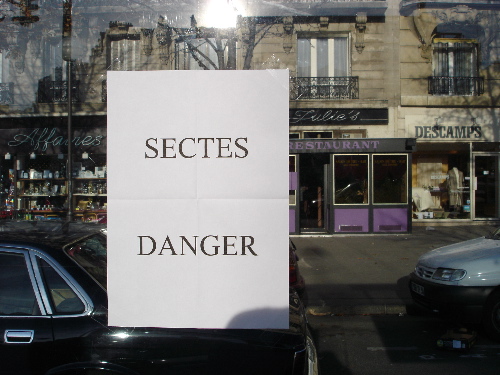
So, today I went down to Place de la Nation to see if I could find some of the posters put up by Les Racailles de France. I went around the enormous square-cum-roundabout two times. On my way I passed a slightly junky Christmas market, a chef opening oysters outdoors for a restaurant, half a dozen couples kissing, more than a dozen lapdogs (many of them dressed for the cold), a kid playing Gameboy as he was walking (as a Parisian kid version of the typical Parisian ‘walking while reading a book’) and many Sunday strollers and vegetable market shoppers, but I saw no posters from The Riffraff of France. Others had now put up sheets of paper in the bus shelters, in order to voice their opinion on present day politics. DANGER. SECTS, it said. And nothing more. Sects are very dangerous here in this country, I’ve learnt yesterday at a public meeting commemorating the centenary of la laïcité (the separation of state and church). Was the poster ironic or not? I don’t know. Anyway, the meeting, the dangers of sects and religion and the whole debate around la laïcité must wait for a now.

Sunday's message at Place de la Nation

Message at bus stop at Place de la Nation, Sunday 11th December

I should have provided a proper welcome to my blog from Charonne (as I’ve moved house) and to the new name (Cicilie amongst the Parisians), but I’ll leave that…

Read more

Now what?

Two weeks ago, at the time I finished my French lessons, I had planned to quietly sit down and rethink my research project. The goals of the project still seemed justified, but I was not sure about the approach; I felt I was about to suffer from a severe information overload.

[teaserbreak]

The evening 16 days ago, the 28th of October, I watch the news as usual. In addition to a reportage about an amateur theatre group for youth in a banlieue, two episodes catch my attention. The Interior Minister’s seems unreserved in his backing of the police version of events when two young boys were accidentally electrocuted in a transformer station the previous evening. I note down my surprise. No investigation is yet concluded, and both the two TV channels I watch take care to mention that two versions of the event still exist. (Since then, we’ve learnt that Sarkozy’s version was not the true one. The police had been physically pursuing the boys, whereas they had not been involved in any break-in but were running from an identity control.)

The second brief note I make from the news concerns the attacks on police and fire fighters in Clichy-sous-bois the night before. It calms down almost immediately in Clichy-sous-bois, but the apparently self-destructive rioting spreads to “sensitive areas” (“quartiers sensibles”) all over France. The unrest has been on the wane for several days now. But we are only starting to see the political repercussions. As I read on a chat forum on Beur FM (=French Arab radio): “In the presidential election in 2007, who will you vote for; Sarkozy or Le Pen?” And political populism and the Front National are only some of the possible political consequences I have in mind.

So, if I thought the research approach needed a rethink two weeks ago, the Clichy-sous-bois event has not made me change my mind. The research question is more justified than ever, in my opinion: what influences senses of belonging and community making in a cosmopolitan city like Paris? But how can I best study it? So far, I’ve considered, and rejected, three possible approaches: 1) Hanging around in a (multi ethnic) music or artist collective, preferably with political objectives. 2) A neighbourhood study in the cosmopolitan area Belleville. 3) Participating in two (multi ethnic) political groups working towards recognition of the colonial era in France. Yesterday, when I asked to local (Maghrebi) baker if he would help me with my research, I messed it up a bit and confused my three approaches. It was easier when I just asked the greengrocer what he thought about the present situation… Anyway, now it seems to me that I just have to live with the information overload some more time, to see what will happen.
To be continued…
[teaserbreak]

Two weeks ago, at the time I finished my French lessons, I had planned to quietly sit down and rethink my research project. The goals of the project still seemed justified, but I was not sure about the approach; I…

Read more

TV fieldwork

Apart from a visit to the cemetery with about 50% of the French population on All Saints’ Day (La fête de la Toussaint) and a visit to the Institut du monde arabe for the exhibition L’âge d’or des sciences arabes, fieldwork the last week has mostly consisted of watching TV and reading newspapers. If it weren’t for the media, I would have no idea that the Paris region is making it to the headlines many places in the world. The media, on the other hand, is – not surprisingly – full of it.

[teaserbreak]

I find the unrest spreading from the sad Clichy-sous-bois incident a complex issue to write about. Its contested meanings; its strong element of class – and half-heartedly glossed over element of what the Anglo-Saxons would call “race” –; the political rivalry; l’insécurité versus la précarité (read: right- versus left-wing rhetoric); the stereotypical scenario of police harassment and no-future young men in the Parisian banlieues (which has become such an icon of French integration problems that, for instance, quite a few people here as well as in Norway can’t get their heads around the fact that I’m doing fieldwork in Paris proper, and not some banlieue); and finally, the evocation of colonial times with the curfew. It’s all at the heart of what I’m here to find out about. So, how to start untangling it?

The media coverage was the first thing that surprised me. From when I came here I have to admit that I found French national TV rather crappy. Every possible break, even between regional and national news is filled with commercials. But the journalistic treatment of the riots has been a far cry from commercially exploitative speculation, as I see it. There have been interviews with every possible actor in the drama. One of the first I remember was the unlucky Lille-supporter finding his car reduced to smoking ashes after seeing his team beat Manchester United in a Champion’s League match in Stade de France (the grand stadium is situated next to the sad, sad, sad towerblocks in Seine Saint Denise, both can be seen from the train to Charles de Gaulle airport). His astonishing calmness caught my attention; it’s been a good day which ended badly, but luckily no one got hurt… Then the hooded rioters themselves, never very articulate, posing for the camera; nique “Sarko”… it’s for the two kids who died… la colère… les flics… – Ok, those scenes are perhaps a bit over the top. But then there are all the reportages with the grand frères and local mediators putting the not very likable kids into a bigger sociological picture; they have no other means to express their anger at the police stopping and searching them all the time, at Sarkozy who wants to “clean the banlieues with a high-pressure cleaner…” (“nettoyer au Kärcher”, an expression being repeated almost as many times as voyous and racailles the last weeks… Even the footballer and world champion Liliam Thuram appeared on TV last night and expressed his anger at this way of talking about les banlieues and its inhabitants (himself an old banlieusard)). Not to forget the endless number of young and old seemingly representative banlieusards expressing their frustration over their burnt down workplaces, shops, kindergartens, gyms and cars. (For the record; their views are varied, but of course they soon started to get tired of it all. A survey today showed that 73% of the French population are in favour of the curfew if it can return order. 89% are in favour of re-establishing local organisations helping with employment and housing issues – which make part of the long-term propositions from the Villepin government).

In addition, French media is full of long, thorough and profound analyses and discussions, from every possible angle. The discussions range from sociology and economics, to philosophy (of course, these people are French) and architecture. – Can it really be that history is missing…? Historic memories are at least evoked now with the curfew: The law dates back to l’un du pire moment de notre vie publique – one of the worst moments in French public life, the Algerian war. (That’s what I heard from the clock radio when it’s work related relevance forced me to wake up this morning). So, yes, historic memories are not far away, but I think the only place I’ve heard an historic explanation is at the greengrocer’s.

The journalists’ carefulness to expose positive sides, like solidarity and creative initiatives, in the banlieues has also surprised me (though I doubt that the grocer would share my view here). For instance, the reportage of the tragic death of an elderly man a few days ago showed how the neighbours (“incidentally” of all colours and ages) came to pay their respect to the widow (white). A teenage boy of Maghrebi origin kissed her on the cheeks, an old African woman in traditional dress put her arms around her.

So, I think I’ve been a little bit surprised by the breadth, depth and serenity of the coverage. But what has surprised me the most is the patience and understanding expressed by analysts, journalists and many of the people in the streets. The economic crisis and the social problems in its wake are indeed acknowledged here. In addition, just after the riots had started I got an inkling impression that some commentators tacitly approved of the clear signs of Frenchness shown by the rioters. It’s no secret that many here seem to be proud of the French eagerness to demonstrate and revolt. Every week there are perturbations to the Parisian bus routes because of a manif for some political, economic or social cause. And of course there is always une grève going on. So, I wouldn’t be surprised if some middle-aged people – soixante-huitards to be precise – are a bit relieved and think that finally is this generation issue de l’immigration acting real French. Anyway, what is a generation of youth without their own riot? (As a friend of mine jokingly wrote me, when she heard about the contagious effects in Berlin; it wouldn’t surprise her if the ones torching the cars were in fact nostalgic middle-aged people).

Apart from a visit to the cemetery with about 50% of the French population on All Saints’ Day (La fête de la Toussaint) and a visit to the Institut du monde arabe for the exhibition L’âge d’or des sciences arabes,…

Read more