search expand

Finally a slam poetry video: Ucoc at L’Atelier du Plateau

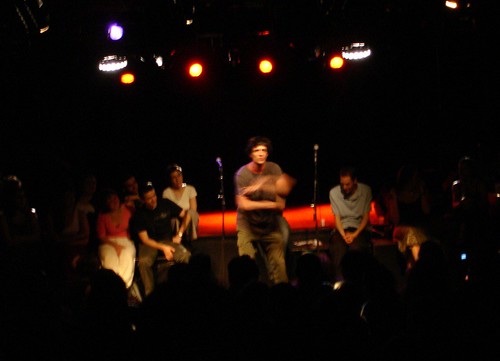
L’Atelier du Plateau is a little neighbourhood theatre on top of hilly Belleville, near Parc Buttes Chaumont. After going down a narrow, cobbled-stoned cul-de-sac, one enters one, large white painted room under a high ceiling. A bar and a small kitchen (serving for the occasion quiche lorraine, vegetarian pizza, each for 3€, massalé de fruits de mer 7€ and gateau chocolat, also 3€), occupies a corner of the room, while low chairs circling red, oriental carpets marking the “stage” take up the rest of the space.

[teaserbreak]
Every sixth week or so, the slammeur and rappeur Dgiz hosts a slam poetry session here. Last Monday – the blue, blue day after the elections – it was packed, with more people standing than sitting. While many presented newly written texts about the elections or at least made reference to it, the example I will give here did not. (The lyrics of “Destiny” ).

Ucoc was one of the first slammeurs I discovered. Late a Friday night in early June 2006, I was standing in the open doorway in the tiny bar Plex y Glass in Rue Oberkampf, when a screaming man fought himself through the crowd right towards me. I had just returned to Paris after an adventurous trip in the suburb Fontenay-sous-Bois (find the post here), where I had attended my (second) first soirée slam. Ucoc’s colère (anger) convinced me instantly that finally, after many months of searching, I had found a focus for my research. As I post more videos here, it will be clear that Ucoc has a very particular style… Enjoy, or bon courage.

The saxophonist is the jazz musician Louis Sclavis. (The cellist Vincent Courtois did not play on this track).

Ucoc’s Myspace site can be found here and OMind, his cooperation with Chantal Carbon, here (with more videos). He is also a frequent contributor to the site www.generationslam.com

The introduction to slam, I can thank a person I had just met on a punk concert, just around the corner from where I lived at the time, in support of the accused after the anti-CPE protests (labour law) some months earlier. After discussing the protests for a while, he said – despite having participated in them himself – that he would like to introduce me to something that was far more important than street protests: poetry! (after quite a few months of dissatisfaction with this incomprehensible society, I had finally started to like it, so a comment like that pleased me immensely). A few days afterwards, he, a friend and colleague of him and the anthropologist headed for the suburbs and back to town again – and since then I haven’t been a week in Paris without attending at least one soirée slam

L’Atelier du Plateau is a little neighbourhood theatre on top of hilly Belleville, near Parc Buttes Chaumont. After going down a narrow, cobbled-stoned cul-de-sac, one enters one, large white painted room under a high ceiling. A bar and a small…

Read more

Discussing slam poetry on TV and the schism in French slam

When I was contemplating a title for this post, the first thing that came to mind was the revolution will not be televised (Gil Scott-Heron’s eternal phrase). This association might seem a bit far off, but watching TV as rarely as I do, makes me surprised how crappy that medium is to pass on intelligible and sensible information. (Apropos French elitism versus Norwegian anti-elitism which I wrote about some posts ago; stating that one doesn’t watch TV is commonplace and almost expected in my circles in France, in Norway on the other side it’s seen as verging on elitism :D )

The show in question is a 30 minutes “debate” on French slam between four slameurs and an interrupting and not very knowledgeable journalist, called “Slam: from the bistro to the telly” (Slam: du bistrot à la télé). It was broadcasted 13.11.06 on France 3, and to my knowledge it’s not widely discussed in slam circles, and when it’s brought up it’s mostly in order to diss the fourth participant, which will also be my subject in this post (in addition to dissing TV in general)… I found it on the Internet here. In addition to a lot of interruptions and all-speaking-at-the-same-time (typical French TV entertainment), it also contains some throwing of water and some short slam performances. I’ll give a short résumé…
[teaserbreak]
The show is recorded just after Toni Morrison invited the slam poets with her to Louvre, and it starts with a reportage from the event, first showing Yo (who hangs around in bars in Belleville and whom I just saw animating the monthly open microphone soirée Slam Caravane taking place in the banliues in Seine-Saint-Denis (9-3)), then Astien [myspace] (whom I just met at a huge slam tournament in Le Mans) and ending with D’ de Kabal (who is one of the initiators of Slam Caravane as well as the event at Louvre, my photo here).
The latter was also present in studio, together with Grand Corps Malade (a photo from the soirée in Saint Denis here), Dgiz [myspace, his old site with some old songs] and Pilote Le Hot. The four seems to me a fairy representative choice, except from – as Dgiz remarked during the séance – où sont les slameuses? (“Where are the female slammers?”) GCM is the blockbuster guy, D’ the one initiating a million events, Dgiz for his personal and artistic trajectory and Pilote le Hot for being (one of) the first to introduce slam poetry to France and for being the central figure in a huge slam network. (Links to Slameur and Fédération Française du Slam Poésie).

It’s not a coincidence that I haven’t mentioned Pilote Le Hot before. The network he belongs to is – with very few people overlapping – almost entirely separated from the milieus I’m frequenting. I don’t know yet how I’ll incorporate this other milieu in my thesis. Initially, I was thinking of making it a small comparative case, but I’m not sure if I’ve got time to treat it properly (Any suggestions?)

The TV programme serves as a good introduction to this schism in French slam, as it turned out to be just a big fight over the definition of slam: For D’, it as a space for free speech (espace de parole libre), GCM emphasised the word partage (“sharing”) – of a text, words and emotions and of a stage – as well as free access to speech (accès libre à la parole) and Dgiz defined slam as taking place through l’écoute ((attentive) listening) and as an ephemeral, poetic moment. He continued by pointing to how representative he found the four slammers present there; un black (D’), un blanc (“white”, GCM), un beur (“Arab”, Dgiz) et un animal (Pilote – who quickly became on edge with everyone) [it was here Dgiz asked where the female slammers were]. D’ de Kabal followed by saying that the slammers is not a community like les jeunes (“the young”) and les rebeus (“the Arabs”) [he’s of course ironic here…], they have different opinions. Neither do they have a leader who tells them how to do things… Pilote on the other hand insisted – by interrupting, monologuing and not listening to the others – to such a degree on the original US-American definition of slam poetry as a competition with a jury in the audience, that GCM ended up calling him a fundamentalist (integriste).

Sharing, listening, free speech and the cosmopolitan environment are characteristics I often hear about the French slam scene. However, for Pilote le Hot, apparently only the rules set down in by Mark Smith Chicago in 1984 counts [wikipedia on history of American slam]. For an anthropologist this conflict between purism and cultural translation is of course interesting, but as I said, I don’t yet know how I best can integrate that other scene into my study – and if I’m not already to integrated myself into one part after the schism to cross the boundary to the other.

Towards the end of the program, the four slammers perform a text (Pilote, with a paper on what he claims slam is, D’ knows his – in rememberance of slavery – by heart, Dgiz improvises on the situation and GCM performs the start of Attentat Verbal – also on slam – from his record). As Pilote is not listening to D’, he throws him a glass of water, Pilote retaliates and later says to GCM that in your text you say that whoever can come and do whatever on stage and say that is slam, but that is not the case… and the slam will soon be a competition in elitisme d’underground… GCM calls him an integriste, Dgiz says that you can slam in French and you’ve got French slam now where you can do whatever you want… GCM says Pilot; you’ve certainly given a beautiful picture of what slam is tonight, but he also invites everyone to come to the small bars and cafés where the real slam is going on and see for themselves what it is. D’ almost gets the last word by saying something like (it’s hard to hear because of the noise…) slam is like a large pavement where everyone can find their place but where one sometimes finds a dog turd, and points in direction of Pilote…

Compared to the law of 20 sec concentration span obviously ruling on talk shows on TV, the three minutes recommended time for a slam seems like ages. But the journalist was perhaps happy with the noisy, distracted show he got…

When I was contemplating a title for this post, the first thing that came to mind was the revolution will not be televised (Gil Scott-Heron’s eternal phrase). This association might seem a bit far off, but watching TV as rarely…

Read more

Slam poetry


Slam ‘aleikum – slam poetry soirée in Saint Denis (93)

I realised last night – dozing uncomfortably under rather dramatic circumstances, in the midst of a thunderstorm lightening the sky and with the wind making slamming windows and shutters throughout the street, and not to mention the pool of sweat from the perpetual heat wave as well as my untimely cold – that it’s about high time I write about what I’m actually doing here.
[teaserbreak]
At the end of the slam poetry soirée I had just attended, one of the slameurs – in one of his usual, but extraordinarily forceful performances – had ran onto the chairs among the audience and screamed the end of his poem standing on his knees on two chairs right in front of me. I can’t say for certain that I understood exactly what his text was about, I must to admit (I was outside when he started, and due to the seemingly explicit content I’d like to be sure before I go into it. My illness made me a rather bad researcher as well as bad company yesterday….). Images from his performance, the incredible heat in the small exhibition locale, the animated audience and many of the others – slammers, poets, story-tellers, toasters, mc’s, rappers – made its way into my imagination last night and disturbed my sleep in an unpleasant, but not uninteresting way.

I find the slam poetry scene in Paris rather extraordinary. The mix of people – from school children to pensioners, with a peak around the age of 30 I’d guess, women and men, and all colours and with seemingly no social or class bias – is amazing, so is the variety and authenticity in many of the texts and performances. People slam about personal or everyday experiences, issues of identity, history, love and sex… I’m so optimistic about my research project after I discovered this looking-glass by which I hope to better understand as well as describe some important aspects of French society. As I’ve found my research focus, the biggest challenge now is to understand the depth and nuances of what these slameuses et slameurs are saying, – as their rhymes and rhythms, poetics, imageries, slang and verlan not exactly make French more accessible for a foreigner. Having said that, it’s hard to find a scene more inspiring for expanding my understanding of the language of Baudelaire… (And as passionate I am about literature as well as social issues, I’m also a rather classically trained anthropologist, so it pleases me to do research on such a human universal phenomenon as spoken word performances.)

Cycling home in the night, I cursed my poor state of health and wondered what could have happened if I had hung around outside the locale a little longer as people stood chatting or if I had joined the group who went down to Canal Saint Martin to do a slam sauvage there. (I just got two enthusiastic, though apparently tired, text messages from one who had been by the canal: “Quelle nuit,”…). I think these regrets, as well as the anxiety about the project and sadness for having to leave just now when things are so great, contributed to my stormy sleep.

I’ll probably provide some links and stuff for the slam poetry scene later, but for the moment I’m not yet sure how I’ll go about the important issue of anonymity if this is really what my Ph.D. project will focus on.

I’m hesitating before writing the final paragraph. In several posts earlier in this blog, I’ve made reference to the skin colour of the people present. I’ll to that now as well, but with a reluctance which I’ll explore somewhere else: The group going down to the canal consisted of eight people with the following traits: black, Chinese, North African (the only girl except from me), one seemingly white (10-22 years older than the rest of us) and one seemingly Latin American and three European/whites (East, half Balkan and North (me)). The ethnic mix among the ones hanging around after closing time was about as diverse.

Slam 'aleikum - slam poetry soirée in Saint Denis (93)

I realised last night – dozing uncomfortably under rather dramatic circumstances, in the midst of a thunderstorm lightening the sky and with the wind making slamming windows and shutters throughout the…

Read more