search expand

Back in the field

Yesterday brought me no less than two très belles coïncidences. First – as I told yesterday – the issue of Le Monde I got on the Air France flight had assigned a whole page to my research object, the very reason for which I was coming down to France again this week; the French slam scene. (Today it’s Libération’s turn). The second coincidence was almost as belle; as I strolled around in my beloved Belleville/Ménilmontant neighbourhood I spotted a poster in a window announcing that the historian Pascal Blanchard, coeditor of La fracture coloniale, was having at talk at the local library 2 hours later. La fracture coloniale was in fact the very book I decided at the last moment not to bring with me here, as I would have little time for reading, – but which I’ll have to read as soon as I get back, since I’m writing an essay on the current struggle over history going on here.
[teaserbreak]
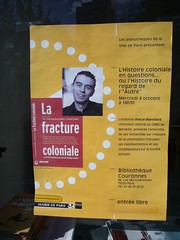
So, before I took the metro down to The Seine and the junk (i.e. boat), La Guinguette Pirate, for the weekly Wednesday slam session there, I went over to Bibliothèque Couronnes to listen to Blanchard. It was in fact the fourth time in 12 months that I heard him. It was however the first time that he came to a community library right in the neighbourhood where I carry out my fieldwork.

(At La Guinguette, by the way, one of the slammers managed to convince me that the Le Monde article I just had thought was quite well, was quite bad. “It just tells the same old story, and doesn’t even mention all the regular soirées going on, just the star appearance this week. It’s hardly based on any research other than reading the Internet. Your study, on the other hand…” It indeed pleased me to hear that my research is taken seriously, especially since my French obviously not yet is up to the whole complexity of the slam performance repertoire…)

Yesterday was thus packed with significant happenings, and it reminded me of how overwhelming this field often felt when I stayed here last time. In the local neighbourhood, the news, politics on all levels, and in the arts world: everywhere in France these days issues of the colonial past and the cosmopolitan (or lack of cosmopolitan) present are discussed, fought over, – and lived out.

When I come back for my last 8 months of fieldwork from December onwards, I think I have to shield myself from all this noise constantly diverting my attention, and keep the focus narrowly on my specific topic of research. It suits me well that the main topic – the (Parisian) slam poetry scene – almost exclusively is situated in popular neighbourhoods in the vicinity of my favourite boulevard where I’ve spent quite a lot of time studying the social geography, as well as out in two popular suburbs. (Then I can even do a tiny little bit of research in the infamous les banlieues, the gate-keeping concept (à la Arjun Appadurai) par excellence for this kind of research in France…).

Yesterday brought me no less than two très belles coïncidences. First – as I told yesterday – the issue of Le Monde I got on the Air France flight had assigned a whole page to my research object, the very…
Read more

Back in Belleville! (and le monde writes about the slam scene)

I’m back in Paris for 9 days, and this time I’ve settled right in the heart of Belleville, in the Tunisian Jewish neighbourhood (where they’re just about to celebrate Yom Kippur, I think…). A few blocks from the hotel, I’ve found a café with wifi – a café where they also arrange slam sessions, which of course fits perfectly with my intention to get some intensive fieldworking done while I’m here. So, now I sit blogging right at my favourite boulevard :) (Café Cheri(e) is undoubtedly quite trendy now, and it has in fact it’s own blog…).

And talking about intensive fieldworking; while I’m here I can keep myself occupied every night with going to various slam sessions, and these 9 days of intensive focus on slamming started really well as I opened Le Monde (1-2/10/06) on the plane and found that they had dedicated a whole page to the French slam scene!
[teaserbreak]
The article focused on very much the same things as I’ve noticed myself or read elsewhere: “Rare are the places where so many different ages and ethnic and social origins are gathered”. They also trace the genealogy of slam to poets in the Antiquity, Occitan troubadours, West African griots (story-tellers), the American beat generation, and rap as well as to some other references.

These are some of the things the slammers said:

“I want to be a writer, a poet at the same time as I’m with the people. Slam allows this utopia” (Frédéric Nevchehirlian, organiser of slam sessions in Marseille).

“Slam to me is a citizen/socially aware (citoyenne) way of approaching life and the issues the newspapers don’t talk about” (Katel, 20 years, student in journalism and of Cameroonians origin).

The organiser Tsunami talks about the pedagogic aspect of the slam seen and tells that local townhalls in the suburbs ask slammers to rebuild the social ties in the community: “I explain to the kids that I’m a poet, not a cop, vigilante or shrink. I’m not there to tell them that they shouldn’t break things, but to make them understand that they can express what’s bothering them through a text, a poem.”

Digiz, who calls himself troubadour poet citizen, says: “It’s my way of shouting out my freedom. (…). I love that it’s free (la gratuité, the exchange of listening, it’s a poetry of proximity”.

I’d like to translate the rest as well, but I think that would do for today.

My three first hours in Paris has been cold and warm, sunny and rainy. And just now the rain stopped and the sun returned…! I watch people on bikes pass on the cycle lane and I miss my funny little green vélo. Except from that (and perhaps the conditions in the quite dusty hotel I’ll stay in, we’ll see) I think it’s very nice to be back. It’s nice that people greet you with de rien (“you’re welcome”, au revoir (“good bye”), bonne journée (have a nice day!) just because you’ve asked them about the way or because you’ve bought a newspaper. And it’s a lot of other things that are very nice as well, but I’m sure I’ll have the chance to get back to that…

I’m back in Paris for 9 days, and this time I’ve settled right in the heart of Belleville, in the Tunisian Jewish neighbourhood (where they’re just about to celebrate Yom Kippur, I think…). A few blocks from the hotel, I’ve…

Read more

Boulevard phenomenology


Place de Ménilmontant in the autumn (with bikes and cyclists…)

It’s been ages since I’ve been walking down the boulevard, but today I was doing it again. My bike has been stolen! And it was stolen from one of my favourite places, Place de Ménilmontant. Well, such things happen, and anyway it was a too small, but it feels strange that it should happen less than 48 hours before my departure. It’s the third (attempted) crime that happens to me after I came here. First I was robbed for my deposit (1300€!) for a flat that was way too expensive in the first place, then a kid tried to nick my camera during an anti-CPE demonstration (we both looked the same surprised – me because why would someone nick a fellow demonstrator’s camera, him because the camera was attached with a string around my neck so he didn’t get it…) and now my funny little green bike…
[teaserbreak]
Cherry blossoms at Place de Ménilmontant in the spring

Walking down the boulevard again made me think a lot of things. I thought about the very first time I walked that part of it, mid November eight and a half months ago. I was going from my previous flat in bobo (i.e. quite gentrified/emborgeoisé) Ménilmontant to Charonne, which is neither gentrified, neither nothing else – just okey, quite boring. After I’ve left the familiar area around Place de Ménilmontant which is not yet gentrified, but just full of cafés anyway, I passed the main entrance to the cemetery Père Lachaise at the time of the soup kitchen. The queues for free food are divided by gender, which surprised me at the time. Now I’ve passed the soupe populaire outside the Père Lachaise so many times that to not have to pay special attention to the people sitting in the bicycle lane around dinner-time around 20H would have been more surprising than to actually see them there.

Rue de Ménilmontant, in direction of Place de Ménilmontant, with Centre Pompidou in the background

There are some quite deserted areas after Père Lachaise and down to my present flat. I rarely had to pass areas like that where I lived before, so I remembered it made me a bit anxious that first evening mid November, even though the time was hardly more than 8 o’clock in the evening. I remember the anxiety, and it’s funny to think about it now. Now everything is familiar, and it takes more than an empty stretch of the boulevard to make me uneasy. – Just now, on that stretch I passed a blonde and large threesome German family, sweaty and bewildered looking at a map, towards whom I acted Parisian and local and asked if I could help them. They looked for the night bus, and I told them the way – 5 minutes from where we were. I saw a friend off on that bus less than a week ago. How different everything feels now, after some months. – I remember the first time we (my travel company and I) were at Place the Ménilmontant. We felt to be so far east that we hardly imagined that we would dare to go further… And I remember the first time we actually dared to go further east, up the Rue de Ménilmontant, and how I, after a while, should start to say hello to the local Asiatic greengroser there, and how I should see the graffiti change and how I even, at the end, should start to know people in some of the local cafés in nearby Rue des Panoyaux

It’s amazing how quickly we get used to places and how the perception of these places changes completely as we get to know them. One of my – far to many, far to ambitious – plans for the autumn is to write an academic article based on Alfred Schutz’ The Stranger (on how the stranger slowly makes him- or herself at home in a new environment), and Tim Ingold’s notion of dwelling, (on how people, when making themselves at home in that environment also changes that environment a bit). For in a not very long while, I’ll not wander around getting to feel at home in Parisian boulevards, I’ll sit at my office making anthropology of my ethnographic field notes… (And people will not be able to make fun of me saying are you awake now when I send them an e-mail or sms at 10:30 in the morning – but anyway, I’ll still be able to make fun of them for knowing the Parisian streets better than the Parisians themselves ☺ )

Me when I still had my funny little green bike (photo from Pharo in Marseille)

This is not the last post you’ll read about this favourite boulevard of mine, stretching almost all the way through eastern Paris, from Place de la Nation up to Place de Stalingrad and Bassin de la Villette. I hope to soon write a comparison between this Haussmanian grandiose, three-linen and very French boulevard with the cheapest road on the English monopoly board – the hideously gorgeous Old Kent Road, and perhaps my local Oslo street Trondheimsveien. All lively, cosmopolitan east end streets I’ve had the pleasure to live next to for a while in my life.

Place de Ménilmontant in the autumn (with bikes and cyclists...)

It’s been ages since I’ve been walking down the boulevard, but today I was doing it again. My bike has been stolen! And it was stolen from one of my favourite…

Read more

Summer socialising

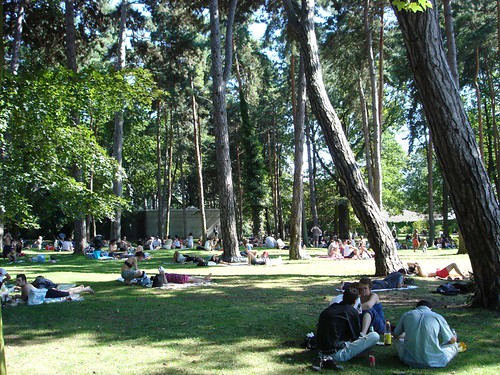
Parc Floral, during the weekly weekend jazz concert.

One of my first blog posts in the autumn was on Le Square and the after-school socialisation among children and parents. Then came the grey and cold winter and street-life almost disappeared. Since then, I’ve returned several times to the seasonal changes and how social and communicative Parisians become as the temperature rises. Now summer is head on. The heat wave is said to reach its peak today, with 34-35 degrees in Paris. I’m staying at home during the day, trying to get on with at least one of the several blog posts that have been simmering in the back of my heads – and bothering my conscience – for a long time. Many of the neighbours across the courtyard have already left for holidays. The rest have their windows wide open like I have, and let various sounds mix between the houses. From my desk, I see the elderly lady get more visits from caretakers than usual, as the French authorities want to avoid the disaster from three years back when 15000 people, mostly elderly, died as a result of the extreme heat wave hitting Europe. Yesterday, some West African women – dressed in even more elegant dresses than usual, so I guess they had some kind of party or celebration – discussed and argued for hours somewhere in the yard. (Someone from a nearby window, who obviously understood their language, called one of them a sarkozyst on one occasion (apparently a summer hit invective – I also heard it in the park a few days ago)).
[teaserbreak]
I like it when all windows in the city are open and you can hear the clattering of plates at your neighbours’ dinner table or perhaps they’re arguing a little, or listen to which football teams the apartment building is cheering for in front of their telly. (I remember when I lived in Athens some years ago, during football matches in the Greek series, we could hear who cheered for the archrival Olympiakos (half of the building) and who were on the right side with Panathinaikos (as my flatmates)). The theme of this text, is exactly emotions like that: The slightly different sensations, emotions, atmospheres and everyday routines that slowly have become part of a (long-time) fieldworkers experiences to such an extent that that they can be difficult to pinpoint and describe. But they’ll be even harder to remember when I get home and quickly get absorbed by my Oslo way of life with own, and different state of mind. Before I know it, Paris will appear as a parallel and distinctly separate universe, and I’ve many reasons to try to struggle against this mental amnesia. One of them I’ll return to in a post soon (hopefully), titled I and politics (part three of My blog, my project and I).

As I’ve written some posts ago, in the day the blistering hot boulevard is almost empty. However, in the evenings it fills up, as people gather at the terraces in front of the bistros and cafés. I’ve been hanging around there for a couple of nights, with some people playing chess for hours and hours until closing time (I don’t play though, as socialising, fieldworking and speaking two foreign languages keep my mind sufficiently occupied). When taking a break from the game, they would play some guitar, sing some variété, believe it or not – including some Edith Piaf imitation (a musical genre the banlieusard in the company knew almost as little about as I, but which a tramp who had put his chair next to us enjoyed immensely) –, or discuss the etymological roots of words with each other or neighbouring tables, and once in a while one at the table was even making few half-hearted chatting-up attempts of passing girls.

(The tramp in fact, got a free drink with us at closing time, as someone included him when we asked if the house wouldn’t give us all a drink in return for our consumption. Apropos levels of alcohol consumption; generally, people seem to drink less here than in Norway when they go out – but I think they go more out – and I’ve got the impression that its usually one in the company who’s drinking quite a lot more than the others. – In Norway, isn’t it often the case that if one (man) is drinking quickly, then the rest of his mates will do the same? – It was in fact about time that I wrote something on alcohol here, and if I haven’t mentioned cannabis yet, I should soon, as both intoxicants are very widely used. The French also consume more antidepressants than others, but that is – probably – a different matter. Or perhaps not, this is after all the country of Baudelaire’s Spleen et Idéal as well as his Paradis Artificiel…).

Almost everywhere in Paris there is a good mix between flats, cafés and local shops, and people often go out in their neighbourhood. (One of the few exceptions to this mix is in the 13e Arrondissement, along the river – that is also the only place I’ve felt unsafe when cycling home at night, as there are very few pedestrians in the streets after the offices close and the employees go home). And in their neighbourhood, or in other public places, I notice to my delight that Parisians speak with strangers and meet new people… It would’ve been interesting to make a survey on where people in Norway and France have met their friends (and partners, as I’ve already mentioned public attempts at picking up strangers seems quite acceptable here. Many years ago I actually read a survey on how many had found their future partners on the metro in respectively Oslo and in Paris. I don’t remember the numbers, but the two cities were of course wide apart). When I ask a group of friends here where they’ve met, I rarely hear “work”, “studies” or “school”, as I think the overwhelming answer would have been in Oslo, instead they say bars or even on the street – or through friends, which is of course also the case chez nous.

As all the interaction in public spaces here continues to amaze me, I was surprised to hear a girl complain about how little she thought the French used the streets. She compared France to a non-European country where she had just spent some months, and like with so much else here in France, she said that the situation for creative street-life also was getting worse under the present government – with all the “securitarian” policing. I’ve got – yet – another example of that, which perhaps I’ll post on another occasion…

Parc Floral, during the weekly weekend jazz concert.

One of my first blog posts in the autumn was on Le Square and the after-school socialisation among children and parents. Then came the grey and cold winter and street-life almost disappeared. Since…

Read more

“Elle va se faire draguer”

Every blog post I’ve tried to write on gender strands for some reason or another before they reach the web. The following text was meant to be a simple and silly account of a quick bike trip around Belleville. However, when I let it rest for a moment in order to start sorting out the huge heap of paper – flyers, magazines, newspapers, brochures… -that was threatening to cover more and more of the surface space in my little office-cum-livingroom-cum-kitchen, I came a cross an old article about a café that I had just passed on my trip. This café reached the national media right after the Mohammad caricature affaire because they put up an exhibition with blasphemous caricatures right in the heart of Belleville. Well, the article in itself wasn’t enough to put me off track. It was rather it’s point of view, or framing, that threatened to put my experiences on my little trip in a new light. I started worrying that my silly little text had to become a bit more complicated.
[teaserbreak]
In one of my French classes in the autumn, my teacher made my research into a little subject of discussion. According to her, a fieldwork in Belleville would be difficult for me, as the local boys would “try to chat me up” (elle va se faire draguer). I’ve been reminded of her words recently, as the season of la drague obviously is well on its way.

The way men and women communicate or not communicate in public spaces in this city is a part of French society I can’t really get my grips on. People exchange glances, or look casually at each other or around themselves, far less in the street here than I’m used to. I think men as well as women feel that that they should keep their eyes to themselves – unless they have certain intentions, that is – but it seems obvious to me that men’s gaze is far freer than women’s.

When I cycled through Belleville the other day, I wasn’t more than giving a young boy a little resigned smile after he – who probably was almost half my age – had leaned out in the street in front of me and called me ma chérie, before he found it opportune to announced to the whole street that one est chaude!. In my hometown Oslo, this – which in my opinion can be categorised as light verbal sexual harassment – has happened to me only a couple of times. At one occasion, when I told the kids to have some respect, they quickly excused themselves. Here, I avoid all further exchanges. I don’t know if that is the best way, but as I said, I don’t understand this interaction. And at occasions when I have answered back, it usually comes to some kind of scene where the man for some reason feels obliged to display a lot of hurt feelings and start an argument.

In another French class we discussed these strange Latin gender relations in public spaces, and una bella Italiana said she appreciated attention in the street. I don’t know if the attention the two of us get is exactly the same, but I didn’t get much support in my class – which for the day consisted of various Latins – for the view that this is limiting women’s freedom.

The kid who called me chaude (“hot”) was probably of North-African origin (either Muslim or Jew, I don’t know – it was right in the Jewish Tunisian part of Belleville). A Danish woman (mid twenties) I discussed this with, said she mostly got attention from men of North-African origin. However, I must say that I’ve experienced approaches by French men of all colours and ages – from old men coming close and almost whispering bonjour (as if I was looking like a prostitute?! – a less “prostitute-like” desscode than mine is hard to find), to such kids – and it happens all over the city. My worst experience took place when I was 17, when two men literally tried to abduct me at Les Halles (they were white French, a point I remember because the police asked specifically about their skin colour).

And it was around here my post stranded some weeks ago. From this point I can wrap up with some more comments on French gender relations in public spaces, – or I can change the framing towards the question of class relations in Belleville, and ask, as they did on posters in a similar quarter in Marseille; à qui appartient la rue? (“to whom belongs the street?”)

I can’t tell how the guy’s sexualising insult should be interpreted. Certainly, it was not a good point of departure for really trying to me draguer. I guess he was probably acting cool in front of his mates. (But why is that a way to act cool, one can ask?) However, the article I found in Le Nouvel Observateur looked at the controversy around public spaces in Belleville in a class perspective.

There is a process of gentrification going on in Belleville and Ménilmontant, where the bourgeois-bohemians are moving into this working-class and cosmopolitan area. And just by Parc de Belleville, a new chic café had decided to make their own little caricature affaire, where they put up religious caricatures on their bright red walls, clearly visible for the passers-byes. (Part of) the local Muslim youth didn’t think that was such a good idea. And then there were discussions (à la français – i.e. loud arguments) and a little destruction, and some national media coverage.

This was certainly a negotiation of space going on, which I, when I read the article, felt was reverberating down to my own recent bike trip. Coincidentally, perhaps, I never experienced any similar incidents on my many trips around Belleville last autumn. Initially, I took all this male expressiveness to be signs of spring, (which seems to affect the locals stronger than elsewhere :D ), but as one of the opening lines in the article went: “the intellos come there with their bikes, while the roughs charge with their Vespas…” I suddenly felt part of a bigger scheme.

As I’ve decided to get this first text on gender relations out on the web now, I’ll not linger any further…

Every blog post I’ve tried to write on gender strands for some reason or another before they reach the web. The following text was meant to be a simple and silly account of a quick bike trip around Belleville. However,…

Read more