search expand

Slam at Louvre (me in Oslo)

As some might have discovered, I’m not exactly flooding this site with new texts at the moment. That’s because I’m busy writing some other stuff (in fact nothing less than starting on la grande oevure which will be my thesis in due time…), before I’m off for Paris again in a few weeks. Right now, sitting in my green coach, googling for some information for a text I must hand in over the weekend, I wish I were already there. Not because writing this text is so terrible, not at all, but because Toni Morrison has been at Louvre, and last Friday she invited along a number of slam poetry artists to slam about classical French paintings and about being étranger chez soi (translated “a foreigner’s home”).

The free newspaper 20 minutes has published a quite nice photo series of the event.

I found the series here (while searching for Café Culturel in Saint Denis for my text in fact). (Excellent site for finding info on the French slam scene by the way, but I’ve got to get back to my text to be handed in soon, no more getting lost at the web for me…).

Well, just one more remark: The French urban art forms seem finally to get a little bit of highbrow acknowledgement. The day I left Paris, at the 13th of October, Le Grand Palais (Eng.) invited in the street, and dedicated a whole weekend to rappers, skaters, graffiti artists, and yes, slammers: La rue au Grand Palais. – A lot to be said about this, of course, but not now.

UPDATE:

I just found out that Mary Stevens has written an interesting post on another event during Toni Morrison’s residency at Louvre in her excellent research blog. Amongst other things, I learnt that it’s not the English title “A Foreigner’s Home” that is a strange translation of the French, it’s the other way around:

From the start, the title chosen by Morrison for her residency caused much debate. In English the title is ‘The Foreigner’s Home’; this has been incompletely rendered in French as the much more limited ‘Etranger chez soi’. The use of the apostrophe makes the English much more interesting: it implies both possession and a temporal relation (’the foreigner has come home’ – and hence is perhaps both foreign and no-longer foreign at the same time). It could also perhaps be read as a comment on the nature of museums, particularly in the post-colonial context. In addition, the English seems to me to place the emphasis on the concept of home, whereas the French stresses the ‘etranger’.

As some might have discovered, I’m not exactly flooding this site with new texts at the moment. That’s because I’m busy writing some other stuff (in fact nothing less than starting on la grande oevure which will be my thesis…
Read more

More poetry

Today I’ve had a quick look at two extremes of the French slam phenomenon. First, I went to an atelier slam in a local activity centre ( Centre d’animation) close to where I lived until August. For two hours every Tuesday, MC Tsunami, the orchestrator of various slam soirées and host of the website planteteslam.com, leads a workshop for youth in Eastern Paris. (However, as he told me, and as I could observe myself, most of those coming have strictly speaking passed the age of youth).
[teaserbreak]
The workshop so rewarding for a novice to poetry that the anthropologist felt a bit torn between participation and observation, but concluded that she wasn’t completely up for playing with la langue de Molière et al. yet. However, I did learn some important features of poetry concerning alliterations (repetition of particular syllables or consonants – a frequent means in French poetry as the articulation is based a lot more on syllables than e.g. English and Norwegain…) and phases (particular phrases or segments of phrases). (Right now I listen to Grand Corps Malade’s at-least-300000-copies-selling album Midi 20, where I just heard him describe himself as just “amongst loads of others, a simple seeker of phases”). I’ll return to syllables, alliterations, phases and the rest of the poetic universe when I get more into it…

Amongst other subjects they discussed and practiced, there was of course also a discussion on slam is and is not (it’s to share and to appear in front of others… – interestingly, the battle aspect which defines slam poetry in the USA, where also the word originates from, has much less importance here in France).

Then over to the other extreme end of the slam phenomenon (which indeed has taken off during the two months I’ve been away): After the atelier at the community centre, I hurried up Boulevard Voltaire (still 11th Arrondissement) to the concert venue Le Bataclan to try to get a ticket to Grand Corps Malade’s show (not slam, since a show doesn’t imply exchange…, as they all say, including GCM himself). Even though Le Bataclan houses a few thousand, and GCM is on stage for 9 evenings between 3rd and 14th October, I could not get a ticket, not even on the street, which has worked well before. The queue for entering was winding far down the pavement and it comprised men in suit and tie (perhaps they hadn’t had time to change after work?) and women in party dresses and hair full of hairspray, to grandparents and children going with their family. With the price ranging from 29 to 39€, it wasn’t surprising that the audience looked a bit different from the slam soirées I’ve been hanging around at. And it looked even more different from the extremely varied audience at the monthly sessions GCM himself hosts at a local cultural centre – centre culturel – in his native banlieue Saint Denis. (For those interested, GCM can be seen in the background to the right on this photo).

As it was sold out today, I’ll not have the chance to see GCM when I’m here this time. Tomorrow, I’ll be at La Guinguette Pirate for another round in the qualification for the slam championship taking place in December. (On Saturday, I was at the qualification round at La Milonga, in the banlieue Fontenay-sous-Bois (94)). On Thursday, I can choose between the weekly slam soirée at Café de Paris (not sufficiently à la mode for having their own website…) and a live show (thus not slam! ☺ ) called “The slam was better before”, apparently with some of the old guys in the game, just around the corner from metro Belleville. (Anyway, I’ve already missed out on a couple of the slam related events popping up all over eastern Paris at the moment: …I was thinking of making a list, but as I quickly looked through all the flyers I’ve got hold of, I realise that I don’t bother…).

Today I’ve had a quick look at two extremes of the French slam phenomenon. First, I went to an atelier slam in a local activity centre ( Centre d’animation) close to where I lived until August. For two hours every…

Read more

Theatre: “In our full conscience and honesty”

Sunday I went to see a poetry performance at a theatre: AC! En nos âmes et consciences (“In our full conscience/honesty”) – Since the audience don’t participate and perform their own texts, it’s not slam, as the two poet performers explicitly told us yesterday. The distinction between slam sessions (democratic and interactive) and poetry shows is important and stressed by many artists. However, many of the recent newspaper articles on slam don’t seem to get this distinction for some reason. –
[teaserbreak]
Except from this important point, a lot of the show reminded of slamming: the personal – not intimate, but somehow authentic…–expressions, texts about politics, love, the importance of sharing the spoken word and particularly the enthusiastic and somehow anarchic vibe. I find a strong element of popular resistance in the slam sessions; there is an urge to express oneself, to create a space, to fight back… I don’t know exactly how to describe it in words yet. We discussed yesterday if the play was optimistic, and we concluded I think that it wasn’t (the political situation at the moment is not really optimistic…), but it is however full of willpower and joie de vivre.

A couple of weeks ago I saw theatre play in Norway, at the fringe theatre Black Box: God hates Scandinavia by the group Sons of Norway (English on myspace here). The two plays have nothing in common, except that they were written and preformed by two young people: two young men in Paris, two young women in Oslo (despite the masculine ring of the group name), and that both echoed important aspects of the socio-political atmosphere in the two countries. I had a hard time yesterday trying to explain how two whores in hell discussing various grotesque ways to die could be a metaphor of the feeling one sometimes can get in the petroleum bubble that is my native country. I did not succeed in my explanation; perhaps it’s a question of sentiments not easily verbalised. The same is of course the case with the anarchic and enthusiastic sentiments one can be part of at the better of the slam soirées: I’ll have a hard time putting this atmosphere into words on a piece of paper.

Sunday I went to see a poetry performance at a theatre: AC! En nos âmes et consciences (“In our full conscience/honesty”) – Since the audience don’t participate and perform their own texts, it’s not slam, as the two poet performers…

Read more

Saturday food market


See more photos from the local food market here.

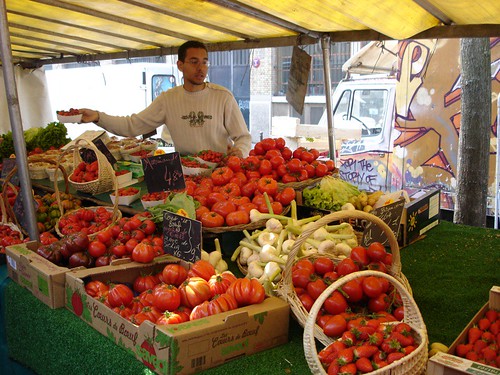
It’s around midday a sunny Saturday in October. The terrace of my regular café-cum-office is still in the shadow, so I decided to take a stroll up the food market which is situated in the middle part of the boulevard. I’ve probably written about these foodmarkets before, but I’ll do it again – this time coming straight from Eastern Oslo and I find their abundance even more striking.
[teaserbreak]
The stretch of boulevard (de Charonne, de Ménilmontant, de Belleville and de la Villette) going all the way from Place de la Nation until Canal St. Martin, houses three food markets, each organised 2 times a week. In addition, there are of course other local food markets all over the place. And we are talking a quite hard core East End, popular area here, and it’s that I find so fascinating. Oslo has the same social fracture between east and west as Paris (and London as well), with the East end being far poorer and far more disadvantaged. According to a newspaper article I read some years ago, the fracture in Oslo in fact mounts to a difference in expected age of no less than 10 years between East and West! I’ve heard surprisingly little talk about it, and I don’t know if the truth can be really that extreme. However, I keep on thinking about the eating habits of the traditional eastenders in Oslo and how different they must be from what they eat here. The food markets here are bourgeoning with fresh fruits and vegetables from all over, with an unimabinable variety of olives, nuts, beans all that, with fresh fish and shellfish of a variety I’ve rarely seen, meat, flowers… everything, and very appetising indeed.

The east end in Oslo has of course changed a lot after the arrival of the immigrants and their fresh fruit and veg shops. And even these shops has spread far into the west end and surroundings now, it’s still a small phenomenon compared to the large outdoor markets here. But I really wonder how my life in Oslo would have been without these shops…

See more photos from the local food market here.

It’s around midday a sunny Saturday in October. The terrace of my regular café-cum-office is still in the shadow, so I decided to take a stroll up the food market which is…

Read more

Indigènes

I’ve just been to see the film Indigènes. I don’t cry very often at the cinema, but I must admit that I had problems stopping weeping during the last part. I, and probably the rest of the audience, knew just too well how the film would end and how the story it self would go on for decades afterwards. I saw it on a cinema nearby, with pensioners (white) and local lycéens (of all colours). It shows on 31 cinemas in Paris, with 4-8 screenings each + two in the weekends.
[teaserbreak]
Indigene is the shameful juridical assignation used for Muslims in French North Africa. Muslims, being indigenes and not citizens like the Christians and Jews, didn’t enjoy equal rights until 1945. It’s incredible, isn’t it, in the country priding itself with the slogan libérté, égalité, fraternité? The entire story of the combatants from the colonies is an incredible account of the failure of this beautiful idea… – Just for instance, this example of France in a nutshell: the soldiers get to view a classical ballet show at the casern, while teaching them to read and write, however, is not a concern.

The film starts with recruitment of soldiers in North Africa. A mother doesn’t want her son to go, as his father had died in the First World War, – for France, probably, and we later learn that the family has been left in misery). But he leaves to fight for La mère Patrie, together with fellow villagers as they shout Vive la France. (I probably got a tear in my eye already at this point, as one is to understand the disappointments that are to come…).

All the four protagonists represent various versions of the failure of France the idea: the petty criminal recollects with his brother how the village was killed by the French, to “pacify” them.

The handsome one falling in love with a white girl at the liberation of Marseille never gets her letters – nor she his – as they are being “censured”. As she is about to unbutton his shirt someone enters the room and he jumps up, in North Africa they’re not allowed to have anything to do with French women. But it’s different here in the mother country, at least for the men coming to liberate her…?

The last disappointment – or treason – is the saddest of them all, and it echoes somehow the disillusionment of all the non-whites with “non-French” surnames in the banlieues who have taken an education as the French dream says, but still see very little of the égalité they’ve been promised: The intelligent, but hèlas so naïve colonel decides to continue on an impossible mission into Alsace, because then, finally, “we will get what we merit” – as they over and over of course not has got until then. His troop gets killed. Another French regiment who enters when the German battalion has been beaten gets all the glory (except from a few of the villagers who thank the only surviving Tunisian), and then we jump 60 years in time and the film ends with the never-more-than-a-colonel sitting on the bed in his little, sparsely furnished room; living-conditions which most French probably recognise from TV reportages on the ancient combatants and migrant workers…

The captain also represents an interesting angle: He passes as a pied noir (a French born in Algeria), but we learn that he is in fact an Arab. That’s an aspect of his identity he keeps close to heart – literally, as a photo of his North African mother he keeps in his breast pocket, and as a secret, that would have kept him from advancing in the army hierarchy had it been known.

Last week, when the film opened, President Chirac decided that the pensions of the ancient combatants finally should be equal to that of the French veterans. Since 1959 their pensions have been “frozen”, as some kind of revenge for the independence…

The four protagonists, Sami Bouajila, Roschdy Zem, Samy Naceri and Jamel Debbouze are all French descendants of North Africans. At Cannes this year the four of them won the prize for the best male protagonist.

The film is not only important it is also very good, and as it concerns the liberation of the whole of Europe from Nazism, I suppose it will be screened in Norway as well. I wasn’t really aware of the important contribution of the soldiers form the colonies before I saw The English Patient, which perhaps not coincidentally, is written by a Sri Lankan author.

The film has created a discussion of course (read some of it in English in The Guardian) – for instance with L’Express devoting their frontpage to the headlines “Should we be ashamed of being French?”

I’ve just been to see the film Indigènes. I don’t cry very often at the cinema, but I must admit that I had problems stopping weeping during the last part. I, and probably the rest of the audience, knew just…

Read more