search expand

Back in the field

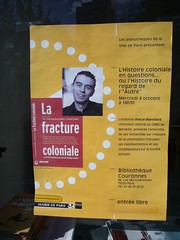
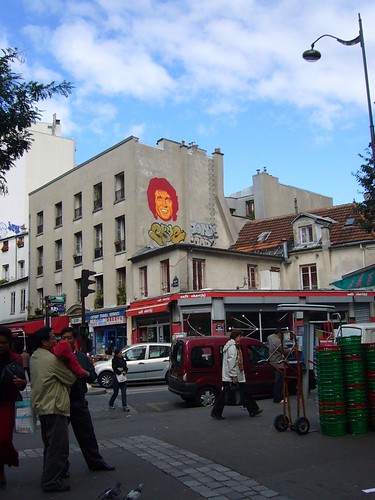
Yesterday brought me no less than two très belles coïncidences. First – as I told yesterday – the issue of Le Monde I got on the Air France flight had assigned a whole page to my research object, the very reason for which I was coming down to France again this week; the French slam scene. (Today it’s Libération’s turn). The second coincidence was almost as belle; as I strolled around in my beloved Belleville/Ménilmontant neighbourhood I spotted a poster in a window announcing that the historian Pascal Blanchard, coeditor of La fracture coloniale, was having at talk at the local library 2 hours later. La fracture coloniale was in fact the very book I decided at the last moment not to bring with me here, as I would have little time for reading, – but which I’ll have to read as soon as I get back, since I’m writing an essay on the current struggle over history going on here.
[teaserbreak]

So, before I took the metro down to The Seine and the junk (i.e. boat), La Guinguette Pirate, for the weekly Wednesday slam session there, I went over to Bibliothèque Couronnes to listen to Blanchard. It was in fact the fourth time in 12 months that I heard him. It was however the first time that he came to a community library right in the neighbourhood where I carry out my fieldwork.

(At La Guinguette, by the way, one of the slammers managed to convince me that the Le Monde article I just had thought was quite well, was quite bad. “It just tells the same old story, and doesn’t even mention all the regular soirées going on, just the star appearance this week. It’s hardly based on any research other than reading the Internet. Your study, on the other hand…” It indeed pleased me to hear that my research is taken seriously, especially since my French obviously not yet is up to the whole complexity of the slam performance repertoire…)

Yesterday was thus packed with significant happenings, and it reminded me of how overwhelming this field often felt when I stayed here last time. In the local neighbourhood, the news, politics on all levels, and in the arts world: everywhere in France these days issues of the colonial past and the cosmopolitan (or lack of cosmopolitan) present are discussed, fought over, – and lived out.

When I come back for my last 8 months of fieldwork from December onwards, I think I have to shield myself from all this noise constantly diverting my attention, and keep the focus narrowly on my specific topic of research. It suits me well that the main topic – the (Parisian) slam poetry scene – almost exclusively is situated in popular neighbourhoods in the vicinity of my favourite boulevard where I’ve spent quite a lot of time studying the social geography, as well as out in two popular suburbs. (Then I can even do a tiny little bit of research in the infamous les banlieues, the gate-keeping concept (à la Arjun Appadurai) par excellence for this kind of research in France…).

Yesterday brought me no less than two très belles coïncidences. First – as I told yesterday – the issue of Le Monde I got on the Air France flight had assigned a whole page to my research object, the very…

Read more

Back in Belleville! (and le monde writes about the slam scene)

I’m back in Paris for 9 days, and this time I’ve settled right in the heart of Belleville, in the Tunisian Jewish neighbourhood (where they’re just about to celebrate Yom Kippur, I think…). A few blocks from the hotel, I’ve found a café with wifi – a café where they also arrange slam sessions, which of course fits perfectly with my intention to get some intensive fieldworking done while I’m here. So, now I sit blogging right at my favourite boulevard :) (Café Cheri(e) is undoubtedly quite trendy now, and it has in fact it’s own blog…).

And talking about intensive fieldworking; while I’m here I can keep myself occupied every night with going to various slam sessions, and these 9 days of intensive focus on slamming started really well as I opened Le Monde (1-2/10/06) on the plane and found that they had dedicated a whole page to the French slam scene!
[teaserbreak]
The article focused on very much the same things as I’ve noticed myself or read elsewhere: “Rare are the places where so many different ages and ethnic and social origins are gathered”. They also trace the genealogy of slam to poets in the Antiquity, Occitan troubadours, West African griots (story-tellers), the American beat generation, and rap as well as to some other references.

These are some of the things the slammers said:

“I want to be a writer, a poet at the same time as I’m with the people. Slam allows this utopia” (Frédéric Nevchehirlian, organiser of slam sessions in Marseille).

“Slam to me is a citizen/socially aware (citoyenne) way of approaching life and the issues the newspapers don’t talk about” (Katel, 20 years, student in journalism and of Cameroonians origin).

The organiser Tsunami talks about the pedagogic aspect of the slam seen and tells that local townhalls in the suburbs ask slammers to rebuild the social ties in the community: “I explain to the kids that I’m a poet, not a cop, vigilante or shrink. I’m not there to tell them that they shouldn’t break things, but to make them understand that they can express what’s bothering them through a text, a poem.”

Digiz, who calls himself troubadour poet citizen, says: “It’s my way of shouting out my freedom. (…). I love that it’s free (la gratuité, the exchange of listening, it’s a poetry of proximity”.

I’d like to translate the rest as well, but I think that would do for today.

My three first hours in Paris has been cold and warm, sunny and rainy. And just now the rain stopped and the sun returned…! I watch people on bikes pass on the cycle lane and I miss my funny little green vélo. Except from that (and perhaps the conditions in the quite dusty hotel I’ll stay in, we’ll see) I think it’s very nice to be back. It’s nice that people greet you with de rien (“you’re welcome”, au revoir (“good bye”), bonne journée (have a nice day!) just because you’ve asked them about the way or because you’ve bought a newspaper. And it’s a lot of other things that are very nice as well, but I’m sure I’ll have the chance to get back to that…

I’m back in Paris for 9 days, and this time I’ve settled right in the heart of Belleville, in the Tunisian Jewish neighbourhood (where they’re just about to celebrate Yom Kippur, I think…). A few blocks from the hotel, I’ve…

Read more

Some French slam poetry web sites

Oh, no not one of those days… Here I sit, it’s Friday evening, people I know get together to drink beer not far from here right at this moment, I could be there, or I could go to see Resistance(s), a screening of short films from North Africa and the Middle East at the Cinemathèque, but no, what am I doing, yes, I sit at my office, looking out of the window at the excellent weather… – well, now the full moon is up… – doing some kind of silly quasi-academic work… And it will take me ages to get all these links right…

Time is overripe for finding out more about slam poetry, the phenomenon by way of which I’ll try to understand and describe La France Métissée. I bumped into the Parisian slam scene with almost no prior knowledge, and for two months I hung around at various slam soirées in eastern Paris and her hot suburbs, just experiencing what was going on.
[teaserbreak]
As I’ve returned to university office life for a couple of months, hoping to start turning my field experiences into science, it’s high time I start finding out what this poetry scene is about. Tuesday I’ll present my fieldwork for my colleagues in the anthropology department, and in addition to telling them what I have experienced, I thought I’d better explain them a little what slam is about as well. I’ve not found much printed literature on the subject, but Internet is of course full of information, as is fitting for this so-called post-modern literary phenomenon. (I’ll return to what’s post-modern about it, as soon as I get a clue). In fact, when I started searching for information on slammeurs and slammeuses today, I discovered the Internet social networking phenomenon MySpace, of which Wikipedia has this to say:

MySpace is also home to various independent musicians, independent filmmakers, and up and coming comedians who upload songs, short films, and other work directly onto their profile. These songs and films can also be embedded in other profiles, an interconnectedness which adds to MySpace’s appeal for musicians, filmmakers, and comedians alike.

Hence, obviously a perfect post-modern place for post-modern poetry…

From the languages presenting articles on slam poetry on the online encyclopaedia wikipedia, I understand that the genre is most vibrant in the USA, where it was created, and in Sweden, Germany and France where it was initiated in the mid- to late 1990s. (In Norway slam exist, but it’s not very big – however as a form of spoken word tradition it has existed in various shapes since time immemorial, at least since the Viking skald or bard. Apropos that époque, slam is apparently also an old Norse word, meaning hitting hard, like in slam the door (slamre med døren, in contemporary Norwegian).

Now to the websites I’ve come across on French slam poetry – only in French, unfortunately… (when I get hold of my usually so present Webmaster, I’ll include some of them in a blog roll):

Grand corps malade made it to the bestseller lists with his album released this spring, thus making slam poetry known to a large public. He has even got an entry on French wikipedia. I strongly recommend his poem on his native banlieue nord, Saint-Denis (sound) and Enfant de la ville(text).

The collective 129H Production (with a new and an older website, apparently with the same content): “Supportive structure for artistic production in France and West Africa”. Hear some of their texts on their sites on myspace.com: Néobled (listen, blog with agenda, bio etc, Rouda (listen to a text on slam sauvage, blog with agenda, bio etc) and Lyor (listen, blog with agenda, bio etc). (The three of them also have blogs on the website Haut et fort, but my iBook refuses to link to them for some reason…)

Le meilleur ami des mots (Myspace with Qui est le meilleur ami des mots ?, France Fiction or two other texts): Souleymane Diamanka (listen) and John Banzai (listen).

Some general information pages on the French slam scene: Planète Slam (a very instructive site if one gets past the initial annoying pop-up ads… ;) ), Fédération français de slam poésie and Keep it green. UPDATE: Le-slam.org Universlam
And some more sites on Myspace with soundtracks, videos, bios etc: Rahman, site de l’homme-soleil, Rahman on My Space, Le Robert on Myspace (Le petit prince listen and read the poem), Rara Fonpanié on Myspace

And finally, I found a site on My space with the usAmerican slammer, Soul Williams – for those who don’t understand French ☺

(I’ve probably overlooked loads of important sites, and then there is one more question; where are the ladies?!)

Afterword: I’ll probably very soon have to make a revised version of this post, as I get to know the slam scene at the web, until then I just have to mention that I’ve found at least some of the slammeuses – on Slam ô feminin, of course…

Oh, no not one of those days… Here I sit, it’s Friday evening, people I know get together to drink beer not far from here right at this moment, I could be there, or I could go to see Resistance(s),…

Read more

– my research project so far (part 2): Parisian slam poetry vs British Asian ethnogenesis

In the second part of my presentation, I moved on to the particular field where I hung around and conducted anthropological fieldwork proper; thus participated as I observed or vice versa. As some will already know, that field is a slam poetry scene in Paris. I’ve written about it here already, and I’ll surely return to it, so I’ve not found it worth translating that part of my presentation here. Instead, I’ll reflect a little around the comparison I’m intending to make between the slam poetry phenomenon in Paris and the cultural expressions which constituted a core element in my study in London. In the third and final part of this post, I’ll try to recall the questions I got after my presentation.
[teaserbreak]
In my MA/MPhil thesis I looked at the creation (i.e. the ethnogenesis) of a home-grown British Asian identity – thus a new way of being British –, where cultural expressions, particularly music, with influences from south Asia played an important part. Without cutting corners in my future analysis, these two artistic phenomena – the wave of British Asian music, London 1999, and the slam poetry scene, Paris 2006 – show interesting similarities and differences.

In both phenomena, people create a space where they can express themselves. I’d say that it can be described as a, more or less, free space, and it reminds me of my favourite (anarcho-)philosophical quote:

Maybe the target nowadays is not to discover who we are, but to refuse what we are. We have to imagine and to build up what we could be to get rid of this kind of political “double bind,” which is the simultaneous individualization and totalization of modern power structures. The conclusion would be that the political, ethical, social, philosophical problem of our days is not to try to liberate the individual form the state, and from the state’s institutions, but to liberate us both from the state and from the type of individualization which is linked to the state. We have to promote new forms of subjectivity through the refusal of this kind of individuality which has been imposed on us for several centuries (Foucault 1982, “The subject and power”).

I’ve already sketched the outline of an analysis of to what degree some British Asian cosmopolitans in my study, represented attempts at such new forms of subjectivities. I think Foucault’s perspective can be a constructive approach to my Parisian field as well.

Another similarity between the two phenomena is that they were in vogue (when I did my research), seemingly just about to reach the top before they get commercialised, get too big and turn stale, with too many jump the bandwagon… The knowledge of how trends, commercial forces and bourgeoisation work probably worry participants in all such artistic waves.

On the other hand, the differences are also interesting: The slam poetry scene in Paris seems to have little to do with identity politics, and its cosmopolitan and heterogeneous (thus non ethnic/communitarian) nature is striking. All this, I find characteristic of the French society, and in contrast to the British.

I know this overview of the two fields is extremely sketchy, but this theme is not at all what I will be working on at the moment. The point has just been to justify my choice of the slam scene as suitable for a comparison with my London ethnography.

In the second part of my presentation, I moved on to the particular field where I hung around and conducted anthropological fieldwork proper; thus participated as I observed or vice versa. As some will already know, that field is a…

Read more

Back home part 2 – presenting my project so far (part 1)

Each time I tell about my fieldwork, I end up saying different things to different people, and usually I feel that it turns out quite messy, whatever I say. That was certainly the case when I tried to sum up the main points to my supervisor. So before my first seminar presentation (in front of a small multidisciplinary audience), the time had come to structure all I had experienced neatly into a comprehensible – and hopefully quite comprehensive – format.

My presentation was almost purely empirical, as I’ve not been reading much else than newspapers the last 9 months. The structuring principle I chose was to first give a socio-political overview of the bigger social events that took place during my fieldwork (October 05 to July 06), before I shifted to a more concrete micro focus on what and whom I’ll focus my research on (due to a need to anonymize at the web, I’ll be a little less concrete in this English version). I see the major socio-political events as forming a backdrop to my ethnographic micro focus, which – I hope – in turn can contribute to the understanding of these larger events. The first part of this post gives an English version of the first, events focuses, part of my presentation. The next part moves on to the micro focus, with a few words on my intended comparison with London as well as an attempt to sum up some of the comments I got after my presentation.

This is roughly what I said:
[teaserbreak]
I have not changed the fundamental focus of my project, thus I still focus on societal integration in two postcolonial European metropolises, particularly aspects of identity (formation) and belonging. However, my narrow focus on the so-called second generation (of one ethnic category; British Asians) in London, seemed – as predicted – of little relevance in Paris. [And coming to think of it, neither “identity” nor “belonging” is of that much importance to me anymore… We’ll see now, after summing up, if not “Communities in the making: Space, time and revolt” isn’t after all a more fitting title.]

During my 9-10 months of fieldwork, several large political events with huge relevance for my project took place. In the end of October, three weeks of rioting – car burning (which French youth are particularly keen on doing on a regular basis) and burning of schools and the like took place in deprived suburbs characterised by high unemployment and a large proportion of habitants of non-European decent.

In the spring, we had several weeks of massive protests against the new labour law, which had the intention of liberalising and increasing the flexibility of the labour market, but were seen as creating more insecurity (insécurité).

In addition, I would like to mention the abrogation, by President Chirac, of the less than a year old law paragraph saying that schools should teach the positive effects of colonisation. Until it’s abrogation, the paragraph and the protests it caused, never ceased to make it to the headlines. For instance, scheduled protests by the Martiniquais, including the poet Aimé Césaire, made Interior Minister Sarkozy to cancel his trip to the (French!) island.

The first day in commemoration of slavery (as a crime against humanity) took place the 10th of May. I had been looking forward to the day, anticipating it as a key event in my fieldwork. It was perhaps due to my great expectations that the day – for me – turned out to be almost a non-event.

The latter two events – the controversial paragraph about the teaching of history and the commemoration of slavery – give evidence to how important the struggle around the definition of (the correct and official version of) history is in France. I read into these events, as well as the last one I’ll mention – the active mobilisation against the new immigration law –, an increased demand for recognition of the transnational foundation of the French nation. [If this appears opaque at the moment, I’ll probably return to it in later posts, as I’m planning to work on what I’ll claim is a transnational appropriation of time and space this autumn…].

(Contrary to what was the case in the UK – and Norway! – the caricature affaire was no big event in France.)

I was struck by the constant focus on crisis and the feeling of anger and frustration present in the French society. The feeling of economic insecurity was present to a completely different degree there than what I was used to from Norway. In the beginning, the protests against the liberalisation of working conditions, seemed of little importance to my research (despite the fact that the law was part of Prime Minister de Villepin’s project on “égalité de chances”). However, as the protests gained ground, they pointed me in directions of important aspects of French social and political life:

*) Mobilising and protest: the belief that it’s possible, worthwhile and even correct and a good thing for proper citoyens to protest (i.e. it had already worked against the paragraph on colonialism).

*) Revolutions and riots as central aspects of the French national narrative, which is echoed on various levels in society, from the enthusiasm with which the pedestrians cross the street on red light – often dragging their children along, to the widespread (acceptance of) civil disobedience when “godfathering” and hiding sans-papiers children who are threatened by expulsion. For instance, many parents, teachers and other middle-aged people described the (sometimes quite violent) protests in the spring as a learning experience of democracy for the young. Apropos the riots in the banlieues: many commentators saw – utterly seriously, which surprised me – the riots as a positive sign: they riot against injustice, donc they are very French indeed!

*) Explicit and active scepticism against “(economic) liberalism”, partly as a so-called “Anglo-Saxon” phenomenon. (I.e. also “the republican model of integration” is also seen in contrast to the “Anglo-Saxon” multiculturalisms.

The two waves of protest and riot were easily interpreted within ideological discourses – not only by social scientists, but also not least in the public discourse. Both the two large events were frequently lifted up to a higher politico-philosophical level: For instance, one could readily hear that the riots in the banlieues were a proof that the French model of integration was destitute and France needed to turn in more in direction of multiculturalism. Equally, instead of the typically (so it went) French line of confrontation in politics – resulting with 1-3 millions in the streets against the CPE/first employment contract – needed to learn more from the “Scandinavian line of consensus”.

I find it interesting – particularly to my British/French comparison – that an excellent newspaper like the Guardian in my opinion not wholly grasps some particularities of French society in this respect. They wondered about the fact that 70% of French youth wished for something as boring and safe as a position as a public servant, and interpreted the protests as conserving and backward looking. My point is not whether their interpretation is right or not, but I find it quite ethnocentric and in lack of a native French point of view. (But that’s what we have anthropologists for ☺ )

My analysis is still at an embryonic or even less developed state, but it seems to me that these differing interpretations indicate a different relationship to the state, thus different state traditions, amongst British and French youth. I also have suspicion that one might read into the attitudes differences in visions of what constitutes a good life: perhaps in terms of more focus on career versus leisure, on consumption versus other forms of expressivity…. Well, probably I’m idealising the French context…

I hope to get a better grasp of these larger socio-political issues by looking at them though an ethnographic micro focus. However, it took me many months of fieldwork before I found such an ethnographic focus where I would be able to grasp what I saw as significant in the present situation. I went to loads of meetings and various gatherings and hung around in various places, but I found neither a suitable environment nor a suitable focus – until two months before I left the field.

I know this post can do with some links, but I’ll have to leave that for later… sorry

Each time I tell about my fieldwork, I end up saying different things to different people, and usually I feel that it turns out quite messy, whatever I say. That was certainly the case when I tried to sum up…

Read more