search expand

1st of May in Paris

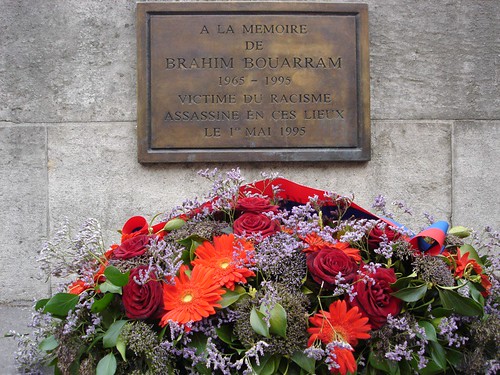
1st of May, in the morning, I cycled through the quiet streets to a bridge by the Louvre Museum. At the Pont du Carrousel, there is a commemorative plate for Brahim Bourram, who 11 years ago, on this day, drowned after he was thrown into the river Seine by skinheads coming from the annual Front National demonstration. Paris Major Delanoë had put down flowers, and every year MRAP – (Movement against racism and for the friendship between the peoples) – arrange a commemorative ceremony. General secretary Mouloud Aounit didn’t have a microphone, and I was too far away to hear what actually was said, but MRAP has posted a statement on their webpage, which I shall quote from as it speaks directly to the current situation in France:
[teaserbreak]

This crime should remind us tragically that the words always precede actions, that words – the discourses of hate, exclusion – can lead to the irreparable. Brahim Bouarram, Ibrahim Ali, Imed Bouhoud, Ilan Halimi and many others have paid their life for the freedom of racist speech.

At this 1st of May 2006, when the verbal violence of racist speech is given expression in a build-up between the president of the Front National, Philippe de Villiers [president of the right wing Movement pour la France] and Nicolas Sarkozy, it is the duty of all antiracists to remind that if this process is let to develop, it meanst to take the risk of making these individuals accomplices in putting words into action. [my translation, read the whole press release in French here]

The communiqué ends by an appeal for vigilance and civic resistance.
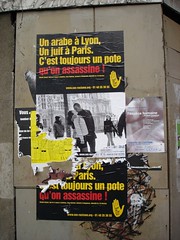
And from here this blog post could take many directions. I’d like to write about this typically French habit of appealing to the duty of the citoyens, MRAPs interesting – and in my opinion laudable – position and (lost) court case in the Mohammed caricature incident, the sombre and complicated issue of racially motivated murders, the recent media appearances of de Villiers (speaking of an islamisation of France and the need for a francisation) and of course this “build-up of violent speec” (violence des propos racistes s’exprime dans une surenchère). The latter issue I’ll expand on very soon in a post with the catchy title Liberté, Égalité, tes papiers! (stolen from an anti disposable immigration flyer). The present post shall however continue recounting 1st of May, as I experienced it.

Three years ago, at the moment the commemorative plate for the murdered Brahim Bouarram was inaugurated by Major Delanoë (see this article from 2003 on Paris Indymedia (in French)), Le Pen used (according to the media) the occasion to make an ironic remark on a nearby gathering: “That bridge will soon resemble our great religious sites, because it seems that every year a commemorative plaque will be put up to thank the little hoodlums petits voyous who every year allow themselves to slander the Front national.” (I’ve found other quotes as well from Front National concerning this event, which I don’t think should be forgotten).

This attempt by Front National to clean up their public image and to put the blame on others continues: A news report from this year’s 1st of May FN procession showed how an FN member (a representative to the European Parliament) told an aggressive man shouting “France for the French” to leave the cortege, remarking that he didn’t want this behaviour in front of the journalists and the “leftwing media” and suggesting – or even saying? – that this was a provocateur paid for by the Interior Ministry. The FN themselves had distributed blue posters shaped like France proclaiming: “Aimez-la où quittez-là!” for this annual procession in honour of Jeanne d’Arc
(I haven’t yet looked into the relationship between FN, Jeanne d’Arc and the 1st of May, see Wikipendia (in French)).
As I don’t look like an Arab (which was the unfortunate fate of Brahim Bourram), I thought it safe to go and have a look at this procession. However, I didn’t and as this is such a sombre subject, I’ll not make a joke about why it turned out that way.

This blog post was supposed to be about 1st of May, but I’ve already written almost two pages about the far right. For my part, the 1st of May celebration ended on a happier antiracist note with “rock against Sarko” by a classical French punk band at Place de la Nation. But before I wrap it all up with that story, I shall say a few words about the other processions I missed that day, just to give an idea of the things going on in Paris on mayday.

First, I missed when one of the major labour unions (La Force Ouvrière) put flowers on the Communards’ Wall (Mur de Fédéres) at my local cemetery, the Père Lachaise. Then in the afternoon, I missed half of the major procession going from Place de la République to Place de la Nation. (I though the procession would pass by Bastille, but they went the straight axis RépubliqueNation via Boulevard Voltaire (surely no unintentional symbolism here- I’ll come back to this symbolic axis of republicanism later, in which I think also Quilombo (the libertairian bookshop situated in rue Voltaire) has its place – I’ve just learnt that Quilombo was the name of antislavery settlements in Brazil, and Voltaire deserves a little reminder of the history of antislavery movements… I’ll maybe write why at a later occasion)).

The second half of this major 1st of May manif was dominated by transnational leftwing parties – Turks, Latin-Americans (going all together), Tamils (performing the Ramayana!) and Kurds…

The last event I missed, I skipped by my own choice, although I regret it a little now. 2nd of May the temperature returned to over 20°, but it was really chilly, grey and rainy on the 1st (and even worse the day before when I skipped two street parties; one for some sans-papiers families ejected from a squat and who now lives in a square, another just locally in Ménilmontant). The Euromayday organises Mayday parades all over Europe, and the phenomenon shows amongst other things the rapid dispersion of ideas, in this case counter movements, through the internet. Suddenly precarity has become a word in English (se a US-American blog post on this and the interesting recent Wikipendia entry), and even in Norway some left-wing radicals have adopted the notion of a génération précaire, stemming from the CPE-movement in France. (In January when I wrote the post on insecurity à la français this was not yet the case). But as I’m – and maybe eventual readers as well are – getting a bit fed up by this text now, I’ll end here. We’ll probably have the chance to delve into French punk concerts, the internet and protest movements and what else, later. I’m already preparing the part three of My blog, my project and I, – this time on… oh, yes, as always these days… politics and I.

1st of May, in the morning, I cycled through the quiet streets to a bridge by the Louvre Museum. At the Pont du Carrousel, there is a commemorative plate for Brahim Bourram, who 11 years ago, on this day, drowned…
Read more

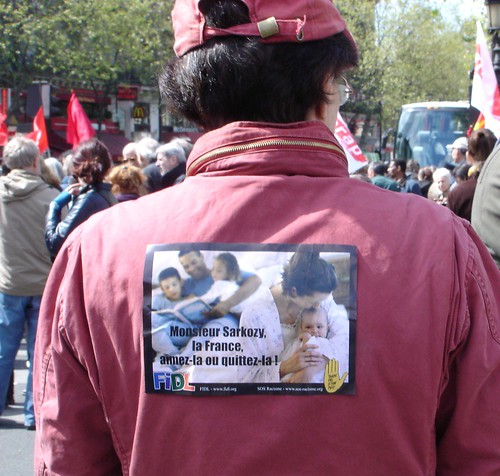
“Monsieur Sarkozy, if you don’t love France, leave her”

Today’s most important event is probably what I’m watching right now; the French cup final described as the dream final for the supporters and the nightmare for the forces of order. Since it’s between my two and only favourite French teams, it’s a dream final for me as well. After I’ve settled my little foldable bike import firm in Marseille my loyalties will probably settle for the Mediterraneans, but until then I’ve spent too much time in the capital to not have divided loyalties. There goes La Marseillaise… All the 80 000 (with tickets sold out weeks ago and reaching 400€ at the internet) are not singing, but quite a few are. The President arrives and shakes the hands with all the players…
[teaserbreak]
Well, not everyone will agree that this is the most important event today. Before going to what has been the most important event for me, I had a glance at an TV audience complaints programme, where I heard a TV spectator who was so angry, and found it surrealist that Zidane announcing his retirement had made it to the number one headline on the evening news the other day. (The spectator en colère was a religious man and in his opinion a news event in the Middle East was far more important). (PSG has already scored after 5 minutes! Luckily Olympic Marseille looks like they can equalise any moment). Zidane’s forthcoming retirement has not passed lightly in the public debate, but the last days the Clearstream affaire has of course out-shadowed other news. The question is; will really de Villepin have to go now after he somehow got through the CPE storm (though dropping to a an all time low for a Prime Minister on popularity ratings)? I can’t be bothered to go into this affair here (see The Guardian if interested), but the affair latches on to a question I saw on a funny poster today: On top of a drawing of the three leading politicians President Chirac, Prime Minister de Villepin and Interior Minister Sarkozy it was written Choisie? Subie? (“Chosen? Or suffering from?”)

In order to explain this drawing, I shall go on to what has been today’s most important event for me: The demonstration (of course encore une manif! It’s been more than three weeks since the last one…) against the new immigration policy which will be discussed in Parliament in three days.

According to this new law, immigration to France should be “chosen” (immigration choisie) rather than “suffered from” or “undergone” (subie). In practice, this means that people who are useful to the French economy are invited in, while the law will be more restrictive on the others – the asylum-seekers, the family reunions and the unregistered sans-papiers. The labour party (PS) politician Christiane Taubira said on the news today that she had too much respect for humanity to accept even the notion immigration choisie. Activists have in a similar humanist vein renamed the government term immigration subiedisposable immigration” (immigration jetable).

Either the political climate is hardening here, or I’ve just taken too long to grasp how far right the Interior Minister is willing to go. When the Votez Le Pen poster with Sarkozy’s photo appeared in January, I have to admit that I found it a too strong for my taste (on the other hand I could wholeheartedly appreciate the Sarkozy satire poster “When I hear the word banliue I reach for my Flash-ball (rubber bullet weapon)” and the Raspouteam stencil). But after Sarkozy’s two latest “love France or leave her” and the “If Le Pen says that the sun is orange, do I have to say that it is blue?”*) I must admit that the poster was far more updated on French politics than the newly arrived anthropologist.

Quite a few demonstrators today had come to the conclusion that the interior minister obviously doesn’t love France as she is, so they suggested that he packs his bags and leave.

The cup final is finished long time ago (Paris Saint-Germain led all the way from the 5th minute and won 2-1…).


*) The exact quotes are “s’il y en a que cela gêne d’être en France, qu’ils ne se gênent pas pour quitter un pays qu’ils n’aiment pas” (Le Nouvel Observateur 28/04)« Si certains n’aiment pas la France, qu’ils ne se gênent pas pour la quitter » (Le Figaro and Le Monde 29/04) Le Monde 27/04 has published a more extensive interview with the interiour minister on the subjet.

Today’s most important event is probably what I’m watching right now; the French cup final described as the dream final for the supporters and the nightmare for the forces of order. Since it’s between my two and only favourite French…

Read more

Marseille (communications)

I’ve spent Easter time in Marseille. In 3 hours and 10 minutes the TGV takes you more than 800 km south from Paris to the Mediterranean city, through the French countryside, past a few villages, a castle or two on top of a cliff, a viaduct, blooming apple orchards, the river Rhone and loads of white cows. “Quite why, you might wonder,” the Guardian wrote in the heat of the CPE-affaire, “is a country with wonderful infrastructure, beautiful towns and countryside, world-class companies and highly productive workers tearing itself apart again?” I do find that paradox intriguing, and the comfort of the Train Grande Vitesse was an apt opportunity to give the transportational part of it a thought. Most major train itineraries in France take around 3 hours, an infrastructural feat I – perhaps because I come from a country made of massive granite – find very fascinating. I wonder how people can bother to take domestic planes at all from the capital in this country, not to mention to London, when they can just jump on the efficient metro to one of the grandiose railway stations and get on a double-decker TGV, and get off at an equally grandiose station at their destination a few hours later. (Public transport in this country is one of the very few things that run on time – after 6 months here I still haven’t figured out exactly when the TV news starts, and I’m still not sure how delayed the conference, demo, meeting etc. will be – but public transport is reliable indeed, as long as there isn’t a strike or a manif blocking the way).
[teaserbreak]
Thinking of what I have planned writing about from Marseille I realise that this post could equally been titled “communication” (…which I add at this moment…). “Communication” can stand for all the three features that we noticed in particular on our weeklong holiday in Marseille. All the three of them are common in Paris as well, but in Marseille they’re somehow amplified:

First: I’ve got the impression that les Marsaillais are quite chatty. In Paris too people say things to strangers in public spaces. (This is perhaps normal in many countries in the world, but again, Norway is not only made of granite, it’s also very sparsely populated so we haven’t really discovered the finesse of human interaction yet ;-) ) I’ve written earlier that many people speak to themselves on meetings and conferences, apparently in order to get contact with their side-person so they have someone to share their opinions with (expressing opinions is undoubtedly very important in France). In public spaces people aren’t usually trying to enter into long term exchanges, they’re just saying a few words: In the supermarket today a boy around twenty commented that my nutritional intake today surely would be well-balances (I had some cartons of juice and a big bag of salad in my shopping basked, in order to fight of a threatening cold. He bought a packet of biscuits). And if people – kids, youth or adults – double you on a narrow pavement, chances are that they would say Pardon! or Excusez-moi! as they pass. If I carry flowers from the market, someone will possibly make a joke, usuallyare they for me? But particularly I appreciate all the passers-bys giving a Bon appétit! when they see someone eat in public. A couple of days ago, when we had lunch on the pavement outside a local bistrot someone even shouted bon appétit from a passing car.

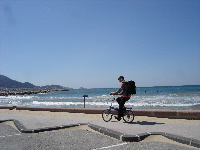
Foldable pocket bike at the beach in Marseille

These examples are from Paris, but my impression is that the Marseillais talk even more to strangers. When I stayed in France some years ago, I spoke more French in one week in Marseille than I had done the previous 4 months in Paris. This time, apart from all the ordinary bon appétit it was our small foldable pocket bikes that made quite a few Marseillais talk to us. Even a busdriver leaned out of the window at a red light and said he had always wanted such a bike and now he would like to know where we had got them. All the interest our bikes generated would probably have inspired someone a little more entrepreneurial than us to start a local import firm and live happily for the rest of our lives down there.

The second feature we noticed about Marseille is how calm people are in the traffic. It’s quite a Zen experience to cycle in Marseille, – but also in Paris, I should add, which I noticed when I unfolded my little green pocket bike and started cycling here as well. The contrast couldn’t have been bigger to cycling in London, which is almost an extreme sport experience (at least at the time I was there, which was just before Major Livingstone got to power). The bikes here are often older and of a more classical city bike posture than the typical off road or hybrid bikes in Oslo or London. That makes people sit more straight and almost backward leaning. In addition, many cycle really slow. And all kinds of people cycle; from elderly men and ladies to kids via businessmen. But this is Paris I’m talking about again. In Marseille there aren’t that many people on bikes, and the infrastructure for bikes are much worse than in the capital, with no bicycle lanes and at the moment the whole city centre is just a construction site for the new pride, the tramway. But despite all this, the drivers have surprisingly a lot of patience with us cyclists (perhaps they were just staring at our attractive foldable pocket bikes?).

I find it surprising that the city traffic in France give this Zen impression at the moment, because that was certainly not how I remember it from my first visits to Paris in the late 1980s.

Initially, I was thinking of writing a comparison between “multicultural” Belleville (social demographer Patrick Simon’s description) and cosmopolitan Marseille, but the only thing I’ll say about the cosmopolitan feature of the city for now is that les Marseillais apparently see it as some kind of public duty to make metissée babies. It wasn’t even the anthropologist, who is supposed to notice such things, but her companion who remarked the high number of people of mixed origins in the city of 2600 years of immigration.

I’ve spent Easter time in Marseille. In 3 hours and 10 minutes the TGV takes you more than 800 km south from Paris to the Mediterranean city, through the French countryside, past a few villages, a castle or two on…

Read more

“Ethnography as the inscription of participatory experience”

After an oh so long time in the field, I’ve finally got around to make a summary of some good advice I’ve returned to from time to time during my stay. They’re rather commonsensical knowledge for any graduate in anthropology, but it’s surprising how quickly I get accustomed to the details of everyday life, and thus stop paying attention… (from Writing ethnographic fieldnotes (Emerson, Fretz and Shaw, 1995)).
[teaserbreak]
On focus: – how to look in-order-to write (p.26)
*) on a scene: take notice of initial impressions available to the senses
*) give priority to processes (rather than causes etc); what is occurring (rather than why)
*) look for practical concern of actors; – conditions and constraints

On description (p. 32-):
*) write down the details of key components of observed scenes and interaction
*) avoid generalising characterisations – be concrete!
*) concrete sensory details of the scenes, settings, objects, people, action and talk
*) concrete details of everyday life which show (rather than tell)
*) how are emotions expressed (careful with generalisations…)
*) sensory (rather than analytic) adjectives
*) verbatim (rather than summarised) dialogue
+ the accompanying gestures, facial expressions, movements, postures…
*) sensory imagery (rather than evaluative labels)
*) immediate details showing agency and process in situations, auditory and kinetic details – evoke all senses which recall the moment of the experience (p. 72)
*) specify the conditions under which people invoke and apply terms (p. 139)

On reflection:
*) self-consciously recognise my own fundamental orientations (p. 62).
*) avoid evaluative wording; – but when using an evaluative term describe what led to the judgement
*) highlight the process of determining meaning
*) how are my accounts products of my (implicit) decisions about participation and description?
*) how do social events come to be perceived and written up as data? → reflect on the interplay/dialectic relation between theory/analysis and the creation of data. (Data are products of prior interpretative and conceptual decisions (p. 167).
*) which incidents/experiences toughed off particular attention and interests?
*) “see how our own renderings of others’ … worlds can never be descriptions from outside that world … understand our own enterprise in much the same terms that we understand those we study” (p. 216)

On writing:
*) remember the interplay of concrete exemplification and discursive commentary (p.174): – remain sensitive to how analytic reframing of ethnography might distort (local) meaning
*) when giving ethnographic examples; present the negotiated, processual quality of interaction (p. 175).
*) remember when presenting: the text about people’s way of life creates that world as a phenomenon for the reader (p. 214).
*) the reader should be able to assume the producer (i.e. me), the research process and the product (the text) as a coherent whole → (what I learnt occurred on spesific occations and was shaped by methods and modes of participation) (215).

After an oh so long time in the field, I’ve finally got around to make a summary of some good advice I’ve returned to from time to time during my stay. They’re rather commonsensical knowledge for any graduate in anthropology,…

Read more

Space, time and revolt: – My blog, my project and I, part 2

The working title of my project has been Communities in the making: Identity and belonging in postcolonial Paris and London. Initially, the idea was to do a similar project to the one I had done for my master thesis. However, after I came to Paris I quickly learnt that the situation here is quite different from the one in London 6 years ago. The first thing I realised was that it was no wonder my first fieldwork went pretty well, but – hélas – I yet don’t see any reasons for this one to follow suit…
[teaserbreak]
In London 1999, I stumbled right upon the climax in the creation of a home-grown British Asian identity. And what chance, because that kind of identity politics was exactly what I had prepared for. Before I crossed the North Sea to arrive in London I had read Paul Gilroy’s brilliant There ain’t no black in the Union Jack almost to pieces, and what I found amongst the second generation British Asians was a situation quite similar to the one Gilroy described amongst black Britons 10-15 years earlier. (Gilroy shows how a way of being black and British had been created through political struggles, a process where music and social/political movements played an important role. The British Asian identity politics I found going on in London in the second half of the 1990s was formulating a strategic, or political identity, as a response to stigmatisation (for a large part).

And then I went happy go lucky to Paris to find a French, republican equivalent…

Perhaps the Marche pour l’Egalité in 1983 (also called “march for the Beurs (French Arabs)”) can be compared to the identity political process I witnessed in London, but there are so many differences that perhaps it would be a too gross simplification to equate the two phenomena. To the extent that there are or have been identity political movements here in France, I think they would take a very different shape.

These different shapes are of course exactly what I’m here to look at, but until now I have had problems finding a nice little comparable and “studiable” phenomenon. Instead of something small, manageable and significant, I’ve become utterly overwhelmed by noteworthy phenomena and processes going on, and – of course – by an accelerating amount of academic literature on whatever imaginable and relevant subject. For instance, it’s been written books on the situation of French Arabs and the situation in the banlieues at least since 1983… And every month there are new publications coming – I have lost track of books and journals already published on the November 2005 riots; Banlieue, lendemains de révolte, La République brûle-t-elle?… (I’ve got four of them but there are many more).

So, after I had become aware of – through the confrontation with the French context – how focused and pertinent my previous field study had been, I understood that I needed a sharper and more locally adapted focus for my approach here. My first idea was to look at interaction in, and appropriation of, space. The first two months of my fieldwork I lived next to the neighbourhood of Belleville, and every day I crossed through a field of ethnic, cultural and social diversity with is perhaps one of the most complex on earth: Relatively recently arrived East Asians establishing new enterprises, recently arrived West Africans and equally recently arriving bobos (bohemian bourgeoisie artists and professionals – predominantly, but not exclusively white (and quite a few of them seem to live in ethnically mixed couples)), the long-staying North African Muslims and North African (Tunisian) Jews and the old white artisan and working class, apparently all together… (Apropos the working class element; funnily, at an exhibition at the Town Hall recently, I heard an interview with the photographer Willy Ronis who recounted that he had lived next to Belleville 70-80 years ago, but had been prohibited to go there from his middleclass father, presumably because of it’s working-class shabbiness. Luckily, for those of us who appreciate good photos from Paris he started hanging around there as an adult).

In addition to a research focus on the appropriation of space, I was also thinking of looking at the re-appropriation of history, which was also a phenomenon that quickly grabbed my attention. Before I came here I had just read the anthropological classic Europe and the people without history by Eric Wolf (which as brilliant as Gilroy’s book, here my favourites turn up, one after the other…). And the funny thing was that while only a few of my informants in London said, to quote Asian Dub Foundation; “we’re only here ‘cause you were there”, the theme of France’s dependence on it’s colonies, the atrocious history of slavery, the work the (former) colonial subjects have done and still do here reverberates everywhere – from rap songs to what the local cornershop owner easily will chat to you about… So yes, the re-appropriation of the history of France seemed like a relevant approach.

My contemplation had come about this far when the banlieues seemed to explode last autumn. Whatever I’d been thinking concerning focus for my research until then just drowned in an overload of information. The angry kids outside Paris didn’t seem directly relevant in my comparative study (just as the riots in Bradford, Burnley and Ilford hadn’t made much impact on my findings in London), however the bearings the November riots have had on the media as well as the politics is worth a research project in itself…

(As I write this, on one of the numerous talk-shows which goes on for hours and hours into the night, I can hear them mentioning the autumn’s revolt as they’re discussing the CPE (“All that for that”, as they somewhat self-ironically have dubbed the discussion)… Right now, Alain Finkielkraut – with messy, half long hair, round glasses and a broad stripy tie, a French intellectual, obviously… – seems to be suggesting that the French youth is malleable and easy to seduce; – the president of the student organisation is shaking his head, the porte-parole of the ruling party is looking almost bored… I’m about to lose track of the task of finishing this, absorbed as I easily become of these French discussions… I ought to study one of them anthropologically, as a ritual. If they don’t talk all at once sooner or later, the event has not been very successful). The law on “equal opportunities” (l’égalité de chances) where the CPE has been part and which has been messing up the whole country for more than a month, is meant to be an answer to the problem of the banlieues. The response is rejected by a majority of the French population, including quite a few of the banliusards themselves.

Maybe the law obliging schools to teach the positive sides of colonisation would have been scraped sooner or later anyway, and maybe the silent non-celebration of the centenary of the law on laïcité (separation of state and church) and the bicentenary of Napoleon’s victory at Austerlitz would as well have been subdued anyway, but my impression is that the sensitivity to colonial/historical issues is nothing but gaining in importance at the moment.

So, yes, a focus on a re-appropriation of history could be a well-founded choice for this fieldwork. It fits well in with the larger, comparative object of my research project as well, as this new scrutiny of the history of France also can be seen as a next step in identity politics: British Asians (e.g.) made it possible to be British in new ways – they widened the boundaries of “Britishness” – through reversing and removing the stigmas that for a long time had been attached to their South Asian origins and which had excluded them from being British. The critique that is being lanced against French national history – devoirs de mémoire, “the duty to remember” – can be interpreted as a challenge to the omissions and forgetfulness incorporated into the national history of former colonial powers (as well as other nations). To be French is not what one thinks it is… And by what right can one exclude the descendants of slavery, descendants of soldiers fighting for France in numerous wars, the migrant workers participating in the glorious growth of the post-Second World War period and so on from being citizens of this nation/republic? The empirical phenomenon almost fits too well with my new infatuation for Eric Wolf’s perspective, as well.

For a while much of my attention has been on this re-appropriation of first space, and then more and more of time. But then suddenly, France erupts again. A friend of mine reminded me that all these demonstrations and revolts fit perfectly with my research focus on communities in the making… Yes, she’s right. And I start to reflect on all the anger, revolt and political commitment I have come across here. In fact it’s been so much of it that I’m considering revising the working title of my project to Revolt and belonging in postcolonial Paris: community in the making.

The working title of my project has been Communities in the making: Identity and belonging in postcolonial Paris and London. Initially, the idea was to do a similar project to the one I had done for my master thesis. However,…

Read more