search expand

Demonstrators, casseurs and foreign media

After I had posed the previous text, I realised that I had forgotten to mention that the large majority of demonstrators are peaceful and non-violent, and it’s only at the margins and the end of the demo that the situation can escalate. This fact is obvious to someone who is present at these events or who follows French media, however I have a suspicion that foreign media (again) prefer to show burning cars, hooded youth, teargas and water cannons instead of the one million or three who are demonstrating peacefully.

After I had posed the previous text, I realised that I had forgotten to mention that the large majority of demonstrators are peaceful and non-violent, and it’s only at the margins and the end of the demo that the situation…

Read more

Les cassurs – the “demonstration breaker” phenomenon

“The demonstrators shall be protected, and the casseurs shall be taken in for questioning,” Interior Minister Sarkozy said some days ago. It’s not the first time Sarkozy has expresses his binary vision of the youth in this country (“real and fake youth”). For a minister in charge of interior security, the world might be this simple, (though I remember how he during the November riots used the to two single cases of attacks on humans to discredit the whole three week and enormously widespread revolt). To me it seems like this broad casseur category hides at least three distinct, but perhaps related phenomena: There are the anarchists and left wing radicals who attack the police (and far right “fachos”, if present). Attacks on publicity boards (JCDecaux) and perhaps also on banks and multinationals (as is common in i.e. the UK) can probably also be connected to this category of casseurs – although in my opinion a distinction should always be kept in mind between attacks on property and on humans (including police officers).
[teaserbreak]
The next category of casseurs seems also to have some kind of political motivation, though less articulated. It was a funny situation on TV the other day: Two youths were asked why they were demonstrating. “We’re against the CPE, of course, ” the one replied quickly. “No,” the other goes plainly, “I’m here to fight the CRS [riot police].” It seems to me that this category of casseurs might be related to the November riots, against “Sarko” and probably also the CRS. It shouldn’t be forgotten that the incident sparking off the revolt was an identity control and a police chase ending in the (accidental) death of two young boys and the serious wounding of a third, – facts that were curiously misrepresented by the infamous “Sarko” himself. Such identity controls are a daily ordeal for certain French citizens.

The third category of casseurs is a phenomenon so unheard of that I can’t understand it in any other way than as alienation… There are groups of kids robbing demonstrators of their mobiles and other valuables…! In fact there was one trying to snap my camera as well on Tuesday. (I so much wished that I had the lens open so I had been ready to capture his surprise as he noticed that I had the camera attached in a string around my neck, and it wasn’t just to pick it. My reaction time will never make me a good photojournalist…).

This third category of casseurs is a very sad phenomenon indeed, particularly if the French demonstrations are seen – as I do – as a symbol of the strong participatory sense of citizenship in this country.

“The demonstrators shall be protected, and the casseurs shall be taken in for questioning,” Interior Minister Sarkozy said some days ago. It’s not the first time Sarkozy has expresses his binary vision of the youth in this country (“real and…

Read more

Busy week

It’s been a busy week. While the youth in this country have been blocking and occupying schools and universities – or protesting against those blocking their universities – or been out in the streets demonstrating, burning paper cars or real cars, tagging, breaking a few bus shelters and windows or robbing demonstrators for their mobiles, I’ve been indoors at various prestigious Parisian venues listening to people discussing discrimination.
[teaserbreak]
And my, oh my how the French excels when it comes to discussing! They’ve been criticising themselves lately, for not being able to come to agreement and solve their conflicts like they allegedly do in other European countries. “The Scandinavian model” is said to be such a good approach to compromise. “The Scandinavian model” means the Danish and Swedish economic way of mixing a strong social welfare state with entrepreneurial creativity and a flexible labour market. (I’m not sure why Norway isn’t included in this model; either – as often is the case – the non-European member is just forgotten, or the spectacular oil economy just makes it a case apart).

(However blissfully ignorant I am of all but a few political events up north there in Scandinavia at the moment, I have to say that I personally prefer the French model of vehement and violent discussion a thousand times to the Norwegian way of showing discontent(?) by silently turning towards the far right party… (which verges on being the largest party in Norway at the moment). Neither the economic liberalist and war mongering climate in Britain seems to be a good example to follow, as I see it, but I’m too tired to go into that now).

Anyway, back to the week for vivre ensemble and “fighting against discriminations”: It’s been an amazing affair with two to four panel discussions every day for five days, starting (15-30 minutes delayed – always, as always is the case here) at ten and ending at half past eight, with a long lunch break. And the listeners – or the participants, as they deserve to be called in this case – have been incredibly involved; in asking questions and in showing so much anger that I sense my utter Norwegianness from head to toe. But anger is just a part of it; to me it seems like the French engage with the surroundings more actively than I’m used to. This might seem strange, but I’ll try to explain: The French talk to strangers much more than Norwegians do. At this seminar I quickly noticed that the sideperson, whoever it was, usually sooner or later started mumbling to him- or herself. The right thing then, I found out after a short while, is of course to give some kind of sign of interaction. And people expressed themselves with engagement and intensity. As they do in the streets now.

My impression is that the political life in France is very much alive and vibrant – c’est-à-dire very different from what I’m used to. There were many other aspects of these seminars that caught my attention as well, as for instance various forms of lopsided-ness, which no one commented (despite commenting almost everything else…), for instance extreme gender bias and a tendency to theorise rather high above the people concerned instead of actually listening to what they are saying or letting them speak for themselves. (I’ll probably nuance this appreciation later)). But all together it’s been an amazing affair, to listen to more than 100 discussants and all the contributions from the audience.

(Finally it’s spring… It’s been so wonderfully hot and humid (19°C) that I’ve had the window open all day, and now there is thunder and lightening…).

In the evening, after coming home from all these mind-boggling discussions, I’ve tried to follow the debates on the demonstrators and casseurs (rioters at making trouble at demonstrations), and the students from the banlieues and the casseurs from the banlieues and who are the casseurs and so on… that are taking place in the media as well as on the discussion forums around.

In addition, I’ve tried to deal with the news that the person who should have given me back the huge deposit for a flat I rented months back, is bankrupt and depressed(!) – so he says… And I’ve become completely hooked on flickr, a very interesting site for photo sharing, indeed… So, yes, my last week has been rather busy.

It’s been a busy week. While the youth in this country have been blocking and occupying schools and universities – or protesting against those blocking their universities – or been out in the streets demonstrating, burning paper cars or real…

Read more

Mars – “mois chaud”

It wasn’t the climate the newspaper Le Parisien was thinking of when they some weeks ago wrote that March would be a “hot” month. And indeed they were right…
[teaserbreak]
I must admit that I leave the demonstrations as soon as there are any sign of violence. (Luckily, there are some observers left – I came across these terrific photos on flickr today!) It’s partly due to the fact that my wretched skeleton isn’t fit for running and partly that the situation on the ground becomes completely unclear and confusing. Only after a few days of searching the net and following the news, do I get some understanding of what actually was happening. For instance, the happy atmosphere (“bon enfant” as they say here) last Thursday (16/03, when the lycée and university students were out in the streets against the CPE again), quickly changed when the procession suddenly was encouraged to divert and disperse…

I noticed many had started going in the opposite direction and others stood waiting. And then I scented the teargas and noticed that the riot police (CRS) had taken position in all the side streets. A guy who had obviously got the gas right in his face asked a CRS what was going on. The policeman just lifted his shoulders. (I wonder if they’ve been instructed not to talk to people when the situation is tense. I noticed the same reaction two days later at Place the la Nation, as well. The armoured CRS just utter one-syllabic words, if they utter anything at all.)

I still haven’t found an explanation for why the final part of the procession was met with an air full of teargas and riot police (apparently) blocking most ways out that Thursday. This chronology doesn’t completely fit with the official version, which says that the situation didn’t intensify before “casseurs” (“breakers”/rioters) at the very end of the procession started making trouble… So, yes, the situation on the ground is so confusing that it’s better to go home in time and start searching the net… ☺

The atmosphere changed even quicker at the demonstration two days later (18/03, when the unions joined the students, still against the CPE). The weather had been wonderful (full of pollen in the air, so I wasn’t ready to wait for the teargas this time…), and the crowd really huge (maybe as many as 350 000, which means a 5 km long avenue filled with people for 5 hours). At the moment I arrived at Nation I noticed a lot of people suddenly moving in one direction. I saw black smoke from a fire. A car? Not easy to tell at the moment. As I reluctantly moved in homeward direction, some men came running –had to be undercover policemen, I thought –, and further down the street I saw they had put a boy up against the wall. In fact, first I only saw his trainers, as there were so much police, with and without riot gear, covering him. I couldn’t make myself take any pictures when he was escorted to the police car right in front of me. But others were, so also at the second arrest I saw a while afterwards. This boy wore ski goggles (in case of teargas) and he was shouting something about La France. Strangely, one of the police officers present at arrest of the other boy muttered something about La France as well. (Unfortunately, I must admit that when the French are agitated their language turn almost incomprehensible to me.)

Early next morning it was so quiet at Place de la Nation that I could hear a blackbird sing in top of one of the trees. And it would still take almost one and a half day before the news that the trade unionist Cyril Ferez was in a coma after being trampled underfoot by the CRS would break…

A television crew hung around at the centre of the roundabout, filming the flags and banners still left at the monument (The triumph of the Republic, I think it’s called). A couple of photographers were taking pictures of the damage, – which were nothing really, compared to what were to come at Les Invalides some days later. As I was waiting for the bus to take me into town, I watched the locals out walking their dog or just on a morning stroll, stopping chatting to each other in front of the burnt out car. To elderly women were talking by the shattered bus shelter: “It’s the casseurs. They always come at the end, and they haven’t got anything to do with the demonstration…” Neither of them mentioned the banlieues, (even though the two issues – the revolt in the banlieues (see earlier in this blog) and the student revolt against the CPE 4 months later – in many ways are related).

Who these casseurs might be seem to be of interest to many these days. And who were the ones who apparently caused quite a lot of damage when they occupied the prestigious EHESS (Ecole des Hautes Etudes en Sciences Sociales)?

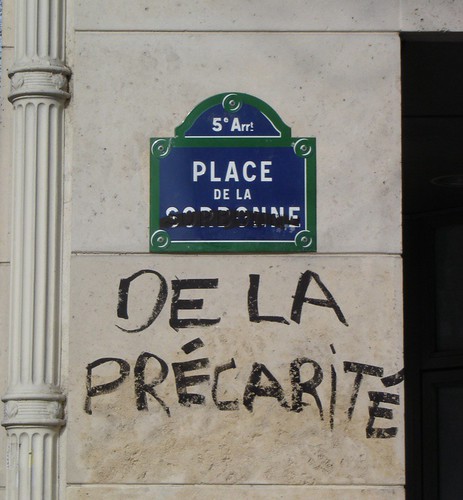
I got off the bus nearby La Sorbonne and stopped by at the closed off Place de la Sorbonne on my way to the Sénat (for the first day in a week of seminars on discrimination). The façades in boulevard Saint Michel were – and still are, I think – full of graffiti and some of the shop windows (mainly clothes shops, there aren’t many libraries left in The Latin Quarter anymore…) were broken. It wasn’t yet 10 o’clock, but the new Parisian attraction was already drawing an audience.

And since then, the trouble has got worse…

It wasn’t the climate the newspaper Le Parisien was thinking of when they some weeks ago wrote that March would be a “hot” month. And indeed they were right…
[teaserbreak]
I must admit that I leave the demonstrations as soon as…

Read more

The strange nature of politics in France – Protesting, part 2

One thing that struck me during the November riots was the high level of understanding they were shown in the French public debate. It seemed to me that quite a few who participated in the public discourse quickly interpreted the burning of state institutions, private cars and local companies in the banlieues as – not acceptable, but, yes understandable – expressions with some sort of political meaning. A friend of mine familiar with politics in Germany asked me if no one had demanded the demission of the Interior Minister, as it is he who is responsible for law and order. And in a German context, according to her, three weeks of youths rioting all over the country would have been an obvious sign that he didn’t do his job properly…
[teaserbreak]
(But not in France: Interior Minster Sarkozy’s popularity grew during the riots. He certainly condemned what happened, but he didn’t crush the riot with police force, which my friend guessed would have happened in Germany. In fact, I’ve heard that the riots were neither halted by the police nor the state of emergency. Rather the youth themselves decided to stop.)

I should ad that some (whites) I spoke to had not much understanding for the pampered youth who had been given money for nothing for so long…

I came to remember this – to me – striking acceptance for protest now that the students “are in the streets” again. As I wrote in the previous post, politics in this country should – it seems to me – to a larger degree than many other places be played out in the streets. And politics is, in fact, a public and popular concern in this country. Demonstrations, and notably student demonstrations, have made governments withdraw laws several times since 1968. This is one aspect of “the French exception” which is being played out right now. Another aspect is the strong opposition in the French opinion against the (neo-)liberal weakening of the labour regulations. (I forgot to explain the Contrat Premier Embauche in the previous post: it’s a contract for people under the age of 26, which gives the employer the right to dismiss the employee without explanation during the two first years.) However, that is another story I’ll not go into here.

In upcoming posts I’ll come back to other aspects of French society, which I find strikingly different from what I’m used to.

One thing that struck me during the November riots was the high level of understanding they were shown in the French public debate. It seemed to me that quite a few who participated in the public discourse quickly interpreted the…

Read more