search expand

The city (long) before lunchtime

A friend of mine said that he’d like to leave a comment on my blog suggesting that my fieldwork could have benefited by some knowledge of what happens in the city before lunchtime. As I have in fact been out there many times before 12 o’clock, I have informed him that such a comment is totally ill-informed. Today I’ll even prove that I was out before dawn on a Saturday. (Since it’s in the middle of winter – and winter indeed, since emergency measures are put into action with Plan Grand Froid niveau 2 and alerte orange (in this country not concerning terror dangers, but exceptional snowfall) in half of France – dawn comes not too early).
[teaserbreak]
What did I find out? As I crossed the city between 8 and 9 o’clock in the morning, I had the chance to take a look at a few peculiarities of French society that I only had knowledge of from films and other secondary sources. For instance, there are people living and carrying out their daily life all over the city, even in the most touristy streets of the Latin Quarter (I know already that people live in the most touristy quarters of the Jewish area, which I’ve done myself). All along the way I saw locals joining their tiny Parisians dogs for a morning stroll, and there were even a man walking his unleashed brown and black lapdogs across Boulevard Saint Michel, where I really didn’t think there were any flats. (I’ve already become so accustomed to the clothes of the dogs that I have lost track of how usual dogcoates actually are, but I’m not sure if I can claim that a majority are wearing them despite the fact that we live under Plan Grand Froid niveau 2). Parents are bringing their children and even toddlers to primary and nursery school at dawn on a Saturday. And yes, there are really baskets with fresh croissants and pain au chocolat at the counter of most/all bistros (as I have seen on so many French films from all times). And many people do in fact have their breakfast in the local café perhaps at the corner. From the bus, I could see customers at the café tables engage in lively conversation long before 9 o’clock. And again, it happens all over the city, and I don’t know how early in the day they started this sociability.

This mix of habitable and commercial areas, of housing and public facilities, seem are more thorough in this city than other cities I know. It’s also something which separates Paris proper from some of its deprived banlieues, and which separates the 19th century cities from the modern style Le Corbusier suburbs… I don’t know too much about this yet, but it’s for sure something I’ll return to.

As I was one hour wrong about when the lecture I was going to this morning started, I had the chance to have a second breakfast – croissant beurre and café allongé – and see the bistro morning life from the inside. I found a very typical looking one run by two Chinese (one of them could have been an actor in a film by Wong Kar-Wai) just nearby the EHESS where the lecture would take place. (A lecture, by the way, on the social sciences and the crisis in the banlieues, which I will return to as well).

In the bistro, most people stand along the counter. Some, like the two young, green dressed street cleaners are following the lottery draw on a TV screen. (I’ve noticed that it’s common for the street cleaners and the postmen to drop by at a bistro and have a coffee by the bar on their morning round). Except from the white and native speaking street cleaners, there are two middle-aged men speaking Arab and two women and a man, all in their twenties, speaking Rumanian, I think (it sounds like a mix between a Slavic and a Latin language), and several French speakers. It’s so cold that people keep their overcoats and even woollen hats on, and none stay for long.

At half past nine, the bistro has quieted down. La grisaille du jour has settled, and it has become too unbearably cold to sit here.

At 10 o’clock, life has regained the daytime mode I know well: shops are opening and people – tourists and locals – are strolling along the streets. But a homeless man, just in his sleeping bag, outside a nearby school has not yet woken up. He’s obviously neither benefited from Plan Grand Froid (emergency housing for the homeless), nor from the tents distributed by “Doctors of the world” (with a little not saying, pertinently though sadly “each tent is a roof lacking”).

A friend of mine said that he’d like to leave a comment on my blog suggesting that my fieldwork could have benefited by some knowledge of what happens in the city before lunchtime. As I have in fact been out…
Read more

My blog, my project and I, part 1

The name of my blog is a sort of homage to the field diary that inspired me to start blogging: Jon Henrik among the Ifugaos. Lorenz, my Webmaster and the editor of www.antropologi.info, asked me ages ago to write a few words on why I decided to write a blog from my fieldwork. In fact, the answer isn’t as well-considered as Lorenz, a dedicated net publicist, might have thought. I just thought that what Jon Henrik had done was such a cool thing to do: It was nice to see what he was doing among the Ifuagos. However, after I started I have noticed that blogging sharpens the attention, just like taking a lot of photos (and probably painting) does; One starts to see motifs everywhere, and then one has to reflect on how to make the motif into a story so other people can understand what you want to tell them.
[teaserbreak]
This brings me to a question some people have asked me; is your blog your fieldnotes? No, my notes don’t look like my blog at all. My fieldnotes are very sketchy and cover a vast array of themes, and they’re not at all as coherent and focused as I try to make the posts in the blog. The texts here can perhaps be described as somewhere between fieldnotes and academic texts in terms of stringency, but not in terms of analysis. My posts are meant to be descriptive rather than analytic. (I’m not in that phase on the project yet.) The idea is to describe the process of discovery that I’m going through during my stay here. This includes ethnographic discovery, as well as day-do-day theoretical and methodological reflections. It made me happy to hear a friend of mine say that she found my reflections on the fieldwork situation and research process helpful. Nothing is better than students or others being inspired or learning something from what I write.

After I started blogging, I’ve become aware that there is a whole world of bloggers out there (for instance, one in ten Frenchpersons have their own blog!) Certainly, this must have a chaotic and anarchic democratising effect on public communication. And I can imagine that there must be yet undiscovered effects on individual reflection and social integration as well, (just like the diary had in its time, and text-messages and e-mails have now). For an anthropologist, this has theoretical implications as well as interesting methodological possibilities. – I hope some native Parisians sooner or later would talk back to me on my blog, but I guess they’re so busy blogging themselves, that they haven’t got the time to read other people’s blogs…

That was my blog, now on to my project. But since this post is long enough, the middle part of the presentation will have wait for later. The only thing I want to reveal for now is that its working title is Communities in the making: Identity and belonging in postcolonial Paris and London.

The name of my blog is a sort of homage to the field diary that inspired me to start blogging: Jon Henrik among the Ifugaos. Lorenz, my Webmaster and the editor of www.antropologi.info, asked me ages ago to write a…

Read more

Security à la français: précarité and insécurité

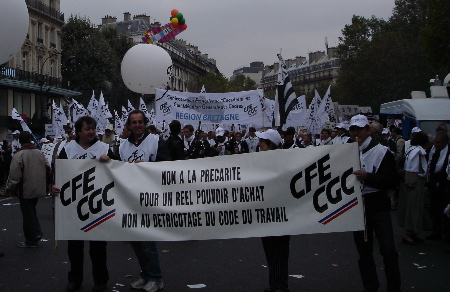
From a large demonstration 04/10/05: “against uncertainty, for a real increase in buying power and against dismantling of the labour regulations”.

Last week I was back home for a few days, and I went to a seminar on the wide-ranging notion of safety/security (“trygghet”). As it happens, two aspects of “security” play important roles in French politics and society; however, these aspects do not seem to be very high on a security agenda in a Norwegian context. I think this difference in emphasis points to interesting economical and social differences between the two societies.
[teaserbreak]
It was in fact at language school at l’Alliance française, amongst middle class students from all over the world, that I realised the insecurity the middle classes is experiencing at the moment, perhaps almost globally, but particularly in continental Europe. The buying power of the majority of the population is in many countries going down. (Excuse me for appearing naïve, but the accelerating consumerism in the Norwegian society must have blinded me to the situation elsewhere). Large parts of the population can no longer take for granted the growth and upward social mobility from one generation to the next, which has been such important forces in the capitalist societies since the second world war.

In France, unemployment among the under-25-year-olds is 21% (and of course doubled in the so-called “problem areas” (zones sensibles)). Thus précarité (insecurity, uncertainty, particularly concerning social issues, like job security) is a key aspect of French political discourse, especially among the left.

The news coverage before Christmas frequently returned to the issue of the dropping buying power, and at Christmas time the TV news showed report after report about the homeless (les SDF; sans domicile fixe). A typical story of a SDF shown on the news is about a normally well-dressed and well-kept male perhaps around the age of 40 who had “everything a few years ago, but then he lost his job…” According to a friend of mine, such stories are not common at German television. Despite high rates of unemployment, homelessness is apparently not such a big problem there. The atmosphere of la précarité in France is obviously reinforced by the enormous lack of suitable housing, a problem Germany does not suffer from.

The other aspect of security in French politics and society is l’insécurité. If the notion of précarité appeals to the left, insécurité is a winner on the right. For some reason, insécurité has particularly come to mean urban violence (but it can also be used in relation to road safety and food safety). (Since the French can’t talk about “race” and ethnicity, they have come up with a whole range of terms that can connote “race” and ethnicity… I think insécurité sometimes have such connotations, but probably not always. I will certainly return to this particular French way of talking about social and ethnic issues, which is very different from the Anglo-Saxon way).

“Insecurity” has not been very important in French politics the last 4 years (thanks to some clever political stunts by Interior Minister Sarkozy), but after an absurd incident of violence and harassment on a train in Southern France New Year’s Eve, it’s up on the agenda again – 15 months before the next presidential election, as the journalist commented. It was probably the overwhelming focus on “insecurity” in the media and in the political discourse that made the socialist candidate loose to the extreme right candidate in the 2002 elections (see “It’s better to vote than to burn cars”). Thus, if French politics are returning to the issue of insecurity now, it means that it’s taking a turn in a particular direction.

In the news today, Prime Minister Dominique de Villepin announced a new employment policy for the young unemployed, a move which of course can be latched on to the précarité debate. Interior Minister Sarkozy, on the other hand, announced 700 new positions in a kind of railroad police, and a few days ago he suggested the creation of a school police as well, thus clearly an issue of l’inséurité.

Neither précarité nor insécurité have such prominent positions in the Norwegian society. As I mentioned, the difference in focus – and reality – epitomises differences between the two societies: Norway has an oil economy apparently in safe distance from the vagaries of the world (when oil prices are rising with consequences for populations all over the world, Norway is making a bigger profit than ever). The French society is noticeably part of to the rest of world – culturally, economically, politically and physically – in a different way than Norway.

From a large demonstration 04/10/05: “against uncertainty, for a real increase in buying power and against dismantling of the labour regulations”.

Last week I was back home for a few days, and I went to a seminar on the wide-ranging notion…

Read more

A forgotten link

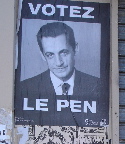
In my previous entry I had forgotten to paste in a link, which would have given more sense to the claim that choosing between Le Pen and Sarkozy isn’t much of a choice to some radical commentators. This omission gives me the possibility to return for a second to the poster put up around Paris just before Christmas, which didn’t make the ruling party very happy: Votez Le Pen.

The first time I saw the poster on the wall, someone – in typical French public, democratic tradition – had embellished Sarkozy’s face with the facial characteristics of Dracula. (The streets of Paris are full of such popular voicing of opinion, on posters or as comments written on the wall or on other signs or posters). Quite understandably, the poster has created a number of discussions on the Internet, as well (see further down).

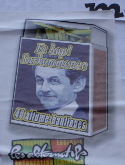
Picture to the right: A sticker on the wall with a drawing of a matchbox with Sarkozy’s face and the text: 40 banlieue matches.

A non-exhaustive list of sites on the Internet discussing the controversy:
– An article on the matter in The Guardian (in English!)

– Articles (in French) from the political group (Act up, for HIV positives, who made the poster in order to protest against the immigration policy of Sarkozy: The press release “A poster to denounce a racist discourse and a fatal policy” and an article on all the controversy it stirred.

– Le Monde’s article (in French) “Act up withdraws the poster from their site

– An interview with Sakrozy in Liberation (in French) “I know better than Thuram what’s happening in the banlieues” and the reply from Act Up the day after: “Sarkozy caricatures himself“.

– A number of discussions in Internet chat rooms and blogs: France TV 5, samizdat.net, les indigenes de la republique,
Indymedia, rebellyon.info, grioo.com, and so on…

In my previous entry I had forgotten to paste in a link, which would have given more sense to the claim that choosing between Le Pen and Sarkozy isn’t much of a choice to some radical commentators. This omission gives…

Read more

“It’s better to vote than to burn cars”

Two days ago President Jacques Chirac proclaimed the end of the state of emergency which has been in place in France for almost two months. At the same press conference, the president also announced that the law paragraph obliging teachers to “teach the positive effects of colonialism on the former French overseas territories” should be rewritten. The paragraph was implemented in February last year and has made it to the headlines once in a while since then. However, it wasn’t until after the November revolts that mainstream politicians, really started giving much attention to the controversial issue.
[teaserbreak]
“The paragraph divides the French,” Chirac said, “that’s why it should be rewritten.” Would it have been suggested rewritten if it wasn’t for the revolts? And would the notion of a divided French people have been so prominent if it wasn’t for the burning cars making headlines around the world and threatening the tourist industry? It’s no doubt the social fracture, which increasingly has been interpreted as a colonial fracture, has climbed even higher on the public agenda the last months. From the 27th of October and three weeks onwards, France experienced the biggest social revolt since the Second World War, rivalled only by May 1968. On short term, the revolt has had an effect on the president’s speeches, but the interesting research question now is what its long-term legacies will be.

Just before Christmas one of the big news headlines was “it’s better to vote than to burn cars”. A collective of celebrities originating from the banlieues – amongst them a footballer (Lilian Thuram), a rapper (Joey Starr, NTM), a director (Mathieu Kassovitz (link in English!)) and an actor (Jamel Debbouze) – organised a media happening in Clichy-sous-Bois (where the deaths of two boys sparked off the riots), in order to make the young banlieuesards register for an election card. (To have the right to vote, the French born before a certain reform need an election card, which they get by signing up at the town hall).

The next presidential election doesn’t take place before spring 2007, but with the previous one still fresh in memory it’s better to be well prepared. In the infamous 2002 presidential election, 37% of the 18-24 years old didn’t vote in the first round – the round that eliminated the socialist candidate (Lionel Jospin) and gave the French a choice between a candidate from the Right (Jacques Chirac) and the Extreme Right (Jean-Marie Le Pen). Or, between a crook and a fascist, as many put it. (If you google “crook” and “fascist” in French – hence escroc and facho – you get hundreds of sites from around election time, appealing for people to vote for the “crook, not the fascist!”). Many have already started to dread a possible repetition of that shameful affair. But this time, the stakes can be even higher; the choice might be between Sarkozy and Le Pen. (Which according to some radical commentators isn’t much of a choice.)

Back to Clichy-sous-Bois before Christmas: “If we don’t take care of politics, politics will take care of us,” the celebrity collective stated. The youngsters seem well aware of being taken care of by the authorities, but do they believe in the power of the voting ballot? According to newspaper reportages they didn’t welcome the stars very heartily: – To vote for whom? Who represents us? Why weren’t you here earlier, during the riots? One even accused the actor Jamel Debbouze of being “un Arabe de service” (which I think must be an equivalent of Malcolm X’s notion of house negro, the slave who protects the master and his suppressive system even more eagerly than the master does himself. Perhaps coincidentally, it was Debbouze who played the slightly retarded greengrocer assistant in the highly successful The Fabulous Amelie of Montmartre, a character which in fact was the only non-white in a film accused of white-washing France).

Whether it’s thanks to the stars, or just to the riots themselves, the last month it has been more people than usual signing up for election cards. If nothing else at least they can vote against “Sarko and Le Pen”, as quite a few has put it on their way to the townhall. But we’ll have to wait and see if it’s really better to vote than to burn cars.

Two days ago President Jacques Chirac proclaimed the end of the state of emergency which has been in place in France for almost two months. At the same press conference, the president also announced that the law paragraph obliging teachers…

Read more