search expand

Bienvenu à mon blog de Charonne

It’s been more than two weeks now, since I’ve moved house. This move has made me realise that I in fact lived in a village before, and now I seem to have moved downtown. In downtown Charonne, I’m not recognised by the baker the second time I enter his shop, and the same faces don’t surround me on the street every day. In our little neighbourhood in Ménilmontant I saw familiar faces all the time, and even a shy person like me got to know the local merchants in not much time. As I think about how quickly I got a sense of the village-like place I moved from, I realise that I’m not able to give a good description of my new quarter yet, despite having lived here for a while.
[teaserbreak]
Part of the impersonal atmosphere of Charonne – a quartier populair a little northeast of Place de la Bastille – comes down to it being wintertime. There are no longer chairs and tables outside the cafés and bistros, and people don’t hang around outside but hurry home and inside on their way from the metro or bus. And crossing a local square, I only come across some youths asking for cigarette papers or the odd loner, doing nothing on a bench. The parents and children, staying for hours after school time in the warm days of autumn are long gone. December is a hard month discovering an area…

My impression so far is that the middleclass bohemian bourgeoisie (‘bobo’) creeping down, or up, the hill in Ménilmontant, have not reached here yet. There is a small gallery of modern, figurative paintings and a little shop of ceramics in my street – in addition to an appealing little shop for making your own hanging garden – but I suppose a gallery or two doesn’t qualify a Parisian area as gentrified. The working classes seem for the most part still left by themselves. (There is however a couple of all right restaurants around including a sushi place, but still I’d claim that it doesn’t count as gentrification). My impression is strengthened when considering the food on offer in the local supermarkets; my amateur guess is that the number of ecological products at sale might be an indicator of the social class of the area. The only ecological groceries you can get here, are staple foods and other long lasting products (usually quite dusty). There are no ecologically grown bananas or other fruits or vegetables… I haven’t checked for organic meat, I’ll have a look next time. (When talking about supermarkets; one thing I like about French supermarkets is the loooong time many people spend in front of the cheese counter). Similarly, only one supermarket around here sells expensive and small (thus easily stealable?) beauty products like facial creams and razor stuff. In that particular store they are also more persistent in asking their customers to leave their bags in custody when entering the shop. Is there a connection? I’m only guessing.

I learnt by coincidence – on a screening of a film from a local elementary school on the 100 years anniversary for the law on laïcité (the separation of church and state) – that the local schools are in fact classified as educational priority. Being a ZEPzone éducation prioritaire – means there exist a number of socio-economical disadvantages here. (I’ll for sure return to the question of ZEP, as it has played an important role in the debates both before and after the November riots/revolts. ZEP is the French version of affirmative action; habitants of particular areas, instead of particular (ethnic) categories, are considered as disadvantaged and thus entitled to special attention).

When thinking about it, I think perhaps my description has been a bit one-sided. If I’ve given the impression that the area is in any way shabby, I should correct myself. I find the area ordinary and a bit impersonal, but far from shabby. The streets are incessantly being washed by small, green cars here, as in the rest of the city. The squares, the flowerbeds and the trees lining the boulevard are being well kept. And the buildings, greyish by pollution, are well maintained.
Apart from a couscous take-away, a yet uncounted number of tiny bars where (mostly) men seem to hang around the counter at every hour of the day, a surprisingly tidy food-market twice a week, an abundance of pharmacies (at least as many as there are newsagents but fewer than there are bakeries and patisseries), my local area also comprises an anarchist bookshop (Quilombo). Perhaps my very favourite thing of Paris life is walking down a street, an anonymous just normally picturesque Parisian street, and then you stumble upon an amazing graffiti, or a café so charming that you just have to enter – or an anarchist bookshop, just around the corner on your way to the supermarket.

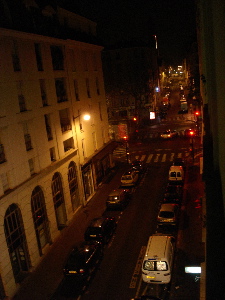
When I finished writing this post, I realised that I had not taken any photos of the area (perhaps another sign of how impersonal I find it), so I had to take one right now, out of my bedroom window. Thus, Charonne by night…

It’s been more than two weeks now, since I’ve moved house. This move has made me realise that I in fact lived in a village before, and now I seem to have moved downtown. In downtown Charonne, I’m not recognised…

Read more

Meetings, conferences, debates, demonstrations, concerts…

One month ago I had problems leaving the house in order not to lose out on some heated debate or in-depth reportage covering the riots on TV or radio. Now the debates have entered the public spaces in Paris, and on some days they’re so prolific that if I choose one, I lose out on others. For instance last Thursday there was a demonstration against l’état d’urgence sociale (the social state of emergency), supported by a range of political organisations, a few labour unions and at least one political party (Les Verts – The Greens). As such street demonstrations pop up every second day in this city, that opportunity was the first to be eliminated from my range of choice on this afternoon’s schedule. It was more difficult to choose between a seminar arranged by the French Association of Anthropologists on the actuality of anthropology and the crisis in the banlieues and a debate at Institute du Monde Arabe on “the children of immigrants and integration”. I made my decision on the basis of the number of names of participants originating outside Europe.
[teaserbreak]

From left: the rapper Hamé from the groupe La Rumeur, the sociologist Nacera Guénif-Souléamas (co-editor of Féministes et le garçon arabe, 2004), Dominique Vidal (editor of Le Monde Diplomatique), sociologist Saïd Bouamama member of the association Les Indigènes de la République (written, among other books, L’Affaire du foulard islamique: la production d’un racisme respectable, 2004) and the sociologist Abdellali Hajjat (written Immigration post-coloniale et mémoire, 2005). Visible in the background is the striking architecture of l’Institute du monde Arabe.

The score on names was 80% versus 0%, and (unfortunately, on behalf of our discipline) anthropology drew the shortest straw. But there were no need to regret my choice. The white 20% at IMA was Dominique Vidal, the editor of Le Monde Diplomatique, and his polite but blatantly hardcore political stance, kicking left as well as right, made him a great chair of the debate. According to him, the crisis should be understood as social and (post-)colonial, with the Interior Minister Sarkozy functioning as the trigger, with his “cleansing the housing estates with fire hoses” rhetoric. The other participants comprised four sociologists aka political activists of various forms, and one rapper. The all argued against the ethicising interpretation of the revolts; that Islam or polygamy is to blame, the youth are not integrated and so on. “It’s not a lack of integration,” Abdellali Hajjat said, “it’s rejection. And it’s the structure of French society that is reproducing these inequalities.”

With the exception of one or two elderly men, who heated the debate considerably by defending Sarkozy and criticising the revolting youth, the audience seemed mostly to agree with the panel. Just as I heard it amongst second generation youth in London, I hear here as well, over and over again; “if they hadn’t come to us, I wouldn’t have been here…” The colonial connection seems never to be far away in people’s own understanding of the situation, perhaps even less so here and now, than in London in 1999.

The colonial connection as well as the rejection of ethnicity as a factor in the revolt was equally present on the marathon happening of a meeting/concert and what not, that I attended yesterday. But I think this post is long enough, so this will have to do for this time.

One month ago I had problems leaving the house in order not to lose out on some heated debate or in-depth reportage covering the riots on TV or radio. Now the debates have entered the public spaces in Paris, and…

Read more

Riffraff of France

Sunday's message at Place de la Nation
Message at bus stop at Place de la Nation, Sunday 11th December

I should have provided a proper welcome to my blog from Charonne (as I’ve moved house) and to the new name (Cicilie amongst the Parisians), but I’ll leave that for later. We’ll jump right into the action with an in medias res report from this sunny winter Sunday. Today I went hunting for posters from Les Racailles de France (the Riffraff of France). This group, consisting mainly of girls in their twenties from the suburbs of Paris, has put up 300 “commemorative plaques” in key areas of the capital, saying things like: “A homage to hundreds of thousands of immigrants who came to construct and reconstruct a France which keeps them, their children and grandchildren outlawed from society. When will there be a law on the positive role of immigration?”
[teaserbreak]
They ask, of course, for a law asserting the positive sides of immigration since the parliament in February voted for a law on valorising in education the positive role of colonialism. Not surprisingly, this law has been a hot potato from the moment it was passed. After the November riots, the hot potato has gained in importance and is now setting the political agenda of the Republic. Last week, the Interior Minister Sarkozy had to cancel a trip to Martinique because Martiniquais – from the poet Aimé Césaire to members of Sarkozy’s own (right wing) party – obviously weren’t keen on welcoming him.

The last week also included the bicentenary of the battle of Austerlitz, won by Napoleon. The government avoided turning up on any official commemoration, and the tepid celebration in fact taking place was eclipsed by the demonstration. The emperor seems finally to have turned into a persona non grata – for reinstating slavery. Hence, the headline of the day turned out to be not the battle of Austerlitz, but whether Napoleon could be compared to Hitler or not.

So Les Racailles de France seize the moment to demand a rewriting of French history. Immigration is not a yo-yo, they say to the newspaper Le Monde, and points out that the population seen as a problem now, was needed as soldiers protecting France in the wars. This and other groups continue the fight with words instead of fire, and it seems they have come long way in just a few weeks. The commemoration the 11/11, the day of the Armistice (ending the First World War), the former colonial combatants were hardly mentioned in the French news – in stark contrast to the same commemoration in Britain. (There, the recognition came in the late 1990s). Less than a month later, the colonial past of this country is present to the point of being able to set the political agenda day after day.

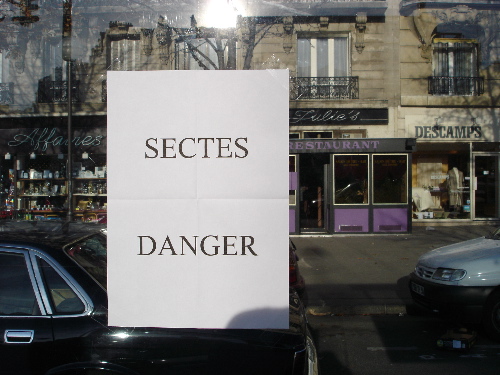
So, today I went down to Place de la Nation to see if I could find some of the posters put up by Les Racailles de France. I went around the enormous square-cum-roundabout two times. On my way I passed a slightly junky Christmas market, a chef opening oysters outdoors for a restaurant, half a dozen couples kissing, more than a dozen lapdogs (many of them dressed for the cold), a kid playing Gameboy as he was walking (as a Parisian kid version of the typical Parisian ‘walking while reading a book’) and many Sunday strollers and vegetable market shoppers, but I saw no posters from The Riffraff of France. Others had now put up sheets of paper in the bus shelters, in order to voice their opinion on present day politics. DANGER. SECTS, it said. And nothing more. Sects are very dangerous here in this country, I’ve learnt yesterday at a public meeting commemorating the centenary of la laïcité (the separation of state and church). Was the poster ironic or not? I don’t know. Anyway, the meeting, the dangers of sects and religion and the whole debate around la laïcité must wait for a now.

Sunday's message at Place de la Nation

Message at bus stop at Place de la Nation, Sunday 11th December

I should have provided a proper welcome to my blog from Charonne (as I’ve moved house) and to the new name (Cicilie amongst the Parisians), but I’ll leave that…

Read more

Now what?

Two weeks ago, at the time I finished my French lessons, I had planned to quietly sit down and rethink my research project. The goals of the project still seemed justified, but I was not sure about the approach; I felt I was about to suffer from a severe information overload.

[teaserbreak]

The evening 16 days ago, the 28th of October, I watch the news as usual. In addition to a reportage about an amateur theatre group for youth in a banlieue, two episodes catch my attention. The Interior Minister’s seems unreserved in his backing of the police version of events when two young boys were accidentally electrocuted in a transformer station the previous evening. I note down my surprise. No investigation is yet concluded, and both the two TV channels I watch take care to mention that two versions of the event still exist. (Since then, we’ve learnt that Sarkozy’s version was not the true one. The police had been physically pursuing the boys, whereas they had not been involved in any break-in but were running from an identity control.)

The second brief note I make from the news concerns the attacks on police and fire fighters in Clichy-sous-bois the night before. It calms down almost immediately in Clichy-sous-bois, but the apparently self-destructive rioting spreads to “sensitive areas” (“quartiers sensibles”) all over France. The unrest has been on the wane for several days now. But we are only starting to see the political repercussions. As I read on a chat forum on Beur FM (=French Arab radio): “In the presidential election in 2007, who will you vote for; Sarkozy or Le Pen?” And political populism and the Front National are only some of the possible political consequences I have in mind.

So, if I thought the research approach needed a rethink two weeks ago, the Clichy-sous-bois event has not made me change my mind. The research question is more justified than ever, in my opinion: what influences senses of belonging and community making in a cosmopolitan city like Paris? But how can I best study it? So far, I’ve considered, and rejected, three possible approaches: 1) Hanging around in a (multi ethnic) music or artist collective, preferably with political objectives. 2) A neighbourhood study in the cosmopolitan area Belleville. 3) Participating in two (multi ethnic) political groups working towards recognition of the colonial era in France. Yesterday, when I asked to local (Maghrebi) baker if he would help me with my research, I messed it up a bit and confused my three approaches. It was easier when I just asked the greengrocer what he thought about the present situation… Anyway, now it seems to me that I just have to live with the information overload some more time, to see what will happen.
To be continued…
[teaserbreak]

Two weeks ago, at the time I finished my French lessons, I had planned to quietly sit down and rethink my research project. The goals of the project still seemed justified, but I was not sure about the approach; I…

Read more

Information overload 2 / internet fieldwork

A day at work…: I was about to get outside (its freezing, but sunny). Unfortunately, it was time for 12 o’clock news before I managed to escape.

[teaserbreak]

Oh, here we go again. La ligue de droits de l’homme and MRAP (Mouvement contre le Racisme et pour l’Amitié entre les Peuples) are interviewed concerning the expulsion of troublesome foreigners with or without their residence permit in order. Ok, that’s certainly very interesting, but it’s not news to me.

But then the journalist mentions that a gathering is to take place at Champs de Mars tomorrow. That I’ve not heard before. I’ve got to search the Internet. Nothing on the sites of MRAP or Le ligue de droits de l’homme, but on Paris.indymedia I find something interesting. It starts right on: “Putain, are you all in front of the TV-set or what?” Then he(?) goes on to recount to the indymedia radicals his voyages in cyberspace of a very different France, skyblog. (See for instance cites2france.skyblog.com . Skyblog has, for some reason still unknown to me, become the site for the banlieue bloggers.) Obviously, this guy(?) is mad at his commerades at indymedia: « banlieues, villes et campagnes tous ensemble » et personne n’y répond… But now we’ve got the chance, he says, and reveals the news he found on skyblog about the upcoming gathering. For this indymedia-blogger, the event is already inscribed in the revolutionary French history (he refers to the fight for one week paid holiday in 1936, 1968 and of course the commune…). Ok, that was sociologically interesting, but I still don’t know much about what will take place tomorrow. I try google: “rassemblement tour eiffel”.

And what do I find? Great, I’m doing a whole sociological la distinction tour d’internet here. Le Weblog du 7ème Arrondissement (a posh district indeed…) refers to another blog, the Parisist. The Parisist asks if Paris will burn on Friday, since les banlieues are planning to pay us a visit, – with reference of course to messages circulating on skyblog. On the 7th Arrondissement blog one can read this: “There are good reasons for organizing such an event for all the honest citizens who have had enough of all this violence. On the other hand, certain others seems to want to use this gathering in order to throw gunpowder on the fire.” And it cites: ON VA CRAME PANAME COUSIN ON VA VENIR ENCULER SARKO CHEZ LUI (we’ll burn Paris (cousin= cousin or police informer), we’ll go fuck Sarko at his place). The Parisist one the other hand, seems a little less sensational as it drily comments the same citation; “evidently, we prefer the second suggestion.”

It’s already two o’clock. I still don’t really know what will happen tomorrow. So what should I do now; continue searching or finally manage to get out of here?

A day at work…: I was about to get outside (its freezing, but sunny). Unfortunately, it was time for 12 o’clock news before I managed to escape.

[teaserbreak]

Oh, here we go again. La ligue de droits de l’homme and MRAP (Mouvement…

Read more