search expand

TV fieldwork

Apart from a visit to the cemetery with about 50% of the French population on All Saints’ Day (La fête de la Toussaint) and a visit to the Institut du monde arabe for the exhibition L’âge d’or des sciences arabes, fieldwork the last week has mostly consisted of watching TV and reading newspapers. If it weren’t for the media, I would have no idea that the Paris region is making it to the headlines many places in the world. The media, on the other hand, is – not surprisingly – full of it.

[teaserbreak]

I find the unrest spreading from the sad Clichy-sous-bois incident a complex issue to write about. Its contested meanings; its strong element of class – and half-heartedly glossed over element of what the Anglo-Saxons would call “race” –; the political rivalry; l’insécurité versus la précarité (read: right- versus left-wing rhetoric); the stereotypical scenario of police harassment and no-future young men in the Parisian banlieues (which has become such an icon of French integration problems that, for instance, quite a few people here as well as in Norway can’t get their heads around the fact that I’m doing fieldwork in Paris proper, and not some banlieue); and finally, the evocation of colonial times with the curfew. It’s all at the heart of what I’m here to find out about. So, how to start untangling it?

The media coverage was the first thing that surprised me. From when I came here I have to admit that I found French national TV rather crappy. Every possible break, even between regional and national news is filled with commercials. But the journalistic treatment of the riots has been a far cry from commercially exploitative speculation, as I see it. There have been interviews with every possible actor in the drama. One of the first I remember was the unlucky Lille-supporter finding his car reduced to smoking ashes after seeing his team beat Manchester United in a Champion’s League match in Stade de France (the grand stadium is situated next to the sad, sad, sad towerblocks in Seine Saint Denise, both can be seen from the train to Charles de Gaulle airport). His astonishing calmness caught my attention; it’s been a good day which ended badly, but luckily no one got hurt… Then the hooded rioters themselves, never very articulate, posing for the camera; nique “Sarko”… it’s for the two kids who died… la colère… les flics… – Ok, those scenes are perhaps a bit over the top. But then there are all the reportages with the grand frères and local mediators putting the not very likable kids into a bigger sociological picture; they have no other means to express their anger at the police stopping and searching them all the time, at Sarkozy who wants to “clean the banlieues with a high-pressure cleaner…” (“nettoyer au Kärcher”, an expression being repeated almost as many times as voyous and racailles the last weeks… Even the footballer and world champion Liliam Thuram appeared on TV last night and expressed his anger at this way of talking about les banlieues and its inhabitants (himself an old banlieusard)). Not to forget the endless number of young and old seemingly representative banlieusards expressing their frustration over their burnt down workplaces, shops, kindergartens, gyms and cars. (For the record; their views are varied, but of course they soon started to get tired of it all. A survey today showed that 73% of the French population are in favour of the curfew if it can return order. 89% are in favour of re-establishing local organisations helping with employment and housing issues – which make part of the long-term propositions from the Villepin government).

In addition, French media is full of long, thorough and profound analyses and discussions, from every possible angle. The discussions range from sociology and economics, to philosophy (of course, these people are French) and architecture. – Can it really be that history is missing…? Historic memories are at least evoked now with the curfew: The law dates back to l’un du pire moment de notre vie publique – one of the worst moments in French public life, the Algerian war. (That’s what I heard from the clock radio when it’s work related relevance forced me to wake up this morning). So, yes, historic memories are not far away, but I think the only place I’ve heard an historic explanation is at the greengrocer’s.

The journalists’ carefulness to expose positive sides, like solidarity and creative initiatives, in the banlieues has also surprised me (though I doubt that the grocer would share my view here). For instance, the reportage of the tragic death of an elderly man a few days ago showed how the neighbours (“incidentally” of all colours and ages) came to pay their respect to the widow (white). A teenage boy of Maghrebi origin kissed her on the cheeks, an old African woman in traditional dress put her arms around her.

So, I think I’ve been a little bit surprised by the breadth, depth and serenity of the coverage. But what has surprised me the most is the patience and understanding expressed by analysts, journalists and many of the people in the streets. The economic crisis and the social problems in its wake are indeed acknowledged here. In addition, just after the riots had started I got an inkling impression that some commentators tacitly approved of the clear signs of Frenchness shown by the rioters. It’s no secret that many here seem to be proud of the French eagerness to demonstrate and revolt. Every week there are perturbations to the Parisian bus routes because of a manif for some political, economic or social cause. And of course there is always une grève going on. So, I wouldn’t be surprised if some middle-aged people – soixante-huitards to be precise – are a bit relieved and think that finally is this generation issue de l’immigration acting real French. Anyway, what is a generation of youth without their own riot? (As a friend of mine jokingly wrote me, when she heard about the contagious effects in Berlin; it wouldn’t surprise her if the ones torching the cars were in fact nostalgic middle-aged people).

Apart from a visit to the cemetery with about 50% of the French population on All Saints’ Day (La fête de la Toussaint) and a visit to the Institut du monde arabe for the exhibition L’âge d’or des sciences arabes,…
Read more

Information overload 1

Between “civil war” and “end of republicanism” – and the state of emergency paragraph from the war in Algeria…

“Civil war” is of course Le Pen polemic. But besides that, Front National has been taking it very easy lately; perhaps they don’t really have to say much at all in the present situation. So to my long time favourite, the well-oriented and critical The Guardian: Why do they ask if this is the end of the republican model of integration? From quite a few French perspectives it seems paradoxical that these riots, class riots almost, should mean the end of striving towards equality and solidarity. Why not interpret it as the end of hyper liberalism, or indeed capitalism, instead? And last; the law paragraph now in use, dates from the war in Algeria, a fact mentioned over and over again, in newspapers, TV and radio. What does that mean? Not to forget; what does it mean to grandsons of the Algerians experiencing the state of emergency in 1955?

Between “civil war” and “end of republicanism” - and the state of emergency paragraph from the war in Algeria...

“Civil war” is of course Le Pen polemic. But besides that, Front National has been taking it very easy lately; perhaps they…

Read more

Real and fake youth, in Clichy-sous-bois

There are also real youth, whom we must help… Interior Minister Sarkozy has not really been up to it when making public statements lately, to say it the least.

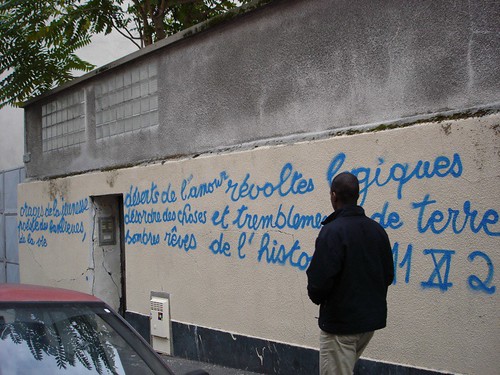
Poèsie de banlieue
[teaserbreak]

A short time after two young boys got electrocuted when hiding from the police in a transformer station, M Sarkozy plainly and affirmatively stated that the police had arrived after an attempted break-in, but no, they had not been chasing the boys. A few days later there is still no sign of any break-in, and no one wants to say for certain why three boys (one survived, but got badly injured) would climb a three-meter high wall with barbed wire and hide in such a lethal place if there were no need for it… And Sarkozy still rambles on about zero tolerance to urban violence, about cleaning up the hoodlums (“voyous”) and riffraff (“racailles”) and eradicating the traffickers… One of the few clear facts in this story is that the three victims had no previous police record. The boys’ families have refused to meet the interior minister because of his clear signs of incompetence. Sarkozy’s version of life in the banlieues and the local grasp of things in Clichy-sous-bois seem miles apart. I heard a kid on the radio, sounding a bit like a rapper, saying about the youth in Clichy-sous-bois: on veut de logements, on veut de bulots, on veut de vêtements, on veut d’intégrer… One out of two youths in the area is unemployed, and the general precarité in French quartiers sensibles is well-known. The newspaper Liberation (left-wing) claims that Sarkozy is trying to capitalise politically on the situation, situating himself to the right indeed. Such an analysis does not seem to be foreign to many issues concerning social integration in this country.

There are also real youth, whom we must help… Interior Minister Sarkozy has not really been up to it when making public statements lately, to say it the least.

Poèsie de banlieue
[teaserbreak]

A short time after two young boys got electrocuted when…

Read more

Une manif… encore

Today I stumbled upon a demonstration again. I’d been walking around Bas Belleville looking for the spot where the last barricade of the Commune de Paris had been finally defeated.

[teaserbreak]

The defeat of the commune is commemorated every year right around the corner from where I live, by the wall of Père Lachaise. I’ve seen an old poster for this year’s commemoration: Every participant should bring a red flower to leave on the graves of the communards. And then they sing a song called le temps de cerises, apparently an ode to a love affair which is like cherry blossoms. Cherry blossoms are of course incredible beautiful, but oh, so ephemeral…

I didn’t find the exact place of the last barricade. But around where it should have been there is now a kind of neighbourhood association- La Bellevilleuse -, open a couple of hours every first Saturday of the month, and devoted to fighting the demolition of the last old quarters of Belleville. (I should check it out between 14h and 17h the first Saturday in November). The Tunisian Jews are far more present and active in that neighbourhood than is this association. I’ll probably write about that later as well. All of a sudden, it’s all caucher and patisserie tunisienne. And just around the corner it was durian, plastic trash and East Asian fashion. (I’ll probably end up writing a thesis just on how it is to cross such a corner: what is this change? Why and how does it all of a sudden become totally different?)

Anyway, the theme was demonstrations: So, after admiring the mural paintings up in rue Belleville, scenting the durians down in rue Belleville and so on, I suddenly bumped into this demonstration down in Boulevard de Belleville. I think it was about the same place Les indigenes de la République had their stand a fortnight ago. This Saturday, it was a Collectif des Sans-Papiers. And it was a tiny, little demonstration for the sans papiers, and against the increasing police raids they have been facing the last months. Sans papiers (=without [identity] papers) is the French name for undocumented immigrants. Rights, or rather lack of rights, for the sans papiers have been an issue in French politics for a long time. After the deadly fire in a hostel earlier this year, the issue of the sans papiers have been liked to the issue of the right to housing, droit au logements. (And not to forget what’s happening in Mellila and Ceuta…). Three weeks ago, I stumbled upon a much larger demonstration, up in the XIX arrondissement, exactly for this droit au logements. Since I run into these happenings by chance all the time, I suppose there must be many of them.

Since I had nothing better to do, I joined the little manif(estation). When we came down to Hotel de Ville, the police, with their blue busses, batons, gas masks and even guns, started to congregate. Well, the police normally carry guns here, but such riot gear never stops to surprise me. Police partout, justice nulle part, as people chanted, in good anarchist spirit. I had just seen a terrible film a few days ago – Nuit Noire, 17th October 1961 – when then Parisian police massacred a pacifist demonstration for a free Algeria. Between 50 and 200 people were killed and their corpses thrown into the Seine. It’s just 44 years ago. Honte, honte à ce pouvoir, qui fait la guerre à sans papiers… (Shame on the power that wages war against the immigrants). I would like to make some poetic link here, from the sans papiers to the Commune, today’s and yesterdays struggles and so one, but I guess it goes without saying…

Today I stumbled upon a demonstration again. I’d been walking around Bas Belleville looking for the spot where the last barricade of the Commune de Paris had been finally defeated.

[teaserbreak]

The defeat of the commune is commemorated every year right…

Read more

Le square

When I think about it, one of my favourite things to do in Paris is to hang out in squares (public gardens) after school time.

[teaserbreak]

What’s so nice about that? It seems like all children go to their local public garden with their parents around four or five o’clock in the afternoon. I’ve seen this neighbourhood phenomenon many places around Paris. The children run around and play with each other, while their parents chat, read or just watch the children play. It’s such a nice and neighbourhood-ly thing to do. After an hour or two, depending on the weather, they all leave and pick up a baguette in their local bakery on their way home.

Today it’s been wonderful weather (at least 20°). After I had a coffee at a bistrot at Place de Ménilmontant (partly in order to check out if my suggestion yesterday that the ethnic and gender mix is even here (I was correct, at least it was even around 16h30 on a Monday…)), I walked up the hill to my local square and had a Quiche thon et tomate on a shady bench, right in time to be reminded of how pleasant life in Paris can be for its inhabitants. This public garden worked exactly as the ones I knew well from my stay in Le Marais (4eme Arr.): In Marais there were two perfectly gardened and groomed squares next to each other; one small reserved (by some tacit consent, obviously) for readers, people just wanting to sit quietly by themselves for a while and those speaking in a low voice, and one larger where noisy children ran freely around watched by their parents. (The level of noise children in Paris make when they play seems to be markedly higher than the equivalent level in Norway, – according to someone who is more expert than I on such issues. An nonauthoritative guess would be that there is more discipline in schools here, thus more need to rebel elsewhere…??). The local square here is so lager that it can incorporate both usages, but also here the reading area seem to be kept neatly separated from the play zone (this must be confirmed by more visits to the park…).

I’m not going to write about ethnic mix today, just suggesting that it does not seem to be as even as at Place de Ménilmontant, but far more even than Porte de Montreuil, St. Sulpice, Canal St. Martin or heavily gentrified Marais (an area I’ll return to later). Class mix is a complicated issue I haven’t even started to probe yet… Concerning gender; women were in majority accompanying children, but there were quite a few fathers as well (of all ethnic backgrounds, for those who are interested in such details…).

When I think about it, one of my favourite things to do in Paris is to hang out in squares (public gardens) after school time.

[teaserbreak]

What’s so nice about that? It seems like all children go to their local public garden…

Read more