search expand

Noctambulism (viewed from a balcony on 7th floor)

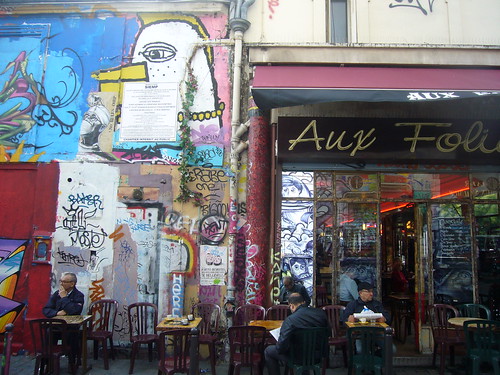
There’s a time for everything, I’ve thought many times the last two years: One does one thing for a while, and then things change again. This time, I hear the night birds down in the street slowly making their way home after a night out in Paris, while I sit at the balcony listening to my child talk about the – for him – new wonders of twilight: “Look! Stal!”, “Play in the darkt!” and “Go down there!” – probably not because he wants to join the people hanging around down there, but because the street sweepers have turned on the water to flow through the gutter before they comes with their green broom at places where the little green sweeper and high pressure water cars can’t reach. He likes this early morning procedure (apparently earlier in weekends than in the week, as it usually happens a little later, at the when we go to the bakery to get breakfast. Maybe it’s because it’s more debris after Friday and Saturday night.) And I like it too, and I think about all the work that has to be done continuously to maintain good living conditions in an urban environment where the population density is as high as it is here (Around 40 000 per km2).
[teaserbreak]
6:30 in the morning is a time I’ve seen very rarely in Paris, only when I’ve been out the whole night myself. I don’t think there’s anywhere I’ve spent the whole night outdoors as many times as in Paris, – perhaps only beaten by the town where I spent my teens, far up north with its light summer nights. Maybe because noctambulism is quite common here – they’ve even got a word for it. The hot July I spent in Paris when I was 17, we hung around at Beaubourg, outside Centre Pompidou – under a large art installation of a dangling planet earth – until we could get on the first metro together with the friends we’d made and eat steaming fresh croissants from an early bakery and warm ourselves at their place. During the fieldwork, there were some nights of wandering as well, of just going from place to place and hanging around and meeting people.

But now I see the other side of it. Once again, I’m living in an extremely noisy street, and this time it’s the night life. (But it doesn’t bother me, because I’m finally in a position where I both need and can afford a certain comfort, so contrary to in Faubourg du Temple the windows here can be properly closed.) In the beginning of the week it ends reasonably early, but already on Wednesday night it intensifies, and Thursday is a small weekend, whereas at Friday and Saturday it culminates when most bars close about 3-4. Then the chatting of the noctambules go on long after the morning has started here at my place and the street sweepers have come with their brooms.

There’s a time for everything, I’ve thought many times the last two years: One does one thing for a while, and then things change again. This time, I hear the night birds down in the street slowly making their way…
Read more

What is it with Paris?

“I can see right away if people are from Paris or from the suburbs,” said a playground & park warden to me. “It’s a different mentality, and they behave and move differently. People from Paris are proud of their city.”
[teaserbreak]
The central interrogation of my thesis draws in several directions: It’s the slam poetry scene, of course, and particularly how such an open and cosmopolitan community is created. Then there is French society as seen through the slam phenomenon, and particularly the processes that makes society more open and cosmopolitan. I think of the binding notion between the two levels of analysis as that of re-appropriation (réappropration), of a postcolonial taking back of both history and space. North-eastern Paris with its long and distinct history of immigration and resistance and where slam first started and still flourish, is an intermediate analytical level, between the localised slam and the ideological or abstract level of France, the republic and all that. But I realise that that’s not all. Perhaps I’ve focused too narrowly on the interesting fact that slam is so concentrated in particular areas of the city, and forgotten that the whole of the city has a role to play in the phenomenon I’m looking at.

Paris has its own soul or spirit. It’s definitely Belleville and the popular eastern parts that keep on seducing me every time I set my foot here, but the city – its history, its density, its function as crossroads, its architecture and beauty… – must play an important role in creating the realities and atmospheres of these districts. Although I haven’t been totally blind to the attraction of Paris before, I haven’t been thinking about the city in that way. And that is even despite how the locals talk. I’ve heard (in my opinion very unlikely) people praise the romantic charms of watching the sun rise from (what I would think of as touristy) Pont des Arts. And people from the (deprived) suburbs talk about when they started going into Paris, and about how many people there never think about that opportunity. So, it is something particular about Paris also for the locals, not only for the tens of millions of tourists that come here every year. Of course.

“I can see right away if people are from Paris or from the suburbs,” said a playground & park warden to me. “It’s a different mentality, and they behave and move differently. People from Paris are proud of their city.”…

Read more

La concierge, Parisian overture part 2

This terrible and expensive mess I created during a tenth of a second’s inattentiveness and a draught from the balcony doors would never have happened if it weren’t for the French holidays. But now the holidays are over and the house has got back its gardienne (a warden, an occupation formerly known as a concierge before it became a derogatory), and then everything falls into place. She probably knows most of what goes on in the apartment block and so she knows when someone needs a plumber, electrician, carpenter or locksmith, and he can recommend them one. So she’s got a whole estate backing up her negotiating power with the local providers of practical jobs, and negotiate she can! I’ve never lived in a building with a concierge before so I’ve never had the chance to see how they excel in their work. And by golly, that was something! Here, I get to my point. Or, I’m not really sure yet what this has got to do with my fieldwork and research, but I have a feeling that to see a concierge work means to see an essential element in how this society works.

The way she negotiated over the phone for a better price and super fast accomplishment with a locksmith she knew, at the same time as she answered all the inhabitants who greeted her en passant for work after her holidays, and intermittently sort of put in place the Jeunet drunkard (who only had tried to help us, but who shrunk a little anyway as he knows he stinks of alcohol probably), called up carpenters in her own flat and gently told them off, commanded Leo and the bird dog not to get to close and so on, all in a firm but sort of generous way. Her charisma was that of a school teacher whom you just know you must behave your very best with, and if you do, things will go your way. I wouldn’t be surprised if Bourdieu have written extensively on la concierge in the French version of The Distinction, because her position in the French class hierarchy must be quite peculiar. I’ve heard a very nice documentary series on these kind of wardens on France Culture a while ago, but now I’ve seen one in action and I definitely want one for my block back in Oslo. (But of course we’ll never get a concierge, we’ve only got this shitty neoliberal caretaker service business providers who call themselves things like economical solutions and who might change a bulb after a week but never ever greet you and make sure that everything is all right).

This terrible and expensive mess I created during a tenth of a second’s inattentiveness and a draught from the balcony doors would never have happened if it weren’t for the French holidays. But now the holidays are over and the…

Read more

Parisian overture, or getting a locksmith in the holiday season


Back in Belleville, – if only for a short visit

Finding a place to stay in Paris is one of the worst things I know (except from at a hotel, which is easy.) I’ve lived at six different places in the city, and almost every time some kind of trouble has been involved. (The only exception had a quite boring neighbourhood which was almost eventless in terms of fieldwork relevance.) This time, everything went unbelievably smooth. Even arriving with a small child was just enjoyable. Until I made a horrible mistake after ten minutes when I closed the high security fucking reinforced door when we were just popping across the street to get something for Leo’s supper. With a draught of wind, the door was closed with a spare key in the key hole on the inside. The next few hours involved a dozen of kind and welcoming neighbours, the wonderfully helpful cleaning lady and her wonderfully caricatural companion taken right out of a film by Jean-Pierre Jeunet (or maybe comics by Tardi), three conmen and three policemen.
[teaserbreak]
It all happened late in the afternoon a Saturday in the end of the French public holiday month. At such times, locksmiths can charge an exorbitant amount of money for opening a door. But not more than 1800€ which these conmen tried to get out of the newly arrived foreigners. Then the caricatural companion phoned the police, and they ran off. Luckily after having let us in, with our tired and impatient little baby, – by demolishing the high security lock completely, but leaving a hole in our door which could not be repaired until the weekend high rate period was over and the honest locksmiths were back from holidays. Then one of the conmen came back (for the “bill” with phone number and everything they had left in the hurry) and shouted outside our damaged but bolted door, and I found it best to call the cleaning lady (for the tenth time), and she sent the police.

Tomorrow, Monday, we’ll hopefully get a new lock and be able to leave the fall all three together.

This time it was my own fault and bad luck, but It seems like I continue to get into trouble and lose money over Parisian flats. I dare not think of what might happen if I ever get the chance of setting in motion my dream of getting my own place to stay in this labyrinth of industrious scoundrels and laborious jurisdiction.

Back in Belleville, - if only for a short visit

Finding a place to stay in Paris is one of the worst things I know (except from at a hotel, which is easy.) I’ve lived at six different places in the…

Read more

Can a conference be a family occasion?


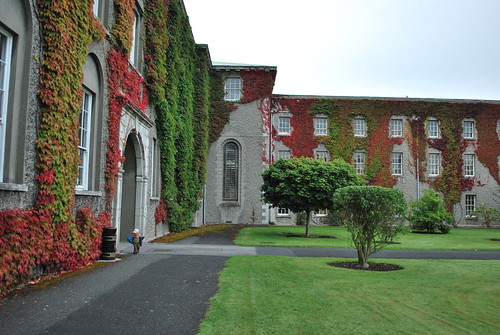
Early morning, Maynooth Campus

Taking one’s family along to a conference is obviously not that uncommon. “Where can I sign up for that anthropologists’ wife association?” my partner wondered, as he saw yet another man pushing a stroller along on the campus here in Maynooth. This month I’ve tried both, conference – or festival, as I often missay it – with and conference without husband and child. With is definitely not much of a festival, but it’s got other charms.
[teaserbreak]
As long as my son isn’t busy with his trucks and tractors in kindergarten, I tend to choose his company. And I’ve to admit that a workshop or plenary must look more than moderately interesting to beat an opportunity to go rabbit spotting in the Gothic garden where we live or clap for street musicians (who play the theme from the Godfather on saxophone and accordion in Balkan fashion) at Grafton street with him.

I’ve managed sort of a mix, but the selective and quick dip into the flood of academic activities a joint family & work solution offers, has deprived me of what I like most about conferences. This happens also to be the reason behind my frequent Freudian slip of calling it festivals. I experienced some of the same phenomenon during the last championship in football: The more you see the more fun it gets. The more anthropology (or other academic genres) I engage in during a 3-4 days period, the more engaging it gets. Listening to debates and commenting on papers during the day, and discussing , chatting and mingling during the night, with too little sleep in-between high-wire the brain in a very creative and inspiring fashion. The first time I experienced it, weeklong camping on rock festivals was still fresh in my memory, and that experience was what an anthropology conference reminded me of. Music, hanging around, meeting new people and much too little sleep until one feels extrovert and elated by nature. Or, in the case of academic festivals; until one dreams of fieldwork and can’t go anywhere without a notebook to jot down the ceaseless spinning of the mind.

So, yes, it’s been nice – Leo abroad for the first time and some new ideas for my thesis (e.g. here) – but not the best of two worlds like I wrote about some posts ago, and not like the balance I seem to have found at work between a short, but hyper-efficient workday and the relaxed and focused time before and after. Probably conference with family is never going to be a festival, but just a plain conference and a nice family event. Next is family at fieldwork.

Early morning, Maynooth Campus

Taking one’s family along to a conference is obviously not that uncommon. “Where can I sign up for that anthropologists’ wife association?” my partner wondered, as he saw yet another man pushing a stroller along on the…

Read more