search expand

The multilingual playground

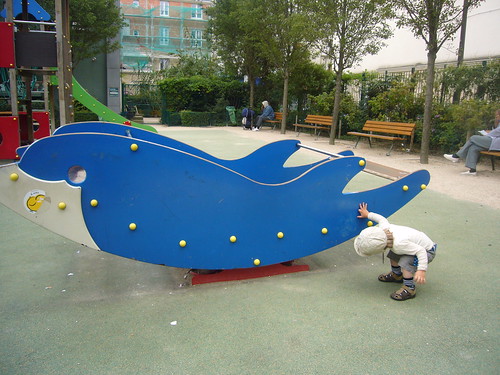
P1130473
(Early Sunday morning. Where are my playmates?)

It’s not the first time I write about how I enjoy hanging out in Parisian playgrounds (see posts from 2005 and 2007). They’re small to middle sized and every neighbourhood seem to have one. So, if you’re looking for a green and shady place to relax for a while and observe the local way of life, a playground can be recommended. Earlier, I haven’t paid much attention to the standard of the equipment, but this time I quickly noticed that all the parks in this part of the town have got new, exciting and very varied games for the different age sets. Perhaps this is part of an renovation of the public spaces in the Northeastern and poorer districts of Paris?
[teaserbreak]

Parc de Belleville in full blossom

Parc de Belleville for instance, has always had very well kept and diverse flower beds compared to comparable spots in Oslo’s poorer neighbourhoods, but now they’ve planted flowers and plans all over it – presumably in relation to the biodiversity plan of the city of Paris. (I see on the municipal net site that Père Lachaise is participating from the 20th Arrondissement, but they haven’t written anything about Parc de Belleville yet.) But I presume also as part of an over-all refurbishment of this part of the city. Anyway, back to the playgrounds.


Leo adds to the diversity and learns to drink running water from watching the older children at the playground

It happens that our local playground is the same one I wrote about in 2007, and I can only repeat what I wrote about diversity at that time. The first friend my son made in France, was a little French Japanese girl with a nice Japanese bug on wheels which she swapped for a while for Leo’s excavator. Another day, Leo talked to himself as he played with cars side by side some older children. One of the north African looking ones asked what language he spoke, and he was so amazed to hear that it was something called Norwegian that he had to boast of his knowledge in Chinese. Whereupon he said something and the Chinese looking boy present (who were even a little older, and not too nice towards the smaller ones) laughed acknowledgingly. Today, he played around two girls where one of them was bilingual in German. And so on. The playground bears witness both to the increasing gentrification and the high Chinese presence in the area, in addition to the North African Muslim as well as Jewish immigration. An many others.

P1130473

(Early Sunday morning. Where are my playmates?)

It’s not the first time I write about how I enjoy hanging out in Parisian playgrounds (see posts from 2005 and 2007). They’re small to middle sized and every neighbourhood seem to have…

Read more

The socio-political geography of East Paris: Parisian slam poetry – a space of resistance?

The most recent paper I failed to give (see previous post) was looking at the slam poetry phenomenon from the perspective of where it is situated, – socio-politically as well as geographically. I wanted to explore the connection between the slam scene’s geographical position in the North and East (and to some extent the 13th Arrondissement in the South) and the socio-political characteristics of these parts of the city. Here’s the abstract for the presentation:

Parisian slam poetry – a space of resistance?
Cicilie Fagerlid, PhD fellow at Cultural Complexity in the New Norway (strategic research programme at the University of Oslo)

In this paper, I will explore the relationship between the Parisian slam (performance) poetry scene and the socio-political landscape of North and East Paris, where the scene is situated. This part of the city is historically popular and left-wing with an important influence of bohemians and artists, and an equally long history of regional and international immigration.

I will argue that what is created during an evening of poetry performances, is to some extent a space of biopolitical resistance. Similar forms of resistance to standardisations of everyday life and/or governmental politics overflow the urban space of the northern and eastern Parisian neighbourhoods – in terms of streetart, political and artistic posters and stickers, low-cost and “alternative” film and music festivals, readings and talks in bookshops and cultural centers, a plethora of demonstrations filling the streets with colours and noise and a general, unruly everyday streetlife. I will situate the slam poetry within this landscape and discuss to what extent Antonio Negri’s notion of a (bio)space “in-between” power relations can be a helpful analytical perspective:

“Where is exodus at home? Where is the space for those who want to go into exodus from power and its domination?” For me, exodus sometimes requires force. And this is, paradoxically, an exodus that does not seek an “outside” of power, but which affirms the refusal of power, freedom in the face of power, in the hollow of its meshes (Negri, Petcou, Petrescu and Querrien 2008).

Negri,Toni, Constantin Petcou, Doina Petrescu and Anne Querrien 2008: “What makes a biopolitical space? A discussion with Toni Negri” in Eurozine at http://www.eurozine.com/articles/2008-01-21-negri-en.html (accessed 02.05.2008)

I’ve decided to continue working on the problematics of this paper during the summer, making it into the two first chapters of my thesis (see the end of this post for a preliminary outline). In the first chapter, I will describe and analyse some of the areas where the slam soirées take place (how I’m looking forward to wander the streets of Belleville and Ménilmontant in my imagination again!). In Chapter 2, I will ask how we can understand the particular space created during a slam – thus grasping the micro-dynamics of a soirée – and secondly, making a connection to chapter 1, I will look at what might be the relations between the slam phenomenon and the particular environment of the city where it is situated.

For some reason, the summer Oslo mood certainly inspires a delve back into my memory of Parisians streets and cafés…

The most recent paper I failed to give (see previous post) was looking at the slam poetry phenomenon from the perspective of where it is situated, – socio-politically as well as geographically. I wanted to explore the connection between the…

Read more

Steps to an analysis: from impressions to data

After I mapped out an outline two and a half months ago, my project has appeared amazingly ordered and under control. Perhaps it’s no wonder then, that I’ve postponed delving back into my fieldnotes for as long as I could, keeping myself busy with ordered and controllable intellectual activities like reading books for literature seminars and writing abstracts for upcoming workshops and conferences as well as even an article.
[teaserbreak]
But I know the kind of chaos that waits in my eight small notebooks and six larger ones, one personal diary, skype chats, e-mails, smses and scattered word documents, and what kind of threat it poses to the ordered outline. Is my fieldwork as I remember it to be? I try to start from the beginning, but quickly gets discouraged. The notes from my first months are chaotic. All kinds of impressions and observations are jumbled together, often without even reference to where and when:

“Nuit noire [“black night”, 17th Oct. 1961 when several hundred peaceful protesters against the war in Algeria were thrown into the Seine]: that was of course what that they were commemorating…” Who, where?!?

“Sarkozy – visit in the banlieue on the news a few days ago. He was thrown things at…” And my comment, without question mark, with capital letters: “what they show on tv”… If I’m not completely wrong and Sarkozy was thrown things at in the suburbs many times in October 2005, this must have been the time he uttered the (in)famous words about using a high-pressure water cleaner in the suburbs (nettoyer au kärcher) to get rid of the hoodlum (voyous). I think perhaps I was surprised that the interior minister got mixed up in such a violent confrontation and uncivilised behaviour and that they showed it on tv, but my comment is of little use.

On a more positive tone; my first fieldnotes indicate what issues I noticed and found worthwhile writing about. Sarkozy’s mediatised confrontation with people in the suburb happened just a few days before the death of the two teenagers that spurred the three weeks of riots in October-November 2005.

The month I was in Paris before the riots broke out, I was mostly concerned about various aspects of identity like gender, ethnic background and class in my neighbourhood in East Paris. Not so strange, since the reason why I had chosen to live in that particular area was it’s ethnic mix. However, I think the link between identity categories and public space was not something I had planned to look for. A blog post from two weeks after my arrival, signals how early that interest struck me. In my fieldnotes, in between page after page with descriptions of interaction between strangers, I found this comparisons between middle class and working class behaviour in the partly gentrified area:

On my way to the bus stop, I walk behind a very agile 6-7 years old girl in full rollerblades gear, and her mom, apparently, wearing a spring green skirt and shirt in another bright colour. A boy, just a little younger, turns to look when the girl swirls past. He tries to copy her superb turn- and break movement (with her heal) and says something to his mother (or grandmother) in French. She (rather plump, in tight-fitting trousers in polyester) replies brusquely in a Slavic language. She takes his hand, and stops, indicating that he should make space for me to pass.

I had just read Distinction by Bourdieu, and I was thinking about the bourgeoisie [in this case a typical bobo bourgeois bohemian] who teach their children to be self-assured about the space they take up in the world, while the children of the working class should be seen but not heard

For about a month, before the riots started, the weather was wonderful and I spent much time outdoors, just walking around, getting a feeling for this part of the city, for gender, class, ethnic background, age… the presence, mixing and variations of these variables. And then came the riots, and emphasised even more strongly the connection between space and categories of people.

After I mapped out an outline two and a half months ago, my project has appeared amazingly ordered and under control. Perhaps it’s no wonder then, that I’ve postponed delving back into my fieldnotes for as long as I could,…

Read more

Vivre ensemble after school time


The playground 10 days ago, before spring came for real

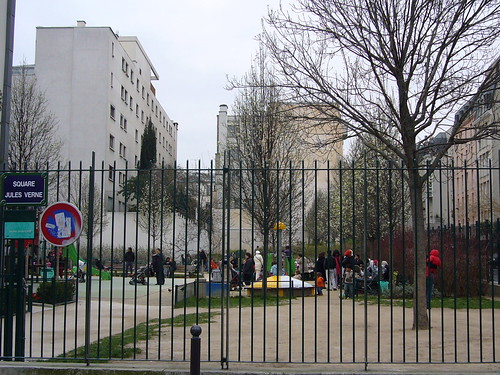
Le square français was the second post I wrote on this blog, but as I’ve spent a sunny spring afternoon on one again, I just have to share my enthusiasm once more.
[teaserbreak]
After school, parents and grandparents in France as well as Norway, pick up their small children. Instead of going straight home, as is normally the case where I come from, many here spend an hour or so at the local playground before they go home to make dinner, several hours after the north European equivalent.

This is a square in Belleville, not so far away from the school where the Chinese grandfather was brutally brought in by the police a couple of days ago, when he came to pick up his two grandchildren after school. As the headmaster was also put in police custody for seven hours for protesting against the arrest, the brutality of Sarkozy’s measures against the sans-papiers has provoked such a widespread political debate that it has reached the election campaign. (For better of for worse…).

This playground in Belleville is the extreme opposite of Sarkozy’s election campaign – which has gone as far as proposing a Ministry for National Identity and Integration… – because here sheer coexistence exists. (A frequent critique I hear of Sarkozy, is that he divides the population, the outright opposite of the sought after vivre ensemble, living together). There is not one skin colour or hair colour missing here in the square – but as we are in Belleville, I hear almost as much Arabic as French amongst the parents, and a Swedish looking father was just saying Yalla! to his two blonde daughters. Judging from parents and children’s dressing – as well as behaviour to some extent – there is a thorough social mix as well.

It pleases me to see this mixed local community, but the phenomenon of coming together like this, of children and parents, on an ordinary Tuesday afternoon, just as part of the routine of everyday life, pleases me even more. It’s such a sociable, nice little everyday thing to do… Hanging around for unreasonably long time in whatever place on earth one can find to watching humans interact, is a habit I’ve inherited from my father (biologist, with interest in every aspect of nature). When I tell him about the French square (perhaps as an unconscious attempt to prepare him so he won’t be too surprised if I end up moving to France in order to provide a good growing up environment for my eventual children :) ), he asks me if I think it’s Mediterranean cultural trait. It might very well be, since in Greece and Spain as well, children, youth and grownups come together on public places and spend time side-by-side and together, long past sleeping time for Scandinavian children. But rather than being Mediterranean, I think actually that it’s the climate in Scandinavia making us standing out from most other societies in the world. (I think we can also include the Anglo-Americans to this. A survey I’ve heard cited on the radio here in France several times recently shows that scepticism and even fear of teenagers, based on the lack of contact between teenagers and adults, are far more widespread in Britain that other countries in Europe). And it’s not a Scandinavian exception I’m particularly fond of.

The playground 10 days ago, before spring came for real

Le square français was the second post I wrote on this blog, but as I've spent a sunny spring afternoon on one again, I just have to share my…

Read more

Art in the suburbs


Slameur and musicians in a forum culturel in the suburb

Following the Parisian slam scene immediately led me to the suburbs. During my 9 months long first stay here, I crossed la pheripherique (ring road) only five times (except to go to the airport). Three times in the summer I attended open microphone slam events; two in Saint Denis (by Stade de France which one can se on the way to the airport) and one in Fontenay-sous-Bois (to the south east). Saint Denis is well connected to the metro system, Fontenay-sous-Bois is not, and it was a true galère to get there, according to one I travelled with. (One of our adventures dans la galère, I recounted here in Nouvelle France).
[teaserbreak]
Before I discovered the slam phenomenon, I went extra muros only twice, both with a friend visiting from Norway. Partly we wanted to have a look at the places where the youth were so angry, partly we went traditional sightseeing. In Saint Denis we dropped by at the famous basilica there where all the French kings have been crowned, and in Val-de-Marne we went to Mac/Val, a contemporary arts museum.

It seems quintessential of for this state, built on the ideal of Enlightenment to the people, to put such avant-garde institutions far into suburbia. It costs (practically) nothing to enter, which is probably a way of encouraging the locals to come to this place. I think they succeeded to some degree. While the exhibition was rather playful, the restaurant was minimalist, in terms both of its interior and the food. Someone told me that the highbrow restaurant was an attempt at encouraging Parisians to take the trip. However, the atmosphere (and prises?) didn’t encourage the locals I observed to feel at home there. (I remember this incident, but I can no loner remember what made me think certain visitors were locals belonging to certain social strata –at the time, I obviously didn’t follow my own note-taking advise and described instead of categorised….)

To get to this museum, one takes a metro line to its final destination (Choisy – Chinatown, in fact, which we discovered also made it a poor target for our angry youth expedition – perhaps the sino-français haven’t yet become second or third generation on the dole?), and then walk or take a bus even further into the (sub)urban sprawl.

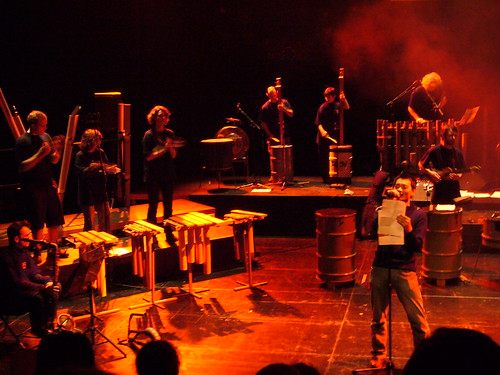
The same travelling procedure, I’ve followed several times the last three weeks. First, I take the metro all the way to its terminus, then I go on by feet, bus or tramway – through names of places one remembers from the November ‘05 riots –, until I am at a Place de la Liberation or Place de la Résistance…(I’ll leave these interesting place names, full of national remembrance, for another post), where I find some more or less grandiose cultural centre where all kinds of experimental artistic activities take place. The slam poetry is not at all seen as an experimental activity, but rather to “invite the street in and listen to it”.

In one of these places, Le Blanc-Mesnil, the whole affair appeared slightly absurd to me: Outside the very grandiose Forum culturel there were groups of predominantly black youth dressed hip-hop style inside, well, the percentage of black hip-hop style was not very high.

The Norwegian arts scene is probably one of the least elitist in the world, while the French is probably quite high on the other end of the spectrum. So, while I find a bit bewildering the time and place to perform some rather experimental jazz jam or modern ballet or whatever, the French seem to react if it is completely normal.

Slameur and musicians in a forum culturel in the suburb

Following the Parisian slam scene immediately led me to the suburbs. During my 9 months long first stay here, I crossed la pheripherique (ring road) only five times (except to go…

Read more