search expand

From La Sorbonne to Université de Saint-Denis

For those who read French, I can recommend Le Bondy Blog. A couple of journalists from the Swiss magazine L’Hebdo settled in the banlieue Bondy during the November revolts, and stayed there for more than 4 months. Before they left, 8 local youth got training in journalism and took over the blog after the professionals. Every post they write – be it miniskirts or soldiers from the colonies helping out France during the war – initiates a lively debate. I had just read Hanane Kaddour’s very instructive post on how geography determines which university you can apply for when I had the opportunity to have a closer look at 4 different university locales in the Paris area in just a few days.
[teaserbreak]
I didn’t know about this sectorisation of the universities before I read this post, and I have to say that that knowledge gave an extra edge to my trip from La Sorbonne to Université de Saint-Denis. I suspect the amphitheatre I visited at Sorbonne must have been one of the more prestigious ones, because prestigious it was indeed. I don’t think the Royal Palace in Oslo have a hall that could match this amphitheatre. Along the walls the French greatnesses were lined up; Molière, Descartes, Racine… In the ceiling, there was a painting of a man reading a huge book amidst antiquity ruins, and over his head the Muses, presumably, and some angels were playing. There were red carpets on the floor and the desks were made of dark, visibly old and worn, wood.

I would never dream of mocking such a presence of history. Far from it. One of the few, or probably only, collective identities I’ve ever felt any affiliation with is that I’m almost a little bit proud of having been a pupil at Norway’s oldest school. We were impregnated with such an identity from the moment we started there. It’s almost a thousand years old and it’s connected to a cathedral (too grand for it’s city ☺ ). On the walls of the cathedral, a pupil three-four hundred years ago has made a tag (in Latin of course) about a gay teacher, which our (gay) teacher showed us. (Here I’ll not fall into the trap of more nostalgia).

The day after we were at Sorbonne the seminar I attended moved to the old Faculté de Médecin, which is in another grandiose building in the Latin Quarter. High ceilings, broad marble stairs, busts, statues, a memorial for medicine students and teachers lost in the First World War, tapestries and Greek myths… It was all very nice. And then I cycled home and took the metro to its final destination, in Saint-Denis.

The people seemed very nice. There was an “Intercultural festival” going on when I was there, so in the vestibule they sold food – French and North African – and played North African music. But I was quite surprised of how dilapidated and worn out the buildings seemed. And there were security guards walking around, and a huge security post right in the entrance hall. The women’s toilet didn’t have a sign – I don’t know if that was intentional – and the walls in the booths were full of holes filled with toilet paper. And the amphitheatre was full of graffiti! I almost had to laugh because the contrast from the central Parisian etablissements I had just left was so great. I didn’t take any photos because that would feel, I don’t know, strange… but I hope to go back, as I said, there seemed to be interesting things going on there. (And the Wikipendia entry on the Paris 8 university shows that it’s been a hotbed for radicalism since it was established far away from the city by de Gaulle after 1968 :D – they even say “tu” to eachother…)

The fourth and last teaching establishment I’ve been to the last week was not a university like Sorbonne and Saint-Denis, but a Grande Ecole, which is supposed to be more elitist (but I don’t know the ranging of La Sorbonne (Pantheon) within this). It was the EHESS – Ecole de hautes études en science sociale – which I’ve mentioned here before. This building is 1950-60s style and in the centre of Paris, but not in the Latin Quarter. Funnily, EHESS was full of graffiti as well. It was occupied long time ago during the protests against the CPE and there were photos available on the internet showing the vandalism, or what to call it, right after the squatters were thrown out. But that is months ago, and the harsh juridical repression in various CPE law cases have already been going on for a long time. But for some reason they haven’t yet removed the scribble, not even what’s written with chalk. I wonder why.

I understand Bondy Blog’s Hanane Kaddour’s concern about being geographically limited to Saint-Denis or some other banlieue university. Especially since which university, or rather Grande Ecole, you go to, have everything to say when you try to get a job afterwards. But at the same time I like the other France as well (and Saint-Denis’ Philosophy department is founded by Michel Foucault!). So why can’t the two of them – the old and historical and the new and vibrant – just come a little closer together?

I’ve left the digression to the end this time: When I was checking a word on Britannica.com I learnt that it’s Malcolm X’ birthday today (1925-1965). His autobiography (written by Alex Haley) is a very, very good book about identity politics, as well as history, jazz and other things, and I can strongly recommend it. When I was writing now, one particular scene from the book, as well as the film (by Spike Lee) came to mind. Malcolm was the best pupil in class, and for a while neither he nor the others seemed to take much notice that he was the only black boy there. However, the teacher did. So, one day he asked his brightest and perhaps favourite pupil what he wanted to do when he grew up, and the young boy answered “lawyer”. But the teacher thought, perhaps rightly, that that could never happen in a segregated America, so he suggested that Malcolm opted for carpentry instead. A suggestion that, as far as I remember, terminated Malcolm’s formal schooling.

For those who read French, I can recommend Le Bondy Blog. A couple of journalists from the Swiss magazine L’Hebdo settled in the banlieue Bondy during the November revolts, and stayed there for more than 4 months. Before they left,…
Read more

1st of May in Paris

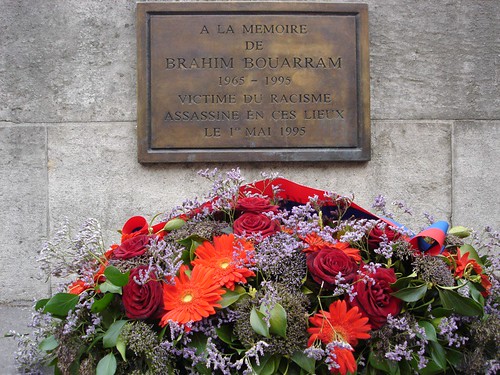
1st of May, in the morning, I cycled through the quiet streets to a bridge by the Louvre Museum. At the Pont du Carrousel, there is a commemorative plate for Brahim Bourram, who 11 years ago, on this day, drowned after he was thrown into the river Seine by skinheads coming from the annual Front National demonstration. Paris Major Delanoë had put down flowers, and every year MRAP – (Movement against racism and for the friendship between the peoples) – arrange a commemorative ceremony. General secretary Mouloud Aounit didn’t have a microphone, and I was too far away to hear what actually was said, but MRAP has posted a statement on their webpage, which I shall quote from as it speaks directly to the current situation in France:
[teaserbreak]

This crime should remind us tragically that the words always precede actions, that words – the discourses of hate, exclusion – can lead to the irreparable. Brahim Bouarram, Ibrahim Ali, Imed Bouhoud, Ilan Halimi and many others have paid their life for the freedom of racist speech.

At this 1st of May 2006, when the verbal violence of racist speech is given expression in a build-up between the president of the Front National, Philippe de Villiers [president of the right wing Movement pour la France] and Nicolas Sarkozy, it is the duty of all antiracists to remind that if this process is let to develop, it meanst to take the risk of making these individuals accomplices in putting words into action. [my translation, read the whole press release in French here]

The communiqué ends by an appeal for vigilance and civic resistance.

And from here this blog post could take many directions. I’d like to write about this typically French habit of appealing to the duty of the citoyens, MRAPs interesting – and in my opinion laudable – position and (lost) court case in the Mohammed caricature incident, the sombre and complicated issue of racially motivated murders, the recent media appearances of de Villiers (speaking of an islamisation of France and the need for a francisation) and of course this “build-up of violent speec” (violence des propos racistes s’exprime dans une surenchère). The latter issue I’ll expand on very soon in a post with the catchy title Liberté, Égalité, tes papiers! (stolen from an anti disposable immigration flyer). The present post shall however continue recounting 1st of May, as I experienced it.

Three years ago, at the moment the commemorative plate for the murdered Brahim Bouarram was inaugurated by Major Delanoë (see this article from 2003 on Paris Indymedia (in French)), Le Pen used (according to the media) the occasion to make an ironic remark on a nearby gathering: “That bridge will soon resemble our great religious sites, because it seems that every year a commemorative plaque will be put up to thank the little hoodlums petits voyous who every year allow themselves to slander the Front national.” (I’ve found other quotes as well from Front National concerning this event, which I don’t think should be forgotten).

This attempt by Front National to clean up their public image and to put the blame on others continues: A news report from this year’s 1st of May FN procession showed how an FN member (a representative to the European Parliament) told an aggressive man shouting “France for the French” to leave the cortege, remarking that he didn’t want this behaviour in front of the journalists and the “leftwing media” and suggesting – or even saying? – that this was a provocateur paid for by the Interior Ministry. The FN themselves had distributed blue posters shaped like France proclaiming: “Aimez-la où quittez-là!” for this annual procession in honour of Jeanne d’Arc
(I haven’t yet looked into the relationship between FN, Jeanne d’Arc and the 1st of May, see Wikipendia (in French)).
As I don’t look like an Arab (which was the unfortunate fate of Brahim Bourram), I thought it safe to go and have a look at this procession. However, I didn’t and as this is such a sombre subject, I’ll not make a joke about why it turned out that way.

This blog post was supposed to be about 1st of May, but I’ve already written almost two pages about the far right. For my part, the 1st of May celebration ended on a happier antiracist note with “rock against Sarko” by a classical French punk band at Place de la Nation. But before I wrap it all up with that story, I shall say a few words about the other processions I missed that day, just to give an idea of the things going on in Paris on mayday.

First, I missed when one of the major labour unions (La Force Ouvrière) put flowers on the Communards’ Wall (Mur de Fédéres) at my local cemetery, the Père Lachaise. Then in the afternoon, I missed half of the major procession going from Place de la République to Place de la Nation. (I though the procession would pass by Bastille, but they went the straight axis RépubliqueNation via Boulevard Voltaire (surely no unintentional symbolism here- I’ll come back to this symbolic axis of republicanism later, in which I think also Quilombo (the libertairian bookshop situated in rue Voltaire) has its place – I’ve just learnt that Quilombo was the name of antislavery settlements in Brazil, and Voltaire deserves a little reminder of the history of antislavery movements… I’ll maybe write why at a later occasion)).

The second half of this major 1st of May manif was dominated by transnational leftwing parties – Turks, Latin-Americans (going all together), Tamils (performing the Ramayana!) and Kurds…

The last event I missed, I skipped by my own choice, although I regret it a little now. 2nd of May the temperature returned to over 20°, but it was really chilly, grey and rainy on the 1st (and even worse the day before when I skipped two street parties; one for some sans-papiers families ejected from a squat and who now lives in a square, another just locally in Ménilmontant). The Euromayday organises Mayday parades all over Europe, and the phenomenon shows amongst other things the rapid dispersion of ideas, in this case counter movements, through the internet. Suddenly precarity has become a word in English (se a US-American blog post on this and the interesting recent Wikipendia entry), and even in Norway some left-wing radicals have adopted the notion of a génération précaire, stemming from the CPE-movement in France. (In January when I wrote the post on insecurity à la français this was not yet the case). But as I’m – and maybe eventual readers as well are – getting a bit fed up by this text now, I’ll end here. We’ll probably have the chance to delve into French punk concerts, the internet and protest movements and what else, later. I’m already preparing the part three of My blog, my project and I, – this time on… oh, yes, as always these days… politics and I.

1st of May, in the morning, I cycled through the quiet streets to a bridge by the Louvre Museum. At the Pont du Carrousel, there is a commemorative plate for Brahim Bourram, who 11 years ago, on this day, drowned…

Read more

Contrat premiere embauche – Protesting à la français

Initially, I hadn’t planned to go to the major demonstration against the CPE (“contract ‘first employment'”) as it only tangentially touches the focus of my fieldwork (tangentially, as the CPE – Contrat Première Embauche – is part of Prime minister Villepin’s plan for égalité des chances: youth unemployment is high in France and even higher in the Zones sensible which is in need of the equal opportunities). But as the echoes of the chanted slogans reached all the way to my flat – situated at least 20 minutes away from the standard demo route Place de la République/Bastille/Place de la Nation – and I saw the diverted traffic as I leaned out of the window, I realised that the scale of the event made it worth defying the heavy rain and head for Nation.
[teaserbreak]
The ten minutes walk down Avenue Philippe Auguste, I was thinking about how different French politics are from what I’m used to. The implementation of the CPE is a good example. In L’Assemblée Nationale the politicians can speak loudly, clap, make noise and sometimes shout, and – most exotically – even express themselves with eloquence. In this, France is similar to Britain. The importance they give to demonstrations is however different.

One month ago, there was a discussion in the National Assembly on the government plan of implementing the CPE and other “equal opportunity” measures, which went something like this: A socialist politician shouted to prime minister Villepin (the architect of the CPE): – You should listen to the streets! (alluding to the first demonstration against the CPE taking place at the time). Villepin, Monsieur l’éloquence personally, replied, with oratorical pathos: I am listening to the streets… – but I also hear the ones who are not down at the streets (pointing to the rather feeble support for the demo). Demonstrations have thus an important political role to play in this country. (I’d like to give some other examples, but as this is meant to be a quick post, I’ll leave it for another time).

As I arrived at Nation, I noticed that 7 of the 8 boulevard and avenues running into the square were lined with the CRS – riot police – standing around, looking after their helmets, shields, batons and other riot gear… (The 8th street was of course the one where the protesters entered). I don’t think such demonstrations, full of healthy (though leftwing) pupils and students and more or less bourgeois labour unionists often turn violent, but the Republic obviously wants to put her measures at display. – So also with her boulevards and avenues, constructed broad and straight as they were in order to easily suppress popular rebellion…

I think about the republic and her broad boulevards, full of politics, as I linger for a while in Place the la Nation: I once participated in a tiny little demonstration in London (I think there were 16 000, which would hardly count as a demo in a country where hundreds of thousands take to the streets many times a year) making City a drum’n’bass dance party and consequently a no-go area for the police for hours… as the narrow and winding streets of City is not made for riot police.

After taking some blurred, grey and rainy photos of the last part of the demo down Rue du Faubourg Saint Antoine from Bastille, I hurried home in order to change shoes, socks, trousers and umbrella (ready for the dustbin) before I went to a neighbourhood democracy meeting in a nearby school, which of course turned out to be full of people discussing, objecting and protesting and talking about art and the importance of preserving small-scale artisan affairs for hours…

Initially, I hadn’t planned to go to the major demonstration against the CPE ("contract 'first employment'") as it only tangentially touches the focus of my fieldwork (tangentially, as the CPE – Contrat Première Embauche – is part of Prime minister…

Read more

The city (long) before lunchtime

A friend of mine said that he’d like to leave a comment on my blog suggesting that my fieldwork could have benefited by some knowledge of what happens in the city before lunchtime. As I have in fact been out there many times before 12 o’clock, I have informed him that such a comment is totally ill-informed. Today I’ll even prove that I was out before dawn on a Saturday. (Since it’s in the middle of winter – and winter indeed, since emergency measures are put into action with Plan Grand Froid niveau 2 and alerte orange (in this country not concerning terror dangers, but exceptional snowfall) in half of France – dawn comes not too early).
[teaserbreak]
What did I find out? As I crossed the city between 8 and 9 o’clock in the morning, I had the chance to take a look at a few peculiarities of French society that I only had knowledge of from films and other secondary sources. For instance, there are people living and carrying out their daily life all over the city, even in the most touristy streets of the Latin Quarter (I know already that people live in the most touristy quarters of the Jewish area, which I’ve done myself). All along the way I saw locals joining their tiny Parisians dogs for a morning stroll, and there were even a man walking his unleashed brown and black lapdogs across Boulevard Saint Michel, where I really didn’t think there were any flats. (I’ve already become so accustomed to the clothes of the dogs that I have lost track of how usual dogcoates actually are, but I’m not sure if I can claim that a majority are wearing them despite the fact that we live under Plan Grand Froid niveau 2). Parents are bringing their children and even toddlers to primary and nursery school at dawn on a Saturday. And yes, there are really baskets with fresh croissants and pain au chocolat at the counter of most/all bistros (as I have seen on so many French films from all times). And many people do in fact have their breakfast in the local café perhaps at the corner. From the bus, I could see customers at the café tables engage in lively conversation long before 9 o’clock. And again, it happens all over the city, and I don’t know how early in the day they started this sociability.

This mix of habitable and commercial areas, of housing and public facilities, seem are more thorough in this city than other cities I know. It’s also something which separates Paris proper from some of its deprived banlieues, and which separates the 19th century cities from the modern style Le Corbusier suburbs… I don’t know too much about this yet, but it’s for sure something I’ll return to.

As I was one hour wrong about when the lecture I was going to this morning started, I had the chance to have a second breakfast – croissant beurre and café allongé – and see the bistro morning life from the inside. I found a very typical looking one run by two Chinese (one of them could have been an actor in a film by Wong Kar-Wai) just nearby the EHESS where the lecture would take place. (A lecture, by the way, on the social sciences and the crisis in the banlieues, which I will return to as well).

In the bistro, most people stand along the counter. Some, like the two young, green dressed street cleaners are following the lottery draw on a TV screen. (I’ve noticed that it’s common for the street cleaners and the postmen to drop by at a bistro and have a coffee by the bar on their morning round). Except from the white and native speaking street cleaners, there are two middle-aged men speaking Arab and two women and a man, all in their twenties, speaking Rumanian, I think (it sounds like a mix between a Slavic and a Latin language), and several French speakers. It’s so cold that people keep their overcoats and even woollen hats on, and none stay for long.

At half past nine, the bistro has quieted down. La grisaille du jour has settled, and it has become too unbearably cold to sit here.

At 10 o’clock, life has regained the daytime mode I know well: shops are opening and people – tourists and locals – are strolling along the streets. But a homeless man, just in his sleeping bag, outside a nearby school has not yet woken up. He’s obviously neither benefited from Plan Grand Froid (emergency housing for the homeless), nor from the tents distributed by “Doctors of the world” (with a little not saying, pertinently though sadly “each tent is a roof lacking”).

A friend of mine said that he’d like to leave a comment on my blog suggesting that my fieldwork could have benefited by some knowledge of what happens in the city before lunchtime. As I have in fact been out…

Read more

Bienvenu à mon blog de Charonne

It’s been more than two weeks now, since I’ve moved house. This move has made me realise that I in fact lived in a village before, and now I seem to have moved downtown. In downtown Charonne, I’m not recognised by the baker the second time I enter his shop, and the same faces don’t surround me on the street every day. In our little neighbourhood in Ménilmontant I saw familiar faces all the time, and even a shy person like me got to know the local merchants in not much time. As I think about how quickly I got a sense of the village-like place I moved from, I realise that I’m not able to give a good description of my new quarter yet, despite having lived here for a while.
[teaserbreak]
Part of the impersonal atmosphere of Charonne – a quartier populair a little northeast of Place de la Bastille – comes down to it being wintertime. There are no longer chairs and tables outside the cafés and bistros, and people don’t hang around outside but hurry home and inside on their way from the metro or bus. And crossing a local square, I only come across some youths asking for cigarette papers or the odd loner, doing nothing on a bench. The parents and children, staying for hours after school time in the warm days of autumn are long gone. December is a hard month discovering an area…

My impression so far is that the middleclass bohemian bourgeoisie (‘bobo’) creeping down, or up, the hill in Ménilmontant, have not reached here yet. There is a small gallery of modern, figurative paintings and a little shop of ceramics in my street – in addition to an appealing little shop for making your own hanging garden – but I suppose a gallery or two doesn’t qualify a Parisian area as gentrified. The working classes seem for the most part still left by themselves. (There is however a couple of all right restaurants around including a sushi place, but still I’d claim that it doesn’t count as gentrification). My impression is strengthened when considering the food on offer in the local supermarkets; my amateur guess is that the number of ecological products at sale might be an indicator of the social class of the area. The only ecological groceries you can get here, are staple foods and other long lasting products (usually quite dusty). There are no ecologically grown bananas or other fruits or vegetables… I haven’t checked for organic meat, I’ll have a look next time. (When talking about supermarkets; one thing I like about French supermarkets is the loooong time many people spend in front of the cheese counter). Similarly, only one supermarket around here sells expensive and small (thus easily stealable?) beauty products like facial creams and razor stuff. In that particular store they are also more persistent in asking their customers to leave their bags in custody when entering the shop. Is there a connection? I’m only guessing.

I learnt by coincidence – on a screening of a film from a local elementary school on the 100 years anniversary for the law on laïcité (the separation of church and state) – that the local schools are in fact classified as educational priority. Being a ZEPzone éducation prioritaire – means there exist a number of socio-economical disadvantages here. (I’ll for sure return to the question of ZEP, as it has played an important role in the debates both before and after the November riots/revolts. ZEP is the French version of affirmative action; habitants of particular areas, instead of particular (ethnic) categories, are considered as disadvantaged and thus entitled to special attention).

When thinking about it, I think perhaps my description has been a bit one-sided. If I’ve given the impression that the area is in any way shabby, I should correct myself. I find the area ordinary and a bit impersonal, but far from shabby. The streets are incessantly being washed by small, green cars here, as in the rest of the city. The squares, the flowerbeds and the trees lining the boulevard are being well kept. And the buildings, greyish by pollution, are well maintained.

Apart from a couscous take-away, a yet uncounted number of tiny bars where (mostly) men seem to hang around the counter at every hour of the day, a surprisingly tidy food-market twice a week, an abundance of pharmacies (at least as many as there are newsagents but fewer than there are bakeries and patisseries), my local area also comprises an anarchist bookshop (Quilombo). Perhaps my very favourite thing of Paris life is walking down a street, an anonymous just normally picturesque Parisian street, and then you stumble upon an amazing graffiti, or a café so charming that you just have to enter – or an anarchist bookshop, just around the corner on your way to the supermarket.

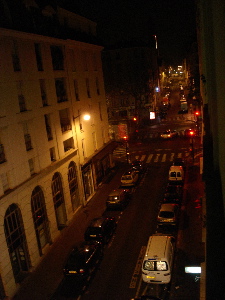
When I finished writing this post, I realised that I had not taken any photos of the area (perhaps another sign of how impersonal I find it), so I had to take one right now, out of my bedroom window. Thus, Charonne by night…

It’s been more than two weeks now, since I’ve moved house. This move has made me realise that I in fact lived in a village before, and now I seem to have moved downtown. In downtown Charonne, I’m not recognised…

Read more