After a long silence, there is finally some activity on antropologi.info! The blogging software I had been using since 2005 (!) is no longer maintained. It is called b2evolution and was wonderful to use. So now I had to find an alternative and move all the content to the new system. I chose ClassicPress, a fork of WordPress which, in my opinion, has become too commercial.
I hope everything is working ok! If not, please let me know – either as comment below or via email (oh, I should update this site as well…)
I tried hard to keep all links intact, I also transferred all users, and tried to recreate the old site as much as possible – not alone, though, it would not have been possible without Chatgpt. We had long nerdy discussions, and now we finally made it!
After so many years, I doubt it somehow, but I’d be happy if some of my readers and fellow bloggers from the good old blogging days are still around here …..
After a long silence, there is finally some activity on antropologi.info! The blogging software I had been using since 2005 (!) is no longer maintained. It is called b2evolution and was wonderful to use. So now I had to find…
In June 2004, I bought the domain antropologi.info, and this website with blogs in English, German, and Norwegian soon became part of a steadily growing anthropology online community. Browsing through old posts, I get surprised by the number of discussions we have had here! That was fun. I really get nostalgic.
It is easy to get depressed when looking at today’s state of anthropology online—and the Internet generally. Such an anthropological community no longer exists, at least not in the open internet. Personal blogs are gone. They have been replaced by shorter posts we share in “walled gardens” like Facebook, Twitter, or Instagram that are controlled by advertising networks. Many anthropologists (as people generally) tend to use these social media sites as a tool for self-promotion rather than for sharing ideas. Very boring, in my view!
Most blogs from the golden age of the Internet are no longer active or have shut down, for example, ethno::log and Savage Minds, which was renamed Anthrodendum in 2017. Others that still exist, like my favorite site Allegra, no longer call themselves blogs but “online multimodal publication platforms”. Their posts have lost their informal tone and now resemble journal articles that can be cited on CVs. Many of the blogs you find on feeds.antropologi.info are run by organizations or institutes that also use them for self-promotion. The culture of linking to other websites and blogs has died completely. What we see now are “blind” and “inward-looking” websites, as blogging pioneer and activist Hossein Derakhshan calls it in his fantastic piece The Web We Have to Save.
At the same time, most newspapers have moved their content behind paywalls. Sources for learning about the world are disappearing. There is less anthropological content available online than, let’s say, 10 years ago. Searching the web for new anthropological content (as I did before) hardly yields any interesting material to blog about anymore.
There are positive developments, though. More and more journals have become open-access journals. More and more academics have moved from Twitter to open, non-commercial platforms like Mastodon. Some have even started experimenting with open digital gardens as a new way to share knowledge as for example anthropologist Kerim Friedman.
I haven’t been active for some years either—an exception was the Corona lockdown in 2020 and 2021.
In 2016, I lost my job as a science journalist at the University of Oslo and moved to Germany one year later. Here, I was not able to find work within my field either and ended up becoming a freelance teacher for German as a foreign language in the least attractive part of the country (which is also the only place where you can still find affordable flats). Teaching German as a foreign language can be fun and rewarding, especially because of the contact with people from all over the world. But teaching full-time drains all my energy and leaves me bored, as I miss the stimulation from anthropology, university life, journalism, and blogging!
So, what now? There are many things one (or I, if I had time) could do, for example, combining language teaching with anthropology. Why not start something like “Learn German with Anthropology”? Most of the texts for language learners, especially at the beginner levels, are too banal to be interesting. So why not write some more inspiring texts so that you not only learn a new language but also something else?
As I mentioned, more and more anthropological journals have removed their paywalls; there are more and more open-access anthropology journals. I recently wrote a piece for the Norwegian magazine Forskerforum, Tidsskrifter er viktigere enn noensinne—meaning “Journals are more important than ever.” While mainstream media has locked down access to knowledge, scientific journals have opened up. Although journals have become a dumping ground for half-ready texts in the neoliberal university economy (“publish or perish“), there are still many academics who are interested in other things than impact factor and the number of publications on their CVs. You will find many of them writing or working for rather small non-commercial open-access journals.
Browsing through journals like the Finnish Suomen Antropologi, Scottish Medicine Anthropology Theory (MAT), or Brazilian Vibrant, I always find too many articles I’d like to read (and blog about…). Most of all, I am fascinated by the passion that shines through in their editorials! Many of their articles need more publicity. I wish I could write about more such hidden treasures as I did before. Maybe it is now more important than ever, as quality content about the state of the world is getting harder to find, and spammy websites dominate Google results.
Another issue: The blog software that I have been using since 2005 (b2evolution) is no longer maintained by the main developer François Planque, and no one has started forking it. Now I wonder how to migrate to another system and to which one, as choices are more limited than in the old times. More and more solutions have become “evil,” meaning commercial and no longer operating within a true open source and open access gift culture as b2evolution has done and WordPress did in the early years. By the way, developer François Planque just wrote a convincing blog post called My 7 reasons to maintain a blog or website in 2024
In June 2004, I bought the domain antropologi.info, and this website with blogs in English, German, and Norwegian soon became part of a steadily growing anthropology online community. Browsing through old posts, I get surprised by the number of discussions…
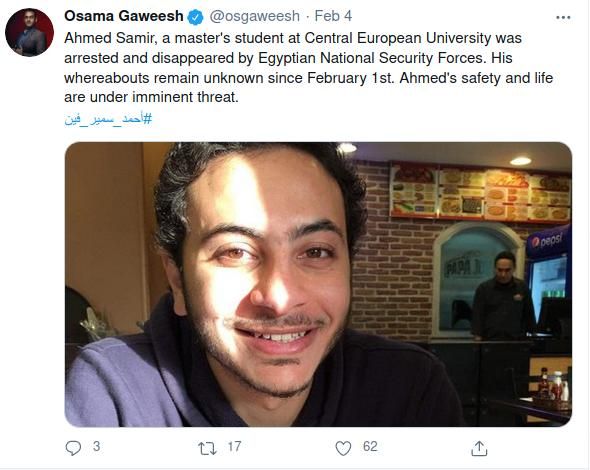
When graduate student Ahmed Samir Santawy December last year arrived at Sharm el-Sheikh airport from Vienna (where he studies at the Central European University), he was taken aside by the National Security Agency and questioned about his research. One month later, his family home in Cairo was raided, and the security forces looked through the family’s phones. As Ahmed Samir was not present, the NSA officers told his family to send him to the police station as soon as he’s back.
The anthropologist went to the police station on January 30 and 1st of February. Since then, nobody has seen him anymore. He never returned.
Forced disappearance are usually defined as cases when a state actor or collaborator secretly abducts or imprisons a person and refuses to acknowledge their fate or whereabouts. In Egypt, forced disappearances have become a common way for the regime to deal with its (perceived) opponents and critics.
In Egypt, the case of the Italian PhD student Giulio Regeni from the University of Cambridge is maybe the most famous one internationally. Regini was researching workers’ rights in Egypt. Five years ago, while on his way to meet a friend in downtown Cairo, he disappeared. More than one week later his dead body was found on the side of a highway on the outskirts of Cairo bearing marks of severe torture.
But it is only one year ago when another academic, the Egyptian Erasmus student Patrick George Zaki who was pursuing a master’s degree at the University of Bologna, was arrested from the Cairo airport and forcibly disappeared, beaten, stripped, and electrocuted on his back and his stomach, and threatened with rape. "A new Zaki case in Egypt" was therefore the headline when Italian news wrote about Ahmed Samir Santawy*s dispperance two days ago.
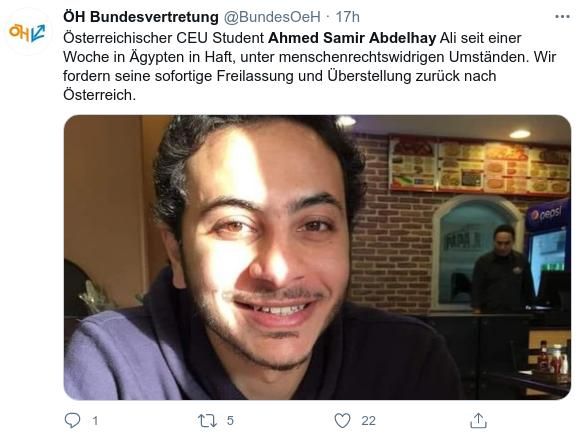
Ahmed Samir Santawy reappeared a few days ago, frightened and with a swollen face, he was beaten. He was not with his family, though, but behind the bars of the State Security Prosecution of Cairo. He was – as the other journalists, researchers and activists before him – charged for joining a terrorist group and dissemination of false information. He has been ordered held in remand for 15 days by the State Security Prosecution.
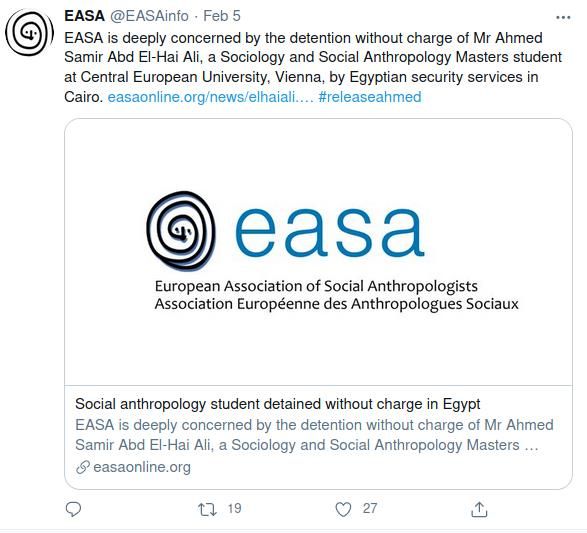
Tweet by the European Association of Social Anthropologists (EASA)
EASA writes:
The European Association of Social Anthropologists (EASA) is deeply concerned by the detention without charge of Mr Ahmed Samir Abd El-Hai Ali, a Sociology and Social Anthropology Masters student at Central European University, Vienna, by Egyptian security services in Cairo. Mr Abd El-Hai Ali is a researcher and student of good standing, working on the history of reproductive law and policy in Egypt.
EASA urges the government of Egypt to take all steps necessary to ensure Ahmed’s swift and safe release, that his legal rights are respected and that he is afforded all legal assistance necessary.
(…)
As scholarly associations with a combined membership of more than 20,000 worldwide, we are committed to the principles of academic freedom and freedom of expression in a democratic society. Our Associations stand for advancing understanding of the human condition through anthropological research, and for applying this understanding to addressing some of the world’s most pressing problems. As an Egyptian student pursuing his Master’s degree in anthropology at Central European University in Vienna, Ahmed is making significant scholarly contributions to help build these bridges of understanding.
We strongly urge the Egyptian Ministry of Interior to do what it can to effect Mr. Samir’s release and safe return to his family. Please don’t hesitate to contact us if we can provide additional information.
PS: He is both called Ahmed Samir Santawy and Ahmed Samir Abd El-Hai and Ahmed Samir Abdelhay Ali – Arab names are a complicated matter!
PPS: Embedding of Tweets did not work well on all devices, I replaced them with screenshots
Ahmed has been involved in several projects with human rights organizations and NGOs in Egypt as a vocal human rights defender. Ahmed’s case is the latest in a series of cases of students being harassed and forcefully detained by Egyptian authorities.
Forced disappearance is a threat to those that oppose regimes. In Southeast Asia, forced disappearance has long been a tool for dictatorial regimes to silence critics. For example, in the Thai case, in the past 5 years, there have been 10 dissidents abducted, forcedly disappeared and killed. The disappearance of Ahmed Samir Abdehay Ali reflected this trend of state crimes across the region.
UPDATES: He was released by presidential decree on July 30, 2022 and now has successfully defended his Master's thesis :Following Unjust Imprisonment, Ahmed Samir Santawy Completes Master’s Studies at CEU (28.9.2023) but the Egyptian authorities have imposed an arbitrary…
One month ago I have written about anthropologist Kareem Ahmady, who has researched child marriage, female genital mutilation (FGM) and sexuality in Iran, before:
Eventually, in a bitterly cold, dark night, I embarked on a journey. Every hour of that unforgettable night, with every path that opened before me through the tough route, I wondered whether there are any roads more impassable than prejudice, ignorance, tyranny and isolation from the rest of the world.
Kurds are known to have no friends but mountains; on the night of my departure, with no lantern to light my path but the white snow, I realized again that the mountains were giving me a shelter and aiding me to start a new beginning with even stronger determination. (…)
What I have been through for the past one and a half years, is the story of a sad tragedy whose sequence, although real, is unbelievable. The Revolutionary Guard security system intended to introduce me as one of the main tools of the “infiltration scenario”. (…) They had come to the conclusion that I had been trained as a teenager for the purpose of infiltration and overthrowing the system.
Ahmady who is a British-Iranian dual national is now safe in the UK. In Iran he was sentenced to nine years prison. In the verdict that he put online (in English!), we read on the first page:
Kameel Ahmady has been acting as a senior expert in sociology and anthropology, directing the propagation of western principles and weakening Sharia/lawful rules and fundamentals in the field of family and marriage, and promoting the necessity to adopt western and humanist values. He was under observation by the Intelligence Organisation of the Islamic Revolutionary Guard Corps (IRGC)
And on page 10:
Generally, it can be said that increasing the age of marriage for children is one of the strategies of the enemy for weakening and ruining the family system; andthat Mr Kameel Ahmady is one of the leaders in the implementation of this strategy in Iran.
And finally:
Ahmady communicated with anti-revolution and problematic institutes and foundations and travelled to occupied Palestinian territories. A teaser, pepper spray, alcohol to the value of alcohol were discovered by Iranian customs (3150000 Rials), as well asother available evidences and documentation. His crime is proved.
Short time after he was everywhere in the news, among others in The New York Times. In an interview with the BBC he said he left without telling anyone but his immediate family:
"I just simply left. I packed my bag with a shaving kit, a few books of mine, and a laptop. And warm clothes, because I knew I had to smuggle myself out of that train in the mountains. It was very cold, very long, very dark and very scary.
In an interview with The Guardian he nevertheless expressed slight optimism and said he would like to have a role in helping create a dialogue.:
“The Islamic regime is run by a small minority, the so-called hardliners, but that generation of leaders are dying out.
“Most people, those not making a living from high politics, corruption, are not reformers or fundamentalists but people who want to see change. There is a hint of hope after the years of hardship and sanctions that have brought people to their knees and crippled the economy.
“If negotiations restart, it’s very important that Iranian civil society and opposition groups are heard on issues like human rights. Nothing good ever came out of conflict and fanaticism, and I say that from personal experience.”
Four women have separately claimed to the Guardian that he assaulted them, and others have made allegations of repeated sexual harassment. (…)
Ahmady said in a statement that the accusations were “baseless slander” organised by professional rivals and the Iranian state in an attempt to smear him and undermine his work. He also said two accusers had been in consensual relationships with him.
SEE EARLIER ON ANTROPOLOGI.INFO with more information about Kameel Ahmady’s research:
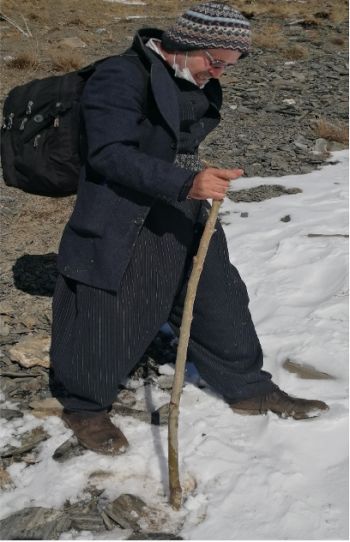
Kareem Ahmady: "I just simply left". Photo: Ahmady's website
One month ago I have written about anthropologist Kareem Ahmady, who has researched child marriage, female genital mutilation (FGM) and sexuality in Iran, before:
Iran jails anthropologist for "subversive research", "seeking…
(via FocaalBlog) In the general public, academics are often viewed as being part of an elite, who lives comfortable lives. In reality this is only true for a small minority of well-paid professors, while the situation for most academics rather ressembles those of other underpaid workers like cleaners or delivery or Uber-drivers – especially since universities are no longer run like public institutions but as corporations with managers and PR departments that all compete for being “world leading”.
A recently published survey among anthropologists in Europe provides us with neat but disturbing statistics. The survey was carried out online and before Corona, between 18 June 2018 and 22 July 2018.
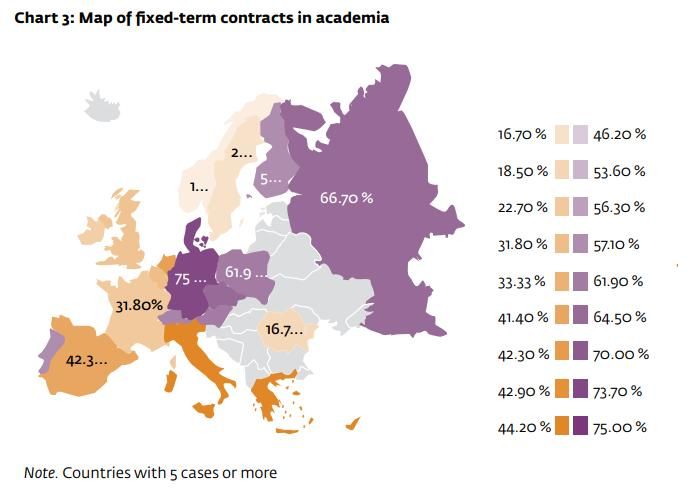
Increasing precarious employment conditions is a major issue here:
Much corridor talk at the 2014, 2016 and 2018 EASA conferences, and many informal chats during the online-only 2020 conference were neither about the latest ground-breaking study nor even about the latest careerbreaking scandals, but rather about the lack of career prospects, which ultimately prevents highly skilled scholars from conducting groundbreaking academic work
Permanent contracts are rare, at least until you get tenure as professor in the age of 50 or so if you are lucky. Short term contracts are the norm, instead, often shorter than six months, thus leaving anthropologists in a constant state of insecurity:
Among those who identified ‘employed in academia’ as their primary status, 44.3% had a permanent contract, and only 31.3% were on permanent and full-time contracts. This means that over two thirds of all academic anthropologists in Europe are in some form of precarious employment.
There are huge differences within Europe and – as expected from my site – Germany, one of the most inequal countries in Europe with growing poverty rates, comes out as one of the worst – or worst country to be. While 49.4% of the respoindents in the UK had permanent contracts, in Germany it was only 12.1%. The numbers for women are of course even worse than for men:
While men and women were equally represented among those on fixed-term contracts, women held a higher proportion of very short-term contracts, i.e. under six months. Women were also less likely to be in senior positions (29% of men versus 19% of women).
One consequence is that you constantly need to look for new employment opportunities. Especially early career researchers “spend an excessive amount of time at work applying for jobs”. Half of all respondents spent more than one month a year applying for jobs. Less than 10% had not applied for a job in 2018.
Changing jobs means in many cases leaving your country, being constantly on the move:
Among those aged 31–35 years, only one third had not left their countries for work or education (excluding fieldwork), while a quarter had changed countries for work three or more times over the last five years.
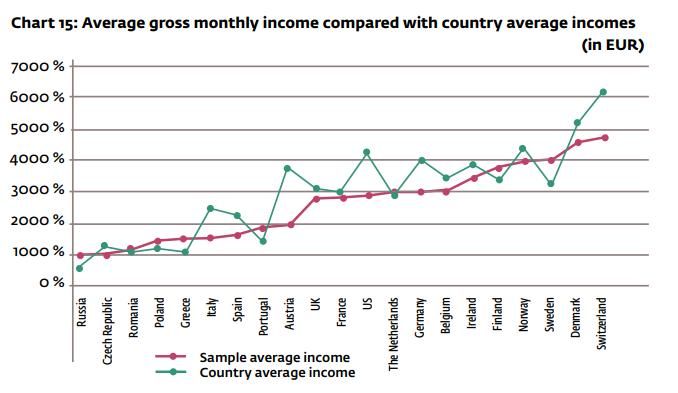
In most countries, the salary is generally below avarage. Especially academics in East Central and South East Europe said their incomes “did not meet their needs”, and that they were “unable to save or manage unexpected expenses”. Among all respondents, only one in four anthropologists had money left at the end of the month.
Less than half of the respondents reported an ability to cover their living expenses solely with the wages from one full-time job. Over one fifth of EASA members also rely on parents and one tenth on family members to support them in making a living.
Temporary teaching fellows or instructors (that are growing in number) were the most vulnerable:
Of these, 68.8% said their income did not cover their needs, 80.7% had no money left at the end of the month, only 6.2% were ‘completely’ in a position to deal with an unexpected expense, and 53.1% were ‘not at all’ able to do so.
Generally, universities do not seem to be a nice place to work in, as also discrimination, harassment, unfair treatment seem to be widespread.
Very worrying: The interests of precarious anthropologists are not sufficiently represented in their academic context:
Precariously employed academics did not join unions because they felt that unions did not represent their interests as the unions were dominated by senior faculty or administrative staff. Insecurity regarding staying in academia or in the country of employment was another reason for not joining.
Membership in unions differs extremly, though. While in Scandinavia most academics are members (Denmark 96% and Finland 84%), the opposite is true for Germany (23%) or Poland and France (4% both).
The situations is probably even grimmer as the report is not representative for whole Europe. Most of the 809 EASA members who completed the questionnaire resided in the West and North of Europe – only 9.7% were residents of East Central and South East Europe.
Susana Narotzky from the University of Barcelona, Spain, sees this underrepresentation as a structural problem within the EASA. In her blog post A History of Precariousness in Spain in the FocaalBlog she writes:
In Spain, many of the part-time non-tenured teaching positions have extremely low salaries and their holders juggle a plurality of jobs that make research difficult. As a result, membership in EASA –which is fundamentally tied to participation in the biennial conference—is rarely sought.
Therefore, a large contingent of (probably) the most precarious voices, many of which are not proficient in English, is not represented in the survey. This may also explain why a large majority of respondents work in Northern institutions which have more resources than those in other countries.
Exclusion by language is also a issue that Natalia Buier from the Central European University criticizes in her post What sample, whose voice, which Europe? at the FocaalBlog. “The reality of EASA is”, she writes, “that for an association that calls itself European it is a surprisingly monolingual one.”
Furthermore, middle-class respondents are overrepresented in the survey. The situation of anthropologists with working class background needs more attention.
In Spain a common experience is that of the grinding of working-class lives not only through exclusion, but also through inclusion into academic spaces.
And while the authors of the report seem to imply that working-class students are at risk of being increasingly underrepresented, there is at least one level at which we are likely to see an increase of the presence of working-class students: the doctoral level. (…). In a world of increasing exploitation, (…) the stability of a four-year PhD scholarship of roughly 1000 euros offers many of working-class background the possibility of more stability than most alternatives. (…)
Increased abilities but diminished resources do not change the fact that the professional machine will probably spit out the student of working-class background at the first opportunity: but that cut out point seems to be increasingly moving towards the post-doctoral phase, where the prolonged subsistence on no or below subsistence level income requires resources that are less likely accessible to colleagues of working-class background.
So, what to do? The recommendations in the report are written in diplomatic language and seem tame and weak.
Without touching the root of the problem, the commercialization of academia, little can be done as Don Kalb from the University of Bergen writes in his post Anthropological Lives Matter, Except They Don’t at Focaal:
Academia should not be run as McKinsey would like it. Our own discipline nowadays has really no other professional rationale than helping to produce democratic, intelligent, and progressive people and societies, not just “more stuff” – research articles, students, diplomas, scholars – against lowest cost. (…)
Outdated academic structures and hierarchies, as well as actively managed neoliberal ones (Netherlands, UK), will have to change if the continent wants to respond creatively and progressively to the massive transformations that are coming to us. Anthropologists should actively make that case and show that they must be part of the creative dynamism.
(via FocaalBlog) In the general public, academics are often viewed as being part of an elite, who lives comfortable lives. In reality this is only true for a small minority of well-paid professors, while the situation for most academics rather…