search expand

War in Iraq: Why are anthropologists so silent?

Many US-anthropologists protested against the Vietnam war in the 60s. Why have anthropologists been so reluctant to engage with the “immense tragedy” and “waste of resources by our governments” in the Iraq war, Antonius C.G.M. Robben and Marshall Sahlins ask in the current issue of Anthropology Today.

There has been much debate and protests regarding the embedding of anthropologists in Human Terrain Teams of the U.S.Army, but not about the consequences of the war for the people in Iraq. There is hardly any independent anthropological research going on in Iraq. Of the 1800 panels (11,000 papers) at the annual meetings of the American Anthropological Association (AAA) between 2006-2008, Robben writes, only one has dealt directly with the Iraq War:

We have been far too timid on the issue of the Iraq war. Rather than tackling the issue head-on, we have dealt with it on the back foot, as an issue of ethical concerns about our professional conduct in military and intelligence matters. What of the broader issues concerning Iraq under occupation and the plight of its peoples? Given the immense human and material cost of this war, why has this not been at the forefront of our professional focus?

Robben criticizes the AAA for not acting independently from the US government:

What is disconcerting is how the AAA appoints the members of the Commission on the Engagement of Anthropology with the US Security and Intelligence Communities on the basis of ‘balancing’ interests between individuals employed in intelligence-gathering capacity and independent anthropologists engaged in bona fide academic activity. Why should this commission include members from the security establishment at all?

Surely, if anthropology is to remain an independent academic discipline, it must insist on populating these important bodies with independent anthropologists free of any personal involvement in such matters. In this case, we can speak of imbalance, for two militarized anthropologists on this commission outweigh the one person representing the critics. It is disconcerting to see how panels at the AAA’s conferences also tend to have a culture of aiming for such ‘balance’.

During the Vietnam-war, anthropologists organized teach-ins, an innovation by famous anthropologist Marshall Sahlins. According to Anthropology Today,

the teach-in … unlike the strike, is a constructive process in which participants bring all their knowledge of a critical issue of public concern to the university, with the aim of generating publicity and action. The teach-in became a powerful instrument in this sense, helping to shift public opinion and eventually to change government policy on the Vietnam war.

In Anthropology Today, Sahlins quotes a footnote in a report by the a Senate Judiciary subcommittee on national security about the beginnings of the teach-ins:

The teach-in movement was born at the University of Michigan after heavy criticism of an original plan for a 1-day faculty ‘work moratorium’ to protest U.S. policies in Vietnam. The notion of a ‘strike,’ while sufficiently dramatic, was so controversial that it diverted attention away from the basic aim of the protest group. During a meeting on the night of March 17 they were batting around alternative ideas […] when Anthropologist Sahlins suddenly interrupted the discussion: ‘I’ve got it. They say we’re neglecting our responsibilities as teachers. Let’s show them how responsible we feel. Instead of teaching out, we’ll teach in – all night.’

Sahlins wonders:

Why is there not the same anti-war agitation today? The absence of a national military draft is often given as the major reason. (…) Among the other significant differences between then and now, consider only the striking fact that at present business courses constitute by far the most popular subject matter of the higher learning in America. Where the mobilization against the Vietnam War drew on a large cadre of already existing rebels without a cause, the Iraq war came upon us as a cause without the rebels. (That’s James Dean the movie, crossed with Lévi-Strauss the books.)

According to Antonius C.G.M. Robben there are lots of ways for anthropologists to take action:

We must find ways to engage issues concerning Iraq objectively and independently, without being railroaded into a partisan security agenda. Now that we have blogs and online communities, teach-ins and university protests are no longer the only instruments of opposition.

And even if fieldwork were impossible, we can surely weigh up and analyse the fragmentary information available and draw on a comparative anthropology of violence and social suffering to help make sense of current events in Iraq. Anthropologists such as Nadje Al-Ali, Keith Brown, Steven Caton, Matthew Gutmann, Allen Feldman and Catherine Lutz have done so.

The adversarial and partisan agendas of Minerva and the Human Terrain initiatives must not be the central focus of our professional engagement at our annual conferences, for they are recipes for creating security-speak elites with an interest in perpetuating war rather than finding solutions.

We must now strive to engage and disseminate our own independent anthropological studies of the military campaigns undertaken as part of the global ‘war on terror’. The teach-in remains a relevant option today, especially now that we have social networking sites such as Facebook to help.

Unfortunately, the articles are available for subscribers only.

SEE ALSO:

Bush, “war of terror” and the erosion of free academic speech: Challenges for anthropology

American Anthropologists Stand Up Against Torture and the Occupation of Iraq

Fieldwork reveals: Bush administration is lying about the “war on terror” in the Sahara

Cooperation between the Pentagon and anthropologists a fiasco?

The dangerous militarisation of anthropology

Many US-anthropologists protested against the Vietnam war in the 60s. Why have anthropologists been so reluctant to engage with the "immense tragedy" and "waste of resources by our governments" in the Iraq war, Antonius C.G.M. Robben and Marshall Sahlins ask…


Read more

Dissertation: Why kids embrace Facebook and MySpace

After 30 months ethnographic fieldwork on Facebook, MySpace and other social networking sites, danah boyd has finally completed her PhD-thesis and put it online. Although she is no anthropologist, she seems to have worked like an anthropologist. Her thesis is relevant reading for anybody who is interested in the anthropology of childhood – especially in children’s relations to adults.

For children spend so much time on Facebook or MySpace (“networked publics”) partly because they are marginalized in their society by adults, she explains in the concluding chapter:

One of the most notable shifts I observed in the structural conditions of today’s teens, compared to those of earlier decades, involves their limited opportunities for unregulated, unstructured social interaction.
(…)
When asked, teens consistently reported that they would prefer to socialize in physical spaces without constant parental oversight. Given that this is not an option for many of them and that many have more access to networked publics than to unmediated public spaces, social network sites are often an accepted alternative.
(…)
Their desire to connect with others is too frequently ignored or disregarded, creating a context in which many must become creative in making space for maintaining connections outside the control of adults. (…) Through the use of technology, teens are able to socialize with others from inside the boundaries of their homes. This presents new freedoms for teens, but it also provokes new fears among adults.

The teen years are marked by an interest in building new connections and socializing broadly. Online-activites are extensions of offline-activites. Teens’ engagement with social network sites reveals a continuation of earlier practices inflected in new ways, she writes.

My findings show that teens are drawn to social media collectively and that individuals choose to participate because their friends do. The appeal is not the technology itself—nor any particular technology— but the presence of friends and peers.

boyd draws many interesting parallels and comparisons:

Baudelaire’s Parisian flâneur enters the public to see and be seen. Teenagers approach publics in a similar vain. Like the flâneur, teens use fashion to convey information about their identities.
(…)
Teens have long struggled to find a place for themselves; they have consistently formed counterpublics within broader structures. Yet when they do, adults typically demonize them, the identity markers they use, and the publics they co-opt. The demonization of MySpace is akin to the demonization of malls and parking lots that took place when I was growing up.

The inability to access publics is an explicit reminder of teens’ marginalized position within society according to danah boyd:

When well-intentioned parents limit access to publics out of fear of potential dangers, they fail to provide their children with the tools to transition into adult society. This may have other unexpected consequences, including isolating teens from political life and curbing their civic engagement. I believe that the practice of maximum control and restrictions infantilizes teenagers, making them more dependent on or resentful of adults and adult society.
(…)
In learning how to make sense of publics that are different from those with which their parents are comfortable, teenagers reveal valuable techniques for interpreting and reworking publics. Their experiences provide valuable insight for understanding how publics are transformed by structural forces.
(…)
The key is for adults, and society more broadly, to engage with these issues and help guide teens in making healthy decisions that allow them to leverage social media in positive ways as part of their everyday lives.

>> download the thesis via danah boyd’s blog

Her thesis reminded me of Mari Rysst’s thesis on the (presumed) “sexualisation of childhood” and the notion of the “pure childhood”.

I’ve only read the last chapter of boyd’s thesis.

By the way: As a famous blogger, danah boyd’s blog post on her thesis has received more than 40 comments within two days. Furthermore, there a numerous blog posts about her thesis already.

SEE ALSO:

Ethnographic Study: Social Websites Important For Childhood Development

Ethnographic study: Social network sites are “virtual campfires”

Ethnographic research on Friendster’s online communities

Cyberanthropology: “Second Life is their only chance to participate in religious rituals”

Danah Boyd on Open Access: “Boycott locked-down journals”

After 30 months ethnographic fieldwork on Facebook, MySpace and other social networking sites, danah boyd has finally completed her PhD-thesis and put it online. Although she is no anthropologist, she seems to have worked like an anthropologist. Her thesis is…

Read more

Open Access Anthropology in Africa – an introduction

logo

Heard of the Sudan Open Archive? Already taken a look at the recent anthropology papers of the University of Pretoria? Many universities in Africa have set up digital libraries, repositories for papers and theses that are freely accessible for everybody.

Here is a short overview over some repositories that also feature anthropology or anthropology related papers in English.

Sudan Open Archive

The Ethnography and Linguistics section of the Sudan Open Archive (SOA) includes papers like Report of The Field Research in Lafon, Eastern Equatoria State: Assessment of the General Conditions and Livelihoods of The Pari People by Eisei Kurimoto or “Presentation on Customary Mediation in the Sudan: Past, Present and Future” by Adam Al Zain Mohammed.

There are comprehensive sections on Conflict and Peace. There are lots of scanned older publications like the 1987-study The Dhein Massacre: Slavery in the Sudan by Ushari Ahmed Mahmud and Ushari Ahmed Ali Baldo.

University of Zimbabwe

screenshot

There is no anthropology department at the University of Zimbabwe, but a department of sociology. Among the six papers we find Anatomy of Alterity: Instrumental Identies Among the San in Zimbabwe by Gillian Chomutare and Elias Madzudo and Revival of Indigenous Food Security Strategies at the Village Level: The Human Factor Implications by Claude. G Mararike.

The Institute of Development Studies has published several papers, among them Plight of children in conflict and post – conflict societies: the case of Africa and Africa and Globalisation Revisited by Donald Chimanikire.

SOUTH AFRICA

We’ll find much more anthropology papers and theses at South African universities.

Rhodes University

screenshot

The anthropology section in the Rhodes eResearch Repository consists of five items. The most recent ones are the master’s theses The resurgence of tuberculosis in South Africa: an investigation into socio-economic aspects of the disease in a context of structural violence in Grahamstown, Eastern Cape by Ida Erstad and The rural-urban interface : the ambiguous nature of informal settlements, with special reference to the Daggafontein settlement in Gauteng by Sibongiseni Kumalo.

University of Johannesburg

There are 14 items in the Anthropology & Development Studies section, among them An analysis of the livelihoods of the Muyexe community located along the Kruger National Park in Limpopo Province by Mkhacani Makamu and Livelihood activities in female-headed households: Letlhakane village by Mamedupe Maggie Kgatshe.

University of Pretoria

7 anthropology papers, for example End of culture? Some directions for anthropology at the University of Pretoria by John Sharp and How equal is equal? A legal-anthropological note on the status of African women in South Africa by J.C. Bekker and C.C.Boonzaaier

University of Western Cape

6 papers by the Department of Anthropology and Sociology, among others Positive Muslims: a critical analysis of Muslim AIDS activism in relation to women living with HIV/AIDS in Cape Town by Abdul Kayum Ahmed and A critical analysis of the effects of tourism on cultural representation: a case study from Leboeng by Masete Mamadi.

University of Witwatersrand

Searching for anthropology gives five hits as for example The silence of colonial melancholy : The Fourie collection of Khoisan ethnologica by Ann Wanless

There are of course more depositories. My selection is based on the overview at http://www.opendoar.org – a website Peter Suber at Open Access News mentioned recently.

In October, Suber pointed to an article on Open Access in Africa that was discussed at Sciencebase.

SEE ALSO:

The resurgence of African anthropology

“Focalizar o que é comum aos seres humanos” / Open Access Anthropology in Brasil

Book and papers online: Working towards a global community of anthropologists

How can we create a more plural anthropological community?

Why open access?

logo

Heard of the Sudan Open Archive? Already taken a look at the recent anthropology papers of the University of Pretoria? Many universities in Africa have set up digital libraries, repositories for papers and theses that are freely accessible for everybody.…

Read more

Dissertation: Sexualisation of childhood?

cover

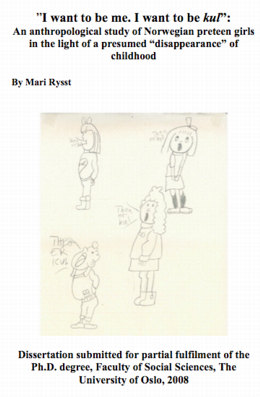
Tight jeans and short tops for seven year-old girls? When anthropologist Mari Rysst was out shopping clothes for her then seven year-old daughter she – to her dismay – mostly found clothes which imitated the teenage look. Seven years later she published her doctoral thesis “I want to be me. I want to be kul” An anthropological study of Norwegian preteen girls in the light of a presumed ‘disappearance’ of childhood.

In the introduction Rysst explains:

This study aims to explore gender constructions, sexuality and peer relationships among preteen Norwegian girls in the light of a presumed “disappearance” of childhood. The focus is on whether girls’ everyday lives are affected by what is currently expressed as the “sexualisation of childhood”. The sexualization of childhood forms part of the wider preoccupation that “childhood” is disappearing, as inferred by the above quotation.

But these fears seem to be exaggerated, she concludes:

By doing participant observation over a two year period in two school settings in Oslo, I concluded that the sexualisation of childhood exists in their social contexts and wider milieu, but does not dominate their overall everyday practices and mixed- gender relationships. These are still filled with sports activities and different forms of both traditional and particular play.

Most importantly, the ultimate indication of any (senior) sexualisation, how they “do love”, still qualifies as variants of “play”, not as older heterosexual practices. This is so because the love relationships are performed according to strict norms or rules. In the first place, they are directed and followed up by the peer community. In the second place, they are a collective rather than a private affair, and lastly, they include a minimum of physical intimacy. (…) The study shows how the subject positions of the kul and of girlfriend/boyfriend did not relate to images of the sexy before the peer group had reached puberty (being aware of individual exceptions).

The notion of the “pure childhood” is,she writes, rather Western – and paradoxical:

Understanding children and childhood in developmental terms has so far meant that children have to be protected from the “evils” of adult society (sex, drugs and violence) in order to become healthy adults. In particular, the positive potential of children can only be realized if they are not “spoiled” (too early) by the “impure” adult world.

In this lies a moral paradox: The ideal, pure childhood is not to involve a preparation for what children will inevitably be confronted with as youths and adults. The paradox is historically and culturally specific, having its roots in the Enlightenment and Rousseau’s perception of children as “pure” or “innocent” (Ariés 1962, James, Jenks and Prout 1998).

>> download the thesis

Mari Rysst has been several times in Norwegian media, see among others my post in Norwegian Doktorgrad: Barn mer opptatt av tauhopping enn G-streng

SEE ALSO:

Transforming the Anthropology of Childhood – Anthropology News April

New book critizises ethnographic methods in market research on children

“We want children to be their own ethnographers”

Anthropologist calls for a greater appreciation of child labor

Technologies of the Childhood Imagination- new text by anthropologist Mizuko Ito

Ethnographic Study: Social Websites Important For Childhood Development

cover

Tight jeans and short tops for seven year-old girls? When anthropologist Mari Rysst was out shopping clothes for her then seven year-old daughter she - to her dismay - mostly found clothes which imitated the teenage look. Seven years later…

Read more

What anthropologists and artists have in common

In the new issue of American Ethnography, we’ll find these words by anthropologist Martin Hoyem:

Artists, like ethnographers, train their eyes to see things other people don’t see. They try to present what they see so that we, the audience, can glimpse something where we have looked a thousand times and failed to find anything noteworthy.

He continues:

“Nothing exists until or unless it is observed,” wrote William Burroughs, in his 1992 Painting & Guns. (…) “An artist is making something exist by observing it. And his hope for other people is that they will also make it exist by observing it. I call it ‘creative observation’. Creative viewing.”

Anthropologists as creative viewers? Sounds good! The January issue includes two articles on the similarities and differences between artists and social scientists. In his article on Robert Frank’s famous photo book “The Americans”, Hoyem quotes anthropology professor Jay Ruby who wrote:

“Frank’s The Americans is a fundamental text. While he did behave like a field worker he knew nothing about ethnography. His contribution to photography was the virtual invention of a photographic narrative. Few have been able to equal it and in many ways it should be a model for ethnographic photographers to follow.”

>> read the whole article “This, upon reading The Americans”

>> Howard Becker: “Photography and Sociology” (republished from Studies in the Anthropology of Visual Communication, 1974).

SEE ALSO:

New e-zine: American Ethnography

The anthropology of nudity: New issue of American Ethnography Quasimonthly

Manga instead of scientific paper: How art enriches anthropology

Connecting Art and Anthropology

Photography as research tool: More engaged Kurdish anthropology

Anthropology, photography and racism

In the new issue of American Ethnography, we'll find these words by anthropologist Martin Hoyem:

Artists, like ethnographers, train their eyes to see things other people don't see. They try to present what they see so that we, the audience,…

Read more