search expand

Ethnographic reports about the uses of ICT in low-income communities

Culture Matters points to “exciting” working papers by the Information Society Research Group about the social and economic benefits of Information and Communication Technology (ICT) in low-income communities in Jamaica, India, South Africa and Ghana: “These working papers strongly re-enforce the benefits of an ethnographic approach for the wider world”.

One of the most convincing papers is according to Culture Matters written by Daniel Miller and Heather: Horst juxtaposes conventional ICT policy making in Jamaica with ethnographic findings and uncovers that the assumptions concerning internet use held by the government as well as international NGOs diverge hugely from the realities.

Culture Matters juxtapose some of the current policies with Miller’s and Horst’s recommendations:

  • Instead of more computers in secondary schools invest in post-educational training for young adults
  • Instead of investing into expensive high-end computers invest in low-price computers without gaming facilities
  • Instead of creating their own content at high costs, a lot of money can be saved by creating portals which identify useful and high-quality web resources
  • Instead of investing in community computers, offer Internet access via individual mobile phones

Also fascinating according to the blog: the reports from Ghana by Don Slater and Janet Kwami:

Again, ethnography unveiled a huge gap between policy assumptions and actual usage. On the one hand there is the widespread belief amongst governments and NGOs that the Internet is a tool of development through information distribution.

Yet all Internet users in the Accra slum studied used the internet only for chat with foreigners (as well as some diasporic family members and friends). “There was exceptionally low awareness of even the existence of websites”. In internet cafes everybody is chatting with unknown foreigners, largely in the North but also in Asia, with a view of accumulating actual and symbolic goods (either on IM (Yahoo or MSN) or in Yahoo chat rooms).

Internet access, although widespread and popular in Accra, is not cheap – one hour costs much more than the average kid’s lunch money – but many teenagers come several times a week, for several hours, solely to chat with foreigners.

>> read the whole post on Culture Matters

>> all working papers by the Information Society Research Group

SEE ALSO:

How internet changes the life among the First Nations in Canada

INTEL-ethnographers challenge our assumptions of the digital divide

How Media and Digital Technology Empower Indigenous Survival

Why cellular life in Japan is so different – Interview with anthropologist Mizuko Ito

Women in Cameroon: Information technology as a way out of the cultural cul-de-sac

Now online: EASA-conference papers on media anthropology

Culture Matters points to "exciting" working papers by the Information Society Research Group about the social and economic benefits of Information and Communication Technology (ICT) in low-income communities in Jamaica, India, South Africa and Ghana: "These working papers strongly re-enforce…

Read more

Keith Hart is blogging

banner memory bank

Economic anthropologist Keith Hart has upgraded his website The Memory Bank. Now it looks more like a blog and produces a RSS-feed so it’s easier to follow. Apart from his blog posts, his book on the anthropology of money is online and many papers.

banner memory bank

Economic anthropologist Keith Hart has upgraded his website The Memory Bank. Now it looks more like a blog and produces a RSS-feed so it's easier to follow. Apart from his blog posts, his book on the anthropology of money is…

Read more

New Proposals – New Open Access Journal

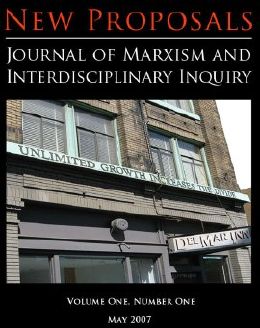
new proposals - cover Anthropologist Charles Menzies is the editor of a new open access journal called New Proposals: Journal of Marxism and Interdisciplinary Inquiry:

New Proposals is a journal of Marxism and interdisciplinary Inquiry that is dedicated to the radical transformation of the contemporary world order. We see our role as providing a platform for research, commentary, and debate of the highest scholarly quality that contributes to the struggle to create a more just and humane world, in which the systematic and continuous exploitation, oppression, and fratricidal struggles that characterize the contemporary sociopolitical order no longer exist.

The first issue was launched in May and focuses on marxist anthropology.

The journal has (of course) its own blog.

new proposals - cover

Anthropologist Charles Menzies is the editor of a new open access journal called New Proposals: Journal of Marxism and Interdisciplinary Inquiry:

New Proposals is a journal of Marxism and interdisciplinary Inquiry that is dedicated to the radical transformation of the contemporary…

Read more

Free access to Anthropologica 2002 – 2005

All articles and book reviews from 2002 to 2005 of the journal
Anthropologica – the official publication of the Canadian Anthropology Society are freely accessible for everybody. Looks more interesting than many other journals, so I might blog about some of the texts later.
>> have a look!

SEE ALSO:

New Open Access Anthropology Journal: anpere – Anthropological Perspectives on Religion

Omertaa – Open access journal for Applied Anthropology

New Open Access Journal: After Culture – Emergent Anthropologies

All articles and book reviews from 2002 to 2005 of the journal
Anthropologica - the official publication of the Canadian Anthropology Society are freely accessible for everybody. Looks more interesting than many other journals, so I might blog about…

Read more

Anthropology and tourism: Conference papers are online

Have they forgotten to password protect the papers? Last year, you needed a password to open the papers of the ASA conference Anthropology and Cosmopolitaism. This year’s papers are freely accessible to everybody- good news! A step towards Open Access Anthropology? Thinking through tourism was the topic of the annual conference by the Association of Social Anthropologist of the UK and Commonwealth (ASA).

The papers can be found in the sections Panels and Plenaries.

SEE ALSO:

Anthropology and the World: What has happened at the EASA conference?

The Secret Society of Anthropologists

Conference Podcasting: Anthropologists thrilled to have their speeches recorded

Now online: EASA-conference papers on media anthropology

Student Conference on Forced Migration – Papers available online

What’s the point of anthropology conferences?

Have they forgotten to password protect the papers? Last year, you needed a password to open the papers of the ASA conference Anthropology and Cosmopolitaism. This year's papers are freely accessible to everybody- good news! A step towards Open Access…

Read more