
search expand

Dissertation: Survival in the Rainforest

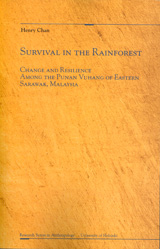
chan cover Are hunter-gatherer communities able to rely completely on the rainforest environment for their food, without any dependence on food traded from farming societies? How has their life changed as a result of settling down? How has the community responded to the drastic changes that have come with logging?

Anthropologist Henry Chan (University of Helsinki) answers these questions in his dissertation “Survival in the Rainforest. Change and Resilience among the Punan Vuhang of Eastern Sarawak, Malaysia” that has been published a few days ago.

For nearly all of their known history, the Punan Vuhang have lived as hunter-gatherers, writes the anthropologist. In 1968, however, they adopted cultivation. His research among the Punan Vuhang began in 1993 and continued through 1995, with a more brief follow-up period in November 2002. Chan is the first Sarawakian awarded the Asian Public Intellectual (API) Fellowship of the Nippon Foundation.

Based on memories of informants, and, where relevant, from participation-observation of present-day hunting-gathering activities, Chan has reconstructed their past economy, history and social organization.

He supports the argument that hunters-gatherers could survive without relying on farming societies for food. For several decades anthropologists and human ecologists have been divided in “The Hunter-Gatherer Dependency Debate”:

Ethnographic studies from the early 1960s of hunter-gatherers emphasized the economic and social advantages of hunting and gathering. This was a complete reversal of an earlier notion that hunter-gatherers are marginalized people on the perpetual verge of starvation, constantly pursuing food, and failing to develop forms of social organization associated with supposedly more advantageous means of production. (…) Lee and Marshall (1961) were the main proponents of a model that maintained that the environment sufficiently provides for the needs of hunter-gatherers.

(…)

Subsequent studies later challenged this model, leading to a series of debates that persisted into the 1990s. These debates pitted against each other two schools of thought commonly known as the “traditionalists” or “isolationists,” and the “revisionists” or “integrationists.” In contrast to traditionalists’ view of the ease in obtaining food, the revisionists documented the difficulty of some hunter-gatherer societies in obtaining carbohydrates. Further, the revisionists maintained that the perception of hunter-gatherers as isolated is erroneous and is an external view imposed on them by anthropologists. (…)

Most revisionists accept the world systems political model, first formulated by Immanuel Wallerstein (1974, 1979), as applicable to the analysis of past and present hunter-gatherers. They argue that the devotion of ethnographic attention to hunting and gathering is itself spurious, and that researchers should instead study how people relate to the forces of capitalism and colonialism.

His data, Chan writes, show that the rainforest is capable of sustaining a hunter-gatherer population:

The case of the Punan Vuhang lends some support to Sahlins’ “original affluence” theory that suggests hunting and gathering people are able to easily satisfy their needs and wants because they have few needs. In fact, of the things they need the most, food, the Punan Vuhang show little concern if no one succeeds in obtaining food for any particular day. They know that someone will get something the next day and share it with everyone else. So long as every hunter explores a field further away and is diligent, there are lots of little things to be found.

In addition to mastering the means by which a wide range of food could be obtained, coping with food scarcity also involved gaining an in-depth knowledge of the environment and its resources according to Chan:

Hunter-gatherers systematically combed the forest and kept in their memory the locations of sago groves, fruit trees and places that attract animals such as salt-licks and wallowing ponds. Armed with this knowledge, hunters brought their specially-bred dogs to hunt wild boars or used blowpipes to shoot tree-dwelling animals and birds. (…) Should an individual hunter fail to obtain game, he did not have to worry about going hungry, for the Punan Vuhang organized themselves so that successful hunters and gatherers shared their food with others.

But this prior situation of food sufficiency, from the past through 2001, was shattered as the Punan Vuhang entered the 21st Century:

In 2001, logging intruded into the remote rainforest and since then has drastically impacted the Punan Vuhang, both physically and socially, as it has left an altered, empty landscape littered with fallen branches and muddy soil. The Punan Vuhang feel frustrated and angered with this wanton destruction of their forest. They spend much time hunting in distant forests, but often return empty handed. Instead of sharing, successful hunters sell meat to loggers whose demand is insatiable.

Many Punan Vuhang men frantically search for scarce aloewood to sell before it is destroyed by logging. Consequently, they neglect their farms and they have to buy rice and sago starch from the logging camp’s grocery shop. Hence, with deforestation, it seems that they have now become truly dependent on outsiders for food. (…) Unable to bear such helplessness, many Punan Vuhang have resorted to alcohol and frequently become drunk.

>> download the thesis

UPDATE: See the comment by Eric Davis related to the Khmer: Hunting and Gathering Discussions

SEE ALSO:

“But We Are Still Native People” – Tad McIlwraith’s dissertation is online

Challenges popular notions on indigenous peoples: Alex Golubs dissertation on mining and indigenous people

How to survive in a desert? On Aboriginals’ knowledge of the groundwater system

chan cover

Are hunter-gatherer communities able to rely completely on the rainforest environment for their food, without any dependence on food traded from farming societies? How has their life changed as a result of settling down? How has the community responded…
Read more

Criticizes the “apathy of anthropologists toward the human rights situation in Balochistan”

“Anthropologists should shed light on the violence in Balochistan Province in Pakistan, anthropologist Hafeez Jamali writes in Anthropology News May 2007. Balochistan is presently the scene of a bitter and violent struggle. Multinationals are exploiting the region’s mineral resources. Hundreds of ordinary Baloch died, some 84,000 civilians predominantly have been displaced and hundreds of political activists have been arrested and tortured.

Jamali criticizes the “apathy of the discipline and of anthropologists toward the appalling human rights situation” there: There is hardly any effort by anthropologists who have worked amongst Baloch people to raise this issue in their ethnographic work, he writes. Most of the current work on Baloch people does not address current political issues:

Indeed (…) much of the past and recent anthropological work on the Baloch people has tended to focus on pastoral-nomadic aspects of Baloch social organization by employing concepts of ecological adaptation and kinship networks. These ethnographic works (…) give the impression that the Baloch are pre-modern beings living in bounded cultural groups which are relatively unconcerned with larger geo-strategic and political developments in the region and the world.

This approach is misleading because Baloch tribes’ resistance movements against colonial rule of the British Raj as well as against inequities of postcolonial states such as Iran and Pakistan were intrinsically linked to regional anti-colonial struggles. The present day struggle in Balochistan also draws inspiration from contemporary movements for self-governance in other parts of the world and in that sense is comparable to the struggles being waged by Palestinians, Kurds and other marginalized ethnic groups.

In view of this situation, it is important that anthropologists who work in and study Balochistan take the influence of regional geo-strategic politics as well as the intrusion of neoliberal globalization in the Baloch people’s lives and the response of the Baloch to such intrusion more seriously in their work.

>> read the whole article in Anthropology News

MORE INFO:

Hundreds missing in conflict-torn Balochistan (IRIN, 10.5.07)

Pakistan’s battle over Balochistan (BBC, 26.8.06)

By the way, in Anthropology News April 2007, there are several articles on the Oaxacan Rebellion (Mexico)

SEE ALSO:

Do anthropologists have anything relevant to say about human rights?

Engaged anthropologists beaten by the Mexican police

‘War on Terror’ Has Indigenous People in Its Sights

Riots in France and silent anthropologists

Anthropologists on the Israel-Lebanon conflict

"Anthropologists should shed light on the violence in Balochistan Province in Pakistan, anthropologist Hafeez Jamali writes in Anthropology News May 2007. Balochistan is presently the scene of a bitter and violent struggle. Multinationals are exploiting the region’s mineral resources. Hundreds…

Read more

Neighborhood Shopkeepers in South Korea – Dissertation by Antti Leppänen is online

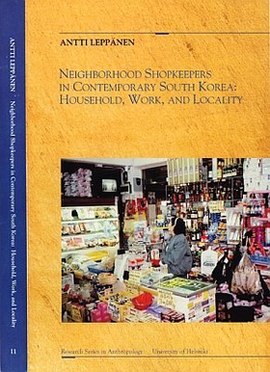
cover Another anthro-blogger has published his dissertation. Antti Leppänen has been on fieldwork among neighborhood shop keepers in South Korea. His interest in this toipc was “aroused by the visible ethnographic difference between my native Finland and the Korea of neighborhoods and marketplaces with its multitude of shops and the colorfulness, restlessness, disorder, and shabbiness of the urban scenery marked by shop signboards, from which my interest moved to people behind the visual façade”.

But that’s not the whole story as he writes:

The article that particularly directed my attention to the keepers of small businesses in South Korea in the first place was Laurel Kendall’s study (1996) of shamanism in Seoul in the 1990s, in which she discusses the phenomenon that the majority of the patrons of shaman rituals she encountered were shop owners, restaurateurs, and proprietors of small companies.

She suggests that the apparent ease with which the shamanistic rituals, earlier practiced mainly to cure illnesses, have now turned to ensuring entrepreneurial success and providing wealth, lies in a “calibration” of those practices to meet the contemporary arbitrariness of the market and the political economy (ibid: 521–2)

He conducted his field research during the aftermath of the Asian currency crisis, colloquially termed at the time as the “IMF crisis,” which highlighted the social and cultural circumstances of small businesskeeper in a specific way.:

The livelihoods of small-scale entrepreneurs became even more precarious than before; self-employment became an involuntary choice for many middle-class salaried employees who were laid off; and the cultural categories and concepts of society and economy – South Korean capitalism – were articulated more sharply than before.

Although the keepers of small businesses occupy approximately one fourth of the population in active work force, the livelihoods of these people and their cultural and social worlds have according to Leppänen rarely been in the focus of social science inquiry.

>> download Antti Leppänen’s dissertation “Neighborhood Shopkeepers in Contemporary South Korea: Household, Work, and Locality”

>> Antti Leppänen’s blog

SE ALSO:

“But We Are Still Native People” – Tad McIlwraith’s dissertation is online

Thesis: How does EU influence the life of farmers in Finland?

Available for download: Alex Golubs dissertation on mining and indigenous people

cover

Another anthro-blogger has published his dissertation. Antti Leppänen has been on fieldwork among neighborhood shop keepers in South Korea. His interest in this toipc was "aroused by the visible ethnographic difference between my native Finland and the Korea of…

Read more

In India: Many anthropology departments are shutting down

Anthropology in India is losing relevance. Many anthropology departments are shutting down, especially in Western India. “Gifted anthropologists” are also shifting to other professions. At the Second Indian Anthropological Congress, KK Basa, director of the anthropology museum Indira Gandhi Rashtriya Manav Sangrahalaya, said anthropological theory needed to keep pace with rapid globalisation.

“Anthropology as a discipline developed in the colonial period is fast losing relevance. It needs to adapt to the transition taking place today,” said Basa according to Express India.

Reading this I wonder what kind of anthropology is practiced in India?

SEE ALSO:

“Anthropology needs to engage in an activist way”

“Discuss politics!” – How anthropologists in Indonesia engage with the public

More and more anthropologists, but they’re absent from public debates – “Engaging Anthropology” by Thomas Hylland Eriksen (1)

Why anthropology fails to arouse interest among the public – Engaging Anthropology (2)

Riots in France and silent anthropologists

Chronicles Women’s Social Movements in India

The Rediff Interview/Nandini Chattopadhyay: Music and Protest

Why American shopping culture is rejected in India

Anthropology in India is losing relevance. Many anthropology departments are shutting down, especially in Western India. "Gifted anthropologists" are also shifting to other professions. At the Second Indian Anthropological Congress, KK Basa, director of the anthropology museum Indira Gandhi…

Read more

Nepal: Anthropologists, sociologists urged to build country

“Anthropologists should actively cooperate in the building of new Nepal”, Subash Chandra Nembang said at the three-day international seminar on ‘social science in a multi-cultural world’, organized by the Nepal Sociological and Anthropological Society (NSAS).

“It is sad that most of the projects run in Nepal do not have participation of sociologists and anthropologists”, he said. Secretary of the Society Bhanu Timsina said the sector has been under shadows as the planners have not realized the utility of the sociologists and anthropologists, according to the website The Rising Nepal.

Unfortunately, neither the conference nor the organisation seems to have a website. Digital Divide?

SEE ALSO:

Anthropology in a Time of Crisis. A Note from Nepal

Global identity politics and The Emergence of a Mongol Race in Nepal

Festivals and Cultural Change in Kathmandu, Nepal

“No Nepalese Can Dare To Challenge Centuries Old Religious Harmony”

Stefanie Lotter: Studying-up those who fell down: elite transformation in Nepal (Anthropology Matters 2/2004)

"Anthropologists should actively cooperate in the building of new Nepal", Subash Chandra Nembang said at the three-day international seminar on 'social science in a multi-cultural world', organized by the Nepal Sociological and Anthropological Society (NSAS).

"It is sad that most…

Read more