search expand

Financial crisis: Anthropologists lead mass demonstration against G20 summit

(Update: Chris Knight suspended over G20-activism) The G20 summit in London next month may be marked by one of the biggest demonstrations since a million people marched against war in Iraq in 2003. According to The Sunday Telegraph, the demonstrations are being organised by anthropologists Camilla Power and Chris Knight.

Under the slogan “Storm the Banks”, the two members of The Radical Anthropology Group are urging the public to vent its anger on the financiers and bank executives many blame for the global economic crisis. They think it is necessary to question or even overthrow capitalism – a taboo topic for the ruling elites.

Very interesting: The Telegraph writes that the two anthropologists work at the University of East London, which is based close to the headquarters of some of the world’s biggest banks. The University is “proud of its links with the City of London and multinational companies based in London”.

The paper quotes the university’ website who “boasts“:

“We are committed to do all we can to ensure that our expertise is made available to benefit business and society. Utilising the wealth of expertise, research capabilities and facilities at UEL our solutions help companies to become more profitable, more competitive and more sustainable.”

(Or take a look at the frontpage of the university and study the language: Is this a university or a oil company or even a bank??)

Anyway, Camilla Power thinks her role in organising the protests does not conflict with her position at UEL and says:

“What our university management thinks is good for students and academics does not always accord with what students and academics think is good for them.”

But maybe they don’t disagree at all? A spokeswoman for UEL said (diplomatically?):

“The University of east London includes a range of academic disciplines and individual academics who advocate a range of viewpoints. We are proud of our diversity, which fosters a spirit of critical inquiry, and we support freedom of debate. We are also proud of our active partnerships with business.”

As often the case when people take to the streets, the media are mostly interested in writing about violence and “the worst public disorder for a decade“. . Up to 3,000 police officers will be on the streets. Armed undercover officers will mingle in the crowds while police snipers will be stationed on rooftops.

>> read the whole story in The Sunday Telegraph

>> Protest website G20 Meltdown

SEE ALSO:

How anthropologists should react to the financial crisis

Anthropologist Explores Wall Street Culture

After the Tsunami: Maybe we’re not all just walking replicas of Homo Economicus

The Internet Gift Culture

“Anthropology needs to engage in an activist way”

(Update: Chris Knight suspended over G20-activism) The G20 summit in London next month may be marked by one of the biggest demonstrations since a million people marched against war in Iraq in 2003. According to The Sunday Telegraph, the demonstrations…

Read more

Dissertation: Sexualisation of childhood?

cover

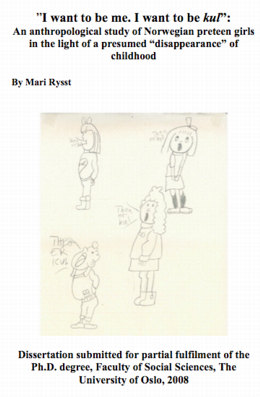
Tight jeans and short tops for seven year-old girls? When anthropologist Mari Rysst was out shopping clothes for her then seven year-old daughter she – to her dismay – mostly found clothes which imitated the teenage look. Seven years later she published her doctoral thesis “I want to be me. I want to be kul” An anthropological study of Norwegian preteen girls in the light of a presumed ‘disappearance’ of childhood.

In the introduction Rysst explains:

This study aims to explore gender constructions, sexuality and peer relationships among preteen Norwegian girls in the light of a presumed “disappearance” of childhood. The focus is on whether girls’ everyday lives are affected by what is currently expressed as the “sexualisation of childhood”. The sexualization of childhood forms part of the wider preoccupation that “childhood” is disappearing, as inferred by the above quotation.

But these fears seem to be exaggerated, she concludes:

By doing participant observation over a two year period in two school settings in Oslo, I concluded that the sexualisation of childhood exists in their social contexts and wider milieu, but does not dominate their overall everyday practices and mixed- gender relationships. These are still filled with sports activities and different forms of both traditional and particular play.

Most importantly, the ultimate indication of any (senior) sexualisation, how they “do love”, still qualifies as variants of “play”, not as older heterosexual practices. This is so because the love relationships are performed according to strict norms or rules. In the first place, they are directed and followed up by the peer community. In the second place, they are a collective rather than a private affair, and lastly, they include a minimum of physical intimacy. (…) The study shows how the subject positions of the kul and of girlfriend/boyfriend did not relate to images of the sexy before the peer group had reached puberty (being aware of individual exceptions).

The notion of the “pure childhood” is,she writes, rather Western – and paradoxical:

Understanding children and childhood in developmental terms has so far meant that children have to be protected from the “evils” of adult society (sex, drugs and violence) in order to become healthy adults. In particular, the positive potential of children can only be realized if they are not “spoiled” (too early) by the “impure” adult world.

In this lies a moral paradox: The ideal, pure childhood is not to involve a preparation for what children will inevitably be confronted with as youths and adults. The paradox is historically and culturally specific, having its roots in the Enlightenment and Rousseau’s perception of children as “pure” or “innocent” (Ariés 1962, James, Jenks and Prout 1998).

>> download the thesis

Mari Rysst has been several times in Norwegian media, see among others my post in Norwegian Doktorgrad: Barn mer opptatt av tauhopping enn G-streng

SEE ALSO:

Transforming the Anthropology of Childhood – Anthropology News April

New book critizises ethnographic methods in market research on children

“We want children to be their own ethnographers”

Anthropologist calls for a greater appreciation of child labor

Technologies of the Childhood Imagination- new text by anthropologist Mizuko Ito

Ethnographic Study: Social Websites Important For Childhood Development

cover

Tight jeans and short tops for seven year-old girls? When anthropologist Mari Rysst was out shopping clothes for her then seven year-old daughter she - to her dismay - mostly found clothes which imitated the teenage look. Seven years later…

Read more

Open access: Journal of Identity and Migration Studies

logo

Xenophobia in South Africa, labour mobility and economic development, minorities’ integration, representation of refugees and forced migrants in the British Economy are some of the topics in the most recent issue of Journal of Identity and Migration Studies.

The journal was founded a bit more than a year ago by The Research Centre for Identity and Migration Issues (RCIMI) at the University of Oradea in Romania. It was recently added to the Directory of Open Acces Journals.

It is an interdisciplinary journal on one of the most popular topics for anthropologists. So far, no anthropologists have contributed to it, though.

>> visit the journal’s website

logo

Xenophobia in South Africa, labour mobility and economic development, minorities’ integration, representation of refugees and forced migrants in the British Economy are some of the topics in the most recent issue of Journal of Identity and Migration Studies.

The journal was…

Read more

New Anthropology Matters out: Practicing anthropology “out of the corner of one’s eye”

Why do people wear and produce fake underwear, fake suits and fake jeans? In the new issue of Anthropology Matters, anthropologist Magdalena Craciun tells us in a well written paper about what it was like researching “the place of fake brands in lives lived in the margins of Europe”.

She has been on fieldwork in Bucharest, Istabul and in her hometown in Romania – and this was no easy undertaking. “I hope that the paper contributes to the collective effort of sharing field experiences for the benefit of other anthropologists”, she writes.

When an anthropologist studies people who wear fake clothes, Magdalena Craciun writes, she is suspected of secretly laughing at and condemning people, practices and objects. Angry reactions persisted as part of the field routine:

“You want to study how we dress in cheap clothes”; “you want to write about how we dress in turcisme [goods made in Turkey] and chinezisme [goods made in China] from Europa”; “we cannot afford good expensive clothes, like the branded ones, and you take us for people who lack taste in clothing”; “I am trying to weave an image, you come to point out the cracks and remind me of the fluff!”

It was no advantage being from the same place as her informants:

Our shared background made people less tolerant of my curiosity about things they thought I should already understand or experiences I should already have had. The presumption was that I was pretending to be an observer when in fact I was a participant, having a vested interest in trivia, and that I would go on to expose and misuse the information (Bakalaki 1997).

In the “Europa” market in Bucharest, she was also rejected as a researcher:

People working in this quasi-illegal place often had hostile attitudes towards me (journalists reported similar reactions). The few friendly traders pointed out that complicity in illegal activities “place us all in the same pot”, and being seen talking with me could be risky for them.

Then she changed her research strategy and started “practicing anthropology out of the corner of her eye”:

I pieced together various impressions, e.g. different ways of exploring the market, visitors’ clothing, ways of selecting the goods, retorts, exclamations of delight or disappointment, until I felt I saturated in this experience.
(…)
I was not looking at things from above or “nowhere”, as detachment implies, but from one side, discreetly. Instead of immersing myself into social worlds, I found myself hanging around, being here and there, grasping knowledge as it appeared, but also provoking its appearance in glimpses.

In Istanbul, I was told that the act of faking a brand is like a “spark” (kivilcim gibi). This is a pertinent image, suggesting the ephemeral, the intangible, the transient that was so central to my fieldwork (fakes are fakes only in the eyes of certain people, fakes are present only for some people, fakes happen and die out). Practicing anthropology out of the corner of one’s eye allows one to catch some of the sparks.

>> read the whole article in Anthropology Matters

>> overview over all articles in the new issue

SEE ALSO:

“Study how and why people wear denim around the world!”

Kosher cell phones, kosher bus routes and kosher clothing: Israel’s Ultra-Orthodox economy

Why do people wear and produce fake underwear, fake suits and fake jeans? In the new issue of Anthropology Matters, anthropologist Magdalena Craciun tells us in a well written paper about what it was like researching "the place of fake…

Read more

Guest post: Review of the Moving Anthropology Student Network conference

What is it like being at a conference with anthropology students from many different countries? Daren Williams from Macquarie University in Sydney has written a review for antropologi.info about the 6th conference of the Moving Anthropology Student Network (Masn) in Sela pri Osilnici, a village at the Croatian – Slovenian border.

The students had much fun and the conference was very well organized by the MASN-team in Slovenia, he writes. And “anthropologists were much better looking than I expected”. But he had expected more and better discussions after the presentations and more participants from the UK and France.

An anthropology conference that gets results: Masn Slovenia 2008

By Daren Williams, Macquarie University, Sydney

Back in July I stumbled across a brief reference to an anthropology conference in Slovenia. A quick google search later and I found the website of the 6th conference of the Moving Anthropology Student Network (Masn). I was sufficiently impressed by the idea: a network of motivated students; and a grass-roots forum to discuss anthropological ideas. The conference was to be held over 5 days in a small town on the border of Slovenia and Croatia. I booked my ticket.

The Setup

A month later, I made my way from Italy to Slovenia by train and bus. The last bus was provided by the Masn Slovenia Team, since our final destination was obscure, to say the least (population 327). Upon arrival at the hotel, each participant was checked-in to their room and provided with a conference pack. The pack included the conference schedule, clipboard, notepad and the usual things, but what impressed me most was the inclusion of a tourist guide pack – with maps and event guides for Slovenia and the capital Ljubljana!

Conference facilities, accommodation, and food were all included in the participation fee of €80 (I understand that the fee was so affordable due to the Masn Slovenia Team’s excellent job of securing sponsorships from local government and non-government organisations). Needless to say, I was highly impressed with the preparation and foresight of the organising committee!

The programme

The days were filled with formal presentations and workshops, whilst the nights gave us an opportunity to socialise.

The first three days were straight to business: presentations and workshops. We attended three presentations each morning. Due to the location of the conference and the conference topic of “Boundaries, Borders and Frontiers”, most of the field work data focused on eastern Europe. However, there were also well-conceived ethnographic material from field work in Nicaragua, Malaysia, and South Africa.

I noticed two things about these morning sessions: firstly, this conference was a great opportunity for students and young scholars to present their work to colleagues, and secondly, the discussion afterwards was mostly uncritical or altogether absent. I see the two points as interrelated, both in a good and a bad way.

In the afternoon, participants were offered a choice of 3-4 workshops per session, so most people found something of interest. Some highlights were: the discussion on post-socialism and its definitions; field work conducted in a life insurance company in Ireland; and, a consideration of anthropologists whom choose to work for the military.

Again, these sessions were great opportunities for presenters to work through their own ideas or issues, this time in collaboration with a group of people whom I felt were constructive, considerate, and intelligent. And the activities did not stop at dinner-time… Each evening after dinner we were treated to ethnographic films, art exhibitions, a night tour of the border, and one night there was an interactive refugee game.

Many people were impressed with the eye-opening film ‘Wetback’, which followed the journey of illegal immigrants from Central America to the USA. Of course, music and alcohol kept participants entertained after the formal activities ended.

On the weekend, a group of us went white-water rafting, and there was also an opportunity to conduct field work. The Masn Slovenia Team organised visas for everyone to cross the border into Croatia, and offered translators to those people willing to meet local residents. I think most people were too exhausted to perform serious field work by that stage, but there was a group who explored the area with cameras, and reported back later to share their ‘perspectives’.

Mission accomplished?

I attended the Masn Conference with one goal in mind: to be mentally stimulated.

I can say, without doubt, that I achieved my goal. From the first night, I spoke to students about anything that came to mind – conversation was not limited to small-talk. Every conversation became a point of reflection for me. Throughout the week I noticed that everyone I spoke with was open-minded (we’re anthropologists after all) and most were able to, respectfully, give a viewpoint that in some way differed from my own (come to think of it, almost every one of my opinions was challenged in some way).

Furthermore, this informal discussion was complimented by the actual programme of morning, afternoon, and evening sessions!

On a personal level, I was able to clarify some of my ideas as well as generate new ones. For instance, simply stating that I was interested in ‘creativity’ was never sufficient – I was always pushed further, to explore my perspective (how is creativity socialised; can it be taught explicitly?) of which eventually became a two-way discussion of examples and experiences.

On a professional level, I now have access to an extensive network of like-minded individuals with information on ideas, universities, publications, or for just having fun.

Lastly, a note about demographics: anthropologists were much better looking than I expected, funky glasses are popular, and what is with guys and beards? Participants came from all parts of continental Europe, Scandinavia, Ghana, and there was also me, from Australia. I was, however, surprised about the low number of participants from the UK and France – two countries with rich traditions in anthropology. Hopefully more of them will get involved for the next one… and the rumour is Romania, October 2009…

SEE ALSO:

First reports from Europe’s largest anthropology conference (EASA)

What is it like being at a conference with anthropology students from many different countries? Daren Williams from Macquarie University in Sydney has written a review for antropologi.info about the 6th conference of the Moving Anthropology Student Network (Masn)…

Read more