
search expand

University Cancels Alternative G20 Summit – Academics Occupy University of East London

Academic freedom and freedom of speech is more and more under threat in the “Western world”: First, the University of East London (UEL) suspended anthropology professor Chris Knight, now they cancel the Alternative summit that should take place at the University campus, the Guardian reports.

A petition was launched to keep the university open. According the Alternative Summit website, academics and students have started to occupy the university:

Despite management efforts to shut down the Alternative London Summit on Wednesday 1st April organisers and speakers are committed to making sure the event goes ahead at the University of East London as planned.
(…)
Organisers are appealing to the public to join academics, union representatives and students in the occupation of the university in order to ensure that prominent political, scientific, academic and activist speakers who have remained committed to the event will be free and able to speak as planned.

It is vital at this pivotal moment in British and world history that we, the people have a public platform to understand and act on alternative ideas and strategies for our political, environmental and economic future.

According to Bernadette Buckley, from the politics department of Goldsmiths, the shut down of the UEL is “an astonishingly grim reflection on the state of academic freedom today.”

“The university is turned into a wasteland in the very moment when the university should instead be up to the task of hosting critical debate and be a hub of creative energies. This is not just about UEL, but about reclaiming universities and education in these times of crisis”, a member of the Chris Knight Reinstatement Solidarity Group on Facebook said.

“I guess the summit organizers are now openly admitting what they’re really afraid: and it isn’t molotov cocktails. It’s ideas”, the first signatory wrote.

A spokesperson for the university explained “that the potential scale of the event and associated risks had become unmanageable, and we would be unable to accommodate safely an event of this nature.”

>> Alternative G20 summit cancelled – University of East London shuts down for duration of G20 talks and cancels alternative summit (Guardian, 31.3.09)

>> Opposition grows as UEL shuts down for G20 (Wharf 31.3.09)

>> Alternative London Summit Press Release

>> Petition To the Corporate Management Team (CMT) of the University of East London

>> Analysis by Maximilian Forte at Open Anthropology

SEE ALSO:

“Intolerant Universities”: Anthropology professor Chris Knight suspended over G20-activism

Financial crisis: Anthropologists lead mass demonstration against G20 summit

How anthropologists should react to the financial crisis

Academic freedom and freedom of speech is more and more under threat in the "Western world": First, the University of East London (UEL) suspended anthropology professor Chris Knight, now they cancel the Alternative summit that should take place at the…

Read more

“Intolerant Universities”: Anthropology professor Chris Knight suspended over G20-activism

(UPDATE: Alternative Summit cancelled, university occupied) Shortly after The Sunday Telegraph wrote that anthropologist Chris Knight is one of the organizers of a mass demonstration against the G20 summit in London, he was suspended from his job at the University of East London, several British newspapers report.

According to the BBC and The Times he was suspended because of the comments he made in an interview for BBC radio.

Chris Knight, (or Mr. Mayhem according to the Evening Standard) said:

“We are going to be hanging a lot of people like Fred the Shred [Sir Fred Goodwin] from lampposts on April Fool’s Day and I can only say let’s hope they are just effigies.

“To be honest, if he winds us up any more I’m afraid there will be real bankers hanging from lampposts and let’s hope that that doesn’t actually have to happen.

“They [bankers] should realise the amount of fury and hatred there is for them and act quickly, because quite honestly if it isn’t humour it is going to be anger.

“I am trying to keep it humorous and let the anger come up in a creative and hopefully productive and peaceful way.

“If the other people don’t join in the fun – I’m talking about the bankers and those rather pompous ministers – and come over and surrender their power obviously it’s going to get us even more wound up and things could get nasty. Let’s hope it doesn’t.”

>> G20 protest professor suspended (BBC, 26.3.08)

>> Anarchist professor Chris Knight suspended after G20 ‘threat’ (The Times, 26.3.08)

>> Protest website G 20 Meltdown

>> The Guardian G20-overview and updates

Professor Chris Knight’s suspension for voicing anti-G20 sentiments is a sign of how intolerant universities have become, writes Rupa Huq in The Guradian.

The incident is “symptomatic of how university management culture has changed”:

The introduction of fees over the past decade has meant universities adopting more business-like ways, serving paying customers rather than Young Ones-style indolent students.
(…)
To some extent, as the polytechnics became universities, the universities underwent a degree of polytechnic-isation too: new and different types of courses appeared ¬– programmes with vocational outcomes and “transferable skills” in place of critical thinking. Exams were shunned in favour of continuous assessment, reflecting the changing needs for skills-based provision to produce good workers to service the economy

At least two Facebook groups have been formed already: Reinstate Professor Chris Knight and Chris Knight Reinstatement Solidarity Group (via Max Forte on twitter)

One of the group members posted a comment by Chris Knight:

“Management at UEL are telling the press the Alternative Summit (http://www.altg20.org.uk) may not happen. Meanwhile, they are actively sabotaging the Summit by crashing the only e-mail we have been using to organize it and by countermanding all requests to the UEL print-shop to produce vital publicity material. Not to mention barring me from getting into my own room on campus which until now has been the organizing centre.

They have done nothing to convince me that they will be respecting Earth Hour from 20.30 this evening. Maybe some of us should get down there around 19.30 tonight? We could then use UEL campus to enforce Earth Hour, secure the Summit venue and uphold the rule of law. I will certainly be down there.”

Comments from group members:

wherever you work you have a point of view about what is going on in the world…how dare jobs be threatened just because of your views…..
they can never stop what we think!!!!!!!

—-

I do support the reinstatement of Professor Knight as it looks like his university have thoroughly overreacted, but I think the anger at the city, specifically, is misplaced. Bankers have behaved as they were encouraged to within the logic of capitalism – it’s not a case of if they’d been a bit less greedy we could have had some version of “good” or “compassionate” capitalism; the entire system is the problem, not a figurehead bunch of bankers.

“Think theyve been trying to find an excuse to suspend him, personally though the move to suspend him over what was said is a stupid move; it shows nothing but UEL being an institution where individuality and political opinion is barred.”

UPDATE: Maximilian Forte at Open Anthropology comments:

Perhaps the most “threatening” thing Dr. Knight has said is to caution the police not to use violence. He is making a perfectly legitimate point, that has been made many times over the centuries, even from the seats of monarchic power and the Vatican: closing off avenues for peaceful protest and dissent will justify, legitimate, and even mandate more violent action for necessary and urgent change.

More anthropologists in action in London at the Alternative London Summit 2009 – here an excerpt from the anthropology section (!):

– David Graeber will be analyzing the banking crisis from a 5,000-year historical perspective.

– Jerome Lewis will adopt a hunter-gatherer perspective on the crisis, explaining how life is possible without hierarchy, money or notions of inevitable scarcity.

– Neil Bennun will be drawing on South African Bushman mythology to illustrate how “Another world is possible”.

SEE ALSO:

Financial crisis: Anthropologists lead mass demonstration against G20 summit (my post 5 days ago)

Blogging and Public Anthropology: When free speech costs a career

Bush, “war of terror” and the erosion of free academic speech: Challenges for anthropology

Engaged anthropologists beaten by the Mexican police

USA: Censorship threatens fieldwork – A call for resistance

Neoliberal applied anthropology: Who owns the research — the anthropologist or the sponsor?

(UPDATE: Alternative Summit cancelled, university occupied) Shortly after The Sunday Telegraph wrote that anthropologist Chris Knight is one of the organizers of a mass demonstration against the G20 summit in London, he was suspended from his job at the University…

Read more

Financial crisis: Anthropologists lead mass demonstration against G20 summit

(Update: Chris Knight suspended over G20-activism) The G20 summit in London next month may be marked by one of the biggest demonstrations since a million people marched against war in Iraq in 2003. According to The Sunday Telegraph, the demonstrations are being organised by anthropologists Camilla Power and Chris Knight.

Under the slogan “Storm the Banks”, the two members of The Radical Anthropology Group are urging the public to vent its anger on the financiers and bank executives many blame for the global economic crisis. They think it is necessary to question or even overthrow capitalism – a taboo topic for the ruling elites.

Very interesting: The Telegraph writes that the two anthropologists work at the University of East London, which is based close to the headquarters of some of the world’s biggest banks. The University is “proud of its links with the City of London and multinational companies based in London”.

The paper quotes the university’ website who “boasts“:

“We are committed to do all we can to ensure that our expertise is made available to benefit business and society. Utilising the wealth of expertise, research capabilities and facilities at UEL our solutions help companies to become more profitable, more competitive and more sustainable.”

(Or take a look at the frontpage of the university and study the language: Is this a university or a oil company or even a bank??)

Anyway, Camilla Power thinks her role in organising the protests does not conflict with her position at UEL and says:

“What our university management thinks is good for students and academics does not always accord with what students and academics think is good for them.”

But maybe they don’t disagree at all? A spokeswoman for UEL said (diplomatically?):

“The University of east London includes a range of academic disciplines and individual academics who advocate a range of viewpoints. We are proud of our diversity, which fosters a spirit of critical inquiry, and we support freedom of debate. We are also proud of our active partnerships with business.”

As often the case when people take to the streets, the media are mostly interested in writing about violence and “the worst public disorder for a decade“. . Up to 3,000 police officers will be on the streets. Armed undercover officers will mingle in the crowds while police snipers will be stationed on rooftops.

>> read the whole story in The Sunday Telegraph

>> Protest website G20 Meltdown

SEE ALSO:

How anthropologists should react to the financial crisis

Anthropologist Explores Wall Street Culture

After the Tsunami: Maybe we’re not all just walking replicas of Homo Economicus

The Internet Gift Culture

“Anthropology needs to engage in an activist way”

(Update: Chris Knight suspended over G20-activism) The G20 summit in London next month may be marked by one of the biggest demonstrations since a million people marched against war in Iraq in 2003. According to The Sunday Telegraph, the demonstrations…

Read more

Imponderabilia – new international anthropology student journal

screenshot

Wow! A new anthropology journal! Made by students worldwide. Imponderabilia is it called, and it is “the product of our love of, and frustration with, anthropology”:

The journal tries to overcome, erode, undermine and blur the boundaries between institutions and disciplines, between theory and practice and between undergraduates and postgraduates. We envision a space where students can share their research and exchange their views, criticisms and reflections on anthropology through articles, interviews, photography and other creative methods.

Imponderabilia draws on the thoughts and insights of students from universities across the world; it represents a genuine dialogue between authors, editors and peer reviewers many of whom have been in contact during the process of planning, writing, and rewriting. Authorship therefore transcends university degrees and field sites and we hope the journal can develop into a platform for the sharing of our common, yet unique experiences of studying and ‘doing’ anthropology.

The first issue (spring 2009) consists of several dozens articles – there are interviews about visual and activist anthropology, text about activists and police at a Climate Camp, the significance of gossip, learning and teaching anthropology, and much more including poetry.

And the journal, based in Cambridge University (UK), exists both in a pdf version (even print?) and an “extended online version” – open access for all of us.

Imponderabilia, by the way means “a series of phenomena of great importance which cannot possibly be recorded by questioning or computing documents, but have to be observed in their full actuality” ( Malinowski 1922)

>> visit Imponderabilia (updated Link with copy from Internet Archive, journal closed down)

On their website I found two other student journals I haven’t mentioned before (local ones though): Abantu (University of Cape Town, South Africa) and Problematics (Stanford University, USA)

screenshot

Wow! A new anthropology journal! Made by students worldwide. Imponderabilia is it called, and it is "the product of our love of, and frustration with, anthropology":
The journal tries to overcome, erode, undermine and blur the boundaries between institutions and disciplines,…

Read more

Why we need more disaster anthropology

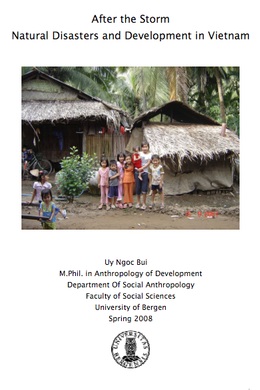
cover

On the 5th of December 2006, typhoon Durian hit Bến Tre province in Southern Vietnam. Close to 100 people died, more than 800 moored fishing boats sank, thousands of buildings collapsed including schools and hospitals. In her master’s thesis, Uy Ngoc Bui looks at how this event changed peoples’ lives and explains why we need more disaster anthropology.

In this extremly well written thesis at the University of Bergen (Norway), Uy Ngoc Bui looks at the role of NGOs, the state and the people themselves’ in the period after the disaster. Although the government and the NGOs did a significant job in handling typhoon Durian the real heroes were the people themselves, who helped one another in a time of great need, she writes:

They showed great courage, endurance and solidarity by overcoming this challenge. As such, it is perhaps no surprise that my study concurs with the many previous studies which state that disaster management is very dependent on the participation of the community, and their strengths and efforts can determine the outcome of the disaster.

Therefore it is important to study peoples’ knowledge and coping mechanisms:

In disasters as floods and tsunamis, traditional knowledge acts as warning signs which can be read ahead of time, saving many lives. This type of information should be spread wherever it is useful, as Red Cross has done in Vietnam.
(…)
I believe that thorough research into traditional knowledge and local coping mechanisms should be emphasised as they are a type of accumulative knowledge which has been passed on throughout generations, adapted to their specific environment. This type of knowledge is valuable because it is not written down, and if is lost, it will be lost forever. Here anthropology has an important job to do.

There are lots of topics to study for anthropologists, for example the local-global linkages and the reconstruction work:

My experience is that more research should be done on the bridging of relief aid with long term reconstruction and development. Relief aid has become more efficient and standardised, which is positive, but this is only short term help for people who are in a vulnerable situation. Decreasing their vulnerability and strengthening their capacity to overcome disasters in the future should be the key foci of anthropologists and NGOs.

(…)

Anthropology provides a unique look at how the local situation relates to the global through the holistic approach. It is therefore important that anthropology uses this approach to better understand the complex local-global linkages in future research. Solid fieldwork on the ground level can show how the lives of the people involved are changed as a result of the disaster and the following intervention by foreign actors. The real effects of natural disasters, the ones that are felt intimately and which linger on long after the dust has settled, are best researched with anthropological methods which can take into account all the historical, economical, political and social factors that are involved in the making of a natural disaster.

One of the global forces are related to global warming:

Many blame the Western industrial ways for corrupting the planet’s eco-system, creating more and more havoc for each year. Research in disaster management therefore also includes research into finding more eco-friendly ways to live.

Uy Ngoc Bui has studied anthropology at the University in Bergen, Norway. As she’s “of Vietnamese origin” she felt that she “had an advantage in being half-immersed in the ‘culture’ already, which would make the transition somewhat smoother”. Furthermore, people were as interested in hearing about Norway and Norwegian culture as she was interested in them, she writes.

>> download the thesis “After the Storm: Natural Disasters and Development in Vietnam”

Today was by the way the second day of an interdisciplinary climate conference in Copenhagen. Among the researchers we find many anthropologists. Kirsten Hastrup is team leader of the research project Waterworlds at the anthropology department at the University of Copenhagen:

The ambition of the project is to study local, social responses to environmental disasters related to water, as spurred by the melting of ice in the Arctic and in other glacier areas, the rising of seas that flood islands and coastal communities, and the drying of lands accelerating desertification in large parts of Africa and elsewhere. The aim is to contribute to a renewed theory of social resilience that builds on the actualities of social life in distinct localities, and pays heed to human agency as the basis for people’s quest for certainty in exposed environments.

SEE ALSO:

When applied anthropology becomes aid – A disaster anthropologist’s thoughts

The Anthropology of Disaster – Anthropologists on Katrina

“Disasters do not just happen” – The Anthropology of Disaster (2)

Anthropology News October: How Anthropologists Can Respond to Disasters

Comparative studies of flood management in neoliberal, social-democratic states needed

New website: Understanding Katrina: Perspectives from the Social Sciences

BBC: Tsunami “folklore” saved islanders

How to survive in a desert? On Aboriginals’ knowledge of the groundwater system

Thailand: Local wisdom protects hometown from the onslaught of globalisation

cover

On the 5th of December 2006, typhoon Durian hit Bến Tre province in Southern Vietnam. Close to 100 people died, more than 800 moored fishing boats sank, thousands of buildings collapsed including schools and hospitals. In her master's thesis,…

Read more