
search expand

American Anthropological Association opposes collaboration with the military – Bloggers react

A few days ago, the Executive Board of the American Anthropological Association (AAA) decided to oppose the embedding of anthropologists in military teams (HTS) in Iraq and Afghanistan. The use of anthropological knowledge in the U.S. military and the militarisation of anthropology has been the most discussed topic among anthropologists this year.

We read:

The Executive Board of the American Anthropological Association concludes (i) that the HTS program creates conditions which are likely to place anthropologists in positions in which their work will be in violation of the AAA Code of Ethics and (ii) that its use of anthropologists poses a danger to both other anthropologists and persons other anthropologists study.

Thus the Executive Board expresses its disapproval of the HTS program.

In the context of a war that is widely recognized as a denial of human rights and based on faulty intelligence and undemocratic principles, the Executive Board sees the HTS project as a problematic application of anthropological expertise, most specifically on ethical grounds. We have grave concerns about the involvement of anthropological knowledge and skill in the HTS project. The Executive Board views the HTS project as an unacceptable application of anthropological expertise.

To facilitate discussion on this subject, the AAA has created this blog as a forum for members to post comments regarding the Executive Board statement and related issues. Currently, their first and only blog post about the Board statement has 64 comments!

It was fascinating to see how quickly the anthropological blogosphere reacted. Short time after the publication of the statement, the first blog posts appeared:

L.L. Wynn at Culture Matters summarizes the statement and the first reactions.

Alex Golub, Savage Minds sounds enthusiastic:

The statement clearly (in my humble opinion) shows the influence of SM (Savage Minds) and the anthropological noosphere more generally on the AAA exec board and every reader, commenter and Mind should be proud to see that this is really a case of our community forming a ‘civil sphere’ that can inform AAA decision making.

I am blown away by the quality of the comments on the AAA blog, as well as the fact that they are published by professors writing in their own name. This is the first time I have seen the anthropology professoriate as a professoriate. I hope that the AAA blog become a major site in the anthropological noosphere.

Kambiz Kamrani, anthropology.net is not so happy about the decision and summarizes some criticisms.

One of the most detailed commentary can be found on the blog Open Anthropology by Maximilian Forte. After having read through over 60 comments on the AAA blog he wrote the post Empty Scholasticism at its Best on the AAA Blog. See also his comment Politics and Ethics: Anthropologists and Human Terrain Systems.

Futhermore, Forte noticed that the AAA still has job adverts for the HTS by the U.S. military on its website (see an example). “This should be a source of embarrassment for the Executive Board of the American Anthropological Association, although thus far there is little indication of any”, Forte writes.

UPDATE (17.11.07):“The AAA disapproving of HTS is unfortunate, U.S. militrary anthropologist Marcus Griffin writes. “Anthropology will have failed to take advantage of an important opportunity to make a difference in the world”. >> continue reading on his blog (link updated)

SEE ALSO:

The dangerous militarisation of anthropology

A few days ago, the Executive Board of the American Anthropological Association (AAA) decided to oppose the embedding of anthropologists in military teams (HTS) in Iraq and Afghanistan. The use of anthropological knowledge in the U.S. military and the…
Read more

New blog: “Open Anthropology” by Maximilian C. Forte

Another new blog: Anthropologist Maximilian C. Forte has recently launched the blog Open Anthropology – “a project of decolonization, growing out of a discipline with a long history and a deep epistemological connection to colonialism”:

OPEN ANTHROPOLOGY arises from a dissastisfaction with the state of knowledge in contemporary and classical anthropology, and is meant to significantly restructure and move anthropology beyond its current confines, beyond the constraints of professionalization and institutionalization, transcending the very “disciplinariness” of a discipline that has often foundered on its own shoals since its inception as “anthropology.”

Maximilian C. Forte is among others the editor of the open access journal KACIKE: The Journal of Caribbean Amerindian History and Anthropology, and writes also for the The CAC Review.

>> visit Open Anthropology

Another new blog: Anthropologist Maximilian C. Forte has recently launched the blog Open Anthropology - "a project of decolonization, growing out of a discipline with a long history and a deep epistemological connection to colonialism":

OPEN ANTHROPOLOGY arises from a dissastisfaction…

Read more

Now online: Up to 100 year old anthropology papers

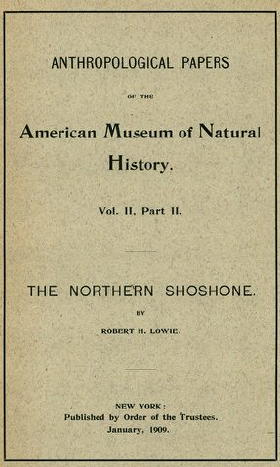
(via Museum Anthropology) More and more open access to anthropology online: The American Museum of Natural History has digitalized their up to 100 year old Anthropological Papers and put them online.

We find both more recent papers like Green revolution : agricultural and social change in a north Indian village and (that’s maybe even more interesting) historic ethnographies from the beginning of the 20th century like Some protective designs of the Dakota by Clark Wissler (published 1907), Tales of Yukaghir, Lamut, and Russanized natives of eastern Siberia by Waldemar Bogoras (published 1918) and The history of Philippine civilization as reflected in religious nomenclature by Alfred L. Kroeber (published 1918).

>> browse the whole collection

SEE ALSO:

2006 – The Year of Open Access Anthropology?

(via Museum Anthropology) More and more open access to anthropology online: The American Museum of Natural History has digitalized their up to 100 year old Anthropological Papers and put them online.

We find both more recent papers like Green…

Read more

Why is anthropological writing so boring? New issue of Anthropology Matters

Writing Up and Feeling Down is the topic of the new issue of the Anthropology Matters Journal. The articles outline the challenges involved when moving from fieldwork to writing, when trying to draw an argument out of unwieldy case studies, when you are told that your writing is not academic enough – or when you suddenly face the dangers of writing for a non-academic audience.

Ingie Hovland writes in her introduction:

The first thing that strikes many PhD students when they sit down to start writing up is that there is a strong tension between the very ‘lively’ experiences of fieldwork and the ‘deadening’ process of writing them down afterwards. In the words of one apocryphal PhD student, captured by Jean-Paul Dumont (1978:6): ‘How is the writing going?’ – ‘Oh it should move along quite well, once I get through beating the life out of my material…’

(…)

Anthropology departments try to prepare their PhD students for the intensity of fieldwork, but they come nowhere close to preparing the students for the intense emotions that writing triggers – such as anxiety, loss of self-confidence, and anger, to name but a few – or how to deal with these.

Given the way things are set up, it is perhaps not surprising that the result is, as Mary Louise Pratt (1986:33) notes, that,

For the lay person, such as myself, the main evidence of a problem is the simple fact that ethnographic writing tends to be surprisingly boring. How, one asks constantly, could such interesting people doing such interesting things produce such dull books? What did they have to do to themselves?

>> read the whole introduction

In Anthropology Matters, Melania Calestani, Ioannis Kyriakakis and Nico Tassi recount a part of their own process of being disciplined into what and how to write and not to write in order for their work to be deemed ‘anthropological’.

>> read “Three narratives of anthropological engagement”

Harriet Matsaert, Zahir Ahmed, Faruqe Hussain and Noushin Islam explore expectations and pressures that suddenly and without warning make themselves known if you are one of those anthropologists trying to write for a non-academic (or even just non-anthropological) audience.

>> read “The dangers of writing up: a cautionary tale from Bangladesh”

Paul O’Hare reflects upon his doctoral thesis write-up, and in particular, the writing up of his empirical work. Writing up is not simply a matter of reporting how we “did” the research.

>> read “Getting down to writing up: navigating from the field to the desk and the (re)presentation of fieldwork”

The final contribution to this issue presents new research from Meher Varma about transnational call centres in India’. Her article examines the increasing presence of North American call centres in Bangalore and Delhi and analyses the ways in which these products of transnationalism have impacted notions of Indian national identity.

>> read “India wiring out: ethnographic reflections from two transnational call centres in India”

SEE ALSO:

Six reasons for bad academic writing

The Secret of Good Ethnographies – Engaging Anthropology Part III

Thomas Hylland Eriksen (Savage Minds): What is good anthropological writing?

How To Present A Paper – or Can Anthropologists Talk? A wishlist

Writing Up and Feeling Down is the topic of the new issue of the Anthropology Matters Journal. The articles outline the challenges involved when moving from fieldwork to writing, when trying to draw an argument out of unwieldy case studies,…

Read more

(No longer) Open access to Annual Review of Anthropology 2007

(via anthropology.net) The Annual Review of Anthropology 2007 is out and all articles are freely available online, for example: (UPDATE: No longer open access. You'll have to get the paper version in your library! Ridiculous pricing: 20 USD per…

Read more