search expand

Engaged research = Terrorism: Germany arrests social scientists

Germany arrested urban sociologist Andrej Holm because of his academic activities. He was accused of being member of a “terrorist association” called “militante gruppe” (militant group) who is suspected to be behind arson attacks against police and army vehicles.

Holm was arrested because his publications contain keywords and phrases, which are also used in the texts written by the Militante Gruppe (especially the term “gentrification”). The warrant also claims that Holm is intellectually capable of authoring the rather sophisticated texts of the militant groups, since he has a PhD in political science. This person is also said to be suspicious because »he works in a research institution and thus has access to libraries, which he can use inconspicuously for doing the research needed to produce the texts of the militant group«.

After lots of emails the protest against German authorities has become global. The American Sociology Association demands that the Federal Prosecutor immediately release Andrej Holm and the other imprisoned from jail at once:

We strongly reject the outrageous accusation that the academic research activities and the political engagement of Andrej Holm are to be viewed as complicity in an alleged “terrorist association”. No arrest warrant can be deduced from the academic research and political work of Andrej Holm. The Federal Prosecutor, through applying Article § 129a, is threatening the freedom of research and teaching as well as social-political engagement.«

Professor Jerome Krase from The City University of New York writes:

What is especially troubling to me as an Activist or Public Scholar is that Dr. Andrej Holm, Dr. Matthias B., Florian L., Oliver R. und Axel H. were investigated and arrested for the kind of activities that I and most other socially conscious social scientists routinely engage in.

Over the course of my career I have engaged in research and writing about Civil Rights for Nonwhite minorities, Affordable Housing, and most recently the rights of the newest immigrants in the United States and abroad.

If such work can so easily be presented as “potentially” (therefore actually) criminal then it must follow that critical academic activities of all sorts, including those that are only distantly related to political and social engagement can be horribly transformed, by the State, into crimes of subversion and terrorism.

I understand that we live in dangerous and difficult times but such menacing actions by those who are sworn to protect the rights of its citizens must be ever more cautious and reluctant to use its power to take those rights away and cast a chilling shadow across the scholarly community that historically has been a bastion against tyranny.

Academic Advisory Council, Attac Germany warns that “if this reasoning is accepted by society it will destroy the fundamentals of a critical public in a free society. If the reasoning is taken as evidence for the membership in a terrorist organization, critical science is put under general suspicion.”

The Open letter to the Generalbundesanwaltschaft (Federal Prosecutor) against the criminalization of critical academic research and political engagement has already been signed by many of the most known social scientists.

More information on the website http://einstellung.so36.net/en

SEE ALSO:

Richard Sennett and Saskia Sassen: The war on shapeless terror. There seems to be no rational basis for the arrest of a group of German sociologists, and the case highlights the fragility of our civil liberties (Comment is free, The Guardian, 20.8.07)

Pessimistic Views on Academic Freedom: A greater percentage of social scientists today feel that their academic freedom has been threatened than was the case during the McCarthy era (Inside Higher Education, 15.8.07 via Savage Minds)

RELATED EARLIER POSTS:

Bush, “war of terror” and the erosion of free academic speech: Challenges for anthropology

Blogging and Public Anthropology: When free speech costs a career

Fired from Yale, anarchist professor points to politics

USA: Censorship threatens fieldwork – A call for resistance

Engaged anthropologists beaten by the Mexican police

The dangerous militarisation of anthropology

Protests against British research council: “Recruits anthropologists for spying on muslims”

San Jose: American Anthropologists Stand Up Against Torture and the Occupation of Iraq

Get Out of the Library and Into the Streets – new book by David Graeber

Germany arrested urban sociologist Andrej Holm because of his academic activities. He was accused of being member of a "terrorist association" called "militante gruppe" (militant group) who is suspected to be behind arson attacks against police and army vehicles.…
Read more

Get Out of the Library and Into the Streets – new book by David Graeber

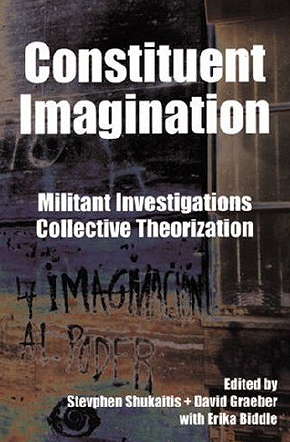
book cover

Popular anarchist anthropologist David Graeber is one of the editors of a new book on the relationship between academics and social action called Constituent Imagination: Militant Investigations, Collective Theorization:

According to libcom.org:

The book opens with the editors’ provocative history of the academy’s inherent limitations and possibilities. The essays that follow cover a broad range: embedded intellectuals in increasingly corporatized universities, research projects in which factory workers and academics work side by side, revolutionary ethnographies of the global justice movement, meditations on technology from the branches of a Scottish tree-sit. What links them all is a collective and expansive reimagining of engaged intellectual work in the service of social change. In a cultural climate in where right-wing watchdog groups seem to have radical academics on the run, this unapologetic anthology is a breath of fresh air.

As Matt Wasserman in The Indypendent claims, there are only few academics with ties to social movements – despite denouncements of “tenured radicals” by commentators on the right:

Plenty of academics write articles for obscure journals on transgression or “interrogate” race, gender and class, but almost none are found in the streets. This is the classic bargain of academia: you can think subversive thoughts as long as you don’t act upon them. Case in point: the firing of Constituent Imagination co-editor David Graeber from Yale University’s anthropology department.
(…)
The writers who contributed to Constituent Imagination want to tear down the barrier set up within the academy between theory and practice. In an occasionally jargon-ridden, often brilliant and generally provocative set of essays, they theorize and research about the globaljustice movement from within the movement.
(…)
The authors, rather than seeing their role as diagnosing the “objective” nature of the system and on this basis prescribing the correct strategy for social movements to follow, instead attempt to work out what it means to perform engaged intellectual work alongside, in service to and within social movements themselves.

>> read the whole review in The Indypendent

UPDATE: Parts of the book are available online at http://www.constituentimagination.net/

Graeber agrees in that there are “very few anarchist professors” but “a good number of grad students and a very large number of undergrads” according to an interview in The Ready Stock Book where he also explains what he thinks about anarchism. We also get to know that he is working on a history of the idea of debt and on a book developing an anarchist version of world-systems analysis with his friend Andrej Grubacic.

Graeber will by the way begin teaching at Goldsmiths College, University of London, in September 2007.

SEE ALSO:

David Graeber: There never was a West! Democracy as Interstitial Cosmopolitanism

Review of Graeber’s book: Fragments of an Anarchist Anthropology / download the whole book

Protests at Yale: When Walmart’s management principles run an anthropology department

“Discuss politics!” – How anthropologists in Indonesia engage with the public

More and more anthropologists, but they’re absent from public debates – “Engaging Anthropology” (1)

Too engaged anthropology? The Lumpenproletariat on the US-Mexican Border

Chronicles Women’s Social Movements in India

book cover

Popular anarchist anthropologist David Graeber is one of the editors of a new book on the relationship between academics and social action called Constituent Imagination: Militant Investigations, Collective Theorization:

According to libcom.org:

The book opens with the editors’ provocative history of the…

Read more

Bilingualism and multiculturalism: New issue of Durham Anthropology Journal

Volume 14 Issue 1 – Summer 2007 of the Durham Anthropology Journal is out. The Open Access journal is edited by postgraduate students at the Department of Anthropology of Durham University. The new issue consists of four articles:

Chris Allen: The death of multiculturalism: blaming and shaming British Muslims
The paper questions the sometimes tenuous relationship between ‘multiculturalism’ and notions of ‘Britishness’ as well as their effect and resonance contemporarily on perceptions and attitudes shown towards Muslims.

Mark Jamieson: Language and the Process of Socialisation Amongst Bilingual Children in a Nicaraguan Village
Social scientists have in recent years devoted a good deal of attention to the role of language in the lives of children. Few, however, have focused on the relationship between language and the logic by which categorical distinctions between children and adults are reproduced.

Michael Carrithers: Story Seeds and the Inchoate
The German word Vergangenheitsbewältigung, ‘overcoming the [Nazi] past’, became a key term to describe the extraordinary form of negative nationalism that took hold in German political culture by the 1980’s. Here the origins of the term, and its rhetorical character, are examined as a case in the study of rhetoric in culture.

Kristin Klingaman and Helen Ball: Anthropology of caesarean section birth and breastfeeding: Rationale for evolutionary medicine on the postnatal ward
Our research examines birth events, feeding strategies and the attitudes underlying them in order to better understand how modes of delivery and postnatal arrangements affect breastfeeding outcomes, maternal satisfaction and safety

>> Frontpage of Durham Anthropology Journal – Volume 14 Issue 1 – Summer 2007

Volume 14 Issue 1 - Summer 2007 of the Durham Anthropology Journal is out. The Open Access journal is edited by postgraduate students at the Department of Anthropology of Durham University. The new issue consists of four articles:

Chris Allen: The…

Read more

New website: Anthropologynet.org – “the worldwide community of anthropologists”

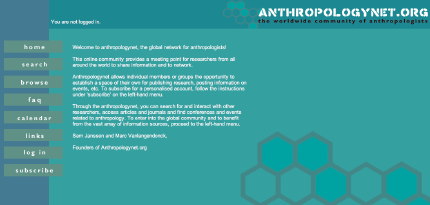
anthropologynet.org front page

A group of anthropologists from Leuwen University, Belgium, has just launched anthropologynet.org, a new website that aims to be a “worldwide community of anthropologists”: Anthropologists can register and look for other members sharing the same (or different) topic of research and publish papers. There is also a calendar.

It does not look very web2.0 but the site has just been launched so we can look forward to the further development of anthropologynetorg.

The website is edited partly by Marc Vanlangendonck who has recently launched Omertaa – Open access journal for Applied Anthropology

>> visit www.anthropologynetorg.net

Two years ago, European students have created MASN – Moving Anthropology Network

SEE ALSO:

World Anthropologies Network: Book and papers online – Working towards a global community of anthropologists

anthropologynet.org front page

A group of anthropologists from Leuwen University, Belgium, has just launched anthropologynet.org, a new website that aims to be a "worldwide community of anthropologists": Anthropologists can register and look for other members sharing the same (or different) topic of…

Read more

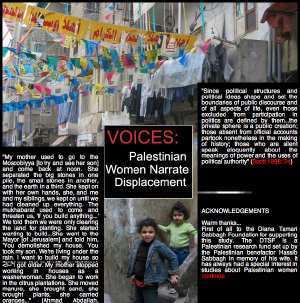
"Voices": Anthropologist publishes e-book about Palestinian women

voices-cover

Voices: Palestinian Women Narrate Displacement is a collection of oral histories recorded by Beirut-based anthropologist and oral historian Rosemary Sayigh. It was published as e-book, devoted to men and women living in Gaza, the West Bank, Jerusalem and Israel. It allows readers to not only read the texts and see the pictures but also to hear the stories in the speakers’ own voices, The Daily Star Lebanon reports.

“Because “Voices” seizes on the advantages of technology, the book transcends precisely those borders so troublesome to the Palestinian condition”, Louisa Ajami writes in her review:

Sayigh became one of the few women to enter the Palestinian camps in Lebanon and she devoted her anthropological expertise to writing about the Palestinian diaspora. Much of her field work has centered on women and children, and she writes of the lives of rural peasant women and their more educated urban sisters with equal attention and flair.

Sayigh writes in the unobtrusive, objective style of an anthropologist, but she also interjects her personal impressions. She gives readers a sense of location, ambience and familiarity. (…) With her detached yet intense approach to recording their stories, Rosemary Sayigh renders her Palestinian subjects’ struggles less abstract and more human.

But there is one drawback for those who don’t speak Arabic:

Each narration is preceded by a short introduction in English. The opening lines of each interview are also transcribed in English, but the full interviews have been left in the original Arabic, as has the audio footage. For non-Arabic speakers, this leaves the bulk of the stories out of reach.

The review in The Daily Star Lebanon is no longer online.

>> read the e-book “Voices: Palestinian Women Narrate Displacement” (Link updated 24.7.2024)

More about / by Rosemary Sayigh

Interview with Rosemary Sayigh (The Jerusalem Times / palestine-family.net)

Rosemary Sayigh: No Work, No Space, No Future: Palestinian Refugees in Lebanon (Middle East International, 10 August 2001)

Rosemary Sayigh: Dis/Solving the “Refugee Problem” (Middle East Report 207 – Summer 1998)

SEE ALSO:

Anthropologists on the Israel-Lebanon conflict

The Future of Anthropology: “We ought to build our own mass media”

Open Source Anthropology : Are anthropologists serious about sharing knowledge?

2006 – The Year of Open Access Anthropology? 2005 was the year anthropology finally became visible on the internet. 2006 was the year of a more public, political and open access anthropology?

voices-cover

Voices: Palestinian Women Narrate Displacement is a collection of oral histories recorded by Beirut-based anthropologist and oral historian Rosemary Sayigh. It was published as e-book, devoted to men and women living in Gaza, the West Bank, Jerusalem and Israel. It…

Read more