
search expand

Journal of European Ethnology is going (a little bit) Open Access

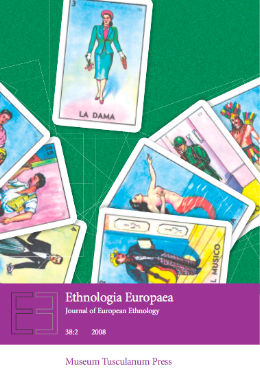
cover

Is Open Access the new buzz-word? Do we see some change in the world of anthropology journals? Angels Trias i Valls recently announced the birth of a new open access journal, Anthropology Reviews: Dissent and Cultural Politics.

And last week, I received an email by Thomas Mogensen, the editor of Ethnologia Europaea. Journal of European Ethnology. He promoted his journal among other things by informing that they support open access publishing. Back issues (older than three volumes) are open access.

And he wrote:

As part of our policy in support of open access publishing, we also would like to offer you a free copy of one of the articles from the latest issue (vol. 38:2). You can access and distribute the article free of charge by using this link: http://www.mtp.dk/pdf/Is_East_Going_West-Or_is_the_West_Moving_East

If we take a look at the previously published volumes, we’ll find out that only back issues from 2004 and newer are freely available. Marketing Manager Niels Stern explains that they only had funds to digitize volumes published since 2001 (they were digitized in 2004). “But of course we would like to go further back”, he writes in an email to me. Being a non-profit publisher, they are still looking for funding initiatives that could aid in this respect.

At the same time, one of the larger commercial publishers is involved in a scandal. Elsevier has been lobbying against the open access movement for a long time on the grounds that open access journals can’t be trusted. Now they confirm that they have put out six fake journals. They look like peer reviewed but were sponsored by unnamed pharmaceutical companies. >> more info at Open Access News

Is East Going West – Or Is The West Moving East is the title of the open access article in the most recent issue og the Journal of European Ethnology.

For her doctoral thesis on (East) German identity-formation in today’s unified Germany, Sofi Gerber has conducted biographic interviews with persons who were born and grew up in the GDR and who now live in unified Germany.

She writes:

The most striking thing in the interviewees’ picture of the Eastern parts of Germany is their general de- scription of a society falling into decay. Contradictory to the hopes invested in the program Aufbau Ost (Re-Build the East), which has invested enormous amounts in the New Federal Republics’ infrastructure and buildings, the interviewees seem, rather, to describe an Abbau Ost (Dismantling the East). My interviewees’ narrations include an othering of big parts of Eastern Germany, as a place in which it is impossible or undesirable to live.

But the East–West boundary is not only reified, but also transcended by the interviewees:

This is articulated both implicitly, in that the interviewees stress other identifications, and explicitly, in that the dichotomisation is described as irrelevant or outdated. (…)
The identification with a region or a town can be described as superior to the East–West identification (…).
Most of the interviewees now living in Berlin identify themselves with the city, mostly because of what they describe as its openness, rawness and charm. Berlin is then not only a geographical place, but also a way of living, which is contrasted with the narrow-minded life in the countryside or the superficial life in other cities.
As described earlier, both of these contrasts can be associated with the East and the West respectively, but the special aura of Berlin can also be described as something extraordinary, transcending this dichotomisation. Even when the interviewees identify themselves with one district, this identification is often described as independent of the former border.

>> visit Ethnologia Europaea. Journal of European Ethnology

SEE ALSO:

New overview over open access anthropology journals

Open Access Anthropology in Africa – an introduction

Open access to all doctoral dissertations at Temple University

Why Open Access?

cover

Is Open Access the new buzz-word? Do we see some change in the world of anthropology journals? Angels Trias i Valls recently announced the birth of a new open access journal, Anthropology Reviews: Dissent and Cultural Politics.

And last week, I…
Read more

Marianne Gullestad and How to be a public intellectual

Today I’ve been at symposium in memory of one of Norway’s greatest anthropologists, Marianne Gullestad who died last year.

She was a public intellectual. She often took part in public debates and sometimes after she had published an article in a scientific journal, she sent a short version of her paper to a local or national newspaper. It must be because of her (and a few others later) that most people in Norway know what anthropology is or have a better understanding of it than in many other countries.

One of the speakers was Richard Jenkins (University of Sheffield). Later in the discusson, he made interesting points about being a public intellectual. He actually questioned the term “public intellectual”. For is there something like a “private intellectual”?

You can also be a public intellectual in the classroom – it might even be a more lasting contribution to the society than writing articles in newspapers, he said:

The term public intellectual presumes that during the rest of the academic work we’re doing something else, that we are private intellectuals. The point is that we are communicating to the public. We are teaching or we are writing. Sometimes we forget how many people who are reading our papers and books around the world, including students.

Being in the public sphere is not just writing for newspapers and being on television. Being a public intellectual is actually a core part of our practice.

We systematically neglect that responsibility, partly by virtue of the way many of us write. We write as if we are writing to a very small circle of people who can understand sentences that are 26 lines long. We have the responsibility to write in a different way when we are doing our academic work. We should not make this distinction between writing for the public and writing academically.

We have a responsibility for intellectual democracy. It does not mean that we have to simplify what we say. One of the many nice things about Marianne Gullestad is that she did not make this distinction. She wrote always in a very clear and straight format, and she did it in both Norwegian and English. This is a responsibility that many of us not take seriously. We should take Marianne Gullestad as an example.

The role of the intellectual doesn’t stop when you walk into the lecture room. It starts there. And it is probably a more lasting contribution to the society out there than writing articles in newspapers.

(edited quote, based on my low quality recording)

For more information on Marianne Gullestad including links to her papers online, see my earlier posts: Marianne Gullestad has passed away and Marianne Gullestad: The Five Major Challenges for Anthropology.

SEE ALSO:

“Discuss politics!” – How anthropologists in Indonesia engage with the public

More and more anthropologists, but they’re absent from public debates – “Engaging Anthropology” (1)

Why anthropology fails to arouse interest among the public – Engaging Anthropology (2)

The Secret of Good Ethnographies – Engaging Anthropology Part III

Why is anthropological writing so boring? New issue of Anthropology Matters

Six reasons for bad academic writing

The most compelling ethnographies

Nigel Barley: “Fiction gives better answers than anthropology”

Open Source Anthropology : Are anthropologists serious about sharing knowledge?

Today I've been at symposium in memory of one of Norway's greatest anthropologists, Marianne Gullestad who died last year.

She was a public intellectual. She often took part in public debates and sometimes after she had published an article…

Read more

New overview over open access anthropology journals

Today we celebrate the first Open Access Anthropology Day. For this occasion, I’ve made a new overview over open access journals in our field (anthropology, area studies and related stuff).

The overview is not complete, still under construction and needs some more system. But anyway, I was surprised over how many open access journals there are. I made many new discoveries. I’ll write more about them in later posts when I’ll have more time. Enjoy the new overview here: http://www.antropologi.info/links/Main/Journals

The overview is based on the Directory of Open Access Journals, the overview by EVIFA and earlier discoveries.

If you want me to add more journals, please leave a comment!

Also, take a look at Sara’s post Happy Open Access Anthropology Day where she sums up all the contributions to this day.

Today we celebrate the first Open Access Anthropology Day. For this occasion, I've made a new overview over open access journals in our field (anthropology, area studies and related stuff).

The overview is not complete, still under construction and needs…

Read more

1st of May is Open Access Anthropology Day!

Free access to anthropological knowledge online! On the 1st of May, we’ll celebrate the first Open Access Anthropology Day!

Sara at Sara Anthro Blog has taken the initiative to this event.

She writes:

Anthropologists, in this day, show their support to Open Access Anthropology. Open Access Anthropology is interested in creating open access alternatives to anthropological publications by promoting Open Access Anthropology Journals

I think this is a great idea and I have already started preparing a blog post for this occasion. Maybe all of us should try to blog about Open Access that day or find other ways to promote free access to scholarship?

The difficulties to access Anthropology News articles that are discussed over at Savage Minds are a good illustration for this cause. See also Why should anthropologists care about open access? and A short summary of recent open access news.

Shortly after Sara’s post, the Open Access Anthropology Blog announced the Open Access Week 19-23 October 2009

UPDATE: Sara made a list of things you can do to promote Open Access Anthropology

Free access to anthropological knowledge online! On the 1st of May, we'll celebrate the first Open Access Anthropology Day!

Sara at Sara Anthro Blog has taken the initiative to this event.

She writes:

Anthropologists, in this day, show their…

Read more

Military Anthropology, HIV and the Engaged University: SfAA Podcasts online

SFAA FLYER

Their first set of conference podcasts in 2007 was a huge success. Now, Jen Cardew and her team published a large number of new recordings from the 2009 conference of the Society of Applied Anthropology.

It seems to have a been an interesting conference. There are podcasts about the following topics:

The Engaged University: What Does it Mean for Applied Anthropology?

Different Fields, Common Challenge: Lessons For and From Military Anthropology

Study of HIV and STIs in the Western Hemisphere, Part I

Studies Of HIV and STIs In The Western Hemisphere, Part II

Professional and Academic Collaboration: Strengthening the Preparation of New Professional Anthropologists

SFAA FLYER

Their first set of conference podcasts in 2007 was a huge success. Now, Jen Cardew and her team published a large number of new recordings from the 2009 conference of the Society of Applied Anthropology.

It seems to have a been…

Read more